

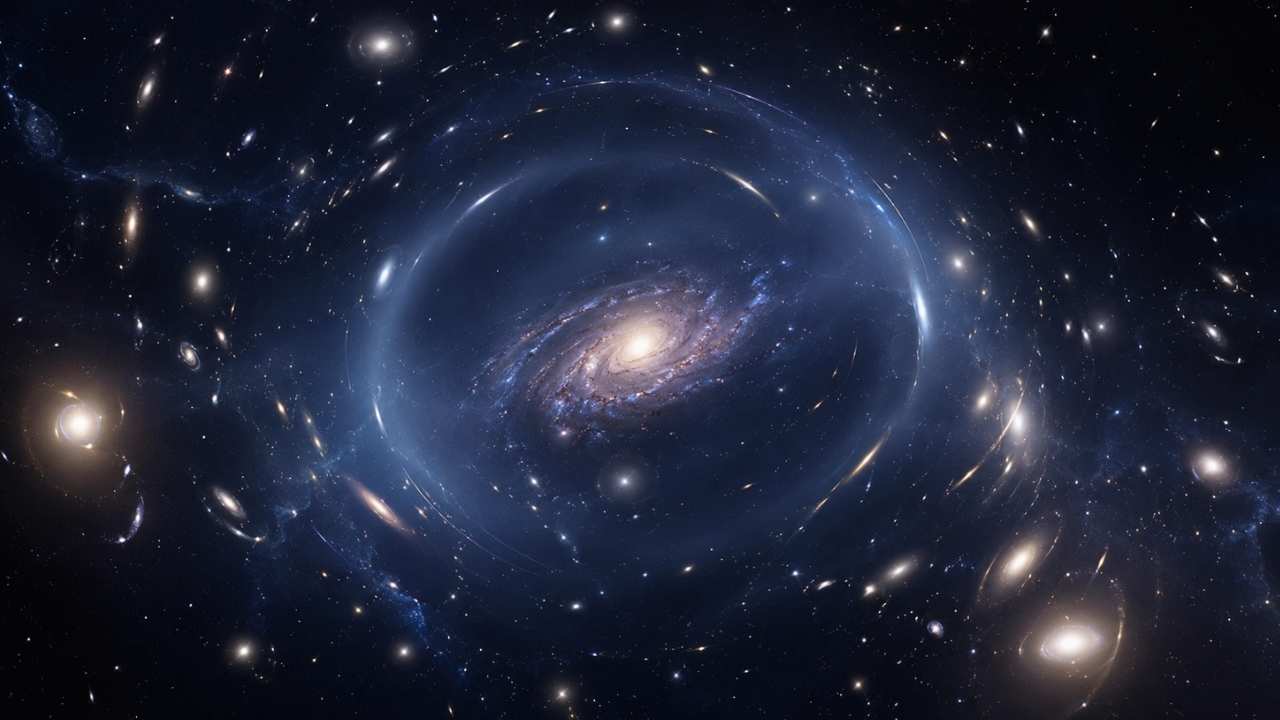
Whenever I stare up at the night sky, it is incredibly easy to think I am seeing the whole picture. The glittering stars, the dusty lanes of the Milky Way, the occasional satellite sweeping past—it all feels so complete and absolute.
But the reality of our universe is far more bizarre, and in truth, we are practically blind to most of it. Everything you can see, touch, or interact with makes up just around five percent of the cosmos. The rest of the universe stays completely hidden in the shadows, dodging our most advanced scientific instruments. So, what is dark matter? It is the invisible cosmic glue holding our galaxy together, and figuring out what it actually is has become modern physics’ wildest and most frustrating obsession.
We know for a fact that it is out there, and we measure its massive gravitational pull every single day across the cosmos. Yet, it slips right through our fingers and dodges our most expensive detectors time and time again. Lately, things have gotten even crazier in the astrophysics world. Throughout 2026, tools like the James Webb Space Telescope and the Dark Energy Survey started mapping this invisible stuff in unbelievable detail, throwing wild new theories into the mix and challenging everything we thought we knew. Let’s break down exactly what this phantom mass is, how we first discovered it, the latest real-time data shaking up the science world today, and why it remains the ultimate scientific cold case.
The Core Question: What Is Dark Matter Exactly?
Let’s get straight to the facts about this cosmic mystery. If you tally up the mass of all the stars, gas clouds, space dust, and planets in a typical galaxy, you run into a huge, unavoidable problem. There simply is not enough gravity generated by that visible stuff to keep the galaxy from flying apart as it spins. Something else lives out there in the void, pulling everything together with an iron gravitational grip that defies our standard visual observations.
Astronomers call this missing mass “dark matter.” We do not call it dark because it looks like a black hole or casts a physical shadow across the stars. We call it dark because it completely ignores light in every possible way. It does not glow, reflect, or absorb light from any spectrum. It just sits there, completely invisible, acting like the universe’s ultimate scaffolding. Without it, galaxies would instantly lose their grip on their outer stars, flinging them out into the freezing depths of deep space.
To really wrap your head around this concept, you have to look at the universe’s total energy and mass budget. Normal matter—the atoms that build you, me, the earth, and exploding supernovas—is just a tiny rounding error in the grand scheme of creation. Dark matter outnumbers our kind of stuff by more than five to one, dominating the physical structure of galaxies.
And the rest of the pie? That is dark energy, a totally different beast that actively pushes the universe apart faster and faster every second. Our standard playbook in cosmology relies heavily on this invisible framework to make the math work. When the universe was young, hot gas and dust naturally fell into deep gravity pits carved out by dark matter over billions of years, eventually sparking the very first stars into existence.
|
Cosmic Component |
Share of the Universe |
What It Actually Does in Space |
|
Normal Matter |
Around 5 percent |
Builds stars, planets, gas clouds, and biological life. |
|
Dark Matter |
Around 27 percent |
Acts as cosmic glue, holding galaxies together via intense gravity. |
|
Dark Energy |
Around 68 percent |
Acts as anti-gravity, accelerating the expansion of space itself. |
The Clues: How Do We Know It Exists?
Fritz Zwicky and the Coma Cluster
If we cannot see it, how do we know our math isn’t just completely wrong? The physical evidence for dark matter is overwhelming and hits us from entirely independent corners of astronomy. The first major clue dropped back in 1933 when Fritz Zwicky, a brilliant but eccentric Swiss astrophysicist, stared at the Coma Cluster. This cluster is a massive swarm of over a thousand galaxies locked together in space. Zwicky carefully crunched the numbers on how fast these individual galaxies moved around their shared center of mass.
He quickly realized they buzzed around way too fast for their own good. Based on the visible starlight shining from the cluster, they lacked the physical mass required to stay grouped together; the incredible speeds should have scattered them into the void long ago. Zwicky coined the term dark matter to describe the invisible mass holding the cluster tight, but the science world largely ignored his findings for decades because they sounded too much like science fiction.
Vera Rubin and the Speeding Galaxies
The undeniable, concrete proof finally hit the scientific community hard in the 1970s. American astronomer Vera Rubin, working alongside instrument maker Kent Ford, looked closely at how individual spiral galaxies rotate, starting with our cosmic neighbor, Andromeda. Think of a spinning playground merry-go-round. If you spin it too fast, kids on the outer edge will fly off unless they hold on incredibly tight. Galaxies work the exact same way, with the glowing core’s gravity acting as the grip keeping outer stars locked in orbit.
Rubin fully expected stars on the far outer edges of Andromeda to orbit much slower than the ones near the dense center. Instead, her spectrograph revealed a flat rotation curve. The outer stars raced around at the exact same blazing speed as the inner stars, which completely defied Newtonian physics based on visible mass. The only logical answer was that a gigantic, invisible halo of mass wrapped around the entire galaxy, providing the extra gravitational grip needed to hold onto those speeding outer stars.
Gravitational Lensing and JWST Maps
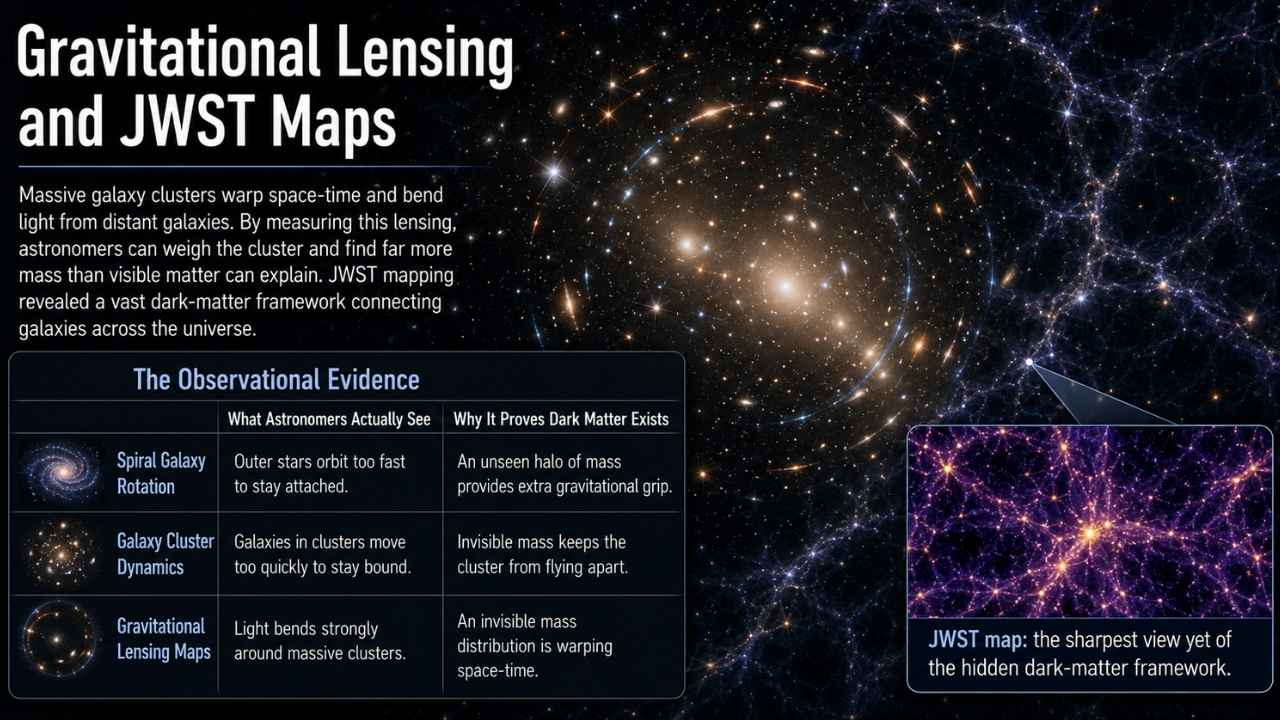
If galaxy rotation curves gave us the initial smoking gun, gravitational lensing gave us the undeniable DNA match. Massive objects actually warp the physical fabric of space-time around them. When light from a distant galaxy travels past a massive cluster on its way to Earth, it follows that warped space, bending and distorting like light traveling through a curved glass funhouse mirror. By precisely measuring this optical bend, astronomers can accurately weigh the entire cluster doing the bending.
Every single time we measure this, the clusters weigh wildly more than their visible stars and glowing gas can account for. Fast forward to 2026, and the James Webb Space Telescope delivered the largest, sharpest map of this invisible substance ever created. The telescope revealed a stunning cosmic web where dense regions of dark matter connect via long, invisible threads stretching across the universe, proving that normal galaxies grew up inside this hidden framework.
|
The Observational Evidence |
What Astronomers Actually See |
Why It Proves Dark Matter Exists |
|
Spiral Galaxy Rotation |
Outer stars orbit way too fast to stay attached. |
An unseen halo of mass provides the extra gravitational grip. |
|
Galaxy Cluster Dynamics |
Galaxies within clusters move too quickly to stay bound. |
Invisible mass stops the cluster from violently flying apart. |
|
Gravitational Lensing Maps |
Light bends heavily around space clusters (mapped in 2026). |
A massive, invisible presence actively distorts the fabric of space-time. |
The Usual Suspects: What Could It Be Made Of?
WIMPs and the Empty Tanks
So, what is dark matter actually made of physically? We know for a fact it is not just dead planets, stray asteroids, or dead stars hiding in the dark, because those would eventually block light or clump together in ways we could detect. It demands an entirely new class of particle unknown to standard physics. For years, physicists bet the house on Weakly Interacting Massive Particles, commonly known as WIMPs. These heavy particles supposedly carry enough mass to create intense gravity but completely ignore the electromagnetic force.
They could pass through thick brick walls, bank vaults, and your own body without hitting a single atom. To catch them, scientists buried huge tanks of ultra-pure liquid xenon deep underground in abandoned mines, hoping a single WIMP might randomly bump a xenon atom and trigger a tiny flash of light. However, despite years of waiting and increasing sensitivity, the latest results remain stubbornly silent, causing many researchers to abandon the WIMP theory entirely.
Axions: The Lightweight Contenders
With WIMPs playing incredibly hard to get, axions stepped right into the center stage of modern physics. An axion is a ridiculously light theoretical particle—billions of times lighter than a single standard electron. However, if the theory holds up, deep space would swarm with so many of them that their combined galactic weight would easily hold spinning galaxies together.
Lab experiments operating today act almost like ultra-sensitive radio receivers, actively trying to tune into the exact microscopic frequency of an axion naturally decaying into a photon inside a powerful magnetic field. As detector technology improves throughout 2026, researchers are narrowing down the exact frequency bands where these ghostly little particles might be hiding, bringing us closer to a potential breakthrough.
Tiny Black Holes and a Split Personality
Here is where the astrophysics community gets genuinely wild with new ideas. In late 2026, researchers published compelling new evidence suggesting that primordial black holes—tiny, ancient black holes forged right after the Big Bang—might make up at least a solid fraction of the dark matter out there. They suspect these tiny, invisible black holes occasionally slam directly through dying white dwarf stars in the Milky Way, triggering massive supernova explosions and leaving very specific, recognizable chemical trails behind.
Furthermore, another massive theory hit the scene recently suggesting dark matter actually consists of two totally different particles working together. Over time, these two particles naturally separate, with heavy ones sinking into the dense core of a galaxy while the lighter ones drift out to form a diffuse, puffy halo. This dual-particle idea perfectly explains why the invisible mass acts super clumpy in some galaxies but incredibly smooth in others.
|
The Prime Suspects |
What Are They Exactly? |
Current 2026 Scientific Status |
|
WIMPs |
Heavy, highly elusive theoretical particles. |
Detectors keep coming up totally empty; their time might be running out. |
|
Axions |
Ultra-light, highly abundant subatomic particles. |
Currently the hottest target; labs are aggressively scanning their exact frequencies. |
|
Primordial Black Holes |
Tiny black holes left over from the dawn of time. |
Gaining serious traction as triggers for mysterious white dwarf supernovas. |
|
Two-Particle Mix Theory |
A complicated blend of heavy and light dark matter. |
Brand new theory beautifully explaining weird and uneven galactic layouts. |
The Invisibility Factor: Why Can’t We See It?
The Rules of Light and Electromagnetism
People always ask me the exact same thing when discussing space, what is dark matter, but they really should be asking: why is it so impossibly good at hiding from us? To truly get this concept, you need to deeply understand how seeing actually works on a physics level. When you look at your smartphone screen, you see light particles, known as photons, actively bouncing off the glass and directly hitting your optical retinas.
For you to see, touch, or feel anything in your daily life, that object absolutely must play nicely with the electromagnetic force. This force governs light, magnetism, and the repulsion between atoms that allows you to pick things up. Dark matter, however, ignores electromagnetism entirely and completely. It never bounces light, it never absorbs light, and it never blocks light passing behind it.
The Illusion of Touch
If I managed to set a heavy bowling ball made entirely of dark matter directly on your wooden desk, it would be totally transparent to the naked eye. Worse, you could not even pick it up to examine it. Your hands use electromagnetic atomic repulsion to grip solid objects, stopping your fingers from simply passing through a coffee cup. Because the dark matter ball has absolutely no electromagnetic charge whatsoever, it would slip right through your fingers as if you were grabbing thin air.
It would then instantly fall through the wooden desk, drop straight through the concrete floor, and plummet directly through the Earth’s molten core due to gravity. It only speaks one language in the entire universe, and that language is pure gravity, making it a complete ghost to human senses and standard optical telescopes.
|
Physical Trait |
Normal Matter (Us and the Stars) |
Dark Matter (The Cosmic Ghost) |
|
Interacts with Light? |
Yes. It actively reflects, absorbs, and scatters light. |
No. It is completely transparent to all forms of light. |
|
Physical Touch Possible? |
Yes. Electromagnetism creates friction between atoms. |
No. It passes cleanly through solid walls and bodies. |
|
Exerts Gravity on Objects? |
Yes. It pulls things toward it based on mass. |
Yes. This remains our absolute only way to track it. |
The Hunt: How Are We Looking For It Today?
Deep Underground Xenon Detectors
We fiercely refuse to throw our hands up and walk away from this mystery just because it is hard. The aggressive hunt for this phantom particle drives modern experimental science forward every single day. We attack the problem from three totally different operational angles. First, heavily shielded physical labs sit miles beneath the Earth’s surface—safely hidden away from confusing cosmic rays and surface radiation.
Down there, scientists wait patiently for a dark matter particle to screw up and directly hit a liquid xenon atom inside a massive, freezing detector tank. The longer these super-sensitive tanks sit in total silence without a single hit, the more theoretical particle models we cross off our suspect list, narrowing down the true nature of the beast.
Read Also: Life on Venus? Astronomers See a Signal in Its Clouds
Mapping the Sky with DES and JWST
While particle physicists dig deep down into the dirt, observational astronomers look straight up into the void. The Dark Energy Survey recently released a massive, breathtaking dataset documenting an incredible hundreds of millions of galaxies across the southern sky.
By painstakingly analyzing exactly how ancient light bends across millions of high-resolution images, they confirmed the standard cosmic model with terrifying precision. They proved beyond a shadow of a doubt that the universe is solidly built on an invisible scaffolding. Combined with real-time deep-field images from the James Webb Space Telescope, we now have actual, usable maps of where this invisible mass pools, clusters, and stretches across the infinite voids of outer space.
Smashing Protons at the LHC
If we absolutely cannot catch it naturally falling from space into our underground tanks, maybe we can violently make it ourselves in a lab. At the Large Hadron Collider located in Switzerland, brilliant physicists smash protons together at near-light speeds inside a massive underground ring. They desperately hope the brutal, explosive energy of the subatomic crash might briefly forge a brand new dark matter particle out of thin air.
We obviously wouldn’t see the newly created particle itself on the sensors, but we would clearly spot the mathematically missing energy rocketing away from the crash site like an invisible thief. It is the ultimate subatomic hit-and-run investigation, and every major collider upgrade brings us closer to generating enough raw energy to crack the case wide open.
|
The Scientific Detectives |
Where They Look for Clues |
How They Hunt the Phantom |
|
Underground Liquid Detectors |
Deep mines (USA, Italy). |
Wait for rogue particles to hit liquid xenon tanks in total darkness. |
|
Sky Surveys (DES and JWST) |
Space orbit and mountaintops. |
Map millions of galaxies to trace invisible gravitational webs in 3D. |
|
Particle Colliders (LHC) |
Switzerland border. |
Smash protons at top speed to artificially spawn new dark matter. |
Final Thoughts
When you completely strip away the massive super-telescopes, the freezing liquid xenon tanks, and the confusing physics jargon, asking what is dark matter simply asks a much deeper philosophical question: what kind of house do we actually live in? For centuries, human beings arrogantly thought we knew the answer. We boldly assumed the universe built its house entirely out of atoms—the exact same familiar stuff that builds our bodies, our oceans, and our rocky planet. Now, modern science forces us to accept that our precious atoms just paint the walls. The actual load-bearing foundation keeping the whole grand structure from violently collapsing stays completely and permanently invisible to our fragile human eyes.
Whether the ultimate culprit turns out to be ancient tiny black holes slamming into stars, a bizarre split-personality particle mix, or something our human brains have not even cooked up yet, successfully solving this cosmic mystery will completely rewrite human reality. It will force us to rewrite textbooks and change how we view our place in the void. Until some brilliant mind finally cracks the code and isolates the particle, we just have to look up at the stunning night sky, humbled by the absolute certainty that the biggest players in the galactic game remain completely out of sight.
Frequently Asked Questions (FAQs) About What is Dark Matter
Can it build planets or alien life?
When you dive into late-night physics forums, you start seeing some brilliant, out-of-the-box questions from curious minds. One major question is whether this invisible substance can build planets, stars, or even hidden alien life forms. The answer is a firm no. For matter to clump together tightly enough to build a hard rock or a burning star, it desperately needs to shed kinetic energy. Normal matter does this easily by emitting heat and light into space when it bumps together. Because this invisible substance cannot emit light or heat, it has absolutely no way to lose its built-up energy. Therefore, it stays stuck forever as a giant, puffy, diffuse cloud surrounding a galaxy. Hidden alien civilizations made of this stuff are mathematically impossible.
Can you physically touch or feel it?
Another common question is whether you could feel it if it passed right through you. You could never feel it. The physical sensation of touching a table is just the electrons in your hand violently repelling the electrons in the wood. Since this cosmic ghost has absolutely zero electromagnetic charge to speak of, it sweeps right through your hand, your bones, and your nervous system without interacting with a single cell. You could have a ton of it pass through your living room couch right now, and the cushions wouldn’t even slightly depress.
Is it in the room with me right now?
People also want to know if it is strictly out in deep space or if it is right here on Earth. It is absolutely here right now. While it heavily surrounds our galaxy’s outer edges in a massive halo, it also naturally drifts everywhere throughout the solar system. Right now, as you read this, an invisible wind of these particles flows harmlessly through your walls, your chair, and your body as the Earth physically plows through the galactic halo during its orbit around the Milky Way center.