


Have you ever watched a stock in your portfolio bleed value day after day, yet you stubbornly refuse to click the sell button? You tell yourself you just need it to bounce back to your original purchase price. Meanwhile, you eagerly sell off another stock the moment it jumps five percent, terrified of losing a tiny profit. If this sounds familiar, you are experiencing loss aversion in investing. This psychological trap tricks smart people into making terrible financial decisions.
Instead of acting like rational market participants, we let our emotions drive the car. We hate losing money so much that we do irrational things to avoid admitting defeat. This bias destroys long-term wealth because it forces you to hold onto dead weight while cutting your actual winners short. Behavioral finance has studied this exact phenomenon for decades, proving that the pain of losing a dollar feels roughly twice as intense as the joy of making a dollar.
Breaking free from these emotional chains requires raw self-awareness. It means fighting your own brain when market volatility kicks in. By understanding exactly how loss aversion in investing manipulates your actions, you can build systems to protect your capital. This guide breaks down the science, the real-world consequences, and the exact strategies you need to rewire your trading habits for good.
Behavioral Finance and Loss Aversion
The Core Question of Investing Psychology
Why do intelligent people consistently make irrational choices with their hard-earned money? You can read countless books on fundamental analysis, memorize intricate chart patterns, and study corporate earnings reports, but none of that theoretical knowledge matters if you panic the moment the market turns red. Our brains simply are not designed to navigate modern financial ecosystems.
We evolved in harsh environments where immediate survival was the only objective, so we naturally react to dropping stock prices as if we are facing a physical predator. This biological mismatch creates massive friction for anyone trying to build long-term wealth. When you stare at a portfolio that is down thousands of dollars, your logical faculties shut down completely. Your amygdala takes the wheel, flooding your system with stress hormones and triggering a fight-or-flight response.
You stop evaluating price-to-earnings ratios and start obsessing over financial survival. Acknowledging this biological reality is the absolute first step toward becoming a better trader. “Investing is not a game where the guy with the 160 IQ beats the guy with 130 IQ.” Warren Buffett. You cannot eliminate your emotions, but you can definitely learn to work around them to protect your net worth.
|
Psychological Challenge |
Biological Reaction |
Financial Consequence |
|
Market Corrections |
Amygdala activation and stress hormone release |
Panic selling at the absolute bottom of a dip |
|
Unrealized Losses |
Denial and rationalization of bad data |
Holding dead capital instead of reinvesting |
|
Small Quick Profits |
Dopamine hit from securing safety |
Capping compound growth prematurely |
Defining Loss Aversion in the Stock Market
In the stock market, loss aversion is the specific tendency to prioritize avoiding losses over acquiring equivalent gains. If you make five hundred dollars on a trade, you feel pretty good. If you lose five hundred dollars, you feel utterly miserable. That negative feeling lingers, ruins your mood, and makes you second-guess your entire strategy. Because the pain is so sharp, investors go to extreme lengths to delay or deny it.
This leads to a bizarre reality where unrealized losses are treated like temporary glitches. As long as you do not sell the stock, the loss does not feel real. You tell yourself the market is wrong and you are right. You wait for a miracle turnaround that usually never comes. This refusal to accept reality ties up your capital, preventing you from putting that money into better companies.
Loss aversion in investing literally paralyzes your portfolio, turning you into a passive victim of market movements rather than an active manager of wealth. It prevents you from seeing the stock market objectively, trapping you in a cycle of hope and regret instead of logic and execution.
|
Behavior Type |
Emotional Driver |
Action Taken |
|
Rational Trading |
Objective risk analysis |
Cutting a loser quickly to preserve capital |
|
Loss-Averse Trading |
Fear of permanent defeat |
Holding a stock down 40% hoping for a miracle |
|
Profit-Taking |
Anxiety over losing gains |
Selling a massive winner after a mere 5% bump |
The Psychology Behind Financial Decision Making
Prospect Theory and Asymmetric Value Perception
The concept of loss aversion comes from Prospect Theory, a framework developed by behavioral economists in the late 1970s. Their research changed economics forever by proving that people do not evaluate financial outcomes objectively. Instead, we look at outcomes relative to a specific reference point. In trading, that reference point is almost always the exact price you paid for the stock.
If the stock is above that price, you are in the gain domain and you become incredibly risk-averse, wanting to lock in the profit safely. If the stock drops below your purchase price, you enter the loss domain. This is where things get highly dangerous. Researchers found that people become aggressive risk-seekers when facing a financial loss.
You become willing to hold a terrible company through bankruptcy just for the slim chance it bounces back to your break-even point. You perceive the value of the asset asymmetrically. The numbers on the screen do not represent absolute wealth to you; they represent a running score of winning versus losing based solely on your original entry point, which the market does not care about at all.
|
Mental Domain |
Market Condition |
Typical Investor Reaction |
|
Domain of Gains |
Stock price is above purchase price |
Extreme risk aversion; rush to secure small profits |
|
Domain of Losses |
Stock price is below purchase price |
Aggressive risk-seeking; holding to avoid failure |
|
Reference Point |
The exact cost basis of the trade |
Complete anchor for all future emotional reactions |
Evolutionary Origins of Averting Losses
You are fighting millions of years of human evolution every time you log into your brokerage account. Our hunter-gatherer ancestors lived on the razor’s edge of starvation and exposure. For them, finding an extra bush of berries was a nice bonus, but losing their current food supply was a guaranteed death sentence. Natural selection favored humans who were intensely protective of what they already had.
Those who took wild, unnecessary risks with their limited resources did not survive long enough to pass on their genes. Today, we carry that exact same survival hardware into a completely different modern environment. A ten percent drop in a broad index fund poses absolutely no threat to your physical safety. You still have shelter, food, and modern security.
But your brain does not know the difference between a stock market correction and a looming winter famine. The biological alarm bells ring just as loudly. This deep-seated evolutionary glitch makes loss aversion incredibly difficult to override through sheer willpower alone, requiring structured systems to bypass our primal fears.
|
Evolutionary Era |
The Perceived Threat |
The Modern Equivalent |
|
Prehistoric Times |
Losing gathered food or shelter |
Watching a stock drop 15% in one day |
|
Primal Reaction |
Intense fear, fight or flight response |
Sweating, anxiety, panic selling everything |
|
Survival Strategy |
Hoarding resources, avoiding all risks |
Refusing to invest, hoarding cash losing to inflation |
The Emotional Toll of Recognizing Defeats
Clicking the sell button on a stock that has tanked forces you to swallow your pride in a very real way. It is a harsh mirror reflecting your flawed analysis, bad market timing, or sheer bad luck. As humans, we hate being wrong more than almost anything else. We build elaborate narratives to justify our choices, and closing a losing trade shatters those narratives instantly.
It transforms a paper loss, which feels theoretical and entirely reversible, into a permanent, undeniable reduction of your net worth. This emotional toll is the exact reason why investors hold on for years. They are not actually protecting their money; they are desperately protecting their ego. The pain of regret is a heavy burden to carry, and delaying the sale pushes that pain into the fuzzy future.
Unfortunately, the stock market does not care about your self-esteem. Every day you hold a dying asset to avoid feeling bad is a day you actively choose emotional comfort over long-term financial growth.
|
Emotional Barrier |
Investor Thought Process |
Healthy Alternative |
|
Ego Protection |
“If I sell now, I admit I was stupid.” |
“I was wrong, let’s learn and move on.” |
|
Regret Avoidance |
“What if it bounces back tomorrow?” |
“The capital is better used elsewhere today.” |
|
Illusion of Control |
“I can just wait out the bear market.” |
“I cannot control the market, only my risk.” |
The Disposition Effect: Loss Aversion in Action
Why We Sell Winning Stocks Too Early?
You buy a stock, and two weeks later it is up fifteen percent. You feel like a genius and a master of the markets. But almost immediately, anxiety creeps into your mind. What if the broader market pulls back tomorrow? What if the company releases a bad earnings report? The fear of giving back those hard-earned gains becomes overwhelming.
To relieve the anxiety, you sell the stock, locking in a modest profit. You get a quick hit of dopamine and tell yourself nobody ever went broke taking a profit. While that old Wall Street saying sounds incredibly smart, it is mathematically terrible for long-term investing. The biggest gains in the stock market always come from a small handful of massive winners that compound over years and decades.
By selling your best performers at the first sign of green, you chop down your strongest trees. You completely eliminate the possibility of a stock doubling or tripling in value, capping your upside because of impatience.
|
Trading Action |
Psychological Trigger |
Market Consequence |
|
Early Profit Taking |
Fear of a sudden market reversal |
Missing out on massive compound growth |
|
Checking Portfolios Daily |
Hyper-focus on short-term noise |
Increased anxiety leading to premature sales |
|
Ignoring Winners |
Assuming the good run is over |
Cutting the assets that actually drive wealth |
Why We Hold Losing Stocks Too Long?
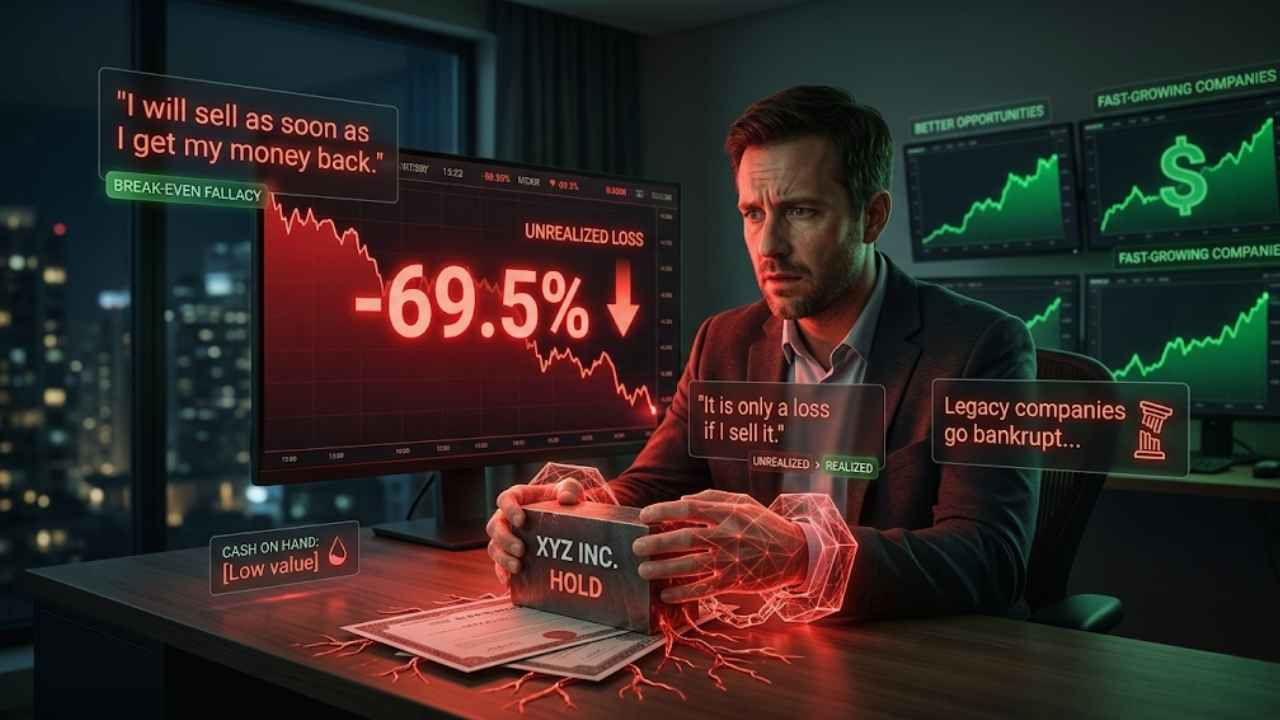
The dark counterpart to selling your winners too early is the absolute refusal to ditch bad investments. When a stock plummets, the rational move is to objectively evaluate if the company is still a sound business. If the fundamentals are broken, you cut the stock immediately. But the disposition effect makes you freeze like a deer in the headlights.
You look at the massive red number on your screen and decide you just need to wait it out. You convince yourself that a loss is not real until you actually sell the shares. You set arbitrary mental rules, promising to sell the second it hits your break-even point. This is entirely delusional thinking.
The market does not owe you a break-even price, and the stock has absolutely no memory of what you paid for it. Holding onto it just causes your portfolio to drag heavily, bleeding out precious capital while better, faster-growing companies soar past you.
|
The Trap |
The Investor’s Justification |
The Reality of the Market |
|
The Break-Even Fallacy |
“I will sell as soon as I get my money back.” |
The stock may never reach that price again. |
|
The Paper Loss Myth |
“It is only a loss if I sell it.” |
Your net worth has already decreased. |
|
The Blind Faith Hold |
“This company has been around forever.” |
Legacy companies go bankrupt all the time. |
Mental Accounting and Financial Buckets
To make matters significantly worse, investors routinely fall victim to mental accounting. We generally do not view our money as one big, fungible pool of wealth. Instead, we unconsciously put different trades into completely different mental buckets. If you buy a massive tech stock and a small healthcare stock, you desperately want both of them to be winners.
If the healthcare stock is up fifty percent but the tech stock is down forty percent, your overall portfolio is still doing fine mathematically. But mental accounting will not let you enjoy that aggregate success. You look at the losing tech stock as an isolated, glaring failure that must be fixed. You obsess over it daily.
Instead of selling the loser and adding more money to the winning healthcare stock, you hold the loser hostage, demanding it turn green before you let it go. This hyper-focus on individual buckets blinds you to the overall health and momentum of your wealth.
|
Concept |
How We Behave |
The Rational Approach |
|
Mental Buckets |
Treating each stock trade as an isolated event |
Viewing all capital as one singular growth engine |
|
Micro-Management |
Obsessing over the one red stock in a green portfolio |
Ignoring individual noise for macro performance |
|
Refusal to Rebalance |
Holding a loser to “fix” that specific bucket |
Selling losers to fund better opportunities |
Real World Consequences of Loss Aversion
The Mathematical Impact on Portfolio Returns
The numbers simply do not lie when it comes to human behavior in the markets. Famous research analyzing thousands of retail brokerage accounts proved that individual investors are far more likely to close a winning position than a losing one. This backward behavior totally wrecks the mathematical foundation of profitable trading.
To be successful in the markets over a lifetime, you need your average winning trade to be significantly larger than your average losing trade. You can actually be wrong more than half the time and still make fantastic money, provided you cut your losers fast. Loss aversion in investing completely flips this math on its head.
It creates a profile where you have a high number of very tiny winning trades, and a small number of massive, catastrophic losing trades. When you let losers run, one bad stock can wipe out the profits from ten good ones, causing you to underperform basic index funds consistently.
|
Trading Metric |
Loss-Averse Trader |
Rational System Trader |
|
Average Win Size |
5% to 10% (Capped quickly) |
50% to 100%+ (Allowed to run) |
|
Average Loss Size |
40% to 60% (Held endlessly) |
7% to 10% (Cut mercilessly) |
|
Long-Term Expectancy |
Negative portfolio drain |
Positive compound growth |
Increased Risk Taking in Losing Positions
It sounds completely counterintuitive, but loss aversion actually turns naturally conservative investors into reckless, desperate gamblers. When things are going well, you want to play it safe and protect your stash. But when you are down big on a position, sheer desperation kicks in. You become willing to take wild, uncalculated risks just to erase the agonizing pain of the loss.
If a volatile stock drops fifty percent, instead of accepting the moderate hit, you might hold on through a disastrous earnings report, praying for a miraculous turnaround. You might even concentrate your entire remaining portfolio into that one failing position, ignoring all fundamental rules of diversification.
You start telling yourself that the stock is now just too cheap to ignore. This is exactly how manageable, normal setbacks turn into unrecoverable financial disasters. You stop analyzing the market rationally and start treating your brokerage account like a casino.
|
Situation |
Rational Action |
Loss-Averse Reaction |
|
Earnings Miss and 20% Drop |
Re-evaluate thesis, likely sell |
Double down and buy more shares |
|
Broad Market Crash |
Review asset allocation calmly |
Panic and move everything to cash |
|
Stock Nears Bankruptcy |
Take the 90% loss and move on |
Buy options hoping for a massive short squeeze |
Missed Opportunities and Sunk Cost Fallacy
Money sitting in a bad stock is dead capital. This brings up the massive, hidden danger of opportunity cost. The stock market is full of incredible, innovative companies that are growing revenues, disrupting industries, and changing the world. If your money is locked up in a legacy business that is slowly bleeding out, you cannot participate in that new growth.
Loss aversion keeps you anchored to the past, completely blinding you to the brilliant opportunities of the present. This happens entirely because of the sunk cost fallacy. You look at a stock that is down sixty percent, and you obsess over all the money you have already burned.
You feel obligated to stay the course to somehow justify the initial investment. You have to realize that the past money is already gone. The only question a rational investor asks is whether this specific stock is the best possible place for their remaining capital right now.
|
Economic Concept |
Definition |
How It Destroys Wealth |
|
Sunk Cost Fallacy |
Factoring past, unrecoverable costs into future choices |
Staying in a bad trade just because you are down |
|
Opportunity Cost |
The potential gain lost by choosing one path over another |
Missing a 100% tech rally while holding a dying retail stock |
|
Capital Velocity |
The speed at which money is moved to productive assets |
Stagnating funds in losers reduces overall velocity to zero |
Recognizing Cognitive Biases in Your Portfolio
Signs You Might Be a Loss Averse Investor
You cannot fix a fundamental problem until you willingly admit you have one. Spotting your own cognitive biases is incredibly tough because your brain constantly lies to you to protect your fragile ego. However, your trading history leaves a very clear, undeniable trail of evidence. Take a brutal, honest look at your portfolio right now.
Do you have a collection of dead weeds? Are there stocks you have held for three years that are down forty percent, while the rest of the market has hit multiple all-time highs? Do you catch yourself constantly checking the price of your losers, desperately hoping for a green day, while completely ignoring the winners that are doing all the heavy lifting?
Another major red flag is how you consume financial news. When a company you own misses earnings, do you read objective analysis, or do you hunt down obscure forums that agree with your bullish thesis? If you do this, your emotions are firmly in the driver’s seat.
|
Behavioral Red Flag |
What You Do |
The Harsh Reality |
|
Confirmation Bias |
Only reading bullish articles on your losing stocks |
You are ignoring facts to soothe your anxiety |
|
Portfolio Blindness |
Refusing to log into your account during red weeks |
Avoiding the truth does not stop the losses |
|
Excusing Bad Data |
Blaming short sellers for a stock’s decline |
The business fundamentals are likely just terrible |
The Danger of Moving Stop Losses
A stop loss is supposed to be your ultimate, unemotional safety net. It is a mechanical order placed with your broker to automatically sell a stock if it drops to a certain price level. The core idea is to remove raw emotion from the equation entirely, deciding your maximum acceptable risk before you ever enter the trade.
But for an emotionally compromised trader, a stop loss becomes an instrument of psychological torture. Imagine you buy a stock at fifty dollars and set a hard stop loss at forty-five dollars. As the stock drifts down to forty-six dollars, sheer panic sets in. You do not want to take the five-dollar hit.
So, you manually log in and drag the stop loss down to forty dollars, giving it “more room to breathe.” The stock drops to forty-one, and you move the stop to thirty. You completely defeat the entire purpose of risk management, turning a planned paper cut into a gaping wound.
|
Risk Tool |
Intended Use |
How Loss Aversion Ruins It |
|
Hard Stop Loss |
Automatically cutting a trade at a set risk percentage |
Manually canceling it right before it triggers |
|
Position Sizing |
Only risking 1% of total capital on one trade |
Adding to the position as it drops to “average down” |
|
Trailing Stop |
Locking in profit as a stock moves upward |
Removing it because you fear getting chopped out |
Averaging Down on Failing Trades
Averaging down is perhaps the most toxic, account-destroying habit born directly from loss aversion. It happens when you aggressively buy more shares of a stock as the price falls. Mathematically, it lowers your average cost basis. If you liked the business at a hundred dollars, you should love it at fifty, right? This specific logic only applies to broad market index funds during a massive macroeconomic recession.
Applying it to individual, failing companies is pure financial suicide. When a single stock gets cut in half, it is usually because the fundamental business model is completely broken. Institutional investors are fleeing the scene.
But the retail investor, desperate to fix their past mistake, buys more. They are not buying because the business suddenly improved; they are buying to pull their break-even price lower, praying a tiny bounce will let them escape. This is throwing good money after bad.
|
Investment Action |
Market Context |
Result |
|
Averaging Down (Index Fund) |
Broad market recession, economy is fine long-term |
Smart accumulation of wealth |
|
Averaging Down (Single Stock) |
Company missed earnings, CEO resigned |
Catching a falling knife, blowing up account |
|
Pyramiding (Adding to Winners) |
Stock is breaking out, fundamentals are accelerating |
Maximizing gains on a proven, winning thesis |
Strategies to Overcome Loss Aversion
Reframing Your Reference Points
The single best mental trick to completely defeat loss aversion is to destroy your internal reference point. Your brain obsessively anchors to the exact price you paid for a stock. You have to actively, aggressively train yourself to forget that arbitrary number. It is completely irrelevant to the future performance of the company.
Look at your portfolio and pretend that it was entirely liquidated into pure cash last night. Now, look at the struggling stock at its current market price today. Ask yourself this brutally honest question: If I had cash right now, would I buy this specific stock today?
If the answer is yes, because you truly believe the fundamentals are amazing, then hold it. If the answer is no, then you must sell it immediately. It does not matter if you are down ten percent or eighty percent. By forcing your brain to evaluate the asset in the present moment, you cut the emotional anchor to the past.
|
Mental Habit |
Old Perspective |
New Reframed Perspective |
|
Viewing Cost Basis |
“I am down 30% on this trade.” |
“This money is currently worth X dollars today.” |
|
Evaluating Holds |
“I will wait for it to recover.” |
“Would I buy this today with fresh cash? No. Sell.” |
|
Judging Success |
“Every trade must be green.” |
“My total account equity is growing yearly.” |
Implementing Mechanical Trading Rules
Willpower is a strictly finite resource. When the market is crashing and red numbers are flashing on your screen, your willpower will absolutely fail you. You will panic. The only way to survive is to have rigid, mechanical rules in place that dictate your actions before the panic ever starts.
Treat investing like flying a commercial airplane. Pilots do not rely on gut feelings during severe turbulence; they follow checklists. You need a strict investing checklist. Write down your exact criteria for buying a company. More importantly, write down your exact criteria for selling.
Set a hard limit on how much of your total account you are willing to lose on a single trade. Place hard stop losses in the market the second you execute a buy order, and swear never to move them down. When a stock hits your predefined exit criteria, you sell immediately. No debate, no hope, no hesitation.
|
Trading Plan Element |
Purpose |
How to Execute |
|
Entry Criteria |
Prevents impulsive, emotional buying |
Must meet 5 specific fundamental/technical checks |
|
Hard Exit Rule |
Prevents massive, unrecoverable losses |
Automatic sell order placed at 8% below purchase |
|
Sizing Limit |
Protects the overall portfolio from one bad idea |
Never put more than 5% of account in one stock |
The Role of Professional Advice and Detachment
Sometimes the absolute smartest move you can make is admitting you cannot do it alone. If you constantly find yourself holding onto garbage stocks and selling your winners early, you are your own worst enemy. You might need to step away from the keyboard and introduce professional detachment to your financial life.
A financial advisor, a wealth manager, or even an automated robo-advisor does not care about your ego. Professionals look at your portfolio as a cold math equation. They do not feel the sharp sting of pride when a stock pick fails miserably.
They will ruthlessly harvest losses and reallocate capital to better opportunities because they are not emotionally married to the asset. If handing over total control feels too extreme, simply find a strict accountability partner. Have a friend or mentor review your trades once a month. Having to justify your terrible decisions out loud breaks the spell.
|
Solution Type |
Level of Control |
Primary Benefit |
|
Robo-Advisor |
Fully Automated |
Zero emotional input; automatic rebalancing |
|
Fiduciary Advisor |
Collaborative |
Professional guidance and a psychological buffer |
|
Accountability Partner |
Self-Directed |
Forces you to justify your irrational holds aloud |
The Long-Term Benefits of Rational Investing
Tax-Loss Harvesting Advantages
One of the greatest secrets of the wealthy is turning a severe market loss into a massive tax advantage. When you finally stop viewing a loss as a personal failure, you can start using it as a sharp financial tool. In the United States and many other countries, realized capital losses can be used to directly cancel out your capital gains.
This brilliant strategy is called tax-loss harvesting, and it is a major benefit of selling your losers. If you made ten thousand dollars selling a great stock, you owe taxes on that gain. But if you finally sell that terrible tech stock for a three thousand dollar loss, you only pay taxes on seven thousand dollars of net profit.
If your losses exceed your gains, you can even use them to offset your ordinary income up to a certain limit. Rational investors actively scan their portfolios looking for losers to cut, specifically to lower their tax burden.
|
Tax Strategy |
The Action |
The Financial Result |
|
Harvesting Losses |
Selling a down stock before year-end |
Offsets taxable gains from your winning trades |
|
Income Offset |
Using excess losses against salary |
Reduces your overall income tax bracket liability |
|
Reinvestment |
Buying a similar (not identical) asset |
Maintains market exposure while securing the tax break |
Improved Mental Health and Reduced Anxiety
Holding a portfolio completely full of losers is physically and mentally exhausting. Every single time you open your brokerage app, you get a sharp hit of cortisol. You spend massive amounts of mental energy making up excuses for bad management teams. You stress endlessly about the money you lost.
When you finally rip the bandage off and sell the bad stocks, you will experience a split second of deep regret, followed immediately by a massive wave of relief. Closing the trade closes the toxic mental loop. You no longer have to care about that failing company. The anxiety simply disappears.
You sleep significantly better at night knowing your capital is finally clean and ready to be deployed into things that actually work. The psychological freedom of a clean portfolio gives you the confidence to trust your analysis again.
|
Psychological State |
Trigger |
Resolution |
|
Chronic Stress |
Checking a bleeding portfolio daily |
Liquidating the bad assets entirely |
|
Decision Fatigue |
Debating whether to sell every morning |
Following a strict, automated mechanical rule |
|
Mental Clarity |
Having a cash balance ready for new setups |
Feeling in control of your financial destiny again |
Building a Sustainable Wealth Strategy
Investing is a brutal marathon that spans decades. You are going to be wrong. Warren Buffett is wrong. Billion-dollar hedge fund managers are wrong all the time. Being wrong on an individual stock pick does not prevent you from getting rich. Refusing to admit you are wrong is what ultimately bankrupts you.
Building a sustainable wealth strategy requires accepting small, frequent losses as a completely normal, unavoidable part of the process. When you finally overcome loss aversion in investing, you stop fighting the math. You let your massive winners run freely, allowing them to compound multiple times their original value.
You cut your losers ruthlessly, ensuring that no single mistake ever threatens your financial survival. You transition from an emotional gambler hoping for a lucky break into a systematic manager of risk. That is exactly how real, sustainable wealth is built.
|
Wealth Principle |
The Amateur Approach |
The Professional Approach |
|
Dealing with Losses |
Taking them personally; hiding from the truth |
Treating them as normal business expenses |
|
Portfolio Growth |
Trying to hit a home run on every single trade |
Letting compound interest do the heavy lifting slowly |
|
Market Perspective |
Viewing the market as a casino to beat |
Viewing the market as a vehicle for long-term ownership |
Final Thoughts
Navigating the stock market requires a lot more than just analyzing corporate balance sheets; it demands totally mastering your own mind. Loss aversion in investing is a universal human glitch, a leftover primal survival instinct that severely damages modern wealth building. When you let the sheer fear of a red screen force you to hold onto dying companies, you sacrifice massive opportunity, compound growth, and your own peace of mind.
By openly recognizing the disposition effect, implementing rigid mechanical rules, and radically reframing your perspective, you can permanently break the cycle of emotional trading. Stop fiercely protecting your ego and start actively protecting your capital. Accept the small, inevitable losses gracefully, let your true winners run fearlessly, and watch your long-term portfolio thrive over the decades. “The four most dangerous words in investing are: this time it’s different.” Sir John Templeton.
Frequently Asked Questions (FAQs) About Loss Aversion Investing
What is the precise difference between risk aversion and loss aversion?
Risk aversion is a conscious, logical choice to avoid high-risk situations entirely, like preferring a guaranteed high-yield savings account over a volatile stock market. Loss aversion is a specific emotional flaw where the psychological pain of losing money is twice as intense as the pleasure of gaining it, which paradoxically causes conservative people to take on massive, irrational risks when they are desperately trying to avoid locking in a loss.
How does the fear of missing out relate to loss aversion in investing?
Loss aversion actually directly fuels the fear of missing out. Investors fear missing out on massive profits so intensely that they make hasty, emotionally driven purchases. They do not want to suffer the psychological pain of watching their neighbors get rich, which often leads to dangerous herd behavior and buying heavily at the absolute top of a market bubble right before it bursts.
Can tax-loss harvesting completely erase my terrible trading mistakes?
It cannot magically give you your money back in full, but tax-loss harvesting effectively turns a bad investment into a highly valuable tax deduction. By finally selling a loser, you realize a capital loss that can legally offset your capital gains, effectively lowering your tax bill and salvaging some real monetary value from an otherwise terrible, painful trade.
Why do I constantly feel the intense need to average down on a losing stock?
Averaging down is a classic, textbook symptom of deep ego protection. You buy more of a falling stock because you are desperate to lower your average cost basis, heavily hoping a small, temporary bounce will let you exit the trade without admitting defeat to yourself. It is a highly dangerous practice that often leads to massive over-concentration in toxic, dying assets.
What is the simplest first step to stop my loss-averse habits?
The absolute simplest step is to stop looking at your cost basis entirely. Hide that column on your brokerage screen if you can. Evaluate every single stock you own based purely on its current price today and ask yourself if you would buy it right now with fresh cash. If you would not buy it today, you need to sell it immediately.