


You’re driving home, slightly distracted for two seconds, and you rear-end a luxury SUV. The driver suffers a severe spinal injury. Suddenly, you’re looking at a $1.5 million lawsuit. Your auto insurance taps out at its $250,000 liability limit. So, who pays the remaining $1.25 million? You do. They will drain your savings, seize your college funds, force a lien on your house, and garnish your future paychecks for decades.
That massive, terrifying financial gap is exactly why you need to get umbrella insurance explained right now, before you ever actually need it. People often think this type of policy is strictly for billionaires, celebrities, or corporate tycoons. That is totally false. Juries today regularly hand out multi-million-dollar verdicts for everyday accidents. A single slip-up can wipe out decades of your hard work. Think of an umbrella policy as a massive financial parachute.
It hovers just above your standard home, auto, and renters policies, ready to deploy the exact second your primary limits run dry. In this comprehensive guide, I will break down how this coverage actually works, what it costs based on real-time 2026 market data, and how to figure out if your lifestyle leaves your bank accounts dangerously exposed.
What Is an Umbrella Policy? (The Basics)
Basically, an umbrella policy is backup liability insurance. It exists entirely to catch you when the absolute worst happens and your normal policies tap out. Every single insurance policy you buy, whether it is auto, home, or renters, has a hard cap on payouts. If a judge orders you to pay more than that cap, your primary insurance company writes a check for their maximum limit and completely walks away. You are legally on the hook for the rest of the bill. An umbrella policy steps in right where your standard insurance stops, bringing a massive secondary bucket of money to finish paying off the lawsuit. These policies usually start at $1 million in coverage and can be scaled up to $5 million or more.
One of the biggest misconceptions is that umbrella insurance is the exact same thing as “excess liability insurance.” While both give you higher payout limits, they function differently. Excess liability strictly provides extra money for one specific underlying policy. Umbrella insurance, however, expands your actual scope of coverage. It acts as a literal umbrella over multiple assets and can even “drop down” to cover specific things that a standard homeowners policy usually ignores completely, like false arrest or worldwide travel incidents.
|
Feature |
Standard Home/Auto Insurance |
Umbrella Insurance |
Excess Liability Insurance |
|
Primary Job |
First line of defense for accidents. |
Massive backup for major claims. |
Increases limit for one specific policy. |
|
Typical Limits |
$100,000 to $500,000. |
$1,000,000 to $5,000,000 or more. |
Varies based on the primary policy. |
|
Coverage Scope |
Very specific to home or auto. |
Broadens coverage across multiple risk areas. |
Does not broaden coverage, only increases cash. |
|
Slander/Libel |
Rarely covered. |
Typically covered. |
Rarely covered. |
|
When it Pays |
Immediately upon a covered claim. |
Only after primary limits hit zero. |
Only after the specific primary limit hits zero. |
What Does Umbrella Insurance Actually Cover?
When you hear “liability,” you probably picture car wrecks or someone slipping on your icy driveway. Those are huge risks, but this insurance casts a much wider net. If your teenage driver loses control and causes a massive pileup, the medical bills and destroyed cars can easily blow past $500,000. If a neighbor’s kid falls off your trampoline and needs surgery, you pay for it. Once your standard auto or home insurance runs out, your umbrella policy covers the leftover medical bills, physical rehab costs, and property replacement. But beyond bodily injury, it covers catastrophic property damage. Imagine a fire starts on your backyard grill and spreads, burning down three neighboring homes in your dense subdivision. Your standard policy will not cover three houses, but your umbrella policy will.
Where an umbrella policy really flexes is in personal liability and lawsuits. Standard policies almost never cover personal injury claims like slander, libel, defamation, malicious prosecution, or false arrest. We live our lives online now, and a heated rant on social media, a nasty Yelp review, or a misunderstood public comment can easily trigger a defamation lawsuit. Furthermore, if you are sued, the insurance company covers your legal defense costs in addition to the settlement amount. Lawyers are incredibly expensive, and defending a frivolous lawsuit can easily cost six figures. Your umbrella policy handles those legal fees so they do not drain your actual $1 million coverage limit. Just keep in mind, it will never pay your own medical bills, fix your own car, or cover intentional criminal acts.
|
Coverage Type |
Covered by an Umbrella Policy? |
Practical Example |
|
Major Auto Accidents (At-Fault) |
Yes, after auto limits max out. |
You cause a multi-car pileup with severe injuries. |
|
Guest Injuries at Your Home |
Yes, after home limits max out. |
A guest slips on your stairs and breaks their spine. |
|
Massive Property Damage |
Yes, after standard limits max out. |
Your backyard fire pit burns down a neighbor’s house. |
|
Libel, Slander, and Defamation |
Yes, almost always. |
You get sued for posting false rumors online. |
|
Your Own Medical Bills |
No. |
You use your health insurance for your own injuries. |
|
Intentional Crimes |
No. |
Committing fraud or assault is never covered. |
Umbrella Insurance Explained: Who Really Needs It?
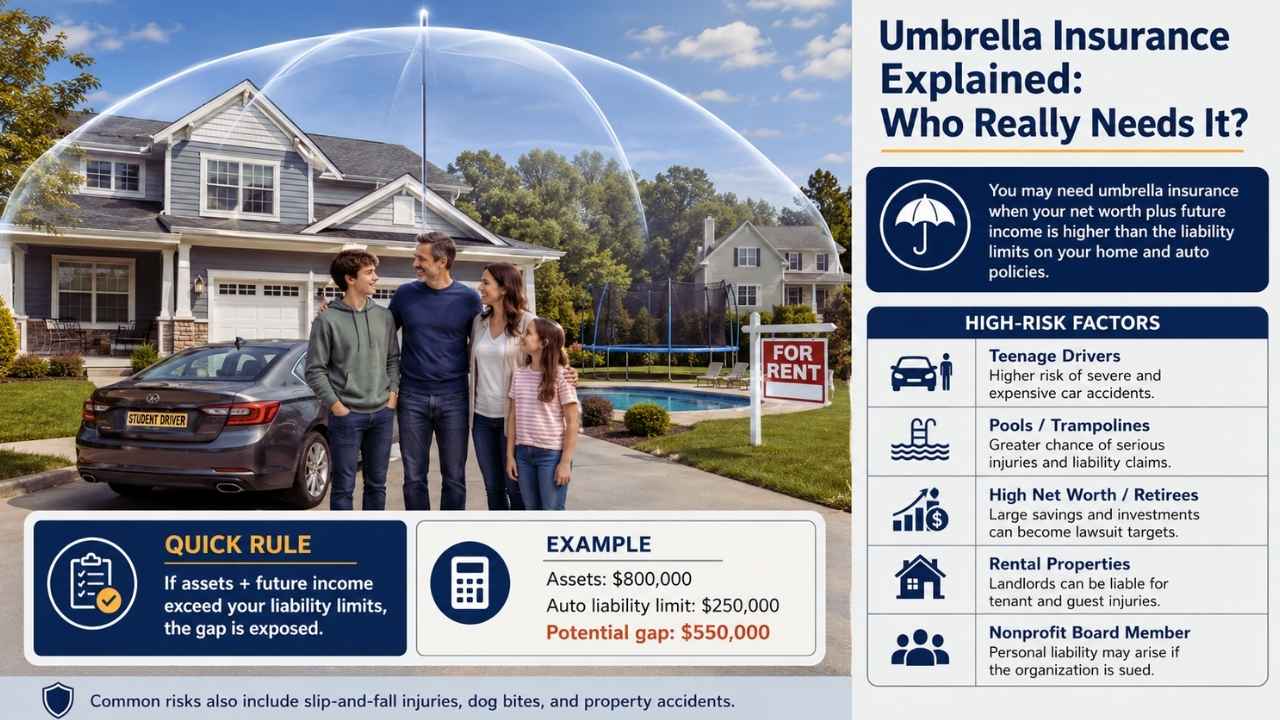
You definitely do not need a yacht to get sued like you own one. Having umbrella insurance explained properly means taking a hard, honest look at what you own and how you live. The golden rule is straightforward: You need this coverage if your total net worth, plus your potential future income, is higher than the liability limits on your current auto and home policies. If you have $800,000 in assets and your auto insurance only covers $250,000, you have $550,000 sitting totally exposed. Beyond basic math, certain lifestyle choices act like massive magnets for lawsuits. Homeowners face constant liability risks such as slip-and-fall injuries, dog bites, or accidents on the property. If you own an “attractive nuisance” like a swimming pool, a trampoline, or a treehouse, you practically beg for liability claims.
You seriously need extra coverage if you have a teenage driver in the house, because inexperienced drivers crash more often and cause significantly more damage. Serving on a board of directors or volunteering for a local nonprofit can also expose you to personal liability claims if the organization is sued. Landlords definitely need this coverage because renters are unpredictable, and you are always on the hook for their safety. Finally, retirees absolutely need to consider this. Even without an employment income to garnish, retirees have massive nest eggs, savings, and assets that can be completely wiped out by a single car accident or a slip-and-fall on their property. Plug your numbers into this calculator to see exactly where you stand.
|
High-Risk Factor |
Why It Spikes Your Liability Exposure |
|
Teenage Drivers |
The highest statistical risk for severe, expensive car wrecks. |
|
Pools / Trampolines |
High risk of permanent physical injury to neighborhood kids. |
|
High Net Worth / Retirees |
Makes you a lucrative, obvious target to drain savings and investments. |
|
Rental Properties |
Exposes you to injuries sustained by tenants and their guests. |
|
Nonprofit Board Member |
Opens you up to personal liability if the organization faces legal action. |
Real-World Liability: Claim Statistics & Examples
Sometimes you need to look at actual lawsuits to realize how fast a normal Tuesday can ruin you financially. Lawsuits are getting wildly expensive, and juries are handing out massive verdicts that destroy families. For example, in one terrifying case, a man taking out his trash was attacked by a neighbor’s dogs that escaped through an open gate. The man suffered severe lacerations and a lower back injury, and the court handed down a staggering $7.7 million judgment against the dog owner. In another instance, a heating and cooling technician fell through the floor of a customer’s attic, falling 20 feet. He sustained massive injuries, and the homeowner was hit with an $8.9 million judgment.
Auto accidents create the most devastating payouts. A woman traversing a crosswalk was struck by a driver, resulting in a traumatic brain injury and an amputated leg. The court awarded her $26.2 million. Even seemingly minor interactions can trigger ruin. In a well-documented personal liability case, a teenager posted nasty, false rumors online about her math teacher. The teacher sued the parents for the daughter’s disparaging remarks, and the judgment came out to $750,000. If those individuals only had a standard $300,000 liability limit, the courts would seize their bank accounts, liquidate their investments, and garnish their wages for the rest of their lives to pay the difference.
|
Real-Life Scenario |
What Triggered the Claim |
Final Court Judgment / Settlement |
|
Pedestrian Crosswalk Accident |
Severe Bodily Injury (Auto) |
$26.2 Million |
|
Service Tech Falling Through Attic |
Bodily Injury at Home |
$8.9 Million |
|
Neighbor’s Dog Attack |
Animal Liability |
$7.7 Million |
|
Teen’s Online Slander |
Personal Liability / Defamation |
$750,000 |
|
Faulty Rental Furnace |
Landlord Liability (Carbon Monoxide) |
$750,000 |
How Much Does Umbrella Insurance Cost in 2026?
You probably assume buying a million dollars’ worth of extra insurance costs an absolute fortune. It really does not. Because your auto and home insurance absorb the first hit, the statistical odds of an umbrella policy actually paying out are relatively low. Insurance companies pass that exact mathematical savings directly on to you. For individuals, a $1 million personal umbrella policy is incredibly cheap, typically ranging from $150 to $350 a year depending on your state and risk profile. Bumping that coverage up to $2 million usually only adds an extra $75 to $100 to your annual bill. When you compare the cost of a basic streaming subscription to the peace of mind of shielding your entire life savings, the math is incredibly favorable.
For commercial and small business owners, the costs are slightly higher but remain an absolute bargain. In 2026, the average cost of commercial umbrella insurance sits at just $86 per month. In fact, 24 percent of small businesses pay less than $50 a month for this coverage, and another 30 percent pay between $50 and $100 a month. Annual premiums for businesses range from $400 to over $7,000 depending entirely on the industry. A retail store owner pays far less than a commercial construction company. Generally, for businesses, it costs about $40 per month for each additional $1 million of coverage you purchase.
|
Coverage Limit |
Average Personal Cost (Per Year) |
Average Commercial Cost (Per Month) |
|
$1 Million |
$150 to $400 |
$40 to $90 |
|
$2 Million |
$300 to $500 |
$80 to $150 |
|
$3 Million |
$400 to $650 |
$120 to $210 |
|
$5 Million |
$600 to $800 |
$200 to $350 |
How to Buy the Right Amount of Coverage
You cannot just guess how much coverage you need or pick a random number out of thin air. Getting the right policy takes some fast arithmetic and a close look at your current insurance. First, add up your net worth and future income. Count your liquid cash, home equity, investment portfolios, and retirement accounts. Then, add in your future earning potential. If you are 35 and making $150,000, you have decades of paychecks ahead of you that a judge can easily garnish. Your umbrella policy needs to comfortably cover your total combined asset value.
Once you know your number, you have to upgrade your primary policies. You cannot buy an umbrella policy if you are riding around with bare-minimum, state-required auto insurance. Carriers make you build a solid foundation first. For example, major insurers like GEICO require you to carry at least $300,000 per person and $300,000 per accident in auto bodily injury liability, or $250,000 per person and $500,000 per accident. They also require your homeowners or renters personal liability coverage to sit at a minimum of $300,000. Once your base limits are locked in, the smartest move is to buy the umbrella policy through the company that already handles your car and house. Insurers hand out massive discounts for bundling, which almost pays for the umbrella policy itself.
|
Step |
What to Do |
The Details |
|
1. Audit Your Assets |
Calculate your true wealth. |
Sum up savings, equity, investments, and 5-year future income. |
|
2. Check Base Limits |
Look at current policies. |
Ensure you have at least $300,000 in underlying home/auto liability limits. |
|
3. Look at Lifestyle |
Factor in your specific risks. |
Bump limits up if you have teen drivers, pools, or rental properties. |
|
4. Bundle Up |
Ask your current agent. |
Buy from your current insurer to score a multi-policy discount. |
|
5. Pick a Limit |
Buy what you actually need. |
Purchase in $1 million blocks based on your total asset audit. |
Final Thoughts
Nobody wakes up expecting to cause a massive car accident or get slapped with a life-altering lawsuit. Relying on luck just isn’t a real financial strategy. Getting umbrella insurance explained shows you one incredible truth: for the price of one nice dinner out a year, you can build an absolute fortress around everything you’ve worked so hard to earn.
Protect your home equity, guard your retirement accounts, and shield your future paychecks. Add up your net worth, look honestly at your risks, and call your insurance agent. Don’t wait until you’re staring down a lawsuit to realize you needed a bigger parachute.
Frequently Asked Questions FAQs About Umbrella Coverage
Does it cover my whole family, or just me?
It covers you, your spouse, and any family members living in your house. If your kid causes a wreck, or your spouse gets sued for an angry Facebook post, the policy steps in. (Check with your agent about college kids living in dorms, as rules vary).
Does it protect me when I travel out of the country?
Yes! This is a massive perk. Standard auto and home policies drop you the second you leave the U.S. and Canada. Personal umbrella policies usually offer worldwide coverage. If you accidentally hurt someone while renting a moped in Italy, you’re covered.
Do renters actually need this?
Absolutely. If you leave a stove burner on, start a fire, and burn down half your apartment complex, you are legally responsible for hundreds of thousands of dollars in property damage. A standard renter’s policy taps out fast.
What’s the difference between excess liability and umbrella insurance?
People mix these up all the time. Excess liability just gives you a higher dollar limit on your current policy. Umbrella insurance increases your limits AND covers completely new things that your normal policy ignores (like slander or overseas accidents).