


You’ve been paying into the system since your very first summer job. You pull up your pay stub, see that annoying little FICA deduction, watch a chunk of your hard-earned money vanish, and just trust the process. But as retirement gets closer, reality sets in.
You start asking the big, scary question: what am I actually going to get back? Figuring out how social security works shouldn’t require an economics degree or three hours on hold listening to terrible government elevator music. At its heart, it’s a giant social insurance program. You pay premiums while you work via payroll taxes. Later down the line, the federal government cuts you a monthly check when you retire, become disabled, or leave behind a family. Congress designed it to replace a piece of your pre-retirement income, not to pay for a lavish, yacht-filled lifestyle entirely on its own. The exact numbers shift every year to match inflation and national wage trends. Heading into the back half of 2026, the average monthly retirement benefit sits around $2,084.
On the high end, the absolute maximum you can pull in—if you waited until age 70 and had top-tier earnings your whole career—is a hefty $5,181 a month. Your personal check depends completely on your earning history, your marital status, and the exact month you decide to claim. Let’s break down the rules, the math, and the strategies so you know exactly what to expect when you finally clock out for good.
The Core Mechanics: How Social Security Works?
To wrap your head around the system, you first have to grasp how the government funds it. The money they take from you doesn’t just sit in a personalized vault with your name on it. The whole operation runs on a “pay-as-you-go” setup. The taxes pulled from your paycheck this week go straight to paying the benefits of today’s retirees. When you stop working, the next generation of workers will fund your monthly checks. Every time you get paid, you’ll notice a deduction labeled FICA (Federal Insurance Contributions Act) or OASDI (Old-Age, Survivors, and Disability Insurance).
That’s your Social Security tax. Employees pay 6.2% of their gross income, and employers match that 6.2%. If you hustle as a freelancer or run your own business, you essentially act as both the employee and the employer. That means you’re on the hook for the entire 12.4%, though you can thankfully deduct half of that on your tax return. But the government doesn’t tax absolutely everything you earn. There’s a strict income limit, known as the wage base cap. For 2026, the SSA set that cap at $184,500.
Any dollar you make above that amount is completely free from the 6.2% Social Security tax. This cap adjusts almost every year based on shifts in national average wages. Keep in mind, while Social Security taxes stop at a certain point, the 1.45% Medicare portion of your FICA taxes applies to every single dollar you earn. There’s absolutely no limit on Medicare taxes. Plus, high earners get hit with an extra 0.9% Medicare tax on income over $200,000 for singles, or $250,000 for married couples filing jointly.
|
Payroll Tax Feature |
Details for 2026 |
|
Employee Tax Rate |
6.2% taken directly from your wages |
|
Employer Match |
6.2% paid by your company |
|
Self-Employed Tax Rate |
12.4% (you can deduct half on your tax return) |
|
2026 Wage Base Cap |
$184,500 limit on taxable earnings |
|
Maximum Tax Paid (Employee) |
$11,439 per year |
The Math: Calculating Your Future Benefit
Your eventual benefit amount isn’t a flat rate that everyone gets. The Social Security Administration looks at your entire working life to figure out what they owe you. Specifically, they pull your highest 35 years of earnings. If you worked a solid 40 years, the SSA does you a solid and drops the five lowest-earning years from the calculation. This means your teenage fast-food jobs making minimum wage won’t drag down your lifetime average.
However, if you only worked for 30 years and took a decade off to raise kids, travel, or care for aging parents, the SSA fills in those five missing years with flat zeros. And trust me, zeros drag your average down fast. To figure out the math behind the scenes, you have to factor in inflation. A $30,000 salary back in 1990 obviously bought a lot more groceries than $30,000 buys today. So, the SSA adjusts, or “indexes,” all your past earnings to match current inflation levels. This levels the playing field, creating what they call your Average Indexed Monthly Earnings (AIME).
Once the SSA has your AIME, they run it through a formula using specific thresholds called “bend points.” Think of bend points like tax brackets, but in reverse. The formula heavily favors lower-income workers. The whole goal is to replace a larger percentage of a low-income earner’s pre-retirement wages while replacing a smaller percentage for high-income folks. For someone turning 62 in 2026, the SSA takes their average indexed monthly earnings and applies the 2026 bend points: $1,286 and $7,749. Here is exactly how the math shakes out:
- You get 90% of your first $1,286 in average monthly earnings.
- You get 32% of the earnings that fall between $1,286 and $7,749.
- You get 15% of any earnings above $7,749 (up to the wage base cap).
- Add those three tiers together, and you get your Primary Insurance Amount (PIA). Your PIA is your baseline. It’s the exact monthly check you get if you retire at your normal, full retirement age.
|
2026 Monthly Earnings Bracket |
Percentage Replaced by SSA |
|
First $1,286 |
90% |
|
Between $1,286 and $7,749 |
32% |
|
Above $7,749 (up to the cap) |
15% |
The Importance of Timing: When to Claim
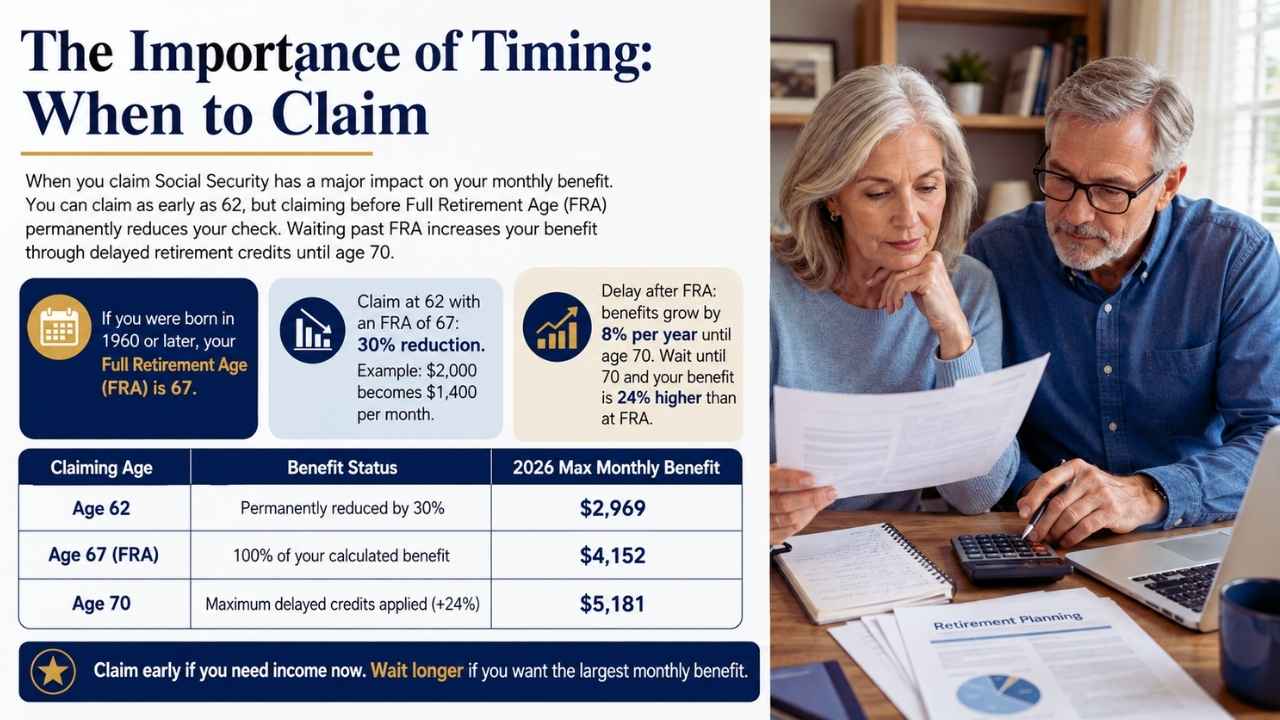
When you decide to claim your benefits completely, it dictates the size of your monthly check. You don’t have to claim the day you quit your job, and you don’t have to quit your job the day you claim. But the timing matters. A lot. Grasping how social security works with these specific age brackets is the biggest secret to maximizing your lifetime payout. You can start taking Social Security as early as age 62. But jumping the gun comes with a massive, permanent penalty. To understand the penalty, you first need to know your Full Retirement Age (FRA).
Your FRA is the exact age you qualify for 100% of your calculated primary insurance amount. If you were born in 1960 or later, your FRA is 67. If your FRA is 67 and you claim at 62, the SSA slashes your benefit by 30%. Ouch. If your full benefit was supposed to be $2,000, claiming at 62 drops it to $1,400 for the rest of your life. For 2026, the absolute maximum someone claiming at 62 can receive is $2,969 per month. On the flip side, the government actually pays you to wait. If you delay claiming past your full retirement age, your benefit grows by 8% for every single year you wait, up until you hit age 70. This delayed retirement credit is one of the best guaranteed, inflation-adjusted returns you’ll ever find.
If your FRA is 67 and you wait until 70, you get a 24% boost. That maximum benefit at age 70 balloons to an impressive $5,181 in 2026. If you are healthy and have a family history of living into your 90s, waiting until 70 almost always nets you the most total money over your lifetime. But if you have health issues or you simply need the cash to keep a roof over your head, claiming early at 62 makes complete practical sense.
|
Claiming Age |
Benefit Status |
2026 Max Monthly Benefit |
|
Age 62 |
Permanently reduced by 30% |
$2,969 |
|
Age 67 (FRA) |
100% of your calculated benefit |
$4,152 |
|
Age 70 |
Maximum delayed credits applied (+24%) |
$5,181 |
Working While Collecting: The Earnings Test Limit
A huge point of confusion for older workers is whether they can hold down a job and collect a check at the same time. Let me clear this up right now: you absolutely can. But you have to follow strict rules if you haven’t reached your full retirement age yet. If you claim benefits before you reach your FRA and you continue to work, you face an earnings limit. In 2026, that limit is $24,480.
If you earn over that amount, the SSA temporarily withholds $1 in benefits for every $2 you earn above the threshold. The rules loosen up a bit during the calendar year you actually reach your FRA. For 2026, the limit in that specific year jumps to $65,160. Plus, they only withhold $1 for every $3 you earn over the limit, counting only the months before your actual birthday.
Here’s the best part. Once you hit your exact FRA, the earnings limit completely vanishes. You could work a full-time executive job making a million dollars a year, and the SSA won’t withhold a single dime of your retirement check. Any money they did withhold earlier because of the earnings test isn’t gone forever, either. The SSA recalculates your benefit when you reach FRA to slowly pay you back over time.
|
Age Status in 2026 |
2026 Earnings Limit |
Penalty for Going Over the Limit |
|
Under FRA all year |
$24,480 |
$1 withheld for every $2 earned over limit |
|
Reaching FRA this year |
$65,160 |
$1 withheld for every $3 earned over limit |
|
At FRA and beyond |
No Limit |
None. You keep 100% of your benefits. |
Maximizing Family Money: Spousal and Survivor Benefits
Social Security acts as a safety net for spouses and families, not just solo workers. If you are married, you have the legal right to claim benefits based on your spouse’s earning record. Getting a grip on how social security works for couples can unlock tens of thousands of dollars in extra lifetime income. When you file, you can claim your own calculated benefit or up to 50% of your spouse’s FRA benefit—whichever number is higher. You don’t get to add them together; you just get the larger of the two amounts.
This rule is a massive perk for couples where one spouse earned significantly more over their career or where one spouse stayed home to raise the kids and lacks 35 years of high earnings. To lock in the maximum 50% spousal benefit, you just have to wait until your own full retirement age to claim. If the worst happens and your spouse passes away, the system provides survivor benefits. A widow or widower can step into the shoes of the deceased and collect up to 100% of their benefit. Again, you keep whichever check is larger, and the smaller one disappears.
You can claim survivor benefits as early as age 60, but taking it before your own FRA means the amount takes a permanent haircut. The rules even cover divorce. You can claim spousal or survivor benefits on an ex-spouse’s earning record. To qualify, your marriage had to last for at least 10 consecutive years, and you must currently be unmarried. Don’t stress—claiming on an ex’s record doesn’t reduce their payout one bit, and the SSA won’t even notify them that you did it.
|
Benefit Type |
Maximum Payout Amount |
Key Requirements |
|
Spousal Benefit |
Up to 50% of worker’s FRA benefit |
Must be at least 62; primary worker must already be claiming |
|
Survivor Benefit |
Up to 100% of the deceased’s benefit |
Can claim at 60; survivor must reach FRA for the full 100% |
|
Divorced Spouse |
Up to 50% of ex’s FRA benefit |
Marriage lasted 10+ years; you must remain currently unmarried |
Yes, the IRS Taxes Your Benefits
A lot of people skip into retirement assuming their Social Security checks are totally tax-free. I hate to break it to you, but that’s just not true. Depending on your other income sources—like pensions, part-time work, stock dividends, or traditional 401(k) withdrawals—the IRS might tax a portion of your benefits at the federal level. To figure out if you owe taxes, you have to calculate a clunky figure the IRS calls your “combined income.” Your combined income equals your adjusted gross income, plus any non-taxable interest you earn (like municipal bonds), plus exactly half of your yearly Social Security benefit.
A critical part of understanding how social security works is prepping for this tax bite so it doesn’t wreck your monthly budget. The tax thresholds are surprisingly low because Congress hasn’t updated them for inflation since the 1980s. If you file as a single person with a combined income between $25,000 and $34,000, up to 50% of your benefit is taxable. If your combined income crosses $34,000, up to 85% of your benefit becomes taxable.
For married couples filing jointly, the 50% tax bracket hits at a combined income of $32,000, and the 85% bracket hits at $44,000. Keep in mind, this doesn’t mean you pay a brutal 85% tax rate. It just means up to 85% of the money you get from Social Security gets treated as normal taxable income on your 1040 form. It gets taxed at your regular income tax rate.
|
Filing Status |
Up to 50% of Benefits Taxed |
Up to 85% of Benefits Taxed |
|
Single Filer |
Combined income $25,000 to $34,000 |
Combined income over $34,000 |
|
Married Filing Jointly |
Combined income $32,000 to $44,000 |
Combined income over $44,000 |
Final Thoughts
Planning for your post-work life gets infinitely easier once you pull back the curtain on the math. Whether you plan to jump in early at 62, wait it out to secure those maximum delayed credits at 70, or run a savvy spousal strategy, understanding how social security works puts you firmly in the driver’s seat. Do yourself a favor: take ten minutes today to set up an account on the official SSA website.
You can pull your annual statement, make sure your past employers actually reported your earnings correctly, and get a highly accurate estimate of your future benefits based on your real data. Knowledge is power. Knowing exactly what the government owes you ensures you can build a stable, stress-free retirement around it.
Frequently Asked Questions (FAQs) About How Social Security Works
How do Cost-of-Living Adjustments (COLA) actually work?
Inflation eats away at your purchasing power, so the SSA uses a cost-of-living adjustment to bump up your checks. The increase ties directly to a specific inflation gauge from the third quarter of the previous year. For 2026, beneficiaries saw a 2.8% boost to help cover the rising costs of groceries and gas. You start building COLA increases from age 62 onward, even if you delay claiming your check until age 70.
What happens to my benefits if I move out of the US?
If you are a US citizen, you can generally receive your checks almost anywhere in the world. There are a handful of restricted countries (think Cuba and North Korea) where the US Treasury cannot legally send payments. Otherwise, your money drops directly into your bank account just as it would if you retired in Florida.
Will Social Security run out of money before I retire?
This is the number one fear I hear from younger workers. No, the program won’t go completely broke. Because it’s constantly funded by payroll taxes from current workers, cash is always flowing in. However, due to shifting demographics—way more retirees and fewer young workers—the trust funds holding surplus cash will likely deplete in the mid-2030s. If Congress ignores the problem, incoming taxes will only cover about 80% of promised benefits. A potential cut is looming, but the checks will never stop completely.
Can I stop my benefits and restart them later?
Yes, but you only get one do-over. If you claim early, panic, and change your mind, you can withdraw your application within the first 12 months. You have to pay back every dime you received, but it resets your record as if you never claimed. Alternatively, once you reach full retirement age, you can voluntarily suspend your benefits to earn the 8% delayed retirement credits up until age 70.