


I always notice how hard it is to quit a popular social app. You find a cleaner, faster alternative online, but you stay put. You also see brand new digital marketplaces struggle to get off the ground.
Meanwhile, established giants grow effortlessly every single quarter. The answer to this puzzle comes down to a simple economic rule. It drives the modern internet. It is the secret sauce behind the largest companies on earth. Once you grasp it, big tech dominance makes total sense.
We call this mechanism network effects. It turns basic software into a global trap. Being the biggest player naturally makes you the best option for every new user who walks through the door. Venture capitalists love this concept. Network effects drive seventy percent of all value created in tech, as investors often point out. I will show you exactly how this works. You will learn the different variations that exist today. You will also see how tech giants use them to crush competition and lock you in.
What Exactly Is a Network Effect?
People throw this term around in business meetings all the time. But understanding the core mechanics requires looking at early communication tools. It also means looking at the math that proves why early tech founders fought so hard for dominance. The whole concept revolves around how a product scales. When more people show up, the experience gets better. It sounds simple, but the math behind it is ruthless. A buggy platform with millions of users will easily beat a flawless app with zero users. I see this happen every day in the software industry.
|
Concept |
Explanation |
Impact |
|
The Simple Definition |
Platform value grows as more people participate. |
Makes user acquisition the main priority for tech startups. |
|
Metcalfe Law |
Value scales with the square of connected users. |
Shows why doubling users actually quadruples the business value. |
|
Connection Density |
Total possible interactions between active accounts. |
Drives daily engagement and kills smaller software competitors. |
|
Value Creation |
Utility generated by people rather than features. |
Explains why buggy apps with huge crowds always win. |
The Simple Definition
A network effect happens when a product naturally becomes more valuable as new people sign up. Picture the first telephone ever made. As a lone piece of metal on a desk, it had absolutely zero practical use. You had nobody to call. But the moment someone built a second phone and plugged it in, both devices gained incredible value. As thousands of phones joined the grid, the system became the communication backbone of society.
In the digital software world, we see this exact dynamic play out on our screens. When you create an account on a modern app, you add a tiny fraction of utility for everyone else. They now have one more contact to reach. This brutal dynamic creates a clear winner. An app might not have the best code. But a massive crowd of active users makes it the only logical choice.
How Metcalfe Law Explains Exponential Growth?
To completely grasp this power, we need to look at the math. Back in the early days of computers, Robert Metcalfe created a mathematical theory. He wanted to explain the financial value of communication hardware. He stated that the total value of any network is proportional to the square of its connected users. If you have two isolated people, there is only one connection.
Add a third person, and you map out three distinct connections. Introduce a fourth, and you generate six possible lines of communication. By the time you hit ten active users, forty-five distinct lines cross paths. The connections grow way faster than the raw number of people. This exponential math explains why a tech company with ten million users holds exponentially more value than a rival with five million. It creates a gap that smaller competitors simply cannot cross.
The Four Major Types of Network Effects
Not all platforms grow the exact same way. Smart founders know there are different flavors of this phenomenon. They often stack multiple types together to build a fortress around their business. We will look at the four main categories that control modern software. These models explain how value flows between users, app builders, and data servers. Understanding these types helps you see exactly why certain apps trap you entirely.
|
Network Type |
Growth Mechanism |
Real World Example |
|
Direct Effects |
Value scales when users join the same exact side. |
Messaging apps and chronological social feeds. |
|
Indirect Effects |
Value scales when two distinct groups connect. |
Operating systems and independent software developers. |
|
Two-Sided Markets |
Supply and demand drive financial transactions. |
Global shopping websites and local ride-sharing apps. |
|
Data Effects |
Algorithms get smarter through daily interactions. |
Search engines and predictive traffic software. |
Direct Network Effects
This is the most straightforward version. It is also the strongest one in the tech sector today. A direct network effect happens when a raw increase in usage leads to an immediate value boost for other users. Messaging apps give us the perfect example. You download a messaging app specifically because your friends and coworkers already use it.
Every new person who joins makes the app slightly more useful for everyone else. There is no middleman here. The users themselves are the entire value proposition. In these closed systems, grabbing users early is a matter of life and death. Once a messaging platform hits critical mass, it turns into a basic utility. You cannot delete it without cutting yourself off from society.
Indirect Network Effects
Indirect networks get a bit more complex. They involve two completely different groups of people relying on each other. The platform value increases for one group only when a complementary secondary group grows. Computer operating systems show this perfectly. If a new system attracts millions of consumers, independent developers rush to build apps for it. They see a massive audience waiting to spend money.
As more apps become available, the operating system looks much better to new buyers. Consumers care about software availability. Developers care about reaching the biggest crowd. This cross-group dependency fuels massive corporate growth. It creates ironclad software monopolies that last for decades.
Two-Sided Marketplaces
A highly specific form of indirect networking is the two-sided digital marketplace. This model facilitates financial transactions between buyers and sellers. Think of modern ride apps or massive digital storefronts connecting obscure merchants with global shoppers. If a platform has millions of active buyers, sellers naturally flock to it. They desperately want access to that spending power.
If a platform hosts a huge variety of sellers with great prices, buyers make it their first stop. The hardest part is solving the initial chicken-and-egg problem. You start with zero buyers and zero sellers. Savvy companies often lose billions deliberately subsidizing one side of the market. They do this just to get the gears turning and establish liquidity.
Data Network Effects
In our era of machine learning, proprietary data acts as the ultimate invisible growth engine. A data network effect occurs when a digital product gets smarter and faster as it gathers information from active users. Search engines rely heavily on this hidden mechanism. Every time you search for a phrase and click a link, the engine learns a tiny bit more about human intent.
With billions of searches happening daily, the dominant engine accumulates a historical data advantage. A brand new startup simply cannot replicate this. A rival might hire brilliant engineers and design a fantastic algorithm. But without the historical data generated by human interactions, their results will always lag behind the current leader.
How Tech Giants Build Unbeatable Business Moats?
Understanding the theory is one thing. Seeing how massive companies weaponize these concepts reveals why big tech feels invincible. Companies do not just stumble into permanent success. They actively engineer their products to trap value and keep competitors permanently locked out. I want to show you exactly how companies push past the initial growth phase. They lock users into long-term habits. Then they spin up a self-sustaining cycle of revenue and expansion.
|
Business Strategy |
Execution Method |
Competitive Edge |
|
Reaching Critical Mass |
Pushing user counts past the breakeven threshold. |
Flips the business from burning cash to free growth. |
|
Creating Lock-In |
Integrating products deeply into daily routines. |
Maximizes switching costs to stop customer churn. |
|
Spinning the Flywheel |
Using momentum to lower prices and attract users. |
Generates massive capital to buy out threats. |
|
Subsidizing Acquisition |
Taking heavy financial losses to secure market share. |
Starves out smaller competitors lacking huge funding. |
Reaching Critical Mass and the Tipping Point
The early days of any network business involve a brutal fight for survival. The company must reach a specific milestone known as critical mass. This represents the exact moment when the value of using the service becomes greater than the friction required to join it. Before critical mass, a startup spends heavily on paid marketing. They offer massive financial discounts and practically beg people to download the app.
Once they hit critical mass, the financial math completely flips. Free organic growth begins to rapidly outpace paid user acquisition. Eventually, the market hits a tipping point. Users naturally coordinate their adoption toward the clear winner. Nobody wants to be stranded on a dead alternative platform.
High Switching Costs and Platform Lock-In
Once a huge tech company gets you inside its ecosystem, they want to make leaving incredibly painful. This brings us to high switching costs. If you want to leave a dominant social app today, you do not just delete the software. You willingly leave behind years of digital memories. You lose a curated media timeline and direct connections to hundreds of acquaintances.
For large businesses using enterprise software, the switching costs run infinitely higher. Moving an entire company from one cloud provider to a rival requires months of painful retraining. You face massive data migration risks and huge upfront costs. This intentional friction lets technology giants justify annual price hikes without losing customers.
Creating the Flywheel of Growth
The ultimate long-term goal for big tech executives is creating a massive self-sustaining corporate flywheel. A physical flywheel takes a massive amount of effort to start spinning. But once it gets going, its momentum keeps it moving continuously with very little extra energy. Tech companies want their core business models to function exactly the same way.
When a company achieves strong network effects, the flywheel spins entirely on its own. More active users attract more independent developers or third-party sellers. More developers create better software tools. More sellers drive down consumer prices through fierce competition. The company then uses massive profits to build enormous data centers and buy out any small startup threatening their model.
Subsidizing Acquisition
Many people wonder how these platforms afford to run at a massive loss for years. Founders use venture capital to subsidize the platform until the network takes over. They hand out free rides, zero-fee deliveries, and massive signup bonuses. They know that whoever builds the biggest network first wins everything. Smaller competitors without massive war chests simply bleed to death trying to match the discounts. Once the winner stands alone, they slowly raise prices to recoup the early losses.
Real-World Examples of Network Effects in Action
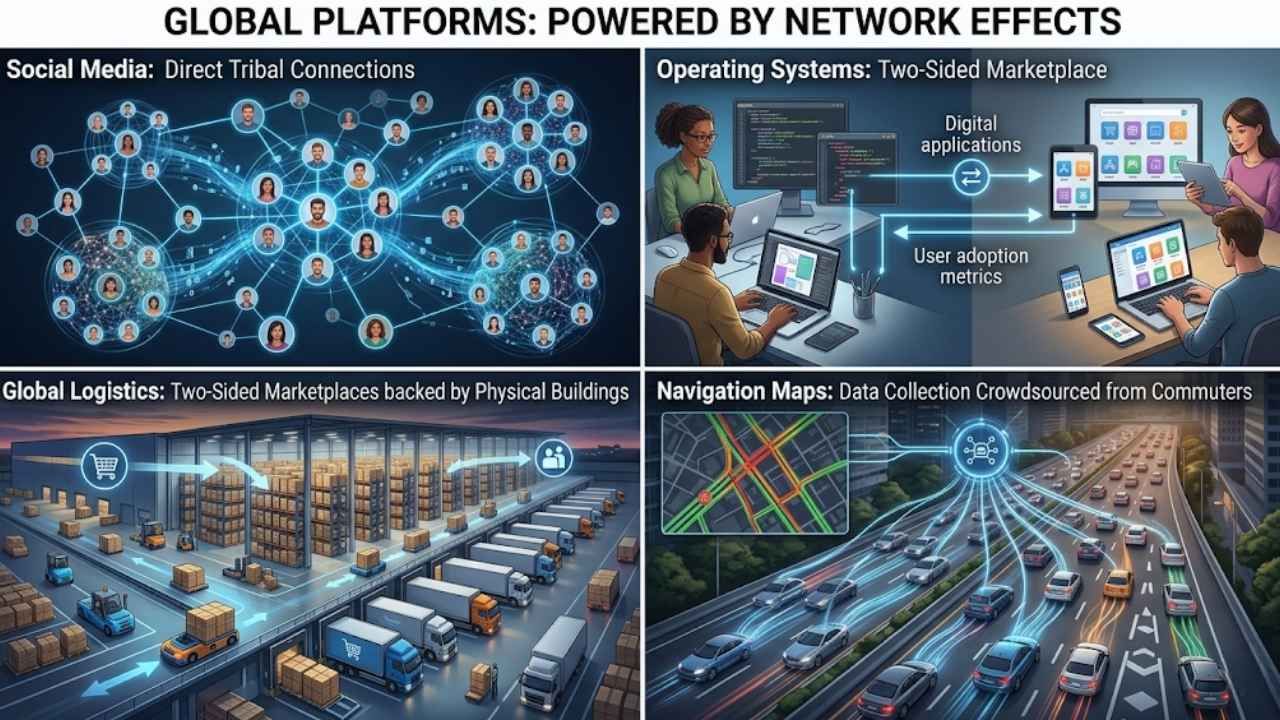
To make these concepts concrete, we can look at the daily tools billions of people rely on. We can identify the specific mechanics keeping them at the top of the food chain. From the way we communicate to how we shop online, these platforms shape the global economy. We will dissect the inner workings of social tribes, massive software environments, and global delivery logistics. You will see exactly why these giants rarely lose ground.
|
Industry Sector |
Network Application |
Why The Monopoly Persists |
|
Social Media |
Direct tribal connections based on personal identity. |
Competitors cannot replicate an individual social graph. |
|
Operating Systems |
Indirect connections matching developers with users. |
App makers refuse to build for platforms with zero users. |
|
Global Logistics |
Two-sided marketplaces backed by physical buildings. |
Startups cannot afford millions of square feet of space. |
|
Navigation Maps |
Data collection crowdsourced from daily commuters. |
Alternative map apps cannot predict live traffic jams. |
Social Media and Tribal Networks
Modern social platforms give us the purest expression of direct network effects. But they also tap into something extremely powerful called tribal effects. They deliberately tie their digital platforms directly to a user sense of personal identity and social standing. Your curated profile, your follower count, and your interaction data become highly valuable digital assets.
They hold real psychological weight in your daily life. If a brand new competitor launches with massively superior privacy features or zero annoying ads, it almost always fails. It lacks that dense social graph. A beautifully designed empty room is ultimately still just an empty room.
Operating Systems and Developer Ecosystems
The mobile operating system landscape represents a massive indirect network effect. A handful of companies completely control the smartphone hardware and the base software. But they do not write all the daily applications themselves. Instead, they provide a lucrative digital environment for millions of third-party developers scattered around the world.
If a new hardware company launches a rival smartphone today, their physical device could feature amazing battery life. But nobody will buy the phone if it cannot run the most popular banking and messaging apps. The developers will not spend time porting their apps because there are no users yet. This dynamic permanently locks the market.
E-Commerce and Global Logistics
Global e-commerce platforms successfully combine massive digital marketplaces with unprecedented physical scale. Independent business sellers desperately need access to a massive global audience just to survive. They willingly list their entire inventory on the biggest platform available, even if the fees hurt. The host platform uses those billions in transaction fees to build physical fulfillment centers.
They buy cargo planes and optimize local shipping routes. This aggressive expansion creates a terrifying physical moat that goes far beyond simple website software. A motivated competitor might code a faster shopping website over a weekend. They absolutely cannot magically replicate hundreds of automated warehouses overnight.
Look at the map application on your phone. It uses crowdsourced data from millions of active drivers to predict traffic speeds and suggest alternate routes. Every single driver acts as a real-time sensor for the network. A brand new map startup might license excellent geographic data. But without millions of live drivers feeding it speed information every second, it cannot warn you about a sudden accident on the highway. The data network effect makes the incumbent app vastly superior in real-time utility.
The Dark Side: When Network Effects Break Down
Despite how invincible big tech seems, these growth engines have serious flaws. Networks can rot from the inside out if the company stops caring about the user experience. Market dominance does not guarantee eternal life. Unchecked growth can ruin an app entirely. We will explore how size becomes a massive liability. You will also see why historical monopolies eventually fell to new paradigms.
|
Failure Point |
Root Cause |
Ultimate Consequence |
|
Platform Congestion |
Rapid user growth severely overwhelming the servers. |
Degraded app performance and highly frustrated users. |
|
Ecosystem Pollution |
Unchecked floods of spam bots and fake goods. |
Total loss of consumer trust and platform abandonment. |
|
Multi-Tenanting |
Low switching costs letting users jump between apps. |
Forces companies into price wars that destroy margins. |
|
Technology Shifts |
A total change in how society interacts with hardware. |
Resets the competitive landscape and destroys moats. |
Negative Network Effects and Platform Congestion
Constantly adding more users does not always equate to a better experience. Completely unchecked hyper-growth rapidly leads to severe negative network effects. Think about a physical highway. Up to a certain point, a highway is a fantastic piece of infrastructure. But once the daily traffic volume drastically exceeds the physical capacity, every single additional car actively makes the driving experience worse.
Digital platforms experience their own forms of severe congestion. When a social network becomes vastly too large, original users often feel overwhelmed by irrelevant content, spam bots, and invasive ads. Growth at all costs eventually ruins the core product experience.
Why Tipping Does Not Always Mean Permanent Monopoly
Business history is full of massive tech companies that reached the tipping point and still eventually collapsed into irrelevance. A dominant network effect protects a company from direct upstart competitors playing the exact same game. It does not protect a company from completely new and disruptive tech paradigms.
The dominant desktop software companies of the late nineties seemed untouchable. But the entire world shifted rapidly away from bulky desktop computers toward pocket-sized mobile devices. A fundamentally new technology resets the board completely. It forces tired giants to build a brand new network from scratch before an agile startup completely replaces them.
Measuring Network Effects and Market Winners
If you want to know which startup will win the next decade, you cannot just look at user growth. Growth alone deceives you if user retention looks awful. We need to look at the metrics that prove a network actually holds value. This section breaks down how investors evaluate platforms. They look beyond simple user counts to understand real engagement and the severe threat of users juggling multiple apps at once.
|
Metric Type |
What It Measures |
Why It Matters |
|
Organic Ratio |
Users joining naturally without paid marketing spend. |
Proves the network pulls people in via word of mouth. |
|
Match Rate |
How often supply meets demand in a marketplace. |
Shows if a marketplace is actually useful or just empty. |
|
Multi-Tenanting |
The percentage of users operating on rival platforms. |
Highlights the critical risk of losing users to discounts. |
|
Cohort Retention |
How long a specific group stays active after signup. |
Indicates long-term utility rather than short hype. |
Key Metrics for Tech Startups
To accurately measure the true financial strength of these platforms, analysts look far beyond simple total user counts. One incredibly vital metric is the ratio of organic user acquisition versus highly expensive paid user acquisition. In a healthy system, the percentage of users who sign up organically should absolutely skyrocket. Existing users constantly invite their peers.
If a massive company still relies heavily on paid television ads to maintain its daily user base, its internal network remains incredibly weak. Another crucial measurement for digital marketplaces is the overall platform match rate. In a ride-sharing app, this means looking closely at driver utilization time rather than just counting registered cars. High match rates objectively prove that daily connections remain highly valuable for everyone involved.
The Multi-Tenanting Challenge
One of the greatest modern threats to digital market dominance is multi-tenanting. This happens when everyday users easily participate in multiple competing networks at the exact same time without friction. If an independent delivery driver also has a rival app open on their dashboard, the barrier to switching teams drops to zero. Because of this massive vulnerability, localized marketplaces deeply struggle to achieve the massive profit margins of pure software monopolies.
They constantly have to offer rider discounts and daily driver bonuses just to prevent users from tapping a different icon. Strong platforms actively build intricate onboarding flows and loyalty programs specifically designed to make multi-tenanting feel like a massive waste of personal time.
Final Thoughts
The modern digital economy runs entirely on network effects. They dictate exactly why certain scrappy startups explode into global giants while seemingly identical competitors burn through cash and vanish. Whether operating through direct communication links, massive two-sided marketplaces, or invisible data collection algorithms, the core premise remains identical. Platform value scales aggressively with active human participation.
Understanding this underlying math clearly explains why big tech stays incredibly big. It also shows why successfully unseating an entrenched digital platform requires far more than just a clever software idea. You have to build a substantially better and infinitely stickier ecosystem from the ground up. And you have to survive the brutal financial phase before hitting critical mass.
Frequently Asked Questions (FAQs) About Network Effects Explained
New social platforms consistently struggle primarily because of direct network effects. The actual intrinsic value of a social app is not its graphical interface. It is the active presence of other human beings. Even if a startup builds an app with brilliant privacy features and absolutely no ads, regular users will not stay active. If their friends, family members, and favorite creators are not there to talk to, they leave. The empty room problem reliably kills most social startups fast.
How does data act as a competitive advantage?
When a massive tech platform processes billions of human interactions daily, it trains its internal algorithms to be incredibly precise. This actively creates a powerful data network effect. The core product automatically improves itself just by people using it. A brand new competitor entering the space with zero historical data cannot possibly offer a comparable user experience. Their algorithms simply lack the time and volume to learn what consumers actually prefer.
What is a two-sided marketplace?
A two-sided marketplace is a centralized digital platform that actively connects two entirely distinct groups. These are usually independent buyers and independent sellers. The platform relies heavily on indirect network effects to grow. An increase in buyers automatically attracts more sellers seeking revenue. An increase in sellers attracts more buyers seeking variety. Familiar daily examples include short-term housing rentals, local food delivery apps, and digital freelance job boards.
Can a company permanently lose its network effect?
Yes, digital network effects possess incredible power but remain surprisingly fragile over long periods. If a platform becomes heavily congested with aggressive spam or poor-quality content, the immense value of the network collapses rapidly. The same happens if a massive shift in underlying hardware technology disrupts the market. If the daily user experience degrades past a certain psychological breaking point, frustrated users will eventually endure the pain of switching to a completely new alternative.
What does the term multi-tenanting mean in technology?
Multi-tenanting refers specifically to the common consumer behavior where users actively maintain accounts on multiple competing platforms simultaneously. We see this all the time in local ride-sharing or food delivery. Users casually check several apps to find the absolute cheapest price or the fastest delivery time. High multi-tenanting severely weakens a company’s pricing power because users jump ship instantly without facing high switching costs.
How does Reed’s Law differ from Metcalfe’s Law?
Metcalfe Law states that a network value scales with the square of its users. But Reed Law argues that the value scales exponentially when users form specific subgroups and distinct communities inside the platform. This perfectly explains why group chats, specialized sub-forums, and niche community pages make certain platforms incredibly addictive. People find it deeply difficult to abandon these sub-communities compared to basic messaging tools.