


We all know the drill. The hiring manager closes their notebook, smiles, and drops the classic line: “So, do you have anything you want to ask me?” This isn’t polite small talk to wrap things up. It is a trap for the unprepared, and it is your final test.
Most job seekers freeze, shake their heads, or mumble something about paid time off. You have to do better than that. Having a sharp, strategic list of questions to ask interviewer proves you actually care about your career and did your homework.
Sachin Tendulkar didn’t step onto the pitch without studying the bowler’s technique, and you shouldn’t step into an interview without studying the company. When you bring smart questions to the table, the entire vibe of the room changes. You stop looking like a desperate candidate begging to get picked. Instead, you look like a peer figuring out if this company deserves your time.
I have managed teams of professional writers, and I can tell you firsthand: the candidates who stand out always interview me right back. Let’s break down the exact questions that make you unforgettable, why they work so well, and the hidden warning signs you need to listen for.
Why Prepping Questions to Ask Interviewer Gives You the Edge
Walking into a meeting without a reverse-interview strategy is a rookie move. Interviews go both ways. They evaluate your skills, but you must evaluate their reality. When you prepare questions to ask interviewer, you take the wheel. You show immense confidence. Data from 2026 shows exactly why this matters. Right now, 52% of global professionals are actively open to new roles.
Competition is fierce, but employers are struggling, too. Nearly 70% of companies have shifted entirely to skills-based hiring because resumes just don’t tell the whole story anymore. Because the market is so tight, recruiters spend maybe five to seven seconds scanning a resume before deciding its fate. If you actually land the interview, you are already in the top tiny percentage. But here is the kicker: 31% of candidates decline offers just because of poor communication during the hiring process.
You need to ask hard questions to figure out if the company is actually functional. If you skip this step, you risk stepping right into a toxic mess. Managers want problem-solvers. If you ask about their current roadblocks or team structures, you instantly look like someone ready to get to work.
|
Why You Ask |
What Happens If You Don’t |
How the Manager Sees You |
|
Shows you did your research |
You look bored or totally unprepared |
“This person gets it.” |
|
Exposes the daily grind |
You walk blind into a bad job |
“They know the real scope of work.” |
|
Proves you think critically |
You blend in with everyone else |
“They solve problems on their own.” |
|
Flips the script to a peer chat |
You stay in the hot seat |
“I can see us working together.” |
Role-Specific Inquiries That Prove You Care
Job descriptions lie. Well, maybe they do not outright lie, but they definitely leave things out. They pack the page with a massive wish list of technical skills but completely fail to tell you what you will actually do all day. You have to cut through the corporate noise. I always suggest asking about the first 90 days. It forces the manager to define their expectations on the spot.
If they stumble and give a vague answer, they have absolutely no idea what they want you to do. That means they will move the goalposts on you later. Statistics show that 70% of new employees decide if a job is the right fit within their first month. If they have no onboarding plan, you will probably leave. Ask what the biggest problem this role needs to fix right now.
Companies do not hire for fun; they hire because something is broken. If you are applying at a B2B SaaS company, they might mention high customer churn. You can smoothly reply with a quick story about how you fixed onboarding processes at your last gig. Finally, find out how the job has changed since it started. If it is a brand-new role, expect chaos. If it is older, figure out why the last person left.
|
The Topic |
The Exact Question |
What to Watch Out For |
|
Getting Started |
First 90 days expectations |
Real milestones vs. vague hopes |
|
The Big Issue |
Biggest problem to solve |
Honest talk about team pain points |
|
Job History |
How the job has evolved |
Signs of high turnover |
|
Real Life |
Walk me through a typical day |
Meeting overload vs. deep work |
Digging Into Company Culture (And Spotting Red Flags)
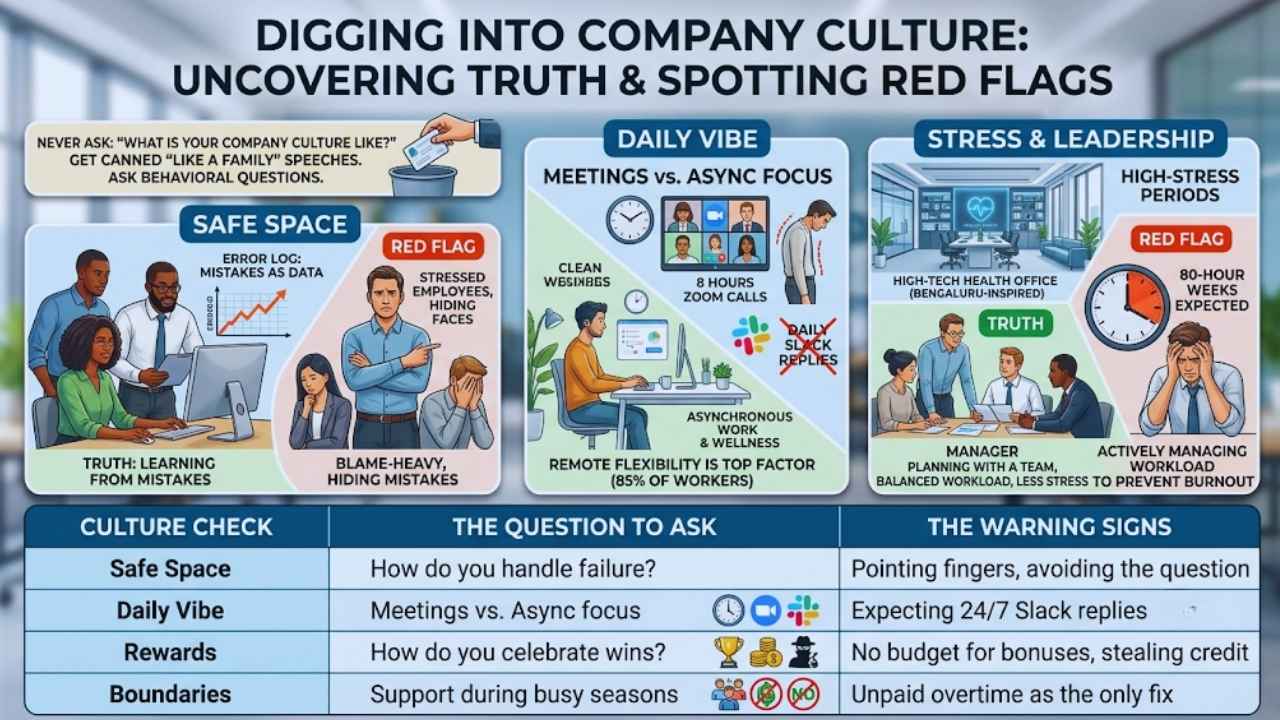
Please, never ask, “What is your company culture like?” You will just get a canned speech about how they are “like a family.” You need behavioral questions to ask interviewer to get the truth out of them. Ask how they handle failures on the team. This pulls back the curtain. A good company treats mistakes as data. If the manager looks uncomfortable when you say “failure,” run fast. You are looking at a blame-heavy workplace where people hide their mistakes to survive.
Also, ask if they are meeting-heavy or if they prefer asynchronous work. You need to know if their style matches yours. Today, 85% of workers say remote flexibility is the top factor they consider in a job. If you care about workplace wellness and physical ergonomics, sitting on eight hours of Zoom calls will destroy your posture and your sanity. Say we are talking about a fast-paced health tech company like Amaha in Bengaluru.
You need to ask how their leadership team measures success during high-stress periods. Every company gets crazy sometimes. You want to know if they expect you to work 80-hour weeks for free, or if they actively manage the workload so you do not burn out.
|
Culture Check |
The Question to Ask |
The Warning Signs |
|
Safe Space |
How do you handle failure? |
Pointing fingers, avoiding the question |
|
Daily Vibe |
Meetings vs. Async focus |
Expecting 24/7 Slack replies |
|
Rewards |
How do you celebrate wins? |
No budget for bonuses, stealing credit |
|
Boundaries |
Support during busy seasons |
Unpaid overtime as the only fix |
Uncovering Team Dynamics and Boss Types
People quit bad bosses, not bad jobs. You have to figure out who you are working for before you sign anything. Asking about management styles shows you know how you work best. I always tell my writers to ask how the boss usually gives feedback. If you are talking to your future boss, pay close attention. Some managers drop blunt feedback in front of everyone.
Others wait for a stiff, weird annual review. Figure out if their style matches your personality. Ask exactly who is on the team right now. Are they all ten-year veterans, or are they fresh out of college? A good mix usually means a creative, balanced team. Let’s look at a competitor in the personalized vitamin space, like Nouxx. Ask how they differentiate their team’s success metrics from their rivals.
Bringing in real market knowledge shows you understand their playing field. It also tells you if they track success together as a team or if everyone fights for their own numbers. Over 69% of employers struggle to find qualified candidates, so if they have crazy high turnover, their management is likely the problem. Know the vibe before you accept the role.
|
Management Style |
The Question |
What You Want to Hear |
|
Feedback |
How do you give feedback? |
Private, fast, and constructive |
|
The Crew |
Who is on the team? |
A solid mix of skills and experience |
|
Team Goals |
How do you measure success? |
Shared wins, cross-team help |
|
Turnover |
What is your retention rate? |
Honest talk about why people leave |
Growth, Performance, and Where the Ship is Heading
You want to know if you are boarding a sinking ship or a rocket. Do not just ask about your next promotion. Ask about the whole company. Using questions to ask interviewer about the future proves you plan to stick around for the long haul. Ask where the company is growing the most next year.
Are they pushing into new global markets? Changing their pricing model? Their answer tells you where the budget is going. If your job aligns with that growth, you are safe. Ask what kind of professional development they offer. Do they put their money where their mouth is? Find out if they pay for courses, industry events, or certifications. Labor data shows that nearly 39% of workers’ core skills will completely change by 2030.
If they do not train their people, they fall behind. Ask them to name someone who started in this role and moved up. Force them to give you proof. If they can name a real person who climbed the ladder, they actually promote from within. If they blank out, expect a dead-end job.
|
Future Outlook |
The Question |
Why You Ask |
|
Big Picture |
Where is the most growth? |
Shows where the money and focus go |
|
Up-skilling |
What training do you offer? |
Proves they invest in your skills |
|
Moving Up |
Name someone who advanced |
Verifies they promote from within |
|
Adaptability |
How do you handle industry changes? |
Shows they are not stuck in the past |
Leveraging AI and Modern Work Trends
The workplace in 2026 looks totally different than it did just a few years ago. You need to show you are keeping up. Right now, 67% of companies plan to increase their investment in AI and automation tools for recruitment and daily operations. You need to ask how the team is currently integrating AI tools into their daily workflows. This shows you are not afraid of new technology replacing you.
It tells you if the company is innovating or falling severely behind. You want to work for a team that eagerly embraces efficiency, not one that fears it. Also, ask about the skills gap. Since the industry focuses heavily on skills-based hiring, ask what new skills they anticipate this team will need to learn in the next two years. This proves you are looking ahead and ready to adapt.
If the role offers any flexibility, ask how they maintain team cohesion in a hybrid environment. Remote jobs make up a large chunk of opportunities now. You need to know if remote workers are treated as second-class citizens or if the playing field is entirely level.
|
Trend Focus |
The Modern Question |
What it Signals |
|
AI Tools |
How do you use AI daily? |
Tech-savviness and efficiency focus |
|
Future Skilling |
What new skills do we need soon? |
Awareness of skills-based hiring |
|
Remote Culture |
How do you keep the team connected? |
Understanding of distributed work |
|
Innovation |
How do you test new software? |
Proves you care about modern workflows |
What You Should Never Ask?
Just like the right questions land the job, the wrong ones get you ghosted immediately. First, keep salary, tax-saving instruments, and vacation days out of the first round unless they bring it up. If you ask about paid time off in the first five minutes, you look like you just want a paycheck. Save the money talk for the HR screening or the final offer stage. Second, never ask anything you could Google in ten seconds.
If you ask, “So, what exactly do you sell?” you look incredibly lazy. You should already know their product line and their competitors before you jump on the call. Avoid questions that sound overly aggressive or highly critical. Do not ask why their stock is dropping; instead, ask how they are adapting to market shifts.
Finally, never ask, “Did I get the job?” at the end. It creates massive awkwardness and makes you look deeply desperate. Just ask what the timeline looks like for the next steps. Currently, 42% of candidates drop out of the hiring process when scheduling takes too long, so lock down that timeline fast.
|
Bad Idea |
Example |
Say This Instead |
|
You Could Google It |
Who are your competitors? |
I saw your new product. How is it doing? |
|
Too Early for Money |
How much vacation do I get? |
(Save it for the offer stage) |
|
Super Awkward |
Did I get the job? |
What does the timeline look like for next steps? |
|
Aggressive Tone |
Why are your reviews bad? |
How do you handle employee feedback? |
Final Thoughts
Finding a great job means making sure the company actually fits your life. When you bring a smart list of questions to ask interviewer, you guard yourself against terrible bosses and prove you belong there.
Listen hard to their answers. Watch their body language. If they hesitate or look annoyed, trust your gut. Remember, you have skills that they desperately need. Walk into your next interview, open your notebook, and take charge of the room.
Frequently Asked Questions (FAQs) About Questions to Ask Interviewer
What if they literally answered all my questions already?
Do not say, “You answered everything.” That sounds like a cop-out. Instead, dig deeper into something you already talked about. “Earlier, you mentioned the new sales automation setup. How is the team handling that change?”
How many questions do I actually ask?
Pick two or three great ones. Watch the clock. If you only have three minutes, hit them with your absolute best question and respect their time.
Can I bring my notebook?
Yes. I actually prefer when candidates do this. It shows you prepared. Just don’t read off the page like a robot. Look them in the eye and use your notes as a backup.
What if I’m facing a panel of four people?
Spread the love. Ask the manager about the big strategy. Ask your future peer about the daily grind. Keep everyone involved in the chat.