


Hitting your 40s often triggers a quiet financial panic. You check your accounts, do some quick math in your head, and realize your actual balance looks nothing like the massive numbers financial gurus brag about. In fact, Northwestern Mutual recently revealed in their 2026 Planning & Progress study that the magic number Americans believe they need to retire comfortably sits at a staggering $1.46 million.
I completely get the anxiety. Life gets wildly expensive in your 30s. Between buying a house, raising kids, covering unexpected medical bills, or battling stubborn student loans, your future nest egg usually takes a back seat. But whatever caused your late start, let’s clear the air right now: you have not run out of time. You still have a solid 20 to 25 prime earning years left on the clock.
That gives compound interest a massive window to work its magic, but only if you get aggressive right now. Coasting simply is not an option anymore. This guide strips away the jargon to show you exactly how to rebuild your retirement savings in 40s. You will walk away with a realistic roadmap to secure your future without living on instant noodles today.
Face the Numbers Without Freaking Out
Before you map out a route, you need your exact starting coordinates. I constantly see people dodge this crucial step because looking at the exact numbers stings. Skip the guilt trip immediately. You must log into every single account, tally up all your outstanding debts, and figure out your exact net worth today. You cannot fix a financial problem that you refuse to measure. Start by calculating your bare-minimum monthly living expenses down to the exact dollar.
Your ultimate financial goal does not rely on a random million-dollar target; it relies heavily on what it actually costs you to survive. When you lower your current overhead, you instantly shrink the massive pile of cash you need to save. Furthermore, you must track down old 401(k)s from your previous jobs. People frequently leave thousands of dollars rotting in high-fee, forgotten accounts when they switch employers.
Roll those stray funds over into a low-cost individual retirement account where you call the shots. Getting perfectly organized solves half the battle, and once you see the complete picture on paper, the panic usually fades. A cold, hard strategy quickly takes over to replace that fear.
|
Metric |
What You Need to Track |
Why You Need to Track It Right Now |
|
Total Assets |
401(k)s, IRAs, home equity, cash in the bank |
Shows you what money is actively growing for your future. |
|
Total Liabilities |
Mortgages, credit cards, auto loans |
Reveals exactly what debt drains your monthly cash flow. |
|
Monthly Burn Rate |
Bare minimum cost to survive for 30 days |
Dictates the size of your emergency fund and retirement target. |
|
Savings Rate |
The percentage of your paycheck you save |
The absolute biggest lever you can pull to catch up fast. |
The Benchmark Reality Check
Financial experts absolutely love tossing around benchmarks to tell you where you should stand. The most famous rule of thumb comes directly from Fidelity Investments, which states you should have three times your annual salary saved by age 40. So, if you make $100,000 a year, they expect to see $300,000 sitting in your investment accounts. If you see a massive gap between your balance and that multiplier, you need to take a deep breath.
These benchmarks assume you enjoyed a perfectly smooth, uninterrupted career path since age 22, but almost nobody actually lives that reality. In fact, real-world data from Vanguard in 2026 shows the median retirement account balance for the 35 to 44 age group hovers right around $40,000. Even the average 401(k) balance for people in this age bracket sits far below the ideal targets.
Instead of feeling defeated, use these targets as a simple diagnostic tool to measure your next moves. If you lag behind the benchmark, it just means you need to bump up your current savings rate immediately. Your 40s usually bring your absolute peak earning years. You finally possess the cash flow you completely lacked in your 20s, and we just need to point it in the right direction.
Read Also: 4 Percent Rule Retirement: Does It Still Work in 2026?
|
Age Milestone |
Standard Savings Benchmark |
What to Do if You Are Behind |
|
Age 30 |
1x Annual Salary |
Start contributing to a 401(k) at least up to the employer match. |
|
Age 40 |
3x Annual Salary |
Hike your savings rate to 15 to 20 percent immediately. |
|
Age 50 |
6x Annual Salary |
Lean heavily into IRS catch-up contributions; max out all accounts. |
|
Age 60 |
8x Annual Salary |
Reassess your asset allocation and plan your Social Security timing. |
How to Supercharge retirement savings in 40s
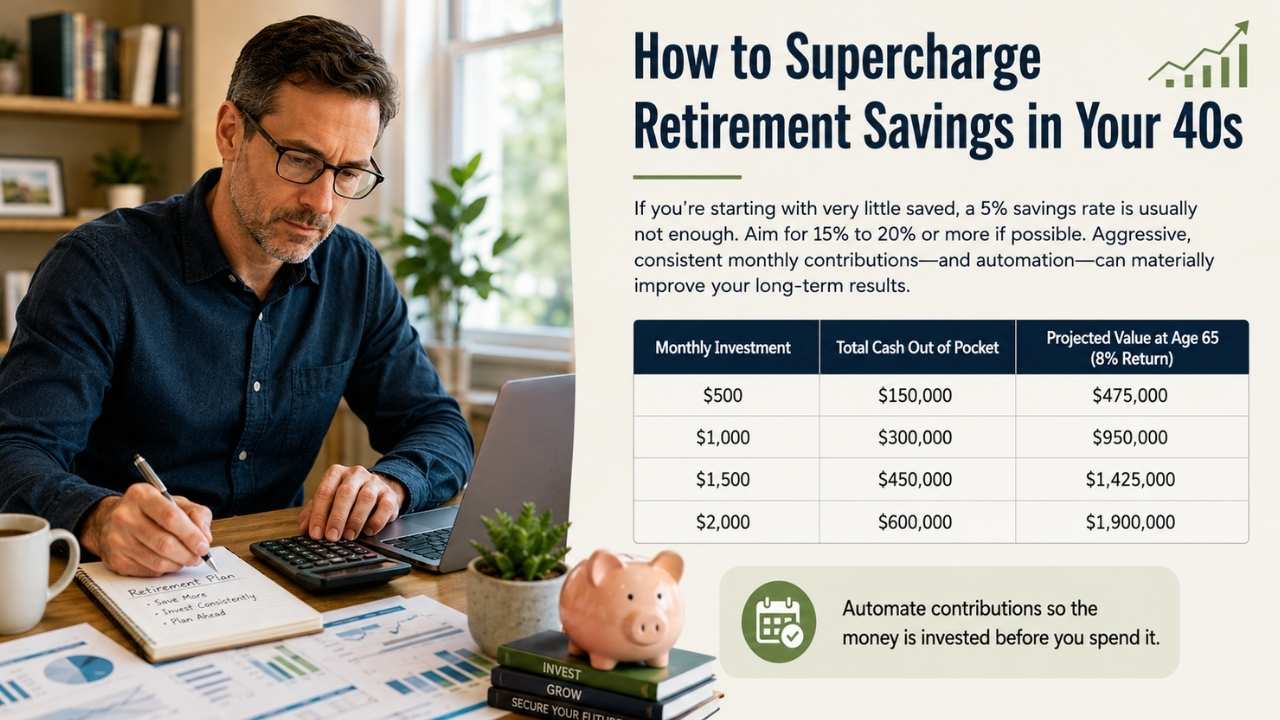
Here is exactly where the rubber meets the road for your financial turnaround. If you have zero saved right now, quietly tucking away 5 percent of your paycheck simply will not get the job done anymore. You need to aim for a 15 to 20 percent savings rate, or even higher if your current salary allows it. Yes, this aggressive stance requires tough choices and a serious budget overhaul, but the strict math demands it.
Let us run the actual numbers to see the proof. If you start at age 40 with absolutely nothing, and you invest $1,500 a month in a broad market index fund returning an average of 8 percent annually, you hit roughly $1.4 million by age 65. If you push that monthly contribution to $2,000, you clear $1.9 million. Compound interest still works heavily in your favor, but you absolutely have to feed the machine aggressively.
When it comes to fixing your retirement savings in 40s, the sheer volume of cash you inject right now dictates your eventual success. You cannot just rely on a long time horizon anymore; you must rely on heavy, consistent principal contributions. Automate these investments immediately. Make sure the money leaves your checking account before you even get a chance to spend it.
|
Monthly Investment |
Total Cash Out of Pocket |
Projected Value at Age 65 (8 Percent Return) |
|
$500 |
$150,000 |
$475,000 |
|
$1,000 |
$300,000 |
$950,000 |
|
$1,500 |
$450,000 |
$1,425,000 |
|
$2,000 |
$600,000 |
$1,900,000 |
Grab Free Money and 2026 Tax Loopholes
If your boss offers a 401(k) match and you ignore it, you literally leave a massive chunk of your own paycheck on the table. A 5 percent match on a $100,000 salary equals a free $5,000 every single year, so take the free money immediately. Beyond the standard match, you need to play aggressively by the current IRS rules. For 2026, the IRS bumped the standard employee 401(k) contribution limit up to $24,500. Meanwhile, Traditional and Roth IRA limits sit at $7,500 for anyone under age 50.
Maxing these accounts shields huge amounts of your hard-earned income from taxes. Once you secure the company match, look very closely at a health savings account. People often misunderstand HSAs, treating them like short-term buckets for buying bandages and paying doctor co-pays. If you carry a qualifying high-deductible health plan, an HSA acts as a secret wealth-building weapon.
It provides triple-tax benefits because the money goes in tax-free, grows tax-free, and comes out tax-free for medical costs. For 2026, a family can contribute up to $8,750, while a single individual can stash $4,400. Even better, once you turn 65, you can withdraw the money for any non-medical reason and just pay standard income tax, exactly like a Traditional IRA.
|
Account Type |
2026 Contribution Limit |
Best Strategy for Your 40s |
|
401(k) / 403(b) |
$24,500 |
Put in at least enough to get the full employer match. |
|
Traditional/Roth IRA |
$7,500 |
Max this out next. Roth accounts give you tax-free growth. |
|
HSA |
$4,400 Single / $8,750 Family |
Triple-tax advantaged. Invest the funds for long-term growth. |
|
Taxable Brokerage |
No Limit |
Only use this after maxing out all your tax-advantaged options. |
The rules around saving for the future constantly shift, and the recent SECURE 2.0 Act introduced several massive changes that directly impact people looking to aggressively catch up. If you are in your late 40s, you are rapidly approaching the golden age of catch-up contributions. At age 50, the IRS lets you stuff even more money into your accounts. For 2026, that standard catch-up limit sits at an extra $8,000 for a 401(k), allowing older workers to stash a total of $32,500 annually.
However, a massive catch takes full effect in 2026 for high-income earners. If you make over $145,000 in Social Security wages in the prior year, your catch-up contributions must go into an after-tax Roth account. You can no longer use them to lower your current taxable income. While this hurts your tax bill today, it forces you to build a massive pool of tax-free money for tomorrow.
Furthermore, SECURE 2.0 created a brand new super catch-up limit for workers aged 60 to 63, allowing them to contribute an extra $11,250 in 2026. While you are not there yet, knowing this runway exists gives you a clear, powerful target for your 50s and 60s.
|
Provision |
How It Works in 2026 |
Impact on Your Strategy |
|
Age 50+ Catch-Up |
Extra $8,000 in 401(k)s. |
Massive boost to compounding once you cross the half-century mark. |
|
High Earner Roth Rule |
Earn over $145,000? Catch-ups must be Roth. |
You lose the upfront tax deduction but gain tax-free withdrawals. |
|
Age 60-63 Super Catch-Up |
Extra $11,250 in 401(k)s. |
A final sprint option to dump massive cash into the market later. |
|
Missing Roth Options |
If a plan lacks Roth, high earners cannot catch up. |
Check with HR immediately to ensure your 401(k) offers a Roth option. |
Kill Your Toxic Debt Immediately
You simply cannot build lasting wealth while paying 24 percent interest on a rolling credit card balance. It remains mathematically impossible to out-invest toxic consumer debt over the long haul. If the stock market delivers a generous 10 percent return in a great year, that credit card still drags your net worth backward by 14 percent. Stop throwing extra cash at a taxable brokerage account if you currently carry high-interest debt.
Attack the debt first using the aggressive Avalanche Method. Organize your specific debts by interest rate, and pour every spare dollar into the most expensive one while paying the bare minimums on the rest. Once you clear that top debt, roll the entire payment amount into the next highest rate.
Every dollar you pry away from the greedy credit card companies becomes a dollar you can funnel directly into your investment accounts. You must treat high-interest debt like a financial emergency because it actively destroys your future purchasing power.
|
Debt Type |
Typical Interest Rate |
Action Plan |
|
Credit Cards |
20 to 29 percent |
Code Red. Pause your extra investing to kill this immediately. |
|
Personal Loans |
10 to 15 percent |
High Priority. Pay these off aggressively once cards are cleared. |
|
Auto Loans |
4 to 8 percent |
Moderate. Pay extra when possible, but keep investing for your future. |
|
Mortgage |
3 to 7 percent |
Low. Pay on schedule. Do not sacrifice investments for this. |
Rethink Your Asset Allocation for Growth
Many people get incredibly nervous when they start saving late in life. They instinctively dump their cash into safe assets like government bonds, certificates of deposit, or basic savings accounts. At age 40, playing it entirely safe actually ranks as the riskiest move you can possibly make. Inflation will eat your purchasing power alive over the next two decades if your money does not grow.
You need aggressive, consistent growth to close your current savings gap. That means holding a heavy, unapologetic exposure to stocks, usually through low-cost index funds like the S&P 500 or total stock market funds. A common financial rule states you should hold 110 minus your exact age in stocks.
At 40, that means keeping roughly 70 percent of your total portfolio invested aggressively in the stock market. You have plenty of time to ride out market dips, corrections, and crashes before you ever need to withdraw a single dime. Do not let short-term drops scare you out of long-term wealth building.
|
Asset Class |
Recommended Range |
Purpose in Your Portfolio |
|
US Stock Index Funds |
50 to 60 percent |
Your main growth engine. Offers high historical returns to help close the gap. |
|
International Stocks |
15 to 20 percent |
Diversification. Protects you if the US economy hits a rough patch. |
|
Bonds / Fixed Income |
10 to 20 percent |
Stability. Cushions the blow when the stock market inevitably drops. |
|
Cash Equivalents |
2 to 5 percent |
Liquidity. Keeps cash on hand to buy stocks cheap during market crashes. |
Pause the College Fund Completely
This specific advice hits incredibly hard for devoted parents. You naturally want to pay for your kids’ college education so they launch into adulthood without carrying a massive financial burden. However, you must face this harsh, undeniable reality: your kids can easily borrow money for college, but you absolutely cannot borrow money to fund your retirement.
If you run out of cash in your 70s because you paid their expensive tuition, you will have to rely entirely on your children for support. By securing your own financial independence first, you actually give them the greatest gift possible. You provide the ironclad guarantee that they will never have to pay your housing or medical bills when you get old.
Pause the 529 plans immediately until your own investment accounts run perfectly on schedule. They will thank you for making this tough decision later in life when they realize the immense value of your self-sufficiency.
|
Priority Level |
Financial Goal |
Justification |
|
1. Urgent |
Emergency Fund (3 to 6 months) |
Stops you from swiping a credit card during a sudden crisis. |
|
2. Mandatory |
Your Retirement Accounts |
Time is running out. This absolutely cannot wait. |
|
3. Optional |
Kids’ College Funds (529s) |
Only fund this if numbers 1 and 2 are completely secured and maxed out. |
|
4. Bonus |
Early Mortgage Payoff |
Only do this if your mortgage rate beats expected stock market returns. |
Crush Lifestyle Creep Right Now
Your 40s usually mark your absolute peak earning years in your career trajectory. You likely make significantly more money today than you ever did at age 25. So, why do you still feel broke? Your lifestyle probably expanded right alongside your growing paycheck. You bought a bigger house, leased a nicer car, started booking expensive vacations, and heavily upgraded your dinners out.
Financial experts call this phenomenon lifestyle creep, and it acts as a silent, devastating wealth killer. You must audit your personal spending ruthlessly. Downsizing an expensive vehicle, canceling forgotten monthly subscriptions, or just cooking at home four more nights a week frees up thousands of dollars every single year.
Take every raise, yearly bonus, or tax refund you receive from now on and pretend it completely vanished. Route those windfalls immediately into your investment accounts. Shrinking your lavish lifestyle slightly today buys you massive, undeniable freedom tomorrow.
|
Lifestyle Cut |
Monthly Savings |
20-Year Value (assuming 8 percent return) |
|
Skipping the new car lease |
$500 |
$295,000 |
|
Cutting dining out by half |
$300 |
$175,000 |
|
Canceling unused subs/gyms |
$100 |
$59,000 |
|
Total Impact |
$900 per month |
$529,000 Added to Nest Egg |
Side Hustles and Boosting Income
Sometimes, you just cannot cut your daily expenses any deeper than you already have. If you stripped your household budget to the bone and live reasonably, your total income becomes the only remaining variable. Accelerating your retirement savings in 40s requires massive amounts of raw cash flow. You simply cannot save money you do not earn.
Advocate for yourself professionally in the workplace. Ask for a major raise, hunt aggressively for a higher-paying job, or pivot entirely to a more lucrative industry. Otherwise, launch a profitable side hustle. The modern gig economy makes turning your specific skills into fast cash easier than ever before.
Freelance writing, industry consulting, virtual tutoring, or even renting out a spare room can quickly generate an extra thousand dollars a month. Push every single cent of that newly created side income directly into the stock market to watch it grow.
|
Strategy |
Effort Level |
Potential Impact on Savings |
|
Job Hopping (New Company) |
High |
Hands down the best way to score a 15 to 20 percent base salary bump fast. |
|
Consulting / Freelancing |
Medium |
Can yield $500 to $2000 monthly by leveraging your existing career skills. |
|
Renting Space (Room/Storage) |
Low |
Passive income that requires barely any daily effort. |
|
Selling Unused Assets |
Low |
Great way to grab a quick, one-time lump sum to kickstart an IRA. |
Final Thoughts
Waking up at age 40 and realizing you fell wildly behind on your financial goals feels exactly like a heavy punch to the gut. But honestly, it also serves as the absolute best possible time to finally course-correct your life. You currently possess the emotional maturity, the peak earning power, and the necessary time horizon to fix this mess completely.
Ignore the overwhelming urge to panic, stop beating yourself up over past money mistakes, and focus entirely on the strict math sitting right in front of you. Track your daily spending, crush high-interest debt aggressively, grab your full employer match, and pour everything you possibly can into low-cost index funds.
Fixing your retirement savings in 40s does not require a magic bullet or a sketchy get-rich-quick scheme. It requires ruthless, consistent choices with your money month after grueling month. Start today, automate your investments, and let time handle the heavy lifting. You absolutely have the power to do this.
Frequently Asked Questions (FAQs) About Retirement Savings in 40s
Does the $7,500 IRA limit apply separately to Traditional and Roth accounts?
No. The IRS gives you a combined, cumulative limit. For 2026, you can contribute a maximum of $7,500 total across all your Traditional and Roth IRAs. You can’t put $7,500 into a Traditional IRA and another $7,500 into a Roth IRA in the same calendar year.
What happens if my employer doesn’t offer a Roth 401(k) but I’m a high earner?
Under the SECURE 2.0 rules taking effect in 2026, if you earn over $145,000, your age-50 catch-up contributions must go into a Roth account. If your employer’s plan lacks a Roth option entirely, you can’t make catch-up contributions until they update their plan. Pressure HR to get it fixed.
Can I just rely on Social Security if I have zero saved?
Relying purely on Social Security guarantees a highly restrictive, stressful life later on. The average monthly benefit only replaces about 40% of a median earner’s income. It exists as a safety net, not your entire survival plan. You need your own money to comfortably cover housing, food, and healthcare.
What is the Backdoor Roth IRA, and should I use it?
If you earn too much money to contribute directly to a Roth IRA (for 2026, the phase-out starts at $153,000 for singles and $242,000 for married couples filing jointly), you can use the backdoor method. You contribute to a non-deductible Traditional IRA, then immediately convert it to a Roth IRA. It remains a completely legal loophole that high earners in their 40s should exploit to build tax-free wealth.