
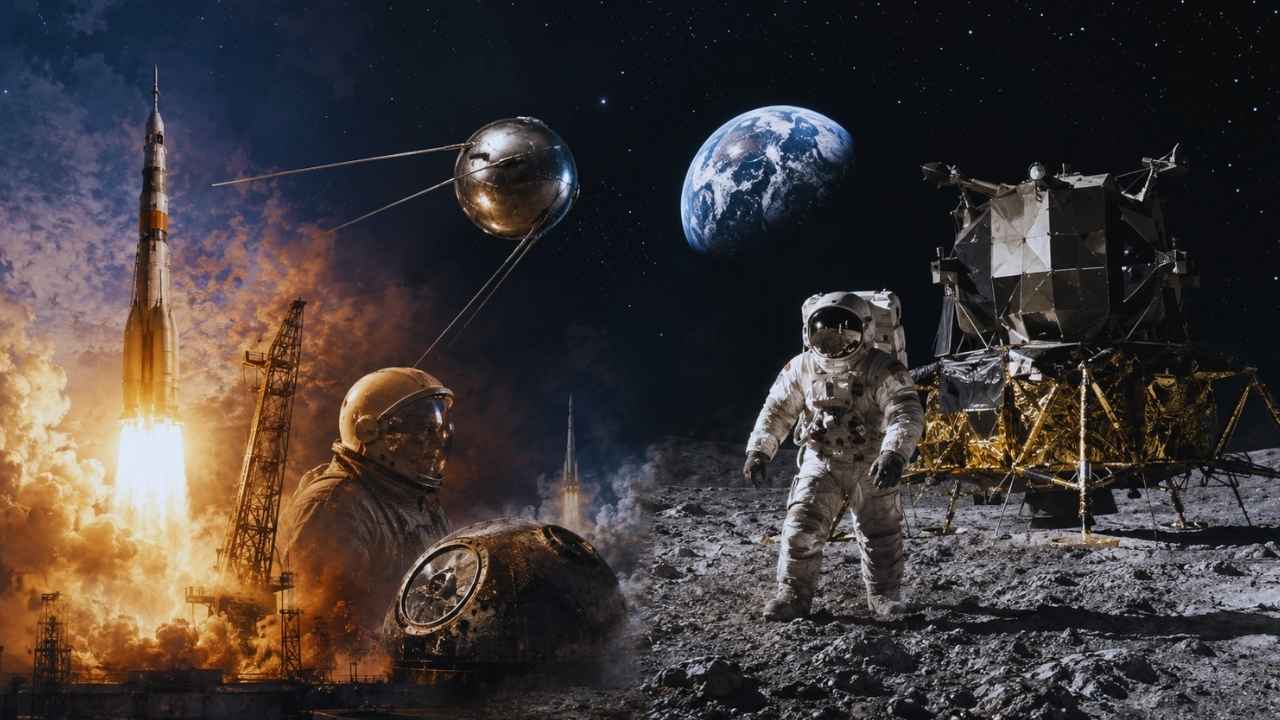
Picture this. It is October 1957. A silver sphere the size of a beach ball is quietly orbiting Earth, beaming a steady “beep, beep, beep” across global radio frequencies. That tiny metal ball was Sputnik 1. It did not just orbit our planet. It completely shattered the political reality of the day. Suddenly, the sky was not the limit anymore.
It was the newest frontline of the Cold War. If you want the space race explained, you have to start right there in that paranoid, high-stakes standoff between the United States and the Soviet Union. This was not just a friendly quest for scientific discovery. It was a massive, incredibly expensive, and deeply dangerous contest. The goal was to prove which system was superior. Capitalism or Communism. Washington or Moscow. The winner would claim the ultimate high ground.
I have always found it wild that a conflict threatening global nuclear destruction actually gave us our greatest technological leaps. The stakes could not have been higher. Let’s dig into how this cosmic sprint started, who crushed the early laps, the sheer human grit involved, and who actually crossed the finish line first.
The Spark: How the Cold War Ignited the Stars?
The seeds of space exploration sprouted in the smoldering ruins of World War II. When Nazi Germany fell, American and Soviet forces practically tripped over each other trying to capture Hitler’s top rocket scientists. They specifically wanted the blueprints for the V-2 ballistic missile. The United States snatched up Wernher von Braun, the mastermind behind the V-2, bringing his engineering team to America through the highly classified Operation Paperclip.
The Soviets grabbed their own share of German hardware and handed their rocket development over to Sergei Korolev. Korolev was a brilliant aerospace engineer who survived a brutal Stalinist gulag only to become the most important figure in the Soviet space program. The state kept his identity a strict secret until the day he died. For a whole decade, nobody cared about exploring space because the focus was purely military. Both sides desperately wanted to build rockets strong enough to carry heavy nuclear warheads across the ocean.
Washington and Moscow quickly realized that a rocket powerful enough to drop a bomb on another continent could also push a payload into orbit. By 1955, both countries announced they planned to launch artificial satellites. The space race grew directly out of the arms race.
|
Pre-Race Element |
United States |
Soviet Union |
|
Top Rocket Scientist |
Wernher von Braun |
Sergei Korolev |
|
Post-WWII Strategy |
Operation Paperclip |
Capturing hardware and localizing engineering |
|
Primary Goal (Early 50s) |
Missile defense and ICBMs |
Heavy-lift ICBMs (R-7 rocket) |
|
Public Stance |
Highly publicized announcements |
Strict, paranoid state secrecy |
A Complete Space Race Explained: The Major Milestones
Things moved from secret military bases to the public stage during the International Geophysical Year in 1957. Both nations promised to launch artificial satellites to map the Earth. Washington confidently assumed they would get there first, but Moscow stayed quiet and worked incredibly fast. When the Soviets launched Sputnik 1 in October 1957, Americans panicked. This crisis gripped the nation because if the USSR could fly a satellite over American cities, they could theoretically drop a nuclear weapon from orbit whenever they wanted.
The United States rushed its own Vanguard rocket to the launchpad just two months later. It blew up a few feet off the ground on live television. The press ruthlessly mocked it, calling it “Flopnik” and “Kaputnik.” This public humiliation forced the US government to act immediately. On January 31, 1958, America finally put Explorer 1 into orbit.
Later that year, President Dwight D. Eisenhower signed a bill creating NASA, taking scattered military rocket programs and mashing them into one civilian agency. Having the space race explained requires understanding one simple fact. Without the sheer terror that Sputnik caused, NASA might never have existed.
|
Date |
Key Event |
Historical Impact |
|
Oct 4, 1957 |
Sputnik 1 launches |
Starts the space race and triggers US panic |
|
Nov 3, 1957 |
Sputnik 2 launches |
First living creature (Laika the dog) in orbit |
|
Jan 31, 1958 |
Explorer 1 launches |
US successfully enters the orbital race |
|
Oct 1, 1958 |
NASA is established |
US consolidates civilian space efforts |
The Soviet Surge: Early Dominance
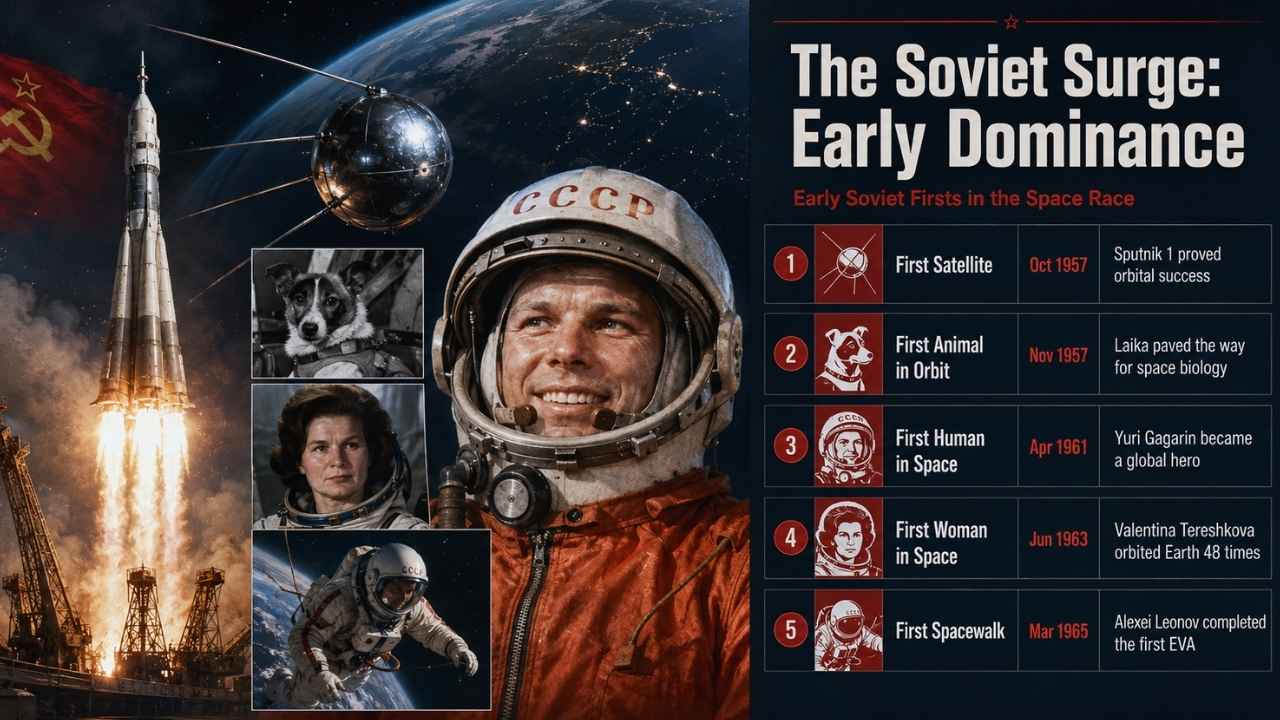
We have to call it like it is. The United States was getting crushed for the first few years. Sergei Korolev’s R-7 rocket was wildly overpowered for a simple satellite, but it gave the Soviets the raw muscle to rack up a long list of historical firsts. Just a month after Sputnik 1, the Soviets launched Sputnik 2 carrying a stray Moscow street dog named Laika. While the US occasionally sent fruit flies or primates on suborbital test flights, the Soviets preferred stray dogs.
They figured strays were tough enough to handle freezing temperatures and starvation on the streets, making them perfect for the brutal conditions of spaceflight. Then came the ultimate blow to American pride. On April 12, 1961, Soviet cosmonaut Yuri Gagarin strapped into the Vostok 1 capsule and became the first human in space.
He orbited the Earth once and came back a global hero. The Soviets did not stop there. They sent the first woman, Valentina Tereshkova, into space in 1963. In 1965, Alexey Leonov stepped out of his capsule for the very first spacewalk. Moscow was running laps around Washington.
|
Soviet Milestone |
Date |
Historical Significance |
|
First Satellite |
Oct 1957 |
Sputnik 1 proved orbital mechanics |
|
First Animal in Orbit |
Nov 1957 |
Laika paved the way for human biology in space |
|
First Human in Space |
Apr 1961 |
Yuri Gagarin cemented Soviet dominance |
|
First Woman in Space |
Jun 1963 |
Valentina Tereshkova orbited 48 times |
|
First Spacewalk |
Mar 1965 |
Alexey Leonov floated in the vacuum for 12 minutes |
NASA’s Comeback: Mercury, Gemini, and Apollo
The United States desperately needed a finish line far enough away to give them time to catch up. On May 25, 1961, President John F. Kennedy stood before Congress and committed the nation to a crazy goal. He wanted to land a man on the moon and bring him safely back before the decade ended. NASA stepped heavily on the gas. The Mercury Seven astronauts turned into national rockstars.
Alan Shepard became the first American in space just weeks after Gagarin, though only on a short suborbital hop. John Glenn eventually matched Gagarin by orbiting the Earth in 1962. Next up was the Gemini program, where NASA learned the grueling, complex reality of actual spaceflight. Astronauts learned how to dock two speeding spacecraft together, survive two weeks in zero gravity, and perform safe spacewalks. Meanwhile, the Soviet moon program secretly fell apart.
The Soviets built a massive rocket called the N1 to rival the American Saturn V. However, the N1 was overly complicated, featuring a massive cluster of 30 engines managed by an analog computer. Every single time they tried to fly it, the complex engine cluster failed and the rocket exploded. By July 1969, Apollo 11 landed in the Sea of Tranquility, and Neil Armstrong stepped onto the lunar dust.
|
NASA Program |
Core Objective |
Result |
|
Project Mercury |
Put Americans in space |
Matched early Soviet capabilities |
|
Project Gemini |
Perfect orbital docking and spacewalks |
Mastered the mechanics needed for the Moon |
|
Apollo 8 |
Orbit the moon |
First humans to leave Earth’s gravity |
|
Apollo 11 |
Lunar landing |
Armstrong and Aldrin walked on the Moon |
|
Soviet N1 Rocket |
Crewed lunar landing for the USSR |
Failed and canceled after four explosions |
The Human and Animal Toll of the Race
You rarely hear about the dark side when you get the space race explained. We love the glossy photos of smiling astronauts and cheering crowds. Pushing the boundaries of physics was violently dangerous. People and animals died to make the moon landing possible. The first casualties were animals. Laika did not survive her journey on Sputnik 2 because the cabin overheated within hours, and she died in orbit.
The US lost several chimpanzees and monkeys during aggressive early test flights before they figured out the life support systems. Then came the human tragedies. In 1967, a fire broke out during a routine launch pad test for Apollo 1. The blaze killed astronauts Gus Grissom, Ed White, and Roger Chaffee. The capsule’s pure oxygen environment turned a stray spark into an instant inferno.
It forced NASA to tear down and rebuild the Apollo command module from scratch. The Soviets faced their own nightmares. Cosmonaut Vladimir Komarov died in 1967 when his Soyuz 1 parachute failed to deploy, sending his capsule crashing into the ground. In 1971, the three-man crew of Soyuz 11 died when their capsule accidentally depressurized in the upper atmosphere.
|
Mission |
Year |
The Tragedy |
|
Sputnik 2 (Laika) |
1957 |
Dog died from extreme overheating shortly after orbit |
|
Apollo 1 |
1967 |
Grissom, White, and Chaffee died in a launch pad fire |
|
Soyuz 1 |
1967 |
Komarov died on impact due to a parachute failure |
|
Soyuz 11 |
1971 |
Three crewmen died from cabin depressurization |
Beyond the Moon: Technology Born from the Race
All that money spent reaching the moon did not just vanish into the cold vacuum of space. It trickled directly down into consumer tech, medical science, and global infrastructure. We still rely on the tools forged during this rivalry. To get to the moon, NASA needed computers that did not take up an entire room. This demand put the development of the integrated circuit on warp speed. That tech laid the direct groundwork for the modern microchip.
The smartphone in your pocket and the laptop on your desk both owe a massive debt to the Apollo guidance computer. We also got weather satellites, which completely changed farming and disaster prep. We got the early frameworks for GPS. Even everyday items like memory foam, cordless power tools, and modern water purification systems come straight from the spaceflight world.
Economically, the impact was massive. The Apollo program employed over 400,000 people and required the support of over 20,000 industrial firms and universities. The Apollo program returned 842 pounds of lunar rocks to Earth, fundamentally changing our understanding of geology.
|
Space Tech Need |
Modern Spin-off |
|
Lightweight navigation |
Microchips and modern computing |
|
Astronaut crash protection |
Memory foam mattresses and helmets |
|
Lunar surface sampling |
Cordless, battery-operated power tools |
|
Deep space tracking |
Foundations of GPS and satellite navigation |
|
Long-duration water supply |
Advanced water purification filters |
Who Really Won the Space Race?
So, who actually won? The answer totally depends on where you draw the finish line. If the goal was the moon, the United States won hands down. Apollo 11 was the crowning achievement of the era. NASA proved that American industrial power and engineering, when fully funded, was unstoppable. Landing humans on the moon required the largest commitment of resources ever made by any nation in peacetime.
At its peak in 1966, NASA’s budget consumed 4.41 percent of all federal spending. By comparison, modern NASA annual spending typically represents 0.5 percent or less of the federal budget. But here is the catch. Once the US won the moon sprint, public interest and government funding fell off a cliff. The Soviets realized they had definitively lost the moon, so they pivoted hard.
They focused entirely on long-duration spaceflight. In April 1971, they launched Salyut 1, the world’s first space station. They later built the Mir space station and figured out how to keep humans alive and working in space for months at a time. In a way, the US won the sprint, but the USSR won the marathon.
|
Metric |
United States |
Soviet Union |
Modern View |
|
Firsts in Space |
Caught up late |
Dominated the 1950s and 1960s |
Not Applicable |
|
Moon Landing |
Achieved in 1969 |
Failed when N1 rocket collapsed |
Privatized moon missions |
|
Post-Apollo Focus |
Space Shuttle program |
Space Stations (Salyut, Mir) |
Commercialization |
|
Ultimate Legacy |
Won the ultimate sprint |
Built the foundation for ISS |
Private corporations lead |
From Rivalry to Cooperation: The End of the Race
That fierce, wallet-draining competition simply could not last forever. As the Cold War thawed in the 1970s, both nations realized something important. Working together in the brutal, unforgiving environment of space made way more sense than fighting over it. Most historians mark the official end of the space race as July 1975, with the Apollo-Soyuz Test Project.
An American Apollo module and a Soviet Soyuz capsule launched separately, met up in orbit, and docked together. The commanders, Tom Stafford and Alexey Leonov, opened the hatch and shook hands. It was an incredible, highly televised symbol of peace. That single handshake set the stage for future teamwork.
It led directly to the Shuttle-Mir program in the 1990s and, eventually, the International Space Station. Built by the US, Russia, Europe, Japan, and Canada, the ISS has kept a continuous human presence in orbit since the year 2000. It proves that science can bridge even the deepest political divides.
|
Milestone |
Date |
Significance |
|
Outer Space Treaty |
1967 |
Banned nuclear weapons in orbit |
|
Apollo-Soyuz |
1975 |
First joint US-Soviet space mission |
|
Shuttle-Mir |
1990s |
US Space Shuttles docked with Russian station |
|
ISS Launch |
1998 to Present |
Ultimate symbol of global space cooperation |
Final Thoughts
When you get the space race explained from start to finish, you realize it was one of the most uniquely productive conflicts in human history. The terrifying tension of the Cold War acted like a high-stakes pressure cooker. It forced us to figure out physics, engineering, and computing faster than anyone thought possible. Without the sheer fear of Soviet dominance, we likely would not have reached the moon for decades. The United States absolutely claimed the grand prize by leaving boot prints in the lunar dust.
But the Soviet Union’s relentless pioneering laid the tracks for humans to actually live and work in orbit. In the end, neither superpower got to keep space entirely for themselves. The real winner was the future. Generations now rely on the technology, the satellites, and the daring legacy left behind by the people who strapped themselves to rockets and aimed for the dark.
Frequently Asked Questions (FAQs) About Space Race Explained
Why do astronauts pee on a tire before launch?
It’s bizarre, but it’s a very real tradition. On April 12, 1961, right before his historic flight, Yuri Gagarin asked his bus driver to pull over so he could pee. He stepped off and relieved himself on the right rear tire of the bus. To this day, Russian cosmonauts (and many international astronauts launching from Baikonur) do the exact same thing for good luck. Female astronauts even bring small vials of urine to splash on the tire.
Did anyone ever play sports in space?
Yes. On February 2, 1971, Apollo 14 astronaut Alan Shepard became the first (and only) person to play golf on the Moon. He smuggled a makeshift 6-iron club head onboard inside his sock, attached it to a lunar digging tool, and smacked two golf balls in the moon’s low gravity. He claimed they flew for “miles and miles.”
Is there a solar-powered satellite still up there from the space race?
Yes. The US Navy launched Vanguard 1 back in March 1958. It was the first solar-powered satellite ever. Its batteries died in 1964, so it doesn’t talk to Earth anymore, but it remains the absolute oldest human-made object still in orbit today.
Did an Apollo rocket actually get struck by lightning?
Yes, Apollo 12. In November 1969, the massive Saturn V rocket launched into a rainstorm and got struck by lightning twice within the first minute of flight. The command module’s screens filled with garbled nonsense. A 24-year-old flight controller named John Aaron recognized the obscure data pattern and told the crew to flip a specific switch (“SCE to Aux”). Astronaut Alan Bean remembered where the switch was, flipped it, and restored the ship’s telemetry, saving the mission.