

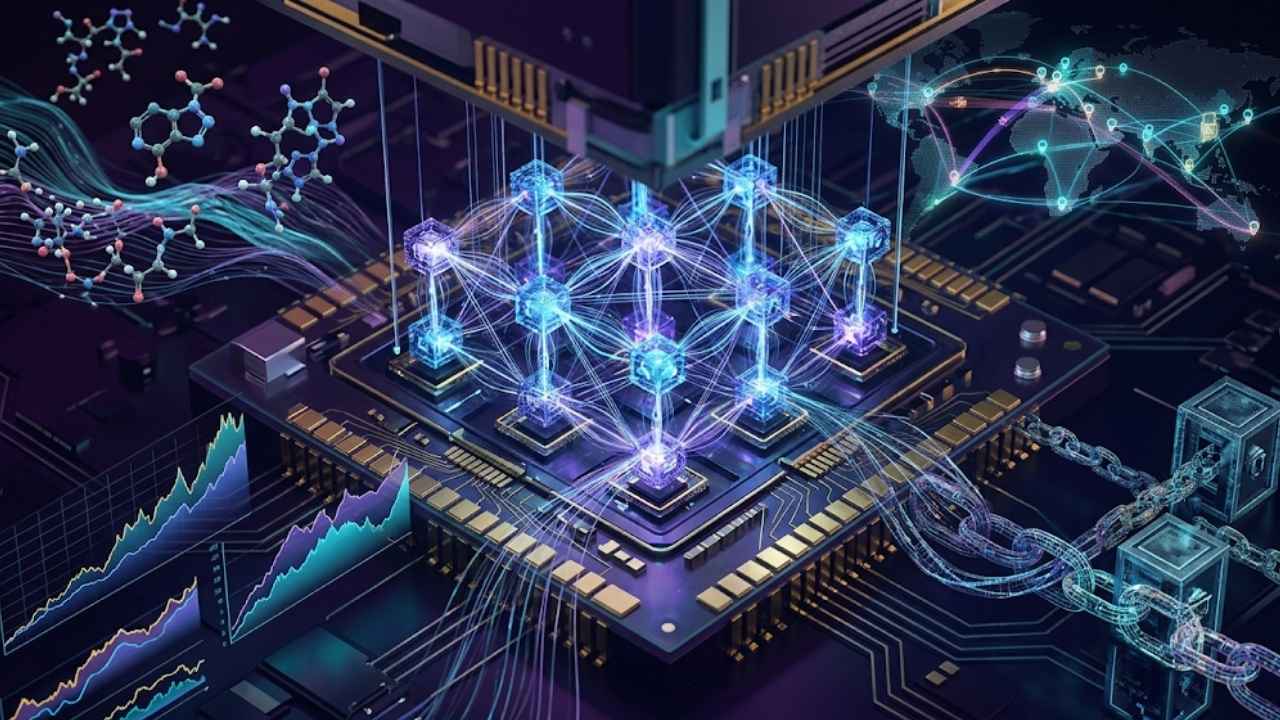
Every time you grab your phone, send a text, or boot up a game, you rely on tech that hasn’t really changed its core logic in fifty years. Sure, our laptops are lighter and faster. But deep down, they process data exactly like they did during the Apollo moon landings: one single piece of data at a time, locked as a 0 or a 1.
We’ve hit a wall. Classical computers just can’t handle complex chemistry, global logistics, or nature itself. They choke because the universe isn’t made of binary code.
Enter the rule-breaker. If you follow tech, you’ve probably asked yourself: what is quantum computing, anyway? It sounds like a sci-fi movie plot. But as we sit here in 2026, it’s purely commercial engineering. Instead of rigid binary code, these machines use the weird, mind-bending laws of subatomic physics to process millions of possibilities at once.
Let’s cut the heavy physics jargon. I want to show you exactly how this tech works, the massive multi-billion dollar market shifts happening right this minute, and why it’s finally ready to change our world.
Let’s Break Down What Is Quantum Computing
Forget everything you know about normal computers. A quantum machine doesn’t just do things faster; it attacks problems from a completely different angle. Your laptop uses bits (a 0 or a 1). A quantum computer uses qubits. Thanks to the strange rules of quantum mechanics, a qubit can be a 0, a 1, or both at the same time. We call this superposition.
Think of a giant maze. A regular computer tries every single path, one by one, until it hits the exit. A quantum computer floods the maze with water. It explores every path at the exact same time to find the exit instantly.
|
Quantum Concept |
The Plain English Translation |
Why It Actually Matters |
|
Qubit |
The basic building block of quantum data. |
Holds vastly more information than a standard digital bit. |
|
Superposition |
Being in multiple states at once. |
Lets the computer test millions of solutions simultaneously. |
|
Entanglement |
Two qubits become permanently linked. |
Exponentially boosts processing power as you add more qubits. |
|
Interference |
Canceling out the wrong answers. |
Steers the chaotic probabilities toward the correct final math. |
The Hardware Race: How They Actually Work
Don’t expect to build one of these in your garage anytime soon. Qubits are incredibly fragile. A slight change in temperature or a stray magnetic field ruins their quantum state. We call this “decoherence,” and it’s a massive headache.
For years, these processors made too many errors to be useful. But the hardware landscape just flipped. Tech giants finally proved that adding more qubits reduces errors. We officially entered the era of fault-tolerant quantum tech, and the 2026 breakthroughs are staggering.
The Major Milestones You Need to Know (2024-2026)
If you want to know why everyone is talking about this now, look at the verifiable data hitting the press lately:
- Google’s Willow Chip (December 2024): Google unveiled a 105-qubit processor called Willow. It proved “below-threshold” error correction—meaning the bigger they build it, the fewer errors it makes. It completed a benchmark math test in 5 minutes that would take the world’s fastest supercomputer 10 septillion years.
- Microsoft’s Majorana 2 (June 2026): Microsoft completely pivoted the industry by releasing Majorana 2. By swapping aluminum for lead, they created noise-resistant “topological” qubits that are 1,000x more reliable, pushing their timeline for a fully scalable quantum computer up to 2029.
- IBM’s $10 Billion Bet (June 2026): Just this month, IBM dropped a massive $10 billion commitment over the next five years. They announced plans to build “Anderon,” the world’s first pure-play quantum wafer foundry, and outlined their roadmap for the “Starling” processor—a fault-tolerant system slated for 2029.
|
Hardware Type |
Leading Players |
How They Build It |
Current 2026 Status |
|
Superconducting |
Google, IBM |
Freezes electrical circuits to near absolute zero. |
The most proven path today; massive error-reduction milestones hit. |
|
Topological |
Microsoft |
Uses exotic, braided particles that naturally block out noise. |
Majorana 2 just proved a 1,000x reliability jump using lead. |
|
Neutral Atom |
Atom Computing |
Traps individual atoms using highly focused lasers. |
Scaling fast with dense 3D layouts that require less freezing. |
|
NMR |
SpinQ |
Uses the spin states of atomic nuclei. |
Works at room temperature and costs under $100k for lab use. |
The 2026 Market Explosion: Show Me The Numbers
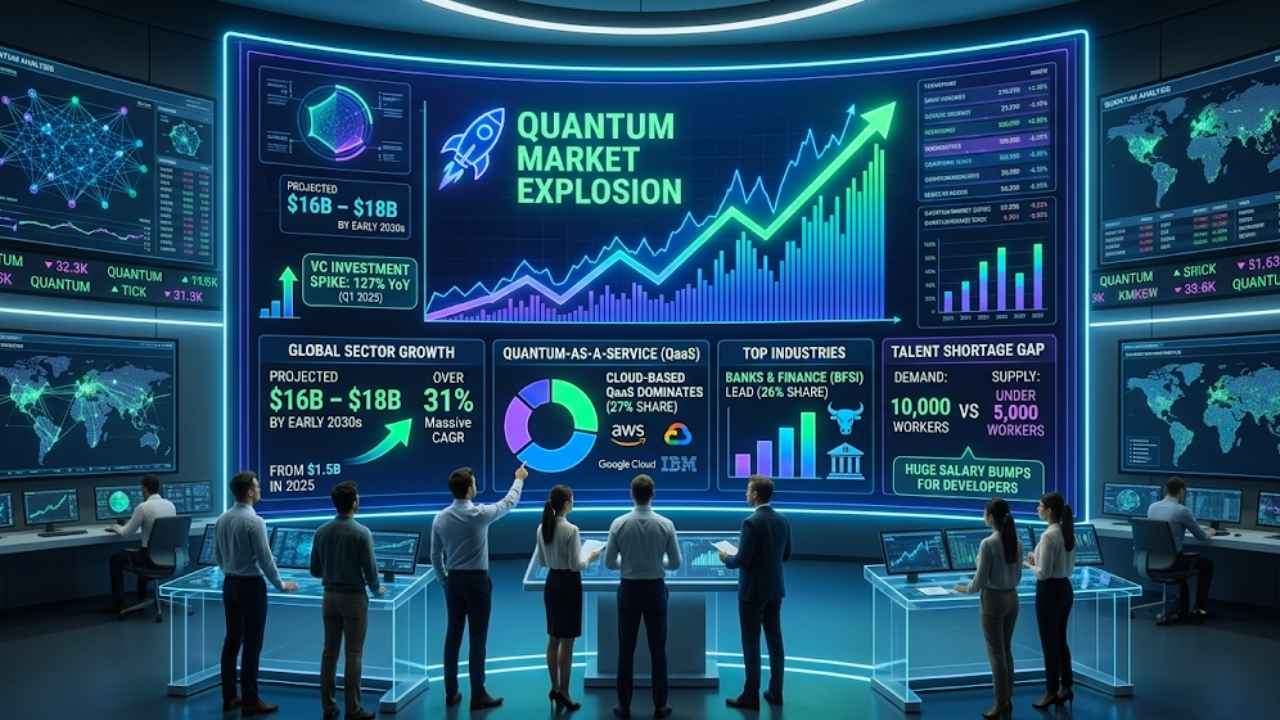
We aren’t waiting for this tech to become a reality anymore. It’s here, and the money flowing into it is wild.
Looking at the latest 2026 market intelligence reports, the global quantum sector sat around $1.5 billion in 2025. Now? It’s on a rocket ship projected to smash past $18 billion by the early 2030s, boasting a massive compound annual growth rate (CAGR) of over 31%. In just the first quarter of 2025, venture capital investment spiked by 127% year-over-year.
Why the sudden rush? Because companies stopped trying to buy the hardware. Now, they just rent it. We call it Quantum-as-a-Service (QaaS). You can literally log into AWS, Google Cloud, or IBM and run your own code on a real quantum processor right now.
|
The Market Trend |
The Real Data |
What It Means for the Industry |
|
Market Growth |
Hitting $16B–$18B by the early 2030s. |
Massive cash influx is moving tech from lab experiments to actual businesses. |
|
How We Buy It |
Cloud-based QaaS dominates (27% share). |
You don’t need a million-dollar budget to test quantum apps. |
|
Who Uses It |
Banks and Finance (BFSI) lead (26% share). |
Wall Street is obsessed with quantum speed for trading and risk. |
|
The Job Gap |
Demand for 10,000 workers; supply under 5,000. |
Huge salary bumps for developers willing to learn quantum code. |
Real-World Action: Who Uses This Tech Today?
So, what does this actually do for you? These machines solve problems that impact human health, our power grids, and your wallet. They excel at finding the best possible answer in an impossibly large pile of data. And they do it by teaming up with normal computers—a concept IBM cemented recently when they wired their quantum chips directly into Japan’s Fugaku supercomputer.
1. Fixing Healthcare and Pharma
Simulating a simple caffeine molecule perfectly requires more digital memory than there are atoms in the universe. Quantum computers naturally mimic chemistry. Pharma companies are using them today to untangle DNA and simulate protein folding. We are talking about cutting drug development times from a decade down to a few short years.
2. Wall Street and Banking
Finance loves this tech. The stock market is a chaotic mess of millions of variables. Banks currently hold the largest market share for quantum adoption. They use these algorithms to optimize massive portfolios, execute high-frequency trades, and spot fraud instantly by analyzing weird behavioral patterns.
3. Global Supply Chains
Imagine routing 10,000 delivery trucks through global traffic, weather, and fuel prices. Normal computers just guess the best route based on history. Quantum systems instantly calculate the exact perfect path, saving logistics companies millions in fuel and dropping carbon footprints significantly.
|
The Industry |
How They Use It Today |
The Payoff |
|
Pharma |
Simulating biology and proteins. |
Faster, cheaper life-saving drugs. |
|
Finance (BFSI) |
Risk modeling and algorithmic trading. |
Deep market stability and instant fraud blocks. |
|
Energy |
Balancing smart grids and battery chemistry. |
Next-gen batteries that hold vastly more power. |
|
Logistics |
Fleet routing and scheduling. |
Massive drops in carbon emissions and fuel costs. |
The Cybersecurity Threat: Preparing for “Q-Day”
Let’s talk about the scary stuff.
The encryption protecting your bank account, government secrets, and private texts relies on math problems that would take a normal computer thousands of years to crack. A mature quantum computer cuts through them in minutes.
The industry calls this “Q-Day.” But hackers aren’t waiting for the machines to get cheaper. They are stealing encrypted data right now, hoarding it until they get their hands on a quantum rig. It’s an aggressive strategy called “Harvest Now, Decrypt Later.”
|
The Security Shift |
What’s Going On |
The 2026 Reality |
|
Harvest Now, Decrypt Later |
Hackers steal files today to break them tomorrow. |
Forcing companies into immediate security audits. |
|
Q-Day |
The day quantum breaks standard RSA encryption. |
Getting closer fast thanks to massive hardware error reductions. |
|
Post-Quantum Cryptography |
New math algorithms that stop quantum hacks. |
The global corporate migration to these new defenses is happening right now. |
That’s why banks and governments are scrambling to upgrade to Post-Quantum Cryptography (PQC). The fix is happening today, not ten years from now.
The Roadblocks Left to Clear
I won’t lie to you—we aren’t totally at the finish line yet. You still can’t buy a quantum chip at Best Buy. The engineering hurdles are brutal. Qubit instability is still enemy number one. Keeping these systems running requires extreme freezing and millions of dollars in infrastructure.
But honestly? The biggest roadblock right now is human capital. We have a severe talent shortage. Current stats show the industry needs around 10,000 quantum-skilled workers, but there are fewer than 5,000 available. We desperately need more software engineers who know how to step away from classic logic and write quantum code.
|
The Roadblock |
The Brutal Reality |
How We Fix It |
|
Error Rates |
Qubits hate noise and vibration. |
Shifting to stable materials like lead and better software mitigation. |
|
Crazy Costs |
Super-cooling fridges cost a fortune. |
Scaling up cloud access so users don’t pay for hardware. |
|
No Talent |
Severe lack of quantum physicists. |
Universities launching dedicated degrees and low-code training platforms. |
Final Thought
We are living through the computing equivalent of the Wright Brothers taking flight. The early hardware was loud and clunky, but the verifiable benchmarks hitting the press in 2026 prove one thing: it scales, and it works.
If you want to nail down what is quantum computing, just remember this: we are finally using the actual rules of the universe to process information. We’re moving past trial-and-error and entering an age of deep simulation. The quantum era isn’t coming. It’s already here.
Frequently Asked Questions (FAQs) About What is Quantum Computing
How much does one of these cost?
Top-tier research rigs cost tens of millions to build and maintain. But smaller, room-temperature NMR machines built for universities and local labs are hitting the market right now for under $100,000.
Why do they freeze them?
Heat equals atomic vibration. If the area around a superconducting qubit vibrates, it shakes the data right out of its quantum state. Freezing the chip to -273°C stops the shaking completely.