
If you want to understand the modern economic world, you have to start by looking at the devastating events that unfolded just over a decade ago. The 2008 financial crisis was the most severe global economic disaster since the Great Depression of the 1930s. It started quietly in the United States housing market but rapidly infected the entire global financial ecosystem like a terrible virus.
Trillions of dollars in wealth simply vanished into thin air, leaving regular people to deal with the terrifying reality of losing their homes, their jobs, and their retirement savings. Massive financial institutions that had stood strong for over a century completely collapsed under the weight of their own terrible decisions. The crisis fundamentally changed how we view banks, debt, and the safety of our money, and the scars it left on the global economy are still visible today.
|
Crisis Metric |
Description |
|
Start Point |
United States housing market collapse |
|
Global Impact |
Triggered the worst worldwide recession in eighty years |
|
Wealth Lost |
Over ten trillion dollars globally |
|
Main Consequence |
Millions of foreclosures and massive job losses |
The Seeds of the Crisis: A Perfect Storm
The Dot-Com Bubble and Low Interest Rates
To truly understand how the 2008 financial crisis happened, we must travel back to the early years of the new millennium. The global economy was shaking from the sudden collapse of internet technology stocks, and investors were losing confidence rapidly. To prevent a deep economic downturn, the central banking system in the United States decided to drastically reduce the cost of borrowing money.
They slashed interest rates down to a mere one percent, making it incredibly cheap for anyone to secure a loan. While this move successfully kept businesses afloat, it had an unintended and massive side effect on the real estate market. Regular consumers suddenly realized they could borrow huge sums of money for a mortgage with very little monthly interest. This flood of cheap cash encouraged millions of people to stop renting and start buying, creating an artificial surge in housing demand that set the stage for the disaster to come.
|
Economic Factor |
Impact on the Market |
|
Stock Market Crash |
Investors pulled money out of stocks and looked for safer investments |
|
Federal Reserve Action |
Cut interest rates to historic lows to stimulate the economy |
|
Borrowing Costs |
Mortgages became incredibly cheap and accessible for the average person |
|
Market Shift |
Capital flooded into real estate, artificially driving up demand |
The American Dream and the Housing Boom
Homeownership has always been considered the ultimate symbol of success and stability. During this time, the government heavily pushed policies designed to help everyone buy a house, regardless of their financial background. Because borrowing was so cheap, a massive wave of eager buyers rushed into the real estate market all at once. When millions of people want to buy houses simultaneously, the prices of those houses skyrocket.
Soon, everyday people started looking at real estate not just as a place to live, but as a guaranteed way to get rich quick. Flipping houses became a national pastime, with people buying multiple properties just to sell them a few months later for a huge profit. The general public developed a dangerous, unbreakable belief that housing prices would always go up and never come down, creating a classic economic bubble built purely on blind optimism.
|
Cultural Shift |
Economic Result |
|
Government Push |
Relaxed policies encouraged widespread homeownership |
|
Surging Demand |
Intense competition for houses drove prices to unnatural highs |
|
Speculation Fever |
Ordinary people bought multiple homes solely to flip them for profit |
|
Flawed Belief System |
Society collectively ignored the possibility that home values could ever drop |
The Mechanics of the Meltdown
What Are Subprime Mortgages?
As the housing boom charged forward, banks eventually ran out of traditional borrowers who had good credit scores and steady incomes. However, the banks were making too much money to let the lending party stop. To keep the money flowing, they started offering home loans to people with terrible credit histories, massive existing debt, and unstable jobs. These highly risky loans became known as subprime mortgages.
To trick these vulnerable borrowers into signing the paperwork, lenders offered adjustable-rate mortgages with tiny introductory payments. They knew the borrowers could afford the first year, but they also knew the monthly payments would eventually triple to a level the borrower could never afford. The lenders simply did not care about the long-term risk because they assumed the borrower could just sell the house for a massive profit before the higher payments ever kicked in.
|
Loan Characteristic |
Explanation |
|
Target Borrower |
Individuals with poor credit history or low income |
|
Adjustable Rates |
Low initial payments that aggressively increased after a few years |
|
NINJA Loans |
Mortgages granted with no income, no job, and no assets verified |
|
Lender Mindset |
Approved anyone under the assumption that rising house prices erased all risk |
The Role of Mortgage-Backed Securities (MBS)
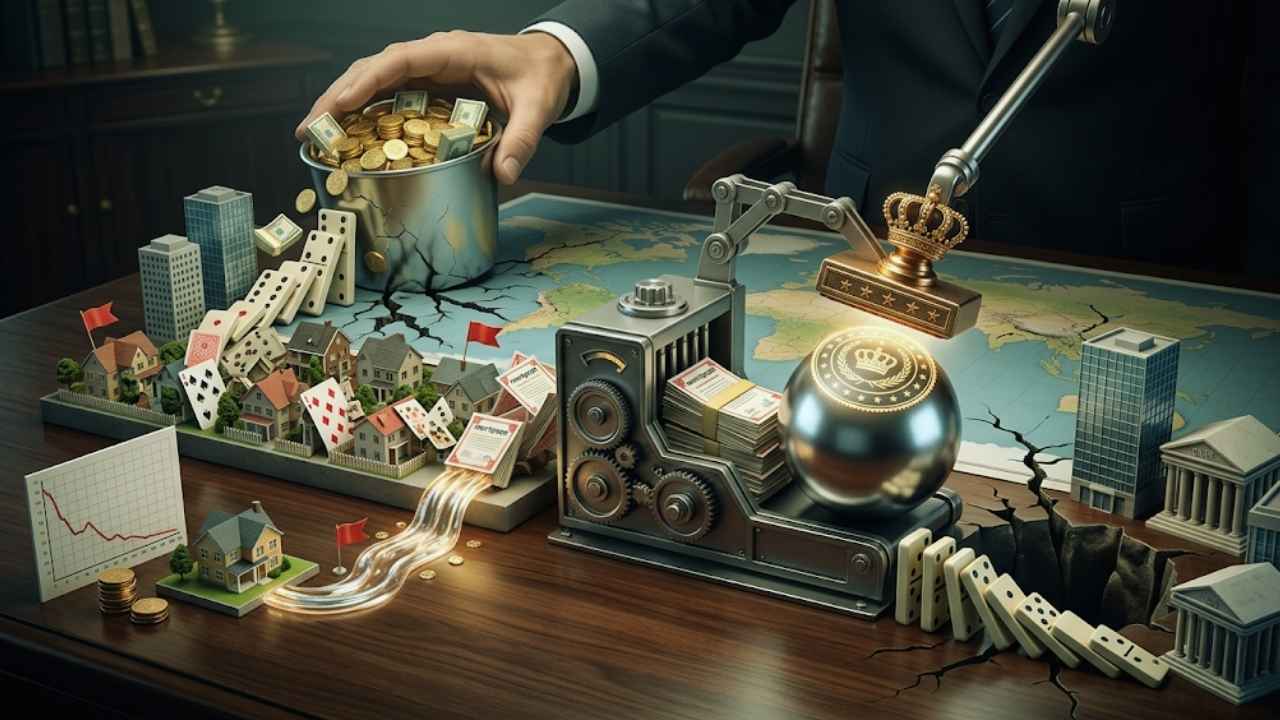
In the past, a local bank would give you a home loan and patiently collect your monthly payments for thirty years. Wall Street completely destroyed this traditional banking model by inventing something called a mortgage-backed security. Instead of waiting thirty years, lenders would take thousands of individual mortgages, bundle them all together into one giant package, and sell that package to Wall Street investment banks.
Wall Street would then sell pieces of that package to global investors, like pension funds and insurance companies. This meant the original lender got their money back instantly and could go out and trap another thousand borrowers. It completely removed the consequence of making a bad loan. If a borrower stopped paying their mortgage, it was no longer the local lender’s problem; it was the problem of a random investor halfway across the world.
|
Concept |
How It Changed the System |
|
Traditional Lending |
Banks held onto loans and cared if the borrower could actually repay them |
|
Securitization |
Bundling thousands of home loans together into a single financial product |
|
Risk Transfer |
Local lenders passed all the risk to global investors and walked away with profit |
|
Volume Over Quality |
Lenders prioritized closing as many loans as possible regardless of borrower quality |
Collateralized Debt Obligations (CDOs) and the Shadow Banking System
Wall Street always wants to squeeze more profit out of a system, so they took securitization a step further by creating collateralized debt obligations. Think of this as taking all the leftover, high-risk mortgages that nobody wanted and throwing them into a giant financial blender. The bankers would mix these toxic loans together and divide them into different layers of risk.
By using incredibly complex mathematics, they somehow convinced the financial world that combining thousands of terrible loans magically created one highly secure investment. These confusing products were bought and sold in a secretive, unregulated market known as the shadow banking system. This system operated completely outside the traditional rules that governed regular banks, allowing trillions of dollars in risky bets to pile up in the dark without any government oversight or public awareness.
|
Financial Tool |
Function in the Crisis |
|
CDO Structure |
A complex mix of low-quality debt repackaged to look like a safe investment |
|
Tranches |
Slicing the bundled debt into different layers of supposed risk and reward |
|
Financial Alchemy |
Using complicated math to disguise terrible subprime loans as premium assets |
|
Shadow Banking |
A vast, unregulated financial network operating completely outside government control |
The Key Players and Enablers
Predatory Lenders and Lowered Standards
The disaster at the ground level was driven by mortgage brokers who acted more like ruthless salespeople than financial advisors. These brokers were paid entirely on commission, meaning they only earned a paycheck when a borrower signed on the dotted line. This created a terrible incentive structure where brokers actively pushed borrowers into the most expensive, complicated subprime loans possible because those loans paid the highest commissions.
Basic underwriting standards were completely abandoned. Mortgage companies stopped asking for proof of income, ignored glaring red flags on credit reports, and even encouraged borrowers to lie on their official applications. It was an industrial-scale manufacturing line of toxic debt, and the lenders justified their predatory behavior simply because Wall Street was begging them to produce more loans.
|
Ground-Level Actor |
Their Destructive Behavior |
|
Mortgage Brokers |
Prioritized high commissions over the financial well-being of the borrower |
|
Predatory Tactics |
Steered qualified buyers into expensive, high-risk subprime products |
|
Abandoned Standards |
Completely stopped verifying basic borrower information like income and employment |
|
Fraudulent Practices |
Actively encouraged consumers to lie on official government loan documents |
The Credit Rating Agencies’ Blind Eye
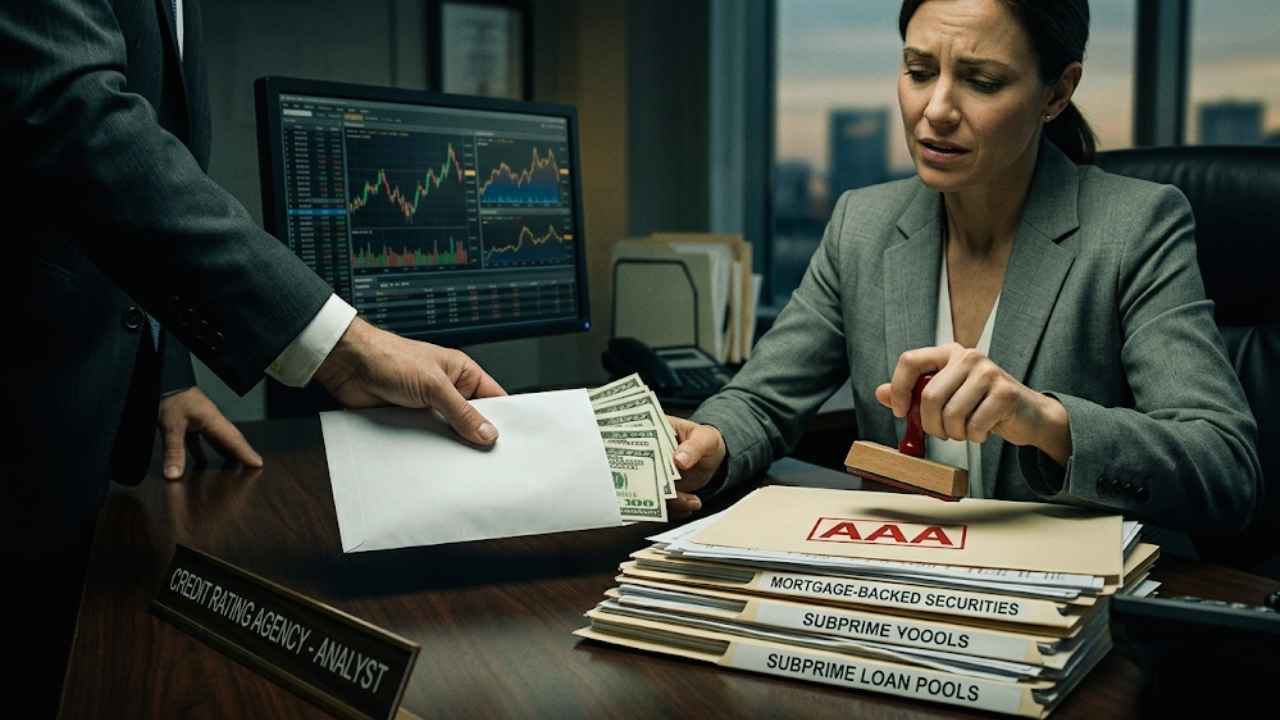
You might wonder why conservative investors like retirement funds were buying these dangerous Wall Street products. The blame for this falls squarely on the credit rating agencies, whose sole job was to evaluate the safety of financial investments. They were supposed to act as independent judges, but they had a massive conflict of interest because they were being paid directly by the Wall Street banks whose products they were rating.
If a rating agency told a bank that their new mortgage product was risky, the bank would simply take their millions of dollars in fees to a competing agency. Fearing a loss of revenue, the agencies happily slapped their highest safety ratings on thousands of toxic financial products. Global investors trusted these ratings completely, unknowingly pouring trillions of dollars into investments that were practically guaranteed to fail.
|
Rating Agency Role |
How They Failed the System |
|
Intended Purpose |
To provide honest, independent evaluations of financial risk |
|
Conflict of Interest |
Agencies were paid directly by the banks creating the toxic products |
|
False Security |
Stamped the highest possible safety grades on packages filled with garbage loans |
|
Investor Deception |
Tricked the global market into buying worthless assets by hiding the true risk |
Wall Street Greed and Excessive Leverage
While the mortgage brokers and rating agencies were busy making bad decisions, the giant investment banks on Wall Street were pouring gasoline on the fire. They were making billions of dollars packaging and selling these mortgage products, but they also decided to keep massive amounts of these toxic assets for themselves. To maximize their profits, these banks used an extreme amount of leverage, which simply means they used borrowed money to make their bets.
Some of the most famous banks in the world were borrowing thirty dollars for every single dollar they actually owned. This reckless gambling meant that if the housing market dropped by even a tiny fraction, the banks would instantly lose all of their own money and face total bankruptcy. They prioritized massive year-end bonuses over the long-term survival of their own companies.
|
Wall Street Action |
Impact on the Economy |
|
Extreme Leverage |
Gambling with massive amounts of borrowed money to multiply potential profits |
|
Zero Margin for Error |
Operating with so little actual cash that a tiny market dip meant total ruin |
|
Short-Term Greed |
Executives chased massive annual bonuses while ignoring long-term catastrophic risks |
|
Hoarding Toxic Assets |
Banks kept billions in worthless subprime products on their own balance sheets |
The Domino Effect: How the System Collapsed
The Housing Bubble Bursts
Eventually, the laws of economics caught up with the American real estate market. Around the year 2006, the central bank had to start raising interest rates to keep the broader economy stable. As borrowing became more expensive, the housing market began to cool down. Suddenly, millions of homeowners with adjustable-rate mortgages saw their monthly payments double or triple.
Because the housing market had stalled, these families could no longer sell their homes for a profit or refinance their loans to escape the crushing payments. Millions of everyday people simply ran out of cash and stopped paying their mortgages. The market was flooded with empty, foreclosed homes, causing housing prices to plummet nationwide. Borrowers realized they owed more money to the bank than their house was actually worth, prompting even more people to walk away in a devastating downward spiral.
|
Collapse Trigger |
Resulting Consequence |
|
Rising Interest Rates |
Made borrowing expensive and triggered massive monthly payment increases for homeowners |
|
Trapped Borrowers |
Families could not afford their new payments and could not sell their depreciating homes |
|
Mass Foreclosures |
Millions of people walked away, flooding the market with empty, unsellable houses |
|
Plummeting Values |
The sheer volume of foreclosures drove national property prices straight into the ground |
The Fall of Bear Stearns
As the foreclosures piled up, those complex mortgage products that Wall Street had sold to the world began to rapidly lose their value. The investors who bought them started bleeding money, and total panic began to grip the financial sector. Banks looked around and realized their vaults were filled with toxic assets that nobody wanted to buy. In the spring of 2008, the panic claimed its first major victim when Bear Stearns, a massive global investment bank, essentially ran out of cash.
Other financial institutions lost all trust in Bear Stearns and demanded their money back immediately, creating a classic run on the bank. Fearing that the collapse of such a large institution would destroy the entire system, the government orchestrated a frantic weekend rescue, forcing another bank to buy Bear Stearns for pennies on the dollar just to stop the bleeding.
|
Escalation Point |
Description of the Event |
|
Toxic Asset Reveal |
Banks realized their mortgage-backed investments were fundamentally worthless |
|
Market Panic |
Investors and institutions desperately tried to sell assets, but there were no buyers |
|
Bank Run |
Lenders completely cut off funding to Bear Stearns, draining its cash reserves overnight |
|
Forced Rescue |
The government arranged an emergency buyout to prevent a wider financial catastrophe |
The Lehman Brothers Climax
The rescue of Bear Stearns only provided a temporary illusion of safety. The true climax of the 2008 financial crisis arrived in September, focusing on an enormous investment bank called Lehman Brothers. Lehman was holding billions of dollars in terrible real estate investments and was drowning in debt. The government and powerful bankers spent a terrifying weekend locked in emergency meetings trying to find a buyer to save the company.
However, the government controversially decided they could not keep using taxpayer money to save reckless bankers, and they refused to provide a safety net. On a Monday morning, Lehman Brothers officially filed for bankruptcy, completely shocking the global markets. It was the largest bankruptcy in history, and it sent a terrifying message to the world that absolutely no bank was safe from total destruction.
|
Historical Moment |
The Shock to the System |
|
Massive Exposure |
Lehman Brothers held an astronomical amount of terrible real estate debt |
|
Failed Rescue |
Emergency weekend negotiations failed to find a willing buyer to save the institution |
|
Government Refusal |
Officials controversially decided to let a major bank fail to teach Wall Street a lesson |
|
Global Shockwave |
The bankruptcy shattered all remaining trust and completely froze global financial markets |
AIG and the Liquidity Freeze
The destruction of Lehman Brothers pushed the world to the absolute brink. Just two days later, an even bigger problem emerged with an insurance giant named AIG. This massive company had spent years selling insurance policies on all of those toxic Wall Street mortgage products. When the housing market collapsed, the people holding those policies demanded that AIG pay out the money. AIG owed billions of dollars that it simply did not have in its accounts.
Because AIG insured almost every major bank on earth, its failure would have caused a chain reaction that wiped out the entire global economy. Terrified, the government immediately handed AIG tens of billions of dollars to keep it alive. Despite this rescue, banks were completely paralyzed by fear. They stopped lending money entirely, meaning regular businesses could not get cash to pay their employees, bringing daily economic life to a grinding halt.
|
Critical Failure |
The Economic Paralysis |
|
Insurance Payouts |
AIG was suddenly forced to pay out billions to cover the failing mortgage products |
|
Systemic Threat |
If AIG collapsed, it would take down nearly every major financial institution with it |
|
Total Credit Freeze |
Paralyzed by fear, banks absolutely refused to lend money to anyone, including each other |
|
Main Street Impact |
Normal businesses could not access basic short-term loans needed to survive daily operations |
The Government’s Response to the Crisis
The Troubled Asset Relief Program (TARP)
With the global financial system essentially having a heart attack, the government had to take extreme and unprecedented action to get the blood flowing again. They quickly pushed a massive piece of legislation through the political system to create the Troubled Asset Relief Program. This program gave the government permission to use hundreds of billions of dollars of taxpayer money to stabilize the economy.
The original plan was to buy the toxic garbage loans directly from the banks so the banks could start with a clean slate. However, the situation was so dire that the government changed its mind and simply injected massive amounts of raw cash directly into the biggest banks in the country. By forcefully giving the banks money in exchange for company shares, the government essentially provided a giant shield that prevented the entire banking sector from going completely bankrupt.
|
Government Action |
How the Program Worked |
|
Legislative Emergency |
Congress quickly passed a massive funding bill to prevent a total economic depression |
|
Massive Funding |
Hundreds of billions of taxpayer dollars were authorized to stabilize the financial sector |
|
Direct Cash Injection |
The government forced raw capital into the banks to ensure their daily survival |
|
System Stabilization |
The program successfully stopped the panic, but generated intense anger from the public |
Bailouts and the “Too Big to Fail” Dilemma
The decision to save the banks was incredibly successful at stopping the panic, but it created an unbelievable amount of anger among everyday citizens. Regular people who had done nothing wrong were losing their homes and their jobs, while the incredibly wealthy bankers who caused the crisis were being handed billions of dollars in taxpayer money. To make matters worse, many of these executives continued to pay themselves massive bonuses right after receiving the rescue funds.
The government defended their actions by explaining that these giant banks were deeply connected to every part of the economy, making them literally too big to fail. They argued that letting these banks die would have destroyed the life savings of everyday people. However, this created a dangerous future standard, teaching Wall Street that they can take insane risks because the government will always save them.
|
Social Consequence |
The Moral Problem |
|
Public Outrage |
Citizens were furious that tax money was used to save the wealthy architects of the disaster |
|
Executive Bonuses |
Bailed-out banks infuriated the public by continuing to hand out massive executive rewards |
|
Systemic Importance |
The government argued that the banks were too entangled in daily life to be allowed to die |
|
Moral Hazard |
Wall Street learned that they could keep all their profits, but pass all their losses to taxpayers |
Global Central Bank Interventions
The sickness of the 2008 financial crisis was not contained within American borders. Because Wall Street had sold their toxic mortgage products to investors all over the planet, the panic quickly spread across Europe and Asia. Central banks around the world realized they had to act together to stop a global depression. They aggressively cut their interest rates down to zero, and in some European countries, the rates even went below zero.
When making money free to borrow still was not enough to fix the problem, central banks began printing trillions of dollars out of thin air. They used this newly created money to buy government bonds in a radical experiment designed to force cash into the economy. This massive wave of global liquidity helped thaw the frozen financial markets, but it also kept the world economy artificially supported by government money for the next decade.
|
Global Action |
The International Response |
|
Worldwide Infection |
The toxic American loans poisoned banking systems across Europe and Asia |
|
Zero Interest Rates |
Global central banks eliminated borrowing costs entirely to force spending |
|
Money Creation |
Trillions of dollars were printed out of thin air to artificially support the markets |
|
Long-Term Dependency |
The global economy became deeply reliant on constant central bank intervention to survive |
The Aftermath: Impact on the Economy and People
The Great Recession
The terrifying financial panic of 2008 eventually calmed down, but it left behind a shattered landscape that triggered the Great Recession. This was a brutal, grinding economic downturn that dragged on for years and caused deep suffering across the globe. Because credit was still incredibly tight, businesses could not get the loans they needed to expand, buy equipment, or build new factories.
Consumer spending completely collapsed because families were terrified of the future and desperately trying to save whatever pennies they had left. The stock market took years to fully recover its massive losses, meaning a whole generation of older workers saw their retirement accounts completely destroyed right when they needed the money most. The economic engine of the world was broken, and the recovery was agonizingly slow and deeply unequal.
|
Economic Reality |
The Brutal Downturn |
|
Credit Squeeze |
Businesses struggled to survive as cautious banks completely stopped normal lending |
|
Consumer Fear |
Everyday spending plummeted as families prioritized survival over purchasing goods |
|
Retirement Losses |
Millions of older citizens lost their entire life savings in the historic market crash |
|
Stagnant Recovery |
Economic growth remained painfully slow for almost a decade following the initial shock |
Rising Unemployment and Foreclosures
The numbers on the stock market screen translated into terrible human tragedies in neighborhoods all across the country. As companies struggled to survive the Great Recession, they engaged in massive, terrifying waves of layoffs. At the worst point, one in ten workers in the United States was completely unemployed, while millions more were forced to take part-time jobs just to feed their families. The housing nightmare continued to destroy communities, as massive banks forcefully evicted millions of families from their homes.
Entire suburban neighborhoods were transformed into ghost towns, with rows of empty, decaying houses bringing down the property value of everyone else who managed to stay. The wealth destruction hit the middle and lower classes the hardest, permanently widening the gap between the rich and the poor and setting back the financial progress of an entire generation.
|
Human Cost |
The Tragic Reality on Main Street |
|
Mass Layoffs |
Unemployment skyrocketed as desperate companies slashed their workforce to survive |
|
Underemployment |
Highly skilled workers were forced to take low-paying part-time jobs just to pay for food |
|
Community Decay |
Millions of foreclosed homes sat empty, destroying the safety and value of neighborhoods |
|
Generational Setback |
The middle class lost decades of built-up wealth that many families would never recover |
Regulatory Reforms: The Dodd-Frank Act
Realizing they could never allow this nightmare to happen again, lawmakers engaged in a massive overhaul of the rules governing the financial industry. They passed a sweeping piece of legislation known as the Dodd-Frank Act, which was designed to shine a bright light into the dark corners of Wall Street. The law forced massive banks to keep much more cash safely stored in their vaults, ensuring they could survive future market crashes without needing to beg the taxpayers for a bailout.
It also created a powerful new government agency dedicated entirely to protecting regular consumers from predatory lending and abusive credit card tactics. Furthermore, the law strictly banned investment banks from taking huge gambles with their own money, forcing them to return to the boring, traditional business of simply holding deposits and making safe loans to communities.
|
Reform Measure |
Protecting the Future |
|
Capital Requirements |
Banks were legally forced to hold massive emergency cash reserves to survive future crashes |
|
Consumer Protection |
A new government watchdog agency was created to fight predatory lending practices |
|
Gambling Restrictions |
Strict rules prevented banks from making reckless bets with their own corporate money |
|
Market Transparency |
Secretive shadow banking transactions were forced into the light for government oversight |
Final Thoughts
Looking back at the timeline, the 2008 financial crisis serves as a brutal reminder of what happens when massive greed is allowed to completely overpower basic common sense. The disaster proved that the global economy is an incredibly fragile web, and that the reckless decisions made in a Wall Street boardroom can easily destroy the livelihood of a factory worker halfway across the world.
While governments have put heavy rules in place to make the banking system safer, the core human emotions of greed and fear that caused the crisis will always exist in the financial markets. Understanding exactly how this crisis unfolded is not just about studying history; it is about recognizing the warning signs so we can protect our own families if the system ever begins to wobble again.
Frequently Asked Questions (FAQs) About 2008 Financial Crisis Explained
What is the simplest way to explain why the 2008 financial crisis happened?
The crisis happened because banks gave home loans to millions of people who could not afford to pay them back. The banks then hid these bad loans inside confusing financial products and sold them to investors worldwide. When the homeowners inevitably stopped making their monthly payments, the complicated products became worthless, causing the massive banks that owned them to go bankrupt and freeze the entire global economy.
How did the financial crisis affect regular people who never took out a bad mortgage?
Even if you paid your bills on time and lived within your means, the crisis likely impacted you. When the banking system froze, regular businesses could not get the cash they needed to operate, which led to millions of massive layoffs. Furthermore, the panic caused the stock market to crash, wiping out the retirement accounts and college savings plans of ordinary citizens who had absolutely nothing to do with the real estate bubble.
Why were the bankers who caused the crash not sent to prison?
This remains a point of deep anger for the public. The main reason is that while the bankers’ actions were incredibly greedy and reckless, most of what they did was not technically illegal under the laws that existed at the time. Proving in a court of law that executives intentionally meant to commit fraud is incredibly difficult, especially when the entire industry and even government regulators were encouraging the same dangerous behavior.
Did the United States government ever get its bailout money back?
Yes, in a surprising turn of events, the direct cash given to the major banks was eventually paid back. The government charged the banks interest and took dividends on the shares they owned, resulting in the Treasury actually making a slight profit on the banking bailouts. However, this profit does absolutely nothing to offset the trillions of dollars in economic damage, lost wages, and destroyed wealth suffered by the general public during the ensuing recession.