

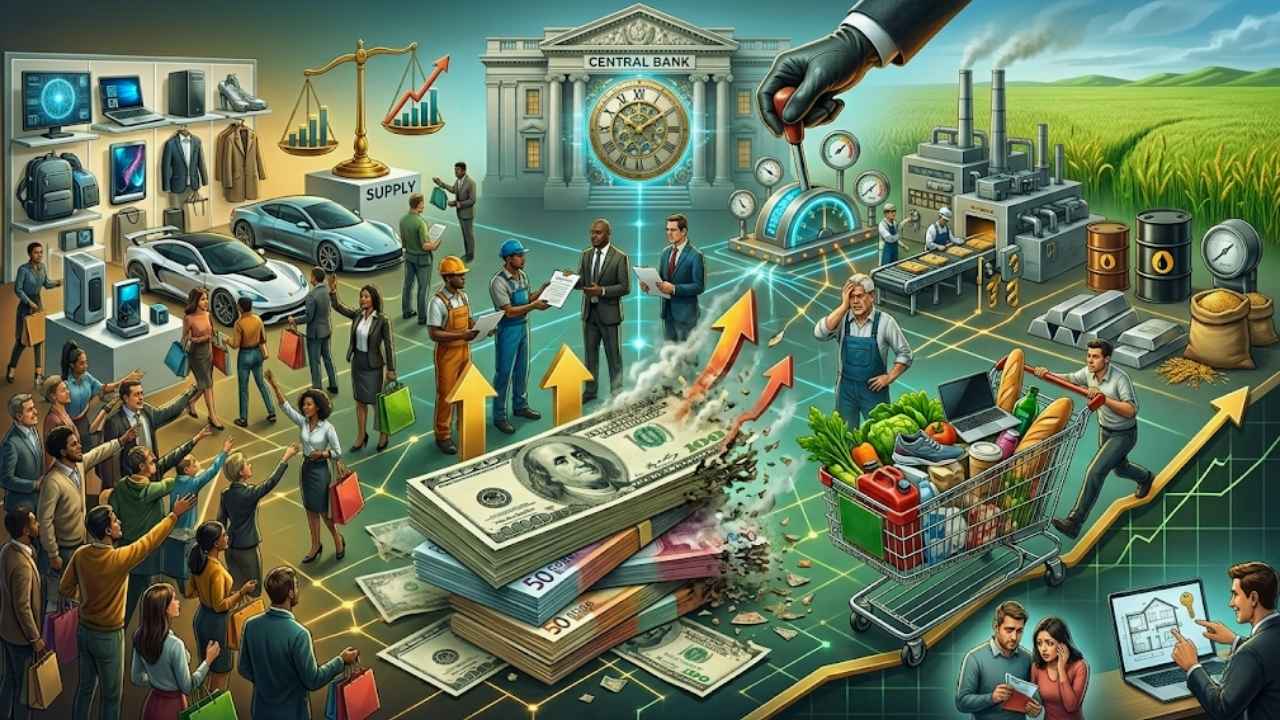
Most people feel the pinch of inflation long before they ever read about it in a financial report or hear a politician debate it on television. You notice it when a simple cup of coffee jumps from four dollars to five, or when your monthly rent climbs higher even though there have been no upgrades to your apartment building.
Essentially, the core concept of how inflation works is the steady, widespread rise in the price of the everyday stuff you buy, which ultimately means the cash sitting in your pocket has less purchasing power than it used to. To truly get a grip on this economic force, you have to look past the individual price tags at the grocery store and see the massive, interconnected picture of how money flows through the global economy.
It is not just about physical things getting more expensive; it is a fundamental story about the value of the currency itself shrinking over a period of time. When governments print more money or supply chains break down, the balance between available cash and available goods shifts dramatically. Understanding this invisible tax on your money is the very first step toward making smarter decisions about your career, your savings, and your long-term wealth.
|
Term |
Simple Definition |
How It Impacts Your Daily Life |
|
Inflation |
A general rise in prices across an entire economy over time. |
Your paycheck buys fewer goods and services each month. |
|
Purchasing Power |
The actual, physical amount of goods a single dollar can buy. |
Decreases steadily as inflation rates climb higher. |
|
Deflation |
A general, sustained drop in the overall prices of goods. |
Can lead to widespread job losses and economic stagnation. |
|
Monetary Policy |
The strategies used by central banks to manage money supply. |
Controls the speed of inflation and your borrowing costs. |
The Concept of Purchasing Power
Purchasing power is the absolute most important real-world measure of your personal wealth and financial security. If you have ten thousand dollars sitting untouched in a basic checking account, that specific number stays exactly the same year after year, but what that exact amount of money can actually fetch in the real world changes every single day. Inflation acts like a silent thief that slowly steals the hidden value of that cash while you are sleeping or going about your workday.
If the general cost of living goes up by five percent in a single year, you effectively have five percent less real wealth than you started with, even if your bank statement looks perfectly identical. This mathematical reality is exactly why keeping all your life savings stashed under a mattress or in a zero-interest account is usually a terrible move for your long-term financial health. You are practically guaranteeing that you will be poorer in the future because your money is not growing fast enough to outpace the rising costs of housing, food, and healthcare.
The Main Drivers: Why Prices Go Up
Prices generally do not just jump overnight simply because local business owners are feeling greedy, though corporate profit-seeking can certainly be a small piece of the overall puzzle. Most of the time, the reality of how inflation works is tied to massive, global shifts in supply and demand that are completely beyond any one individual’s control. You can think of the global economy like a massive seesaw; when there is entirely too much money floating around in people’s pockets but not enough physical products sitting on the store shelves, the retail prices have absolutely nowhere to go but up.
On the other side of the equation, when the underlying cost of making those physical products increases—like when electricity rates or diesel gas prices spike unexpectedly—that extra manufacturing cost eventually lands squarely on the shoulders of the end consumer. Businesses simply cannot absorb massive losses forever, so they are forced to rewrite their pricing models to survive in a tough market.
|
Cause Type |
Primary Economic Trigger |
Real-World Example |
|
Demand-Pull |
Exceptionally high consumer spending and easy credit. |
The massive post-pandemic travel and restaurant boom. |
|
Cost-Push |
Suddenly rising production, labor, or raw material costs. |
A global surge in gas prices making all shipping more expensive. |
|
Built-In |
The psychological expectation of future price increases. |
Automatic annual wage raises negotiated across an entire industry. |
|
Monetary Expansion |
Too much money printed by the central government. |
Massive government stimulus checks flooding the retail market. |
Demand-Pull Inflation
This specific economic phenomenon happens when practically everyone wants to buy the exact same thing at the exact same time, overwhelming the market. If a thousand eager shoppers want to buy a specific brand of highly marketed sneakers, but the overseas factory only manufactured a hundred pairs, the retail price is naturally going to skyrocket. When the national economy is doing fantastic, unemployment is low, and everyone has a stable job with extra disposable cash, everyday consumers confidently start spending more money on vacations, cars, and luxury goods.
This massive, sudden wave of consumer spending practically pulls the retail prices higher because local businesses physically cannot restock their inventory fast enough to keep up with the rabid demand. While this is generally considered a sign of a fast-growing, healthy economy, it can quickly spiral out of control and hurt lower-income families if the global supply chain breaks down entirely.
Cost-Push Inflation
Cost-push inflation is widely considered the much more painful version of price hikes because it usually strikes right when the broader economy is already struggling to stay afloat. If the baseline cost of essential raw materials like lumber, industrial steel, or crude oil goes up significantly, the companies manufacturing your home furniture and vehicles have to pay a premium just to stay in business. In order to keep their factory doors open and avoid massive layoffs, corporate executives simply pass those heavy, unexpected costs directly onto you at the retail checkout counter.
You end up paying significantly more money from your paycheck, but you are not getting a better, faster, or higher-quality product for that extra cash. This incredibly frustrating type of inflation is almost always caused by unpredictable global events, such as a sudden war in a major oil-producing region, massive international trade tariffs, or a severe natural disaster that wipes out an entire season of agricultural crops.
Built-In Inflation and the Wage-Price Spiral
This is the deeply psychological and behavioral side of the inflation coin that keeps central bankers awake at night. Once regular people get used to their grocery bills and rent prices going up by a noticeable amount every single year, they automatically start to expect that trend to continue indefinitely. Anxious workers then naturally approach their bosses to demand higher annual wages and better salaries just to cover their constantly rising living expenses. When the corporate bosses finally cave and give the staff a generous raise, the company’s total operating costs shoot up, forcing the company to raise the sticker price of its commercial products yet again to maintain profit margins.
This creates a dangerous, self-fulfilling loop where higher wages and higher retail prices chase each other in an endless, dizzying circle. Breaking this deeply ingrained psychological cycle is incredibly tough because it requires completely changing how millions of people think about the future value of their hard-earned money.
Measuring the Burn: How We Track Price Changes in 2026
Governments do not just blindly guess about the intricacies of how inflation works; they utilize highly specific, data-driven tools to track price fluctuations across the country every single month. By the time we arrived in the year 2026, these economic measurements had become incredibly sophisticated, pulling in massive amounts of real-time pricing data directly from giant online retailers and global digital payment systems. The statisticians carefully look at what they call a basket of goods, which is honestly just a technical way of describing a comprehensive list of things the average working person spends their paycheck on.
This massive virtual basket includes absolutely everything from the current price of a standard gallon of milk and fresh vegetables to the monthly cost of a haircut, a new smartphone, or a visit to the dentist. By actively comparing the total cost of this massive basket today against what it cost exactly one year ago, economists can finally pinpoint a highly accurate, national inflation rate.
|
Measurement Metric |
Primary Focus Area |
Best Economic Use Case |
|
CPI (Consumer Price Index) |
What average urban consumers pay out of pocket for daily goods. |
Calculating cost-of-living adjustments for social programs and pensions. |
|
PCE (Personal Consumption) |
What businesses actually sell and dynamic consumer shifts. |
The main metric used by central banks for major policy decisions. |
|
Core Inflation |
Overall prices specifically excluding volatile food and energy costs. |
Seeing the true, underlying long-term trend of the economy. |
|
PPI (Producer Price Index) |
What manufacturers pay for raw materials and wholesale goods. |
Predicting future retail price hikes before they hit the consumer. |
The Consumer Price Index (CPI)
The Consumer Price Index is the massive headline number you usually hear reported on the evening news or heavily debated by politicians during election cycles. It meticulously measures the average change over time in the exact prices paid by typical urban consumers for a highly representative basket of everyday consumer goods and necessary services.
If the latest official CPI report loudly declares that national inflation is running hot at three percent, it essentially means that, on average, your daily life currently costs three percent more than it did exactly twelve months ago. It is an absolutely vital national metric because many critical government benefits, social security payments, and even some private-sector union wage raises are tied directly to this exact percentage. If the overall CPI calculation goes up, those monthly payments usually go up right alongside it to deliberately help vulnerable people keep their heads above water during tough financial times.
Personal Consumption Expenditures (PCE)
While the traditional CPI is incredibly popular with the mainstream media, the top economic experts and government policymakers often heavily prefer tracking the Personal Consumption Expenditures index. The main reason for this preference is actually quite simple: the PCE formula brilliantly accounts for how everyday people drastically change their shopping habits when money gets tight.
If premium cuts of beef suddenly get way too expensive, the rigid CPI formula might stubbornly continue tracking the high price of beef, but the flexible PCE acknowledges that you probably quickly switched to buying much cheaper chicken instead. It paints a remarkably more realistic and accurate picture of how stressed people actually spend their limited money when grocery prices are wildly shifting. Because it is highly flexible and dynamic, the Federal Reserve intensely studies the PCE data as their primary, trusted guide for setting national interest rates.
The Various Intensities of Price Hikes
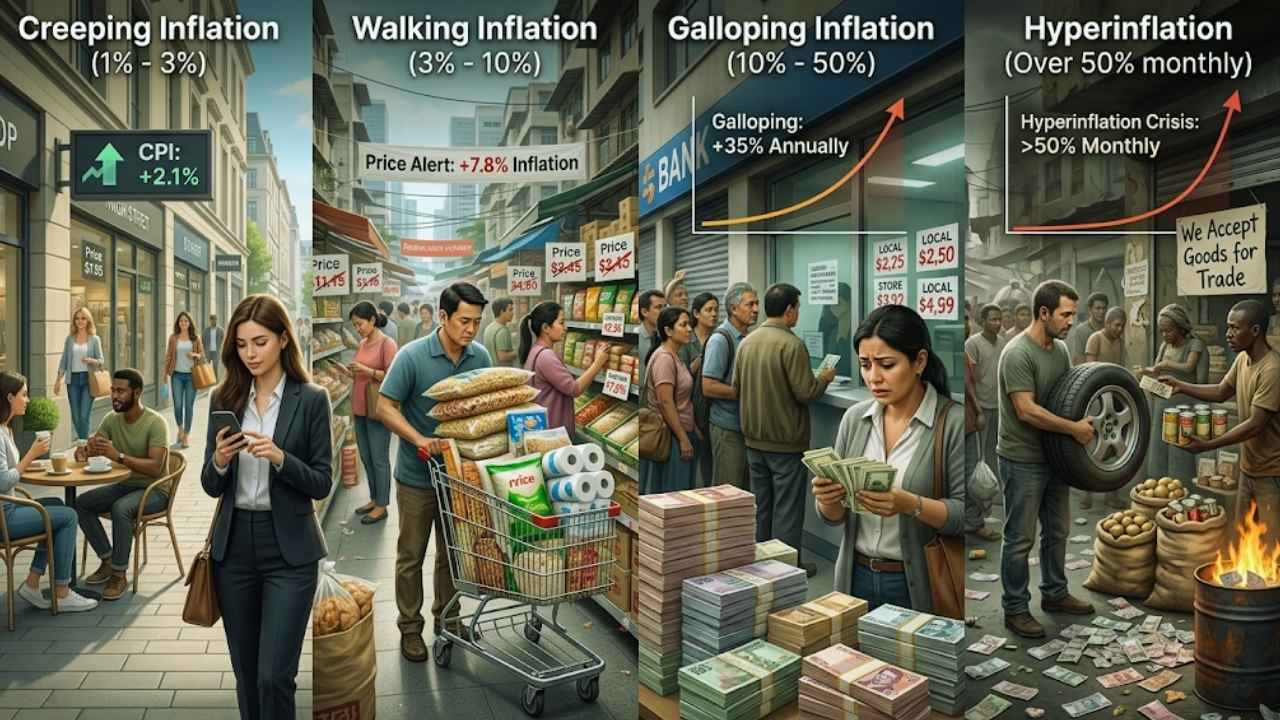
Inflation is absolutely not a singular, universally destructive disaster; sometimes it operates as a quiet background noise that we barely even notice in our day-to-day lives. However, it can occasionally mutate into a full-blown, catastrophic financial crisis that rapidly destroys a struggling country’s entire domestic economy. Understanding the vastly different speeds at which consumer prices can move helps you clearly recognize when a local economic situation is completely normal and when it is definitively time to start worrying about your savings.
In the modern financial landscape of 2026, we witness a incredibly wide range of these inflation intensities completely altering various global markets. You can clearly see highly stable developed nations enjoying slow growth, while simultaneously watching a few struggling emerging economies battle against rapidly collapsing local currencies.
|
Inflation Speed/Type |
Average Rate Per Year |
Typical Result on the General Population |
|
Creeping Inflation |
1% to 3% annually |
Promotes healthy economic growth and stable corporate planning. |
|
Walking Inflation |
3% to 10% annually |
Consumers notice prices and may start hoarding essential goods. |
|
Galloping Inflation |
10% to 50% annually |
Currency loses value rapidly; heavy economic instability begins. |
|
Hyperinflation |
Over 50% in a single month |
Complete economic collapse; citizens abandon cash and start bartering. |
Creeping and Walking Inflation
Creeping inflation is widely considered by modern economists to be the perfect Goldilocks zone for a highly functional, capitalistic society. Sitting comfortably at roughly two percent per year, it is just enough upward pressure to keep nervous people spending their paychecks and confident businesses expanding without causing any widespread public panic. Walking inflation is the exact moment when things start getting a bit too spicy for comfort, generally ranging anywhere from three to ten percent over a calendar year.
This is the distinct point where you absolutely start checking the price of a carton of eggs every single week, and you might seriously decide to buy that expensive new television right now simply because you are terrified it will cost significantly more next month. If a national economy uncomfortably stays in this aggressive walking phase for far too long, the situation can easily break out into something much more dangerous and difficult to control.
Galloping Inflation and Hyperinflation
Galloping inflation is an incredibly serious, highly destructive economic problem where retail prices violently rise by double digits every single year. At this terrifying stage, the local paper money practically starts to feel like a burning hot potato; you desperately want to get rid of it as fast as you legally can in exchange for something real, tangible, and useful, like non-perishable food, real estate, or physical gold.
Hyperinflation is the absolute worst-case nightmare version, where retail prices are literally changing by the hour and store owners have to update price tags multiple times a day. Human history is unfortunately full of incredibly sad stories where desperate citizens literally needed a physical wheelbarrow full of worthless cash just to buy a single, stale loaf of bread. This catastrophic, society-breaking scenario almost exclusively happens when a deeply corrupt or desperate government blindly prints massive amounts of paper money to pay off massive foreign debts it simply cannot afford.
Stagflation: When Things Get Weird
Stagflation is unequivocally the ultimate economic headache for any sitting president or prominent central bank chairman. It is a highly toxic, totally paradoxical scenario where a country suffers from both painfully high inflation and a completely stagnant, shrinking economy at the exact same time. Usually, rising inflation only happens when businesses are booming and essentially everyone in the country has a great-paying job.
In a brutal stagflation environment, the prices of basic survival goods are shooting up, but desperate businesses are also simultaneously firing thousands of workers because the overall economy is practically dying. It is a highly rare and incredibly difficult financial situation to effectively fix, primarily because the traditional economic tools used to aggressively stop inflation almost always make the national unemployment problem significantly worse.
New Economic Realities: The 2026 Inflation Shift
The traditional, textbook way we intensely look at how inflation works has shifted quite significantly over the last several volatile years. Highly advanced technology and wildly shifting international trade dynamics have permanently introduced brand new economic variables that simply were not present a decade ago.
Economists are no longer just staring closely at the global price of crude oil and agricultural grain exports; they are meticulously analyzing the massive costs of computer processing power, data center energy, and digital currency flows across borders. These completely modern, technology-driven factors possess the unique power to either rapidly speed up global inflation or dramatically help slow it down, largely depending on exactly how they are integrated into the global supply chain.
|
Modern 2026 Factor |
Inflationary or Deflationary? |
Primary Economic Reason |
|
Artificial Intelligence Integration |
Strongly Deflationary |
Drastically lowers the time and cost of professional services and labor. |
|
Global Green Energy Transition |
Short-term Inflationary |
Incredibly high upfront material costs for building new infrastructure. |
|
Decentralized Digital Assets |
Neutral / Personal Hedge |
Provides individuals an alternative to failing, hyper-inflated local currencies. |
|
Next-Gen Supply Chain Tech |
Strongly Deflationary |
Real-time tracking and logistics massively reduce global waste and shipping costs. |
AI, Automation, and Productivity Gains
One of the absolute biggest economic stories of the entire 2026 financial year is how artificial intelligence is genuinely fighting back against high inflation across several major corporate sectors. By aggressively automating highly complex, time-consuming office tasks, massive global companies can easily produce significantly more output with far fewer human resources. This incredible, unprecedented increase in worker productivity acts as a massive, powerful deflationary force on the overall global economy.
If a giant software company can suddenly handle its entire customer service department or basic coding needs with fifty percent less operational cost, they can easily afford to keep their retail prices much lower for the consumer, even if their underlying energy costs are currently going up. This tech-driven, hyper-efficient business model is honestly one of the very few major things keeping the everyday cost of many modern digital services from completely skyrocketing out of control.
Stablecoins as a Hedge in Volatile Markets
In deeply troubled emerging countries where the traditional local currency is actively failing, everyday people are heavily turning to decentralized digital stablecoins to vigorously protect themselves from poverty. These unique digital tokens are specifically engineered to stay permanently pegged directly to a highly stable, world-reserve currency like the United States Dollar.
For a struggling family living in a heavily mismanaged country experiencing fifty percent annual inflation, being able to instantly swap their melting local cash for a digital dollar on their mobile phone is an absolute financial lifesaver. It easily allows them to safely participate in the broader global economy and actively keep their entire life savings totally completely safe from the devastating local government inflation tax. This specific technological adoption has quickly become a massive, totally unavoidable part of the international financial landscape in 2026.
The Role of Central Banks and Interest Rates
When rampant inflation threatens to spiral completely out of control and damage the economy, the designated adults in the room—the powerful central banks—have to aggressively step in and forcibly slow everything down. Their absolute main, heavy-handed tool to accomplish this massive task is the manipulation of the national baseline interest rate.
When they decide to boldly raise these target rates, they immediately make it much more expensive for you to carry a balance on your credit card, secure a decent car loan, or sign a mortgage to buy a new family house. This seemingly harsh action is not genuinely meant to punish you personally; it is an engineered, highly deliberate strategy meant to purposefully make everyone in the country spend a lot less money. If millions of people are heavily discouraged from borrowing money and spending it, consumer demand plummets, and retail prices naturally stop rising so incredibly fast.
|
Central Bank Policy Action |
Direct Effect on Borrowing |
Ultimate Economic Goal |
|
Aggressively Raising Rates |
Loans become much more expensive |
Cool down a wildly hot economy and violently lower high inflation. |
|
Drastically Lowering Rates |
Loans become significantly cheaper |
Stimulate a dying, slow economy and actively prevent a deflationary spiral. |
|
Quantitative Easing |
Injecting massive cash into banks |
Support failing banks and heavily encourage widespread corporate lending. |
|
Quantitative Tightening |
Removing cash from the economy |
Shrink the total money supply to aggressively fight soaring retail prices. |
Finding the Silver Lining: Is Inflation Ever Good?
It genuinely sounds totally crazy to the average working person, but a tiny, highly predictable amount of inflation is actually considered a major sign of a healthy, highly functional modern society. If retail prices were constantly falling every single year in a deflationary environment, you would absolutely never buy a brand new car or a house today; you would just stubbornly wait a year for it to become significantly cheaper. This widespread, totally rational consumer hesitation would quickly lead to thousands of retail shops permanently closing and millions of hardworking people suddenly losing their jobs.
A very small, steady rise in prices heavily encourages everyday people to proactively invest their money and aggressively forces local businesses to constantly grow to stay ahead of the curve. It also makes it considerably easier for average people to successfully pay back their massive, old debts, as they are technically paying the bank back with slightly cheaper dollars than the ones they originally borrowed years ago.
|
Demographic Group |
Do They Benefit from Inflation? |
Primary Financial Reason |
|
Heavy Debtors and Borrowers |
Yes, usually. |
They pay back long-term fixed loans with much less valuable money over time. |
|
Hard Asset and Property Owners |
Yes, definitively. |
The baseline value of their physical land, homes, or gold usually goes up. |
|
Fixed-Income Retirees |
No, absolutely not. |
Their strictly set, unchanging monthly pension continuously buys fewer daily groceries. |
|
Pure Cash Savers |
No, absolutely not. |
Their total buying power is slowly, invisibly eaten away year after year. |
Practical Steps to Protect Your Money
You absolutely do not have to sit around and be a helpless victim of rapidly rising retail prices and a weakening national currency. The very first, most critical step you must take is to completely stop keeping all your hard-earned wealth in a basic, old-school checking account that practically pays zero percent interest. You should immediately look for high-yield digital savings accounts or highly secure, short-term government bonds that at least aggressively try to keep up with the current national inflation rate.
Intelligently investing in tangible hard assets like residential real estate or a highly diversified, broad-market stock portfolio is another massively popular, historically proven defensive move. Over the incredibly long run, the broader stock market has almost always historically outperformed standard inflation, successfully helping smart investors grow their real wealth even while the grocery store cost of a loaf of bread continues going up.
|
Financial Strategy |
Inherent Risk Level |
How it Actively Fights Against Inflation |
|
Broad Market Stocks/Equities |
Moderate to High |
Strong companies can aggressively raise their prices to confidently grow profits. |
|
Physical Real Estate |
Moderate |
Property values and monthly rental income usually steadily rise alongside inflation. |
|
TIPS (Treasury Bonds) |
Extremely Low |
The core principal investment value automatically adjusts upward based directly on the CPI. |
|
Commodities (Gold/Oil/Metals) |
Very High |
Physical, limited goods often rapidly spike in value when the base currency weakens. |
Final Thoughts
At the very end of the stressful workday, fundamentally understanding how inflation works is purely about finally realizing that modern paper money is always a constantly moving target. It is absolutely not a static, unchanging thing you just mindlessly collect in a bank account; it is a highly dynamic financial tool that aggressively changes in real-world value based entirely on the chaotic world happening around you. While you personally cannot ever stop the massive global economy from rapidly shifting or prevent oil prices from spiking, you can absolutely change exactly how you proactively react to it.
By consistently staying highly informed, investing your extra cash intelligently into hard assets, and keeping a very close eye on those shifting central bank interest rates, you can confidently make absolutely sure that your personal financial future stays incredibly bright, no matter what crazy numbers pop up at the local grocery store checkout line. A low level of inflation is a completely permanent, heavily engineered part of our modern capitalistic world, but it absolutely does not have to be a slow-moving financial disaster for your personal bank account.
Frequently Asked Questions (FAQs)
Why does the exact price of some specific things aggressively go up while others actually go down?
Even during highly stressful periods of high national inflation, some specific retail items can actually get much cheaper purely because of massive leaps in manufacturing technology. A giant, high-definition television costs significantly less money today than a highly inferior, clunky television did twenty years ago simply because we have become incredibly efficient and automated at building them. Overall inflation is basically a broad, mathematical average of absolutely everything in the economy, so while your monthly apartment rent heavily goes up, your personal tech gadgets might actually get cheaper.
Is my massive student loan or mortgage debt actually getting smaller with high inflation?
Technically speaking, yes, it absolutely is shrinking in real terms. If you currently hold a thirty-year fixed-rate mortgage on a house, you are faithfully paying the exact same dollar amount every single month while your professional salary hopefully goes up to match inflation over the years. The true, real-world value of that massive debt actively shrinks because the modern dollars you are currently using to pay it back are worth far less than they were back when you first signed the massive loan paperwork.
What exactly is the “Shadow Inflation” that financial experts constantly talk about online?
Shadow inflation, which is far more commonly known by angry consumers as shrinkflation, occurs exactly when a massive corporate food brand deliberately keeps the retail price of a specific product exactly the same but sneakily makes the physical package much smaller. You might unknowingly pay the exact same three dollars for a colorful bag of your favorite potato chips, but there are literally five fewer chips hiding inside the bag. It is an incredibly sneaky, highly effective way for massive companies to handle their own violently rising production costs without completely scaring off their loyal customers with a visibly higher retail price tag.
How long does a typical, painful period of highly elevated inflation usually last in a modern economy?
It varies wildly and unpredictably based almost entirely on exactly how fast the central government officially reacts to the growing crisis. If a highly aggressive central bank acts extremely quickly to violently raise baseline interest rates, the hot economy can often be successfully brought back under strict control within a relatively short year or two. Conversely, if cowardly politicians desperately wait far too long to act or recklessly decide to keep aggressively printing paper money to fund projects, a brutal inflationary period can easily last for a deeply painful decade or more, exactly as the world saw during the incredibly turbulent 1970s.
Does high inflation mathematically affect absolutely everyone in the country the exact same way?
No, it absolutely does not, and it is incredibly unfair in how it distributes economic pain across the population. It notoriously hits the working poor and elderly citizens living on strictly fixed incomes the absolute hardest, simply because a much larger percentage of their limited monthly money forcefully goes toward basic, unavoidable necessities like expensive food, gasoline, and apartment rent. Highly wealthy people, on the other hand, often personally own massive, appreciating assets like corporate stocks, commercial businesses, or residential rental property that rapidly go up in value during inflation, which incredibly can actually end up making them significantly richer in the long run.