

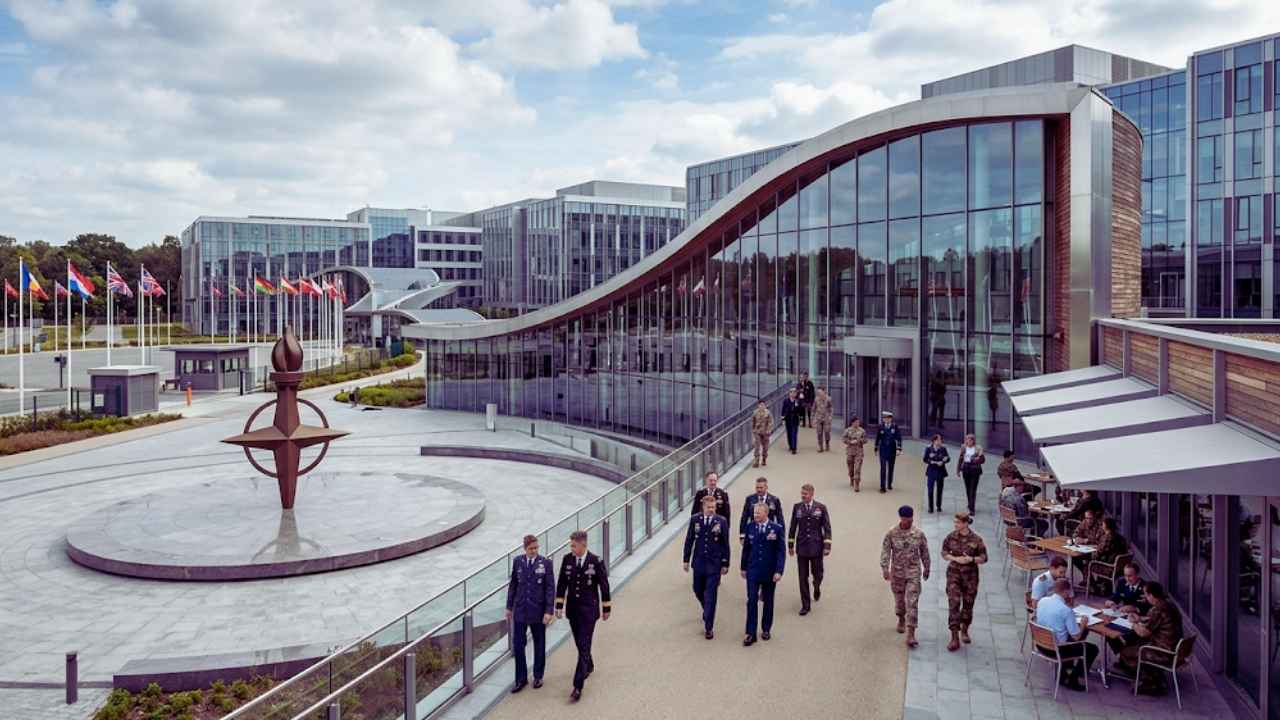
Understanding international military alliances often feels like trying to decipher a foreign language. You hear acronyms thrown around on the news, see world leaders shaking hands at massive summits, and read about troop deployments, but connecting all those dots is another story entirely.
The North Atlantic Treaty Organization is arguably the most powerful military alliance in human history, yet many people still wonder what it does on a daily basis. If you have ever found yourself quietly asking exactly how NATO works, you are in the right place. This guide strips away the complex political jargon to provide a clear, factual, and unbiased look at how this global powerhouse functions in 2026.
North Atlantic Treaty Organization (NATO)
At its core, the alliance is a massive defensive pact spanning two continents. It dominates global news cycles and foreign policy debates, but its basic daily function is often misunderstood. Before diving into the complex military command structures or defense budgets, you have to grasp the historical foundation that brought these nations together. This section breaks down the origin story of the alliance and the primary mission that keeps it together today.
|
Feature |
Detail |
|
Founded |
April 4, 1949 |
|
Headquarters |
Brussels, Belgium |
|
Member Count (2026) |
32 Sovereign Nations |
|
Founding Document |
The Washington Treaty |
What Is NATO and Why Was It Created?
To understand the alliance today, you must look back at the ashes of World War II. In 1949, the world was exhausted by conflict, and the political landscape of Europe was fractured. The Soviet Union was expanding its military and political influence across Eastern Europe. Western nations realized that standing alone would leave them vulnerable to further aggression. In response, twelve nations from North America and Western Europe gathered in Washington, D.C., to sign the North Atlantic Treaty.
The goal at the time was incredibly straightforward. The first Secretary General, Lord Ismay, famously quipped that the alliance existed to keep the Soviet Union out, the Americans in, and the Germans down. It was a mutual pact ensuring that a strong North American military presence remained in Europe to deter Soviet expansionism and encourage European political integration. While the Soviet Union officially collapsed in 1991, the alliance did not pack up and go home. Instead, it adapted to face new global security challenges, from international terrorism to cyber warfare and modern geopolitical tensions.
The Core Mission and Purpose
The fundamental mission of the alliance has always remained identical to its 1949 origins: to guarantee the freedom and security of its members through political and military means. On the political side, the organization promotes democratic values and provides a secure forum where members can consult and cooperate on defense issues. The idea is to solve problems, build trust, and prevent conflict long before a single shot is fired.
On the military side, the organization is committed to the peaceful resolution of international disputes. If diplomatic efforts fail, however, it has the sheer military power to undertake crisis-management operations. These operations happen either under the collective defense clause of its founding treaty or under a United Nations mandate. Ultimately, it operates as a defensive shield designed so its populations can live their daily lives in peace.
Who Is in NATO? (Member Countries & Expansion)
The absolute strength of the alliance lies in its member states. What started as a relatively small group of post-war nations has grown into a massive coalition stretching from the Pacific coast of North America to the borders of Russia. The process of adding new countries is known as enlargement, and every new member fundamentally shifts the geopolitical map. This section outlines the original founders, recent additions, and the strict process required to join.
|
Membership Era |
Nations Included |
|
Founding (1949) |
12 nations including USA, UK, France, Canada |
|
Cold War Additions |
Greece, Turkey, Germany, Spain |
|
Post-Cold War |
Poland, Hungary, Baltic States, and others |
|
Recent (2023-2024) |
Finland, Sweden |
The Original Founding Members
When the treaty was signed in 1949, twelve original founding members laid the groundwork for the modern organization. From North America, the United States and Canada led the initiative. From Europe, the founding nations included Belgium, Denmark, France, Iceland, Italy, Luxembourg, the Netherlands, Norway, Portugal, and the United Kingdom. These nations built a transatlantic bridge, cementing the idea that the security of Europe and the security of North America were permanently linked. Interestingly, Iceland joined despite having no standing army, relying entirely on its highly strategic geographic location in the North Atlantic ocean.
Recent Additions: Finland and Sweden’s Impact in 2026
The political landscape of Europe experienced a seismic shift recently, prompting nations that maintained strict military neutrality for decades to rethink their survival strategies. Following the escalation of conflict in Eastern Europe, both Finland and Sweden abandoned their non-aligned status and applied for membership. Finland officially joined in 2023, instantly doubling the length of the border the alliance shares with Russia. Sweden followed shortly after, becoming the 32nd member in early 2024.
By 2026, the inclusion of these two Nordic countries has transformed the security architecture of Northern Europe. The Baltic Sea is now almost entirely surrounded by allied nations. This geographic reality drastically improves the organization’s ability to monitor maritime activity, secure vital shipping lanes, and defend the airspace in the high north. Both nations brought advanced, highly capable militaries into the fold, strengthening the overall deterrence posture of the continent.
How a Country Joins NATO?
Joining the alliance is not a simple matter of signing a piece of paper. It requires a rigorous, multi-step process governed by Article 10 of the Washington Treaty. This article states that membership is open to any European state in a position to further the principles of the treaty and contribute to the security of the North Atlantic area.
When a country wants to join, it must first be formally invited by the existing members. The aspiring nation then enters a Membership Action Plan, which provides practical advice and targeted support to help the country meet alliance standards. The candidate must prove it has a functioning democratic political system, a fair market economy, and the willingness to make a real military contribution. Finally, every single existing member state must agree to admit the new country. The national parliaments of all 32 members must ratify the accession protocols, meaning a single country can delay or block a new applicant indefinitely.
The Core Principle: What Is Article 5?
If you want to grasp how NATO works at a foundational level, you have to understand Article 5. This single paragraph is the beating heart of the entire treaty. Without it, the organization would just be an expensive political discussion club. This section explains the concept of collective defense and looks at the only time this rule has actually been triggered in history.
|
Article 5 Concept |
Explanation |
|
Core Rule |
An attack on one is considered an attack on all |
|
Response Flexibility |
Members assist as they deem necessary |
|
First Invocation |
September 12, 2001 (Post 9/11) |
|
Primary Goal |
Maximum deterrence against adversaries |
The Concept of Collective Defense
Article 5 establishes the bedrock principle of collective defense. In plain English, it means that an armed attack against one member is legally and politically considered an attack against all 32 members. It is the ultimate global deterrent. The logic is that no hostile nation would dare attack a smaller allied country because doing so would instantly draw the military wrath of the entire alliance, including the massive nuclear capabilities of the United States, the United Kingdom, and France.
However, invoking this article does not mean every member automatically sends combat troops to the front lines the next morning. The treaty specifically states that each member will take such action as it deems necessary to restore and maintain security. This specific phrasing gives individual nations the flexibility to provide assistance in ways that fit their capabilities. Some might deploy infantry, while others might send medical supplies, share critical satellite intelligence, or provide financial backing.
When Has Article 5 Been Invoked?
Despite the massive geopolitical tensions throughout the Cold War, the Cuban Missile Crisis, and various proxy wars, Article 5 has only been invoked exactly one time in history. That historic moment occurred following the terrorist attacks on the United States on September 11, 2001.
Within 24 hours of the planes hitting the Twin Towers and the Pentagon, the alliance activated the collective defense clause. European nations and Canada recognized that the attack on American soil was a direct attack on the entire democratic world. This historic invocation led to allied participation in the war in Afghanistan and several maritime anti-terrorism operations. It proved to the world that the alliance was not just a relic of the Cold War, but a highly functional pact capable of responding to modern, asymmetric threats from non-state actors.
How NATO Actually Works: The Structure and Decision-Making
Running an alliance of 32 distinct, sovereign nations requires an incredibly rigid and well-organized internal structure. The organization operates on two parallel tracks: the civilian political side and the operational military side. Understanding how these two sides interact is the key to understanding how decisions travel from a meeting room in Brussels to troops deployed in the field.
|
Branch / Body |
Primary Function |
|
North Atlantic Council |
The main political decision-making body |
|
Military Committee |
Chiefs of Defense providing military advice |
|
Allied Command Operations |
Plans and executes joint military missions |
|
Allied Command Transformation |
Focuses on future capabilities and training |
The North Atlantic Council (NAC)
The absolute political epicenter of the alliance is the North Atlantic Council. Each of the 32 member countries maintains a permanent delegation at the headquarters in Brussels, headed by an ambassador. The NAC meets regularly at the ambassadorial level, but it also convenes at much higher levels involving foreign ministers, defense ministers, and occasionally the heads of state and government.
The council is chaired by the Secretary General, an international diplomat who serves as the chief administrative head and primary spokesperson for the alliance. The Secretary General steers the consultation process, helps resolve disputes between members, and ensures that policies are implemented. It is inside the NAC where nations bring their direct security concerns to the table, share classified intelligence, and negotiate the broader strategic direction of the continent.
The Military Command Structure
While the politicians in the NAC make the overarching strategic decisions, the military professionals figure out exactly how to execute them. The military structure is guided by the Military Committee, which consists of the top military officers from all member nations. This committee provides the essential, ground-level military advice to the civilian leaders.
Beneath the committee, the actual operational command splits into two main branches. Allied Command Operations is responsible for the daily planning and execution of all joint military missions, headquartered in Belgium. The other branch is Allied Command Transformation, based in Norfolk, Virginia. As its name suggests, this branch focuses strictly on the future. It oversees education, identifies new military concepts, and ensures that allied forces are modernized and capable of facing tomorrow’s technological threats.
Consensus Rule: Why Every Voice Matters
One of the most unique aspects of the alliance is the strict rule of consensus. There is no voting system. A majority cannot overrule a minority. Instead, every single decision made by the alliance must be totally unanimous. Whether it is a minor administrative budget update or a massive decision to launch a military operation, all 32 member nations must explicitly agree.
This means that a country with a relatively small population holds the exact same veto power as the largest military powers in the alliance. While this framework can make the decision-making process incredibly slow and require exhausting diplomatic negotiations, it also serves as the greatest strength of the organization. When the alliance finally announces a decision, it speaks with the undeniable, unified weight of 32 sovereign governments.
Funding NATO: Who Pays for What?
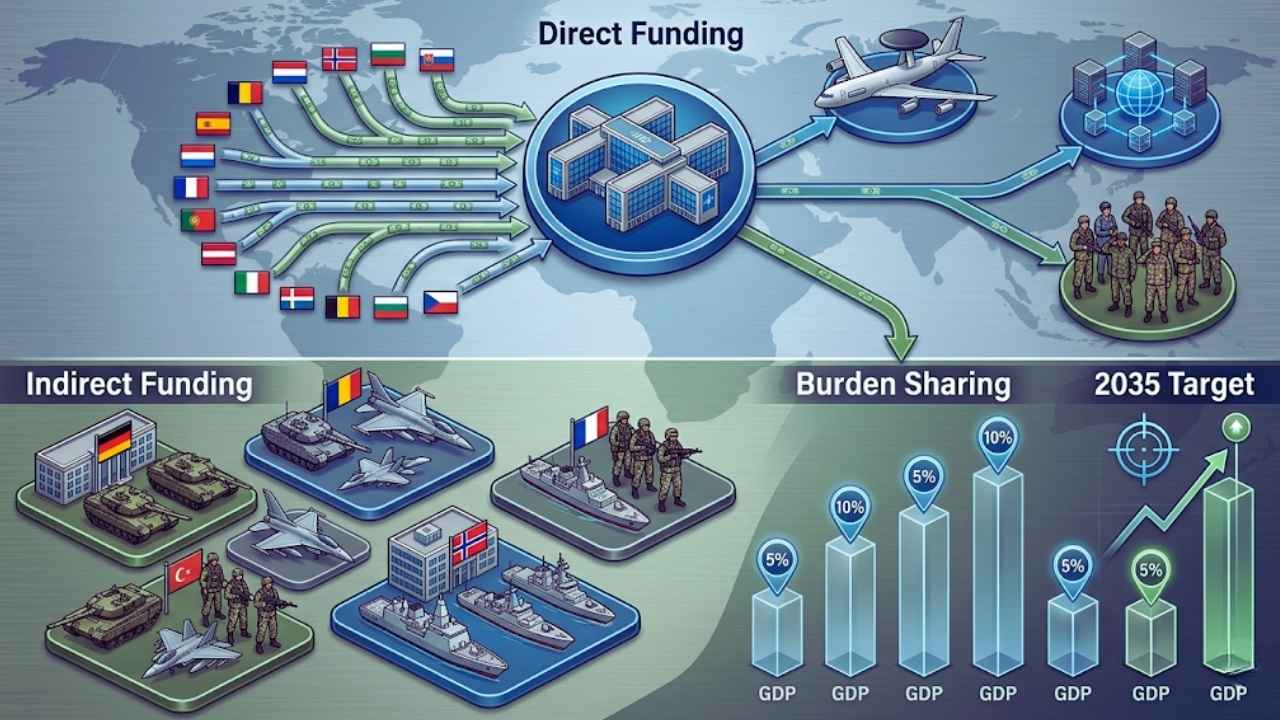
Whenever military alliances make the news, the topic of money inevitably takes center stage. Managing the budgets, buying equipment, and funding operations for a 32-nation coalition is a massive logistical and political challenge. Funding breaks down into direct and indirect contributions, and the rules surrounding these payments have shifted drastically to meet modern threats.
|
Funding Type |
Description |
|
Direct Funding |
Shared budget (~5 billion Euros) for HQ and joint assets |
|
Indirect Funding |
Money countries spend on their own domestic militaries |
|
The 2035 Target |
Spend 5% of national GDP on defense and security |
|
Burden Sharing |
Contributions based on the economic size of each nation |
The 2025/2026 Defence Investment Guidelines (The 5% and 2% Rules)
For many years, the standard guideline dictated that each member country should spend at least 2 percent of its Gross Domestic Product on its own national defense. However, as global security challenges rapidly escalated, those financial commitments proved completely inadequate. During the 2025 summit in The Hague, allied nations recognized that the old baseline had to change.
The alliance established a massive new long-term commitment. Members are now required to invest 5 percent of their GDP annually on overall defense and security requirements by 2035. Under these updated rules, nations must allocate at least 3.5 percent to core military capabilities like tanks, troops, and aircraft. The remaining 1.5 percent is specifically designated for protecting critical civilian infrastructure, defending national cyber networks, and securing the defense industrial base. By 2026, data shows nations like Finland are already heavily exceeding these targets, pushing the entire alliance into a new era of high-budget military readiness.
Direct vs. Indirect Funding
When politicians argue about the 2 percent or 5 percent GDP targets on television, they are talking entirely about indirect funding. This money does not go to a central bank account in Brussels. It is the money a country spends entirely on its own domestic military forces. Because those national forces can be called upon by the alliance during a crisis, strengthening a national military indirectly strengthens the whole coalition.
Direct funding is a completely different mechanism. This is the actual shared budget used to run the organization itself. It covers the costs of the civilian headquarters, the integrated military command structures, and jointly owned hardware like surveillance planes and early warning radar systems. The direct budget is funded by all 32 members based on an agreed cost-sharing formula tied directly to the economic size of each nation. The largest economies shoulder the highest percentage of the daily operating costs.
NATO’s Military Capabilities and Daily Operations
It is remarkably easy to think of the alliance only springing into action during a major war, but the reality is quite different. Allied forces work together 24 hours a day, 365 days a year. The organization maintains a constant, aggressive state of readiness across multiple domains of warfare to deter aggression and protect its borders.
|
Operational Domain |
Daily Activity |
|
Land Forces |
High-readiness battle groups stationed on eastern borders |
|
Airspace |
Fighter jets conducting 24/7 air policing missions |
|
Maritime |
Standing naval groups patrolling major global waterways |
|
Cyberspace |
Constant monitoring of networks and repelling state hackers |
Standing Forces and Readiness
A common misconception is that the alliance owns a massive standing army. With the exception of a few jointly owned surveillance aircraft and drones, the military personnel, tanks, ships, and fighter jets all belong to the individual member nations. Countries simply commit portions of their national militaries to deploy under the alliance banner at a moment’s notice.
The organization currently maintains a highly capable spearhead force known as the Very High Readiness Joint Task Force. This is a multinational brigade consisting of thousands of elite land forces, supported heavily by air, maritime, and special operations units. This task force can deploy within days to respond to any sudden global crisis. Behind them sits a much larger pool of troops, hundreds of thousands strong, placed on heightened alert across the European continent.
Air Policing and Maritime Patrols
Every single day, allied fighter jets take to the skies to physically protect the airspace of the member nations. This air policing mission is a collective effort aimed at tracking and intercepting foreign military aircraft that approach allied airspace without proper flight plans or radio communication. This is especially vital for member nations that do not possess their own fighter jets, such as the Baltic states. Larger nations simply rotate their aircraft through these smaller regions to provide a continuous defensive umbrella.
Similarly, out on the water, the alliance operates Standing Naval Forces. These are multinational groups of destroyers, frigates, and submarines that actively patrol the Atlantic Ocean, the Baltic Sea, and the Mediterranean. They conduct routine mine clearance operations, monitor heavy maritime traffic, deter piracy, and provide a highly visible reminder of the alliance’s naval supremacy.
Cyber Defense and Modern Threats
Warfare is no longer confined strictly to land, sea, and air. Recognizing the devastating potential of digital attacks, the alliance has officially designated cyberspace and space as formal operational domains. A severe cyberattack against a member nation’s power grid, financial systems, or healthcare infrastructure could now theoretically trigger an Article 5 collective defense response.
To counter these invisible modern threats, the organization runs a dedicated Cyber Operations Centre. They regularly conduct massive cyber defense exercises where military hackers practice defending against simulated, catastrophic network intrusions. The alliance also focuses heavily on countering hybrid warfare, where adversaries use a mix of political sabotage, weaponized migration, and economic pressure to destabilize nations without ever declaring formal war.
NATO vs. The United Nations: What is the Difference?
A common area of confusion for beginners learning how NATO works is distinguishing the alliance from the United Nations. While both are massive international organizations aimed at maintaining global stability, their internal structures, total memberships, and daily operating methods are entirely different.
|
Feature |
The United Nations |
The NATO Alliance |
|
Membership |
193 global countries |
32 regional countries |
|
Primary Tool |
Diplomacy and International Law |
Military Deterrence and Defense |
|
Standing Command |
None (Relies on peacekeepers) |
Highly integrated military command |
|
Veto Power |
UN Security Council (Includes Russia/China) |
32 Member Consensus |
Key Structural and Operational Differences
The United Nations is a global diplomatic forum representing nearly every recognized country on Earth. Its primary tools are diplomacy, humanitarian aid distribution, and the establishment of international law. While the UN does deploy peacekeepers, it does not have a standing military command structure. Furthermore, any forceful UN action requires the approval of the UN Security Council, where adversarial nations hold absolute veto power over each other.
Conversely, the North Atlantic Treaty Organization is a highly exclusive regional military alliance strictly limited to North American and European nations that share common democratic values. It is heavily militarized from top to bottom. While the alliance often conducts operations authorized by a UN mandate, it operates entirely independently of the United Nations. It can and will take immediate military action to defend its own territory regardless of what the UN Security Council decides.
Common Misconceptions About NATO
Because of its immense size, political weight, and the secrecy inherent in military operations, several myths surround the way the organization operates. Hostile state propaganda also actively works to distort the truth. Clearing up these misunderstandings is vital to grasping the reality of global security.
|
The Myth |
The Factual Reality |
|
It forces countries to fight wars |
Sovereign nations decide their own troop deployments |
|
It has its own massive army |
Troops and equipment belong to individual member countries |
|
It constantly seeks to conquer land |
It is a strictly defensive alliance focused on deterrence |
|
It controls member foreign policy |
Nations retain total political and economic sovereignty |
Debunking Top Alliance Myths
One major misconception is that the alliance actively seeks out conflicts or attempts to conquer new territory. In reality, it is a strictly defensive organization. Its entire military posture is built around deterrence rather than conquest. The explicit goal is to make the physical cost of attacking an allied nation so devastatingly high that no adversary would ever attempt it in the first place.
Another frequent myth is that the alliance headquarters acts as a shadow government, dictating the foreign policy of its member states. While members actively consult each other on security issues, each nation retains its full national sovereignty. The alliance cannot force a member country to go to war, change its domestic laws, or alter its individual trade agreements. The headquarters serves as a highly secure platform for coordination, not a governing body that rules over independent populations.
The Future of NATO: Looking Toward 2026 and Beyond
As the alliance navigates the harsh geopolitical realities of 2026 and looks toward the next decade, it finds itself at a crucial turning point. The return of large-scale, conventional trench warfare to the European continent in recent years forced the organization to completely tear down and rebuild its strategic posture.
|
Future Initiative |
Strategic Goal |
|
Forward Defense |
Permanently stationing heavy combat units on eastern borders |
|
Defense Innovation |
Investing heavily in AI, quantum computing, and autonomous weapons |
|
Civil Resilience |
Hardening domestic infrastructure against sabotage and cyber attacks |
|
Indo-Pacific Partnerships |
Expanding intelligence sharing with Japan, South Korea, and Australia |
Adapting to New Geopolitical Realities
The military focus has shifted heavily toward a strategy of forward defense. The alliance is moving away from relying solely on flying troops in after a crisis starts. Instead, they are placing combat-ready, heavily armored battle groups permanently near the eastern borders to stop an invasion the second it crosses the line.
Furthermore, the rapid, terrifying advancement of artificial intelligence, autonomous drone swarms, and quantum computing has pushed the alliance to adapt. They recently established defense innovation accelerators to fund cutting-edge technology startups. These strategic initiatives ensure that allied militaries maintain their absolute technological dominance in an increasingly unpredictable world.
Final Thoughts
Grasping exactly how NATO works reveals that it is much more than just an old treaty from the Cold War. It is a living, breathing military and political machine that adapts daily to keep over one billion citizens safe. From the ironclad promise of Article 5 to the complex funding structures of 2026, every piece of the alliance is designed to project strength and prevent war through absolute deterrence.
While the geopolitical landscape will inevitably continue to shift, the core purpose of the organization remains identical to its founding days: ensuring that democratic nations never have to face global threats entirely alone.
Frequently Asked Questions (FAQs) About How Nato Works
What happens if a NATO country attacks another NATO country?
The treaty does not explicitly outline a military mechanism for an internal war between members. Article 5 strictly applies to outside aggression. If two members fight, the alliance relies entirely on immense diplomatic pressure and Article 4 consultations to mediate and stop the conflict before it escalates.
Can a country be kicked out of NATO?
Technically, no. The original Washington Treaty contains absolutely no legal mechanism to expel or suspend a member nation. A country can voluntarily choose to leave the alliance by invoking Article 13, but the other members cannot force a rogue nation out through a vote.
Does NATO have nuclear weapons of its own?
The organization itself does not own nuclear weapons. However, three member states—the United States, the United Kingdom, and France—possess independent nuclear arsenals. The United States also forward-deploys a limited number of tactical nuclear gravity bombs in specific allied European countries as part of the alliance’s nuclear sharing agreement.
Why isn’t Ukraine in NATO?
Joining requires unanimous consent from all 32 members, a stable democratic system, and resolved territorial borders. Admitting a country currently engaged in an active, massive war with a foreign power would immediately trigger Article 5, pulling the entire alliance into a direct, global conflict.
What is the difference between Article 4 and Article 5?
Article 4 allows any member to call for urgent formal consultations if they feel their territorial integrity, political independence, or security is threatened. It is a discussion mechanism. Article 5 is the actual collective defense clause, declaring that an armed attack on one is an armed attack on all, triggering a military or strategic response.