


Ever wonder why a basic white t-shirt costs $10 at Target, but a nearly identical one runs $150 at a high-end boutique? Or why tickets for the 2026 World Cup suddenly spiked to thousands of dollars? You don’t need an economics degree to figure it out. You just need to spot the invisible forces pulling the strings on your wallet.
Getting supply and demand explained without the academic jargon actually makes daily life make sense. It tells you why your grocery bill suddenly spikes, why housing feels impossible one year and stagnant the next, and why concert tickets vanish before you can even click “checkout.”
Every market is a massive tug-of-war. Buyers want a good deal. Sellers want a profit. When you understand how these two sides fight it out, you stop being a victim of the price tag. Let’s ditch the economic fluff and look at the actual, real-world data driving prices today in 2026.
The Core Mechanics: Supply and Demand Explained
Let’s skip the dusty chalkboards. Think of these two concepts as the two pedals driving the bicycle of our economy. You need both to move forward, and they react to each other constantly.
The Law of Supply
Supply is simply what is physically available to buy. Whether we talk about crude oil, freelance writers, or the newest gaming console, supply is the total pool of goods sitting on the shelf.
When prices rise, businesses rush to produce more to cash in. When prices fall, they scale back to avoid losing money. If shoppers suddenly decide to pay top dollar for handmade ceramic mugs, you can bet more local artists will fire up their kilns.
The Law of Demand
Demand represents how many people want a product and—this is the crucial part—have the cash to pay for it. Wanting a Ferrari doesn’t count as demand unless you can actually finance it.
When prices drop, we buy more. When prices rise, we buy less. If your local coffee shop starts charging $12 for a latte, you’ll probably dust off your French press and brew it at home.
|
Concept |
What It Actually Means |
How Price Changes Things |
|
Supply |
Total amount of a good or service available |
Rises as prices go up (producers chase profit) |
|
Demand |
How much consumers want it and can afford it |
Falls as prices go up (buyers look for deals) |
|
The Market |
Where buyers and sellers meet |
Settles when both sides agree on a fair value |
Market Equilibrium, Shortages, and Surpluses
Imagine a playground seesaw. If one side gets too heavy, someone hits the dirt. The market constantly tries to balance that seesaw. When supply exactly matches demand, we hit “market equilibrium.”
At this sweet spot, companies sell everything they make, and consumers buy exactly what they want. Prices stay flat. But let’s be real—the market rarely stays perfectly balanced. It usually swings wildly between two frustrating extremes.
When Demand Wins (Shortages)?
Shortages happen when demand blasts past supply. Think about the toilet paper panic of 2020. Everyone wanted it, but factories physically couldn’t make it fast enough. With shelves empty, sellers jacked up prices because desperate buyers would pay anything.
When Supply Wins (Surpluses)?
Surpluses happen when supply dwarfs demand. Say a brand prints 100,000 neon green hoodies, but shoppers suddenly decide neon green is tacky. The brand is stuck with warehouses full of dead inventory. To clear it out, they have to slash prices and throw massive clearance sales.
If you want supply and demand explained in three seconds, just look at the store. Is there a line out the door, or is the product gathering dust on a 70%-off rack?
|
Market Vibe |
What Is Actually Happening? |
What Happens to the Price? |
|
Equilibrium |
Supply perfectly equals demand |
Prices stay perfectly stable |
|
Shortage |
Buyers wildly outnumber the products |
Prices spike upward immediately |
|
Surplus |
Products sit unsold on the shelves |
Prices plummet to clear out inventory |
The 2026 Cocoa Crisis: When Supply Shocks Stick Around
If you bought a chocolate bar lately, your wallet definitely felt it. This is a perfect look at a massive supply shock hitting a global market and how corporate buyers manipulate the fallout.
Most of the world’s cocoa grows in West Africa. Throughout 2024, extreme weather and crop disease wrecked the harvest. The global supply of cocoa nose-dived. Panicked manufacturers scrambled for the limited beans, pushing cocoa futures to a historic $11,530 per metric ton.
Did we stop eating chocolate? Not completely, but those high prices definitely killed some consumer demand. Big chocolate brands started shrinking their candy bars (hello, shrinkflation) and substituting cocoa butter with cheaper fats. Shoppers swapped expensive truffles for cheaper gummies.
Because buyers purchased less, the raw price of cocoa temporarily dropped back down to roughly $3,500 by June 2026. But here is the catch: agricultural groups like COCEFAAA warn that because farmers are abandoning the trade, the supply is permanently damaged. They expect prices to shoot back over $10,000 a tonne soon. The supply issue was never fixed; buyers just temporarily lowered their demand.
|
Cocoa Crisis Phase |
Supply vs. Demand Action |
The Real-World Price Impact |
|
2024 (The Shock) |
Severe crop failure kills global supply |
Raw cocoa prices peak over $11,500 a tonne |
|
2025 (The Pivot) |
High prices crush consumer demand |
Shoppers switch to cheaper alternative snacks |
|
Mid-2026 (The Lull) |
Grinding slows, creating fake surplus |
Raw prices drop, but threat of a spike remains |
The 2026 AI Chip Plot Twist: Nvidia B200s and Power Bottlenecks
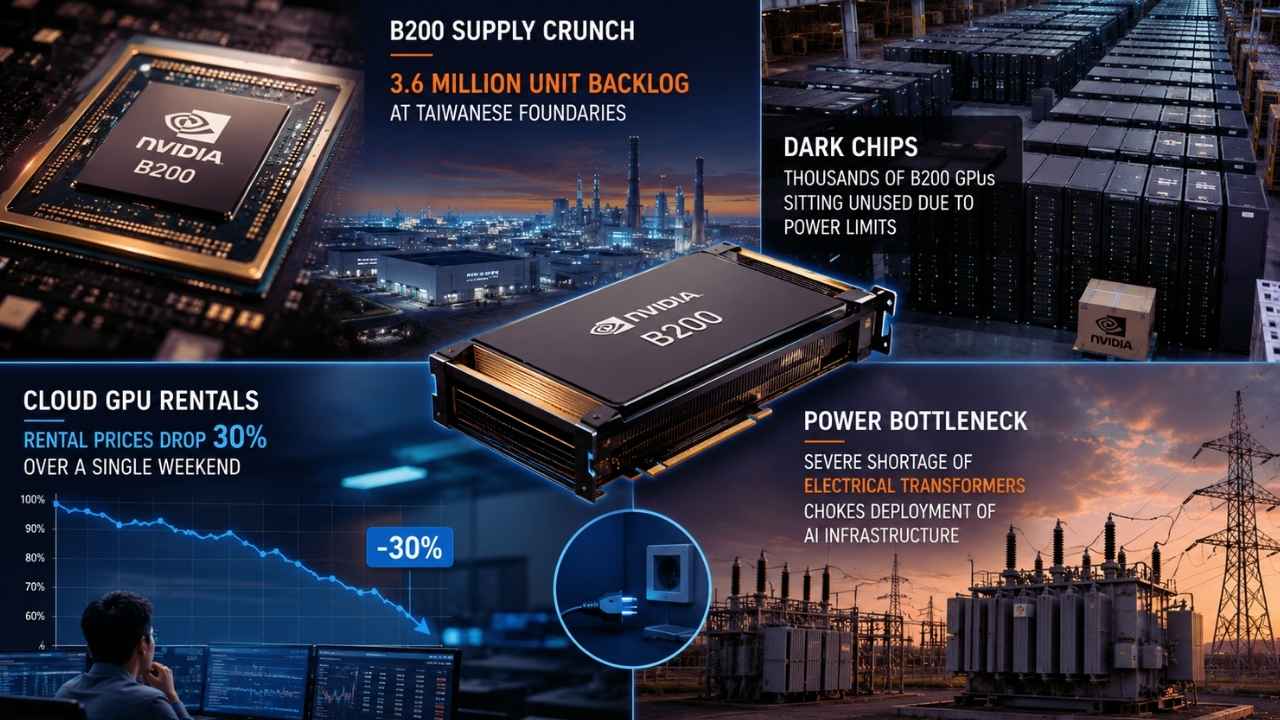
Want to see an incredibly complex supply chain bottleneck? Look at artificial intelligence hardware. In 2026, tech giants are locked in a brutal race to build the smartest AI models. To run them, they need specialized computing power—specifically NVIDIA’s massive B200 GPUs.
Every major tech company demanded tens of thousands of these chips. Supply hit a brick wall, creating a massive 3.6 million unit backlog because the factories in Taiwan couldn’t build them fast enough.
But in June 2026, a crazy plot twist hit the market. The cloud rental prices for these coveted B200 GPUs actually dropped by 30% over a single weekend. Why? Because the bottleneck moved downstream.
Companies hoarded chips, but quickly realized they didn’t have enough electricity or electrical transformers to turn them on. Data centers take years to build. So, thousands of “dark chips” are sitting in warehouses collecting dust. The physical chip supply is tight, but the supply of usable compute power is stuck, leading people to dump their rental contracts.
|
AI Tech Component |
Supply Status in June 2026 |
Demand & Price Result |
|
NVIDIA B200 Hardware |
3.6 million unit backlog at factories |
Hardware remains near impossible to buy outright |
|
Cloud GPU Rentals |
“Dark chips” sit unused due to power limits |
Rental prices unexpectedly drop 30% |
|
Electrical Grid |
Severe shortage of transformers |
Chokes the actual deployment of AI servers |
The 2026 Housing Market: From Frenzy to Flattening Prices
We can’t talk money without talking houses. The US and Canadian real estate markets show exactly how the cost of borrowing manipulates our desire to buy.
Back in 2020 and 2021, mortgage rates hit rock bottom. Borrowing money felt practically free, so housing demand exploded. But builders hadn’t built enough homes. High demand plus low supply triggered insane bidding wars.
Fast forward to mid-2026. The Federal Reserve and Bank of Canada hiked rates to fight inflation and kept them elevated. Borrowing money got incredibly expensive. A house that cost $3,000 a month in 2021 easily cost $4,500 a month in 2026.
This expensive debt suffocated demand. Millions of buyers walked away. Meanwhile, housing inventory surged. Between 2024 and 2025, U.S. housing supply jumped 30%. With rental vacancy rates climbing over 7.3% and builders wrapping up new apartment projects, supply is finally outpacing demand. What happens when demand drops and supply rises? Prices hit a wall. By summer 2026, the explosive home price growth we saw during the pandemic completely flatlined, and prices are actually dropping in overbuilt urban centers.
|
Housing Phase |
Borrowing Costs |
The Supply & Demand Vibe |
|
2020–2021 Boom |
Rock bottom rates |
Cheap debt fueled wild demand against low supply |
|
2024–2025 Shock |
Soaring rates |
Expensive debt crushed demand; inventory spiked 30% |
|
Mid-2026 Reality |
Rates remain high |
Supply outpaces demand; price growth goes flat |
Concerts and the 2026 World Cup: The Dynamic Pricing Backlash
Let’s look at a market driven purely by emotion and fixed scarcity: live events.
The supply of tickets for a concert or a soccer match is hard-capped. A stadium only holds so many bodies. When the 2026 FIFA World Cup rolled into North America, or when artists like Morgan Wallen and My Chemical Romance announced massive 2026 tours, the venues couldn’t magically add 50,000 extra seats.
The demand, however, was astronomical. Millions of fans swarmed ticketing platforms, creating a brutal shortage. Because demand vastly outstripped supply, the algorithms took over.
Platforms used “dynamic pricing”—adjusting the cost in real-time based on how many people were waiting in the queue. This pushed standard pit tickets for rock shows up to $900, and group-stage World Cup tickets as high as $2,735. The backlash was so intense it sparked the “2026 Concert Tours Cost Controversy,” forcing regulators to look into antitrust laws. The supply was fixed, the demand was manipulated by artificial queues, and the consumer paid the ultimate price.
|
Live Event Market |
What’s Going On? |
The Market Impact |
|
Ticket Supply |
Fixed by strict stadium capacity |
Cannot be increased to meet massive fan demand |
|
Fan Demand |
Millions of fans log in at once |
Drives extreme competition and site crashes |
|
The Price Tag |
Algorithms hike prices instantly |
Sparks massive backlash and regulatory probes |
The Hidden Forces: What Shifts the Curves?
Demand doesn’t just change because a store runs a discount. Entire markets shift overnight based on external forces. Economists call these “shifters.” If you really want supply and demand explained well, you have to look at what pushes these invisible buttons.
Shifters of Demand
- Your Income: If you land a huge promotion, you buy more steak and fewer instant noodles.
- Cultural Trends: When TikTok decides a specific brand of water bottle is cool, demand explodes overnight, regardless of the retail price.
- Related Goods: If coffee prices triple, tea demand spikes because shoppers switch teams.
- Expectations: If you hear gas prices will jump by 50 cents tomorrow, you fill your tank today.
Shifters of Supply
- Production Costs: If lumber gets cheaper, factories easily build and supply more furniture.
- Technology: AI tools write code instantly, flooding the market with cheap, entry-level apps.
- Competition: If five pizza shops open on your street, the local pizza supply immediately goes up.
- Red Tape: New tariffs, taxes, or harsh regulations make producing goods harder, choking off the supply.
|
Market Shifter |
Real-World Scenario |
The Direct Impact |
|
Consumer Income |
Tech workers get massive bonuses |
Luxury car sales jump immediately |
|
Cultural Trends |
A celeb wears a retro sneaker |
Store shelves empty out in hours |
|
Production Costs |
Tariffs make imported steel pricey |
Domestic builders supply fewer cheap homes |
|
Technology |
AI does basic graphic design |
The supply of cheap freelance logos explodes |
Price Elasticity: Why We Pay Up for Gas but Ditch Expensive Cereal
Why do we stomach a massive gas price hike but revolt if our favorite cereal goes up a buck? The answer is elasticity. It measures how sensitive we are to a price tag.
Inelastic goods are the things you need to survive. Electricity, tap water, insulin, and gasoline. If the price doubles, you still have to drive to work. Suppliers of inelastic goods hold all the cards because you can’t just walk away.
Elastic goods are highly sensitive to price. Think restaurant meals, luxury watches, or brand-name snacks. If a ribeye steak gets too expensive, you just buy chicken. You hold the power here because you have endless options.
|
Type of Good |
Are We Sensitive to Price? |
Classic Examples |
|
Inelastic |
No (We buy it regardless) |
Power, water, life-saving meds |
|
Elastic |
Yes (We easily find substitutes) |
Vacations, designer gear, snack foods |
|
Unitary |
Somewhat (Matches the price drop) |
Basic household electronics |
Final Thoughts
We deal with these invisible forces every single day. We swipe our cards, accept job offers, and complain about grocery bills. Prices aren’t random numbers pulled out of thin air by greedy CEOs. They are a direct reflection of how much stuff physically exists in the world and how badly we want it.
With supply and demand explained, you finally have the tools to read the room. You know exactly why you should hold off on a house hunt when rates are high and supply is flooding the market. You understand why that chocolate bar costs a fortune, and you know how to steer your career toward industries begging for your skills. The market never stops moving, but once you know the rules, you stop being a victim of the price tag and start making smarter, highly profitable moves.
Frequently Asked Questions (FAQs) About Supply and Demand Explained
Can demand ever ignore the price tag entirely?
Almost never perfectly, but life-saving drugs come incredibly close. If someone needs medication to survive, they pay whatever it costs. That demand is highly inelastic.
What is a Giffen good?
It’s a weird economic glitch where a price increase actually drives up demand. It usually happens in extreme poverty. If a cheap staple food like rice gets more expensive, a struggling family can’t afford meat at all anymore. So, they end up buying more rice just to survive.
Why don’t companies just make more stuff when demand is high?
Sometimes they physically can’t. TSMC struggled for years to build complex factories for NVIDIA chips. Other times, companies intentionally starve the market to look exclusive—think Hermès bags or limited-edition sneaker drops.
Do government price controls actually work?
They usually backfire. When governments cap rent prices to keep things affordable, developers stop building unprofitable apartments, causing severe housing shortages. If they set minimum wages too high without supporting small businesses, companies often automate, killing entry-level jobs.