


We hit a massive turning point this year in how normal people handle their money. Ten years ago, trusting a computer algorithm with your life savings felt sketchy. Now? It is completely normal. The global digital wealth market kicked off 2026 valued at roughly $16.7 billion and is projected to skyrocket past $217 billion by 2035.
Millennials and Gen Z are driving this massive shift, and older investors are quietly migrating their accounts, too. Why? Because nobody wants to manage their piece of the massive generational wealth transfer using paper forms and overpriced financial suits.
The tech simply got ridiculously good, and the fees stayed incredibly low. Today’s platforms do not just dump your cash into a basic mutual fund. They use heavy computing power, execute aggressive daily tax-loss harvesting, and snap up fractional shares to keep your cash constantly working. They pull all this off for pennies on the dollar compared to a human broker. If you have cash parked in a checking account barely beating inflation, you are probably asking the big question right now: Are robo-advisors worth it for my specific situation?
I have watched these apps morph from clunky dashboards into absolute financial beasts. They handle direct indexing, automatically screen for ESG (Environmental, Social, and Governance) investments, and offer high-yield cash accounts pulling over 3.30% APY. But let’s be real—they are not a magic fix for everything. Depending on your tax bracket, your net worth, and how hard you panic when the stock market drops 10%, an algorithm might be your best friend or a total mismatch. Let’s break down exactly how they work, what the actual 2026 fees look like, and if they deserve your hard-earned money.
What Actually Is a Robo-Advisor in 2026?
It is essentially an app that builds and manages your investment portfolio with almost zero human help. You download it, answer a quick survey about your long-term goals and risk tolerance, and the software immediately builds a globally diversified portfolio. Then, it takes the wheel. It rebalances your assets and reinvests your dividends while you sleep.
Back in the day, these platforms were pretty basic. They just acted as digital wrappers that automatically bought a few standard Vanguard Exchange-Traded Funds (ETFs) for you. Today, the tech is intense. Modern algorithms optimize for taxes daily, tracking thousands of data points to adjust to market shifts instantly. Over in Europe, strict regulations even force platforms to run algorithmic bias testing so their financial advice stays completely objective and transparent.
The main hook remains the price tag. A traditional financial planner usually wants to see at least $100,000 in your account before they will even take a meeting, and then they charge you 1% to 1.5% of your total balance every single year. Digital platforms average around 0.25% and let you start with literally $10.
|
Feature |
Human Financial Advisor |
Digital App (2026) |
|
Average Annual Fee |
1.00% to 1.50% |
0.00% to 0.35% |
|
Minimum Balance |
$100,000+ |
$0 to $500 |
|
Portfolio Upkeep |
Manual quarterly checks |
Daily algorithmic scanning |
|
Tax Harvesting |
Sometimes, done by hand |
Automated, daily aggressive moves |
|
Access & Support |
9-to-5 business hours |
24/7 on your phone |
How the Tech Works Under the Hood?
So, what actually happens when you link your bank account and hit deposit? It all runs on Modern Portfolio Theory. The core goal is to maximize your returns while keeping your risk mathematically low. The software spreads your cash across large-cap stocks, international equities, and safe bonds to ensure you aren’t reliant on one single sector.
First, you tell the app how much you would panic during a stock market crash. If you admit you would sell everything, it gives you a safe, bond-heavy mix. If you swear you would buy the dip, you get an aggressive stock portfolio.
Once you deposit money, the system buys fractional shares. If you drop in $50, it does not wait until you have enough cash for a full $500 S&P 500 share. It buys $50 worth of fractions instantly. This completely eliminates “cash drag”—a major problem where uninvested cash sits idle and hurts your compound interest.
Tax-Loss Harvesting and Direct Indexing
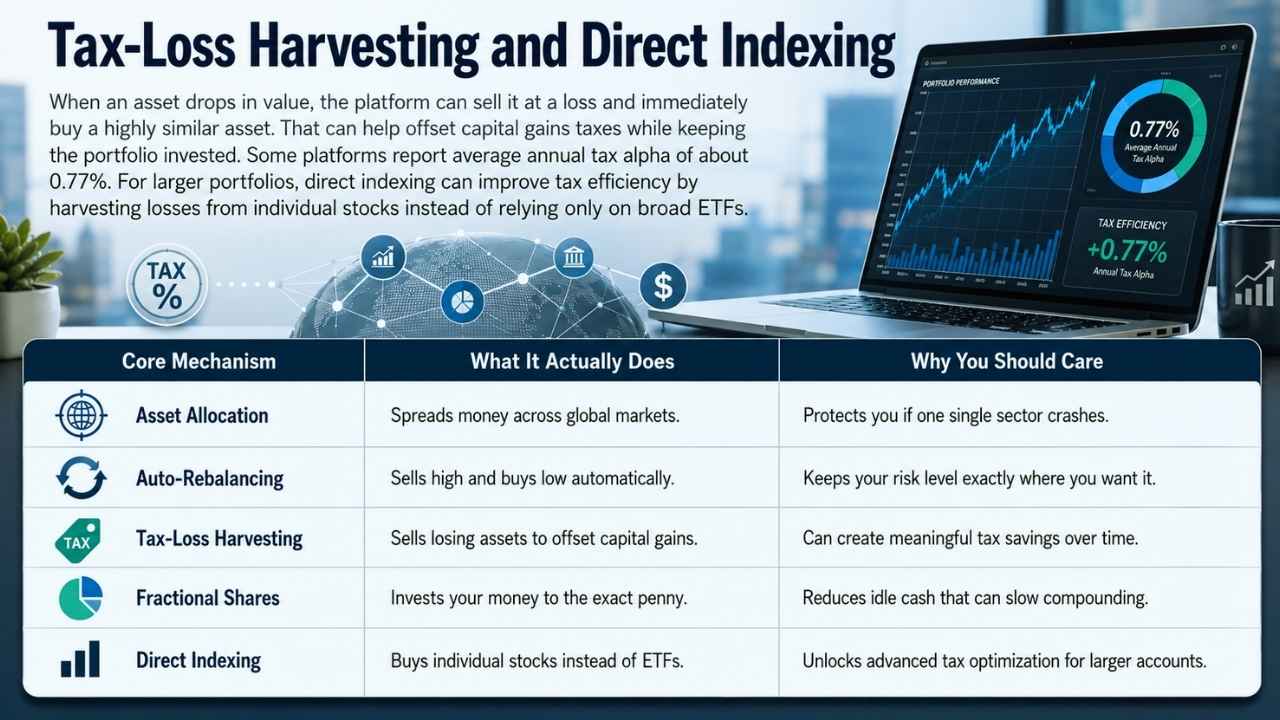
Then comes the real heavy lifting: tax-loss harvesting. When a specific asset in your account loses value, the software automatically sells it at a loss and instantly buys a highly similar asset. You claim that loss on your taxes to offset your gains, but your portfolio stays fully invested. Platforms like Betterment report an average “tax alpha” (extra returns from tax savings) of roughly 0.77% annually.
For larger accounts, platforms now trigger Direct Indexing. Instead of buying a broad ETF, the app buys the hundreds of individual stocks that make up the index. It then harvests tax losses on the micro-level, selling specific losing stocks to offset your tax bill even when the overall market is up.
|
Core Mechanism |
What It Actually Does |
Why You Should Care |
|
Asset Allocation |
Spreads money across global markets. |
Protects you if one single sector crashes. |
|
Auto-Rebalancing |
Sells high and buys low automatically. |
Keeps your risk level exactly where you want it. |
|
Tax-Loss Harvesting |
Sells losing assets to offset capital gains. |
Generates massive tax savings over a decade. |
|
Fractional Shares |
Invests your money to the exact penny. |
Stops idle cash from hurting your compound interest. |
|
Direct Indexing |
Buys individual stocks instead of ETFs. |
Unlocks elite tax optimization for high-balance accounts. |
Top Platforms Dominating Right Now
The industry has shrunk down to a few massive players. Finding the right one depends entirely on how much cash you are starting with and whether you want access to a human planner later on. Here are the exact numbers for 2026.
Fidelity Go: Fidelity is absolutely destroying the competition for beginners. If you have under $25,000, they charge a 0.00% advisory fee. You pay nothing to have them manage your money, and you just need $10 to start. Once you cross $25k, the fee bumps to 0.35%, but that tier unlocks unlimited 1-on-1 coaching calls with actual financial advisors.
Wealthfront: This is the absolute king for pure, hands-off tech investors. They charge a flat 0.25% fee and need a $500 minimum. Hit $100,000, and they automatically upgrade you to direct indexing. Plus, their cash account is a monster this year. They currently pay a 3.30% base APY, but you can push that to 4.05% with referral boosts and earn an extra 0.25% indefinitely if you direct deposit $1,000 a month.
Betterment: Betterment recently overhauled its pricing for 2026. If you have under $24,000, you pay a flat $5 a month. That flat fee eats into small balances fast. But, if you set up a $200 monthly recurring deposit, they drop you to their standard 0.25% tier. Have over $100k? You can upgrade to a 0.65% premium plan for unlimited access to certified financial planners.
Vanguard Digital Advisor: Vanguard lowered its minimum to just $100. It charges roughly 0.15% and completely skips the flashy app design. It’s perfect for die-hard index investors who just want reliable, dirt-cheap automation without the frills.
|
App |
2026 Annual Fee |
Minimum Deposit |
Standout 2026 Perk |
|
Fidelity Go |
0.00% under $25k / 0.35% over |
$10 |
Free to start, free human coaching later. |
|
Wealthfront |
0.25% |
$500 |
Up to 4.05% APY on cash and elite tax tools. |
|
Betterment |
$5/mo or 0.25% / 0.65% Premium |
$0 |
Goal-based buckets and easy CFP access. |
|
Vanguard Digital |
~0.15% |
$100 |
Dirt-cheap index funds and massive reliability. |
Are Robo Advisors Worth It for Your Money?
Let’s cut straight to it: are robo advisors worth it for you specifically? It all boils down to your net worth and your personal habits.
If you are a new investor, busy with your career, or notorious for leaving extra cash in a checking account, a digital app is absolutely worth the 0.25% fee. Think of it as a behavioral tax. Humans naturally suck at investing. We freak out when the market tanks and sell everything at the bottom. We get greedy and buy tech stocks at the absolute peak. An app removes your dumbest emotional impulses. You set up a weekly deposit, delete the app from your home screen, and let the math work for a decade.
Plus, that tiny fee easily pays for itself through tax-loss harvesting. If a platform charges you 0.25% but saves you 0.70% in taxes, you are mathematically coming out way ahead.
But you also need to know when to leave. If you are selling a massive business, dealing with crazy real estate syndications, or navigating complex family trusts, an algorithm will fail you. Apps are amazing for liquid stocks and bonds, but they cannot write a comprehensive estate plan or talk to your CPA about international tax law.
|
Investor Type |
Are They Worth It? |
The Honest Reason |
|
The Beginner |
Yes, absolutely. |
Stops you from overthinking and gets money moving fast. |
|
The Busy Worker |
Yes. |
Automates everything so you get your weekends back. |
|
The Wealthy Founder |
Probably not. |
Zero help with estate planning or business exits. |
|
The Day Trader |
No. |
You cannot pick hot stocks; these are for long-term holding. |
The Big Shift: Hybrid Investing
Here is the most interesting trend hitting the wealth management market right now. People love automation, but they still want a human safety net. “Hybrid” advisory models—where you get slick software plus a human you can call—now capture the majority of the industry’s revenue.
High-net-worth clients want the app to handle the daily tax trades, but they want a human on the phone when they are deciding whether to buy a house, get married, or fund a kid’s college. Platforms like Betterment Premium and Fidelity Go’s top tier perfectly bridge this gap. You get the math of a machine and the empathy of a human.
|
Model |
What It Actually Is |
Who Needs It The Most |
|
Pure Digital |
100% algorithm, zero humans. |
Hands-off investors with straightforward taxes. |
|
Hybrid |
App + real human planners. |
People going through big life changes. |
|
Traditional |
Dedicated human advisor. |
Extremely complex, multi-million dollar estates. |
The Good and the Bad of Automation
Every financial tool has trade-offs. Here is exactly what you need to weigh before you wire your money over.
The Good: Cost and massive convenience. You cut out the expensive downtown office and keep the profits for yourself. You can set up a globally diversified portfolio while waiting in line for a coffee. Plus, top platforms now act as full bank replacements. Wealthfront’s Cash Account offers routing numbers, a debit card, and an APY that crushes traditional banks. They want to be the only money app on your phone.
The Bad: Strict rigidity. You generally cannot buy shares of your favorite tech company inside a standard automated portfolio. If you want to day-trade, you need a separate brokerage account entirely. Also, when the market crashes 20%, an FAQ page gives zero comfort. A human advisor talks you off the ledge; an app just pushes a notification showing your money bleeding out in bright red numbers. Finally, you have to watch out for new revenue streams. In 2026, some platforms are pushing deeper into Payment for Order Flow (PFOF) and Securities Lending, which means they lend your shares out to short-sellers to make extra cash.
|
The Good Stuff |
The Bad Stuff |
|
Dirt-cheap fees (usually 0.25%). |
You cannot easily pick individual stocks. |
|
Hands-free tax harvesting. |
No emotional support when the market tanks. |
|
High-yield cash accounts (3.30%+ APY). |
Useless for complex estate or trust planning. |
|
Fractional shares put every penny to work. |
Talking to a human planner costs extra money. |
Final Thoughts
The way we handle money has completely flipped. Paying a guy 1.5% of your net worth to buy basic mutual funds is a relic of the past. By using massive computing power, smart tax strategies, and fractional shares, these apps have unlocked elite financial tactics for regular people.
So, asking yourself if robo-advisors are worth it in 2026 really comes down to your bandwidth. If you value your time, want to dodge high fees, and need a cold, emotionless system to grow your cash, yes—absolutely. They kill the friction and fear of investing. Whether you go pure digital with Wealthfront to grab that high APY or go hybrid with Fidelity Go for the free coaching; putting an algorithm to work is one of the smartest money moves you can make right now.
Frequently Asked Questions (FAQs) About Robo Advisors Worth It
People ask a lot of nuanced questions before handing over thousands of dollars. Here is the actual truth behind the most common concerns.
Does a digital app protect me in a market crash?
No. Unless your money is in an FDIC-insured cash account, it will drop when the stock market drops. If you hold an aggressive portfolio and the S&P 500 dives 20%, your balance dives right alongside it. But here is the catch: the app automatically buys the dip for you by rebalancing, setting you up to make more money during the eventual recovery.
There are no hidden transaction fees or trading commissions on the big platforms. But, you do pay the tiny Expense Ratios of the ETFs the app buys (usually around 0.05% to 0.15%). You will never see a surprise bill, but those tiny fund fees are baked into the asset prices.
What is the new Betterment fee in 2026?
Betterment tweaked things recently. If your household balance is under $24,000, you pay a flat $5 a month. But if you set up a recurring deposit of at least $200 a month, they waive that flat fee and drop you back to the standard 0.25% rate regardless of your balance.
Can I transfer my existing stocks in without paying taxes?
Watch out for this one. If you transfer existing stocks “in-kind,” the algorithm usually sells them instantly to buy its preferred ETFs to balance your account. If those old stocks had huge gains, the app just triggered a massive tax bill for you. Always talk to a tax pro before moving highly appreciated assets into an automated system.
How does the Wealthfront APY work this year?
As of early 2026, Wealthfront’s base APY is 3.30%. They offer a 0.65% boost for three months if you are a new client, and another 0.75% boost for referrals. You can also snag an indefinite 0.25% bump if you direct deposit at least $1,000 a month.