
You’ve seen the headlines flashing across your screen. “The Fed holds rates steady,” or “New Fed Chair shifts policy.” Wall Street traders hold their breath, mortgage rates swing wildly, and suddenly carrying a balance on your credit card gets a little more expensive.
But if you step back from the daily noise and ask yourself, what is federal reserve, you might realize it’s a giant, invisible force that everyone talks about but very few actually understand.
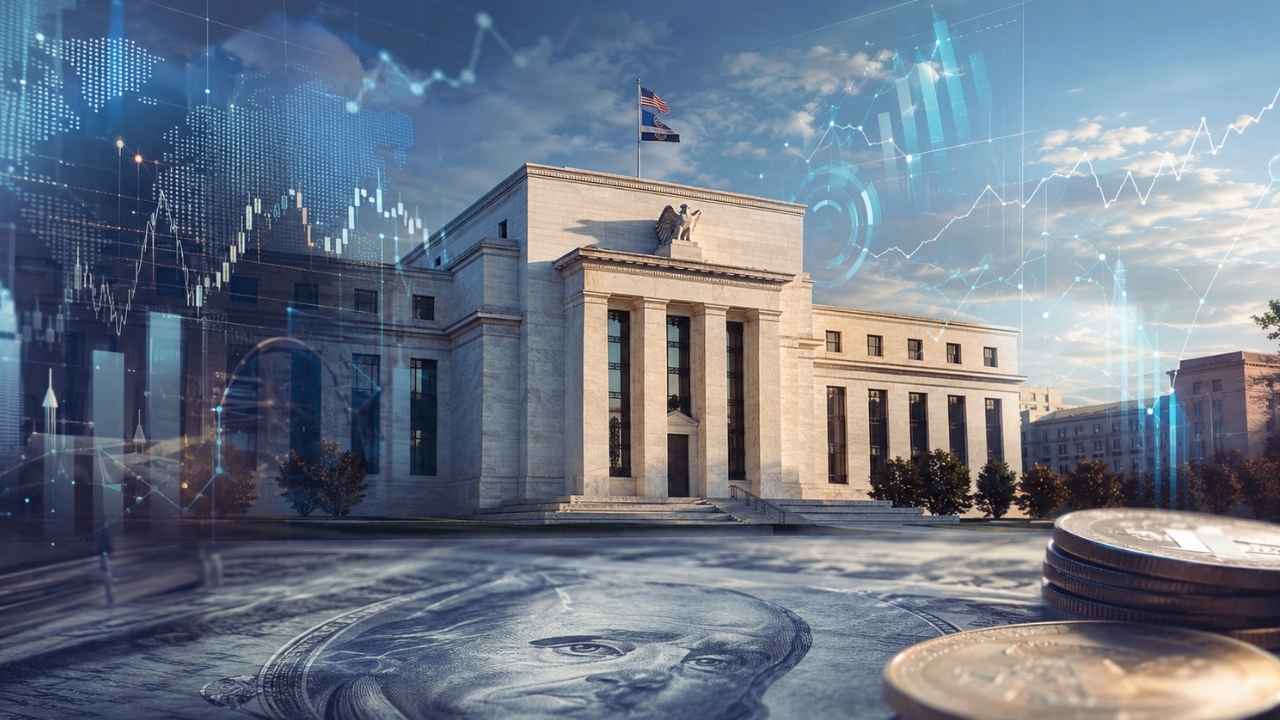
Think of the Federal Reserve as the financial engine room of the United States. It doesn’t hold your personal checking account, and you can’t walk into a local branch to deposit a paycheck. Yet, every time you borrow money to buy a car, swipe your card for groceries, or check your retirement savings, this institution has its hands in the background. It acts as the central bank of the US, engineered to keep the entire economy from spinning out of control.
We’re going to strip away the complex Wall Street jargon. Let’s look right under the hood to see exactly how this system works, why it was created in the first place, and how real-time policy decisions—especially the massive leadership shifts we’ve seen in 2026—hit your wallet directly.
What Is the Federal Reserve?
To clearly answer what is federal reserve, we have to rewind to the early 1900s. Before 1913, the American banking system was essentially the Wild West. Financial panics happened constantly. If a rumor started that a bank was running out of money, people would sprint to withdraw their cash. Because banks lend out most of what they take in, they would quickly run dry and collapse, taking everyone’s savings down with them. The Panic of 1907 was so brutal that Congress finally decided the country needed a permanent financial backstop. They passed the Federal Reserve Act, which President Woodrow Wilson signed into law.
The Federal Reserve is the central bank of the United States. Its core job is to keep the country’s financial system stable, safe, and flexible enough to handle crises. It acts as a “bank for banks” and manages the federal government’s massive flow of cash.
But you won’t find one single, towering building in Washington, D.C., where a few executives sit in a room controlling the entire world’s money. The founders intentionally designed a decentralized system. They wanted to make sure no single political party, Wall Street faction, or coastal elite could dominate the nation’s wealth. To pull this off, the system carefully balances public government oversight with private-sector banking operations.
When you ask what is federal reserve, you are really asking about a vast, interconnected network that monitors the heartbeat of the US economy, pumping cash in when times are tough and aggressively pulling money out when inflation runs way too hot.
|
Feature |
Detailed Description |
|
Founded |
December 23, 1913, following a series of devastating banking panics. |
|
Primary Goal |
Maintaining economic stability, maximum employment, and stable prices. |
|
Unique Structure |
A decentralized hybrid blending government oversight and private banking. |
|
Funding Source |
Entirely self-funded through its own investments; uses zero taxpayer dollars. |
The Three Key Pillars of the Fed System
You can’t grasp how this economic beast operates without breaking down its three main parts. It’s built exactly like a tripod. If you remove just one leg, the whole system falls apart.
The Board of Governors
Sitting in Washington, D.C., this is the pure government side of the operation. It consists of seven members appointed directly by the US President and confirmed by the Senate. They serve staggering 14-year terms. Why 14 years? The goal is to keep them totally insulated from everyday political pressure. Presidents and lawmakers come and go, but a Fed governor stays put, allowing them to make unpopular but necessary financial choices without worrying about losing an election. They oversee the entire system, write strict banking regulations, and participate heavily in setting monetary policy.
The 12 Regional Federal Reserve Banks
Because the US economy is incredibly massive and diverse, the founders didn’t want New York or Washington calling all the shots for farmers in the Midwest or tech companies out West. They carved the country into 12 distinct districts, giving each its own Reserve Bank (such as the Boston, Dallas, or San Francisco Feds). These regional banks act as the eyes and ears on the ground. They track local economic trends, handle massive physical cash distribution, and process billions in electronic payments. When your local community bank needs stacks of physical $100 bills, they order it from their regional Fed.
The Federal Open Market Committee (FOMC)
This is the big one. When you hear financial news networks obsessing over an “interest rate decision,” they are talking about the FOMC. It consists of 12 voting policymakers: the seven Board of Governors, the president of the New York Fed (who always gets a vote), and four other regional Fed presidents who rotate in and out every year. They lock themselves in a room eight times a year to decide the future of the nation’s monetary policy.
|
Entity |
Who They Are |
Primary Responsibility |
|
Board of Governors |
7 presidential appointees in D.C. |
Oversee the system, write complex banking regulations. |
|
12 Reserve Banks |
Regional branches spread across the US |
Monitor local economies, distribute physical currency. |
|
FOMC |
12 voting policymakers |
Set national monetary policy and dictate interest rates. |
What Does the Federal Reserve Actually Do?
You know the basic structure, but what do these economists do all day? The central bank wears a lot of heavy hats. If you want to know what the Federal Reserve’s strategy is on a day-to-day basis, it boils down to four massive responsibilities.
1. Directing Monetary Policy (The Dual Mandate)
Congress gave the Fed two incredibly clear jobs: keep consumer prices stable (crush inflation) and maximize employment (keep Americans working). Economists call this the “dual mandate.” It’s a viciously delicate balancing act. If the economy runs too hot and everyone is spending freely, inflation spikes and ruins purchasing power. If the economy runs too cold, businesses go bankrupt and millions lose their jobs. The Fed adjusts interest rates and shrinks or expands the money supply to keep the economy hovering right in the sweet spot.
2. Supervising and Regulating Banks
The Fed acts as a heavy-handed financial referee. It constantly monitors commercial banks to make sure they play by the rules, keep enough actual cash on hand, and avoid taking reckless, casino-style gambles with your personal deposits. After the brutal 2008 financial crisis, this role expanded massively. Today, the Fed routinely runs severe “stress tests” on Wall Street banks to mathematically ensure they can survive a deep economic depression without ever needing another taxpayer bailout.
3. Maintaining Financial Stability
Sometimes, blind panic strikes the markets. A massive regional bank fails, a global pandemic hits, or a geopolitical conflict freezes up global trading routes. When normal banks stop lending to each other out of fear, the Fed steps in as the “lender of last resort.” They supply emergency, short-term cash to the financial system so healthy banks don’t collapse and businesses can keep making payroll.
4. Providing Financial Services
Every time a bank needs to transfer a billion dollars to another bank, they don’t load up an armored truck. They use the Fed’s secure digital payment systems. The Fed clears millions of complex electronic transfers and physical checks every single day. It also literally handles the government’s checking account, processing social security payments and receiving your tax dollars.
|
Responsibility Area |
Real-World Application |
|
Monetary Policy |
Raising or lowering rates to control inflation. |
|
Bank Regulation |
Conducting intense stress tests on massive Wall Street banks. |
|
Financial Stability |
Pumping emergency cash into markets during a blind panic. |
|
Financial Services |
Clearing daily bank transfers and issuing government payments. |
How the Fed Controls Interest Rates?
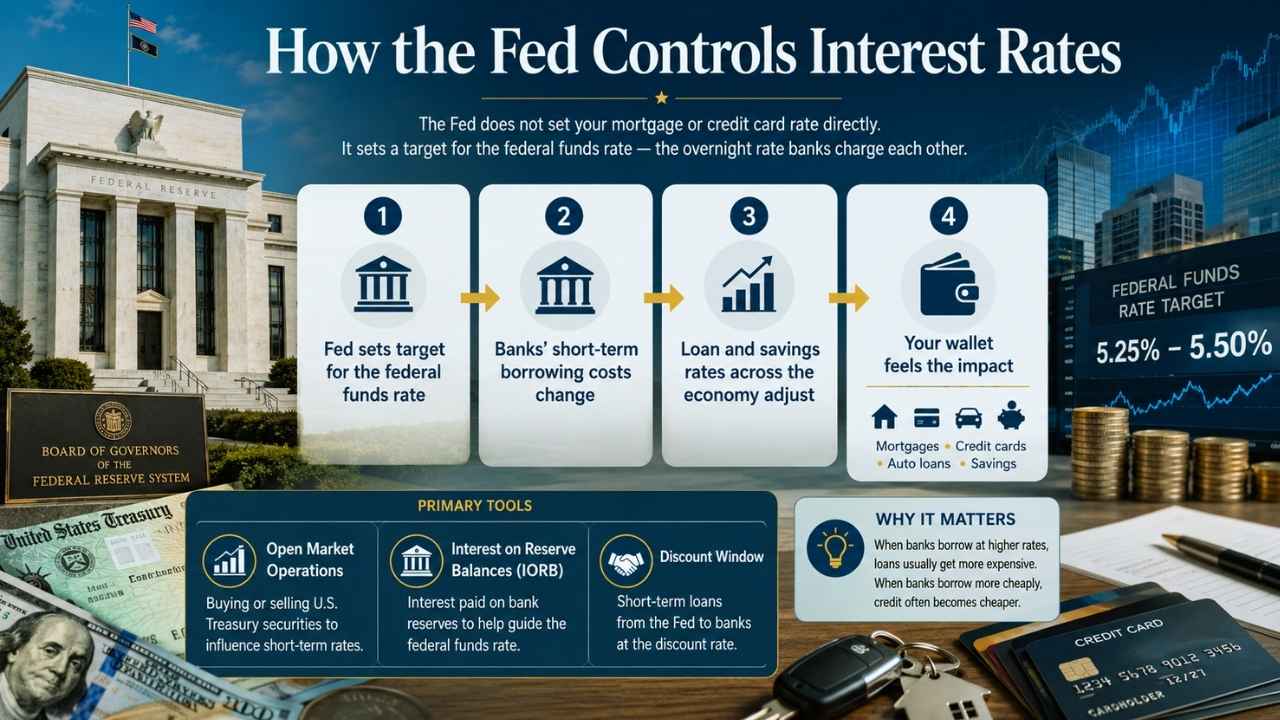
This is the exact mechanism that hits your wallet. The Fed doesn’t log into a computer and set the interest rate on your specific 30-year mortgage or your travel credit card. Instead, they set a target for something called the federal funds rate. This is the baseline interest rate that commercial banks charge each other for overnight, short-term loans.
When banks have to pay more money to borrow cash, they aggressively pass that cost right onto you. When banks can borrow cheaply, they offer you cheaper, more attractive loans. To physically move this rate up or down, the Fed relies on a few primary tools.
Open Market Operations
This is their favorite and most frequently used lever. The Fed buys and sells US government securities (bonds) on the open market. When they buy bonds from banks, they inject fresh digital cash into the banking system. More cash means cheaper loans, which lowers interest rates and stimulates spending. When they sell bonds, they pull cash out of the system, which pushes borrowing rates up and cools down inflation.
Interest on Reserve Balances (IORB)
Banks keep vast amounts of cash parked at the Fed. The Fed pays them interest on this money. By raising or lowering the IORB rate (which they held steady at 3.65% in mid-2026), the Fed creates a floor for interest rates. If the Fed pays banks a high risk-free rate, banks won’t lend to you or me for anything less than that.
The Discount Rate
This is the penalty interest rate the Fed charges banks to borrow directly from their emergency window. Banks usually only tap this during a crisis to avoid looking weak. However, changing this rate sends a glaringly strong signal to the global market about where the Fed intends to push overall interest rates.
|
Policy Tool |
Fed Action |
Result on the Broad Economy |
|
Open Market Operations |
Buy bonds (injects cash) |
Lowers rates, makes borrowing easy, boosts spending. |
|
Open Market Operations |
Sell bonds (removes cash) |
Raises rates, makes borrowing hard, fights inflation. |
|
IORB (Interest on Reserves) |
Raise the rate paid to banks |
Banks hoard cash at the Fed; consumer loans get expensive. |
|
The Discount Rate |
Raise the emergency borrowing rate |
Slows down aggressive bank lending during a boom. |
Why Fed Decisions Mean So Much for Your Wallet?
It’s easy to dismiss central banking as high-level, boring math that only matters to guys in suits on Wall Street. But the stark reality is that their policy decisions filter down to your daily life almost immediately.
Mortgages and the Housing Market
While the Fed doesn’t set 30-year mortgage rates directly, those rates closely track the 10-year Treasury yield, which heavily relies on the Fed’s overall long-term policy direction. When the Fed hikes its benchmark rate to fight off inflation, mortgage rates surge almost instantly. Suddenly, a $400,000 house costs you hundreds of dollars more every single month in pure interest, heavily cooling the real estate market and pricing out first-time buyers.
Credit Cards and Auto Loans
These specific consumer rates react almost overnight to the Fed. Most credit cards have variable interest rates legally tied to the “prime rate,” which moves in exact lockstep with the federal funds rate. If the Fed hikes rates by 0.25% on a Wednesday afternoon, your credit card APR is probably going up by that exact same mathematical amount within a billing cycle or two.
High-Yield Savings and CDs
It’s not all doom and gloom when rates rise. If you are a disciplined saver with cash in the bank, a high-rate environment is fantastic. Banks are forced to compete for your deposits by offering much higher yields on savings accounts and Certificates of Deposit (CDs). Conversely, when the Fed aggressively cuts rates to save a dying economy, those juicy 5% high-yield savings accounts dry up fast.
Job Security and Your Wages
This is the brutal, hidden impact of central banking. If the Fed raises rates too high, borrowing cash becomes so agonizingly expensive that businesses stop expanding. They scrap plans for new factories, freeze all hiring, or start laying people off. Wage growth grinds to a halt. It’s a painful, intentional trade-off required to stop everyday prices from spiraling totally out of control.
|
Financial Area |
When the Fed Raises Rates… |
When the Fed Cuts Rates… |
|
Mortgages |
Borrowing is highly expensive; housing market freezes. |
Borrowing is cheap; housing market booms wildly. |
|
Credit Cards |
Monthly interest charges increase on your balances. |
Existing debt becomes slightly cheaper to carry month-to-month. |
|
Savings Accounts |
Yields rise; you earn great passive money on cash. |
Yields drop; your savings earn virtually nothing. |
|
The Job Market |
Hiring slows down; unemployment often ticks upward. |
Hiring accelerates rapidly; wages and bonuses grow. |
The Independence of the Federal Reserve
One of the most heavily debated aspects of the central bank is who actually controls the levers. Is it part of the federal government? Sort of, but not really.
The Fed was created by an act of Congress, and its rigid structure is defined by federal law. However, it operates independently within the government framework. The US President does not tell the Fed chair what to do, and Congress cannot simply pass a law dictating tomorrow’s interest rates.
History explicitly shows that when politicians control the national money printer, they tend to make terrible, self-serving choices. A politician might artificially slash rates right before a major election to make the economy look amazing, which inevitably triggers a massive, devastating wave of inflation a year later. To prevent this exact scenario, the Fed’s monetary decisions do not have to be ratified or approved by the President, the Treasury, or any executive branch official.
Furthermore, the Fed is a self-funded machine. It does not rely on Congress to pass an annual budget. It earns its own money from the interest on the massive pile of government securities it holds and from fees charged to commercial banks. After paying its internal expenses, it wires all remaining profits straight to the US Treasury.
|
Aspect of the Fed |
Government Connection |
Independent Feature |
|
Leadership |
Board members appointed by the US President. |
Serve 14-year terms; utterly insulated from political threats. |
|
Funding |
Returns all net profits to the US Treasury. |
Zero taxpayer funding; operates entirely self-financed. |
|
Policy Decisions |
Testifies to Congress twice a year. |
Requires absolutely no political approval for rate changes. |
What Is Federal Reserve Strategy Under Chairman Kevin Warsh?
If you want to know what is federal reserve policy right now, you have to look at the massive shifts that occurred in 2026. The central bank had been navigating incredibly choppy, dangerous economic waters. After inflation spikes pushed rates to 5.50% in 2023, the Fed spent 2024 and 2025 gradually cutting rates as the economy cooled, bringing the target down to a range of 3.50% to 3.75%.
However, everything changed in May 2026 when Kevin Warsh was sworn in as the 17th Chair of the Federal Reserve, succeeding Jerome Powell. Warsh, a former investment banker known historically as an “inflation hawk,” took the helm during a highly complicated period. Global energy prices had spiked due to ongoing Middle East conflicts, causing core inflation to stubbornly rise again, pushing well past the Fed’s 2% target.
During his highly anticipated first FOMC meeting on June 16-17, 2026, Warsh and the committee voted unanimously (12-0) to hold the federal funds rate dead steady at 3.50% to 3.75%. They also maintained the interest rate on reserve balances (IORB) at 3.65%.
But the biggest shock wasn’t the rate hold—it was how Warsh changed the playbook. He abruptly killed the Fed’s practice of offering “forward guidance” (telling the market exactly what they plan to do months in advance). He released a dramatically shorter, blunt policy statement. In his press conference, he stated the committee was “unambiguous and unanimous” in its mission to deliver price stability, letting Wall Street know the era of easy money and predictable rate cuts was completely over. He also launched aggressive new task forces, including one heavily focused on how Artificial Intelligence will impact employment and inflation going forward.
|
Time Period |
Economic Situation |
Fed Action & Leadership |
|
2022-2023 |
Runaway post-pandemic inflation peaking over 9%. |
Aggressive rate hikes up to 5.50% under Chair Jerome Powell. |
|
2024-2025 |
Inflation slowly cooling, job market stabilizing. |
Gradual rate cuts down to the 3.50% – 3.75% range. |
|
June 2026 |
Energy shocks and Middle East conflict push inflation up. |
Kevin Warsh takes over; holds rates steady, drops forward guidance entirely. |
Final Thoughts
After digging through the dense history, the complex internal structure, and the massive economic levers, we always come right back to the original premise. What is federal reserve? Ultimately, it is the absolute final shock absorber for the massive American economy.
It certainly isn’t perfect. Hardline critics argue it constantly reacts way too slowly to obvious inflation, or that it keeps rates too low for too long, creating massive, dangerous bubbles in housing and the stock market. Others furiously argue its aggressive rate hikes punish working-class people with credit card debt just to satisfy wealthy Wall Street bondholders. Frankly, both sides have highly valid points. But without this institution, the US financial system would be incredibly fragile, highly vulnerable to the devastating, civilization-halting bank runs that repeatedly crippled the country a century ago.
Frequently Asked Questions (FAQs) About What Is Federal Reserve?
Does the Federal Reserve physically print money?
No. This is an incredibly common misconception. The Bureau of Engraving and Printing (which is a strict arm of the US Treasury) physically prints the green paper bills. The US Mint manufactures the coins. The Fed simply orders the physical cash and securely distributes it to local banks via armored trucks. When Wall Street traders say “the Fed is printing money,” they mean the Fed is digitally adding credits to banks’ reserve accounts out of thin air, not running a physical printing press.
Who actually owns the Federal Reserve?
It is not owned by any single wealthy family or private, shadowy corporation. The 12 regional Reserve Banks are technically set up like private corporations, and the commercial banks operating in their districts are legally required to hold stock in them. However, this specific stock cannot be publicly traded, sold, or borrowed against, and it doesn’t give those banks actual control over Fed policy. It’s a highly unique hybrid structure designed to blend public goals with private mechanics.
Has the Fed ever run out of money?
By strict definition, a modern central bank operating in a fiat currency system cannot ever run out of money. It legally creates the digital reserves that function as base money. During a severe global crisis, it can expand its balance sheet almost infinitely to purchase massive amounts of assets and stabilize a collapsing system.
Can the President fire the Fed Chair if they refuse to cut rates?
The Federal Reserve Act allows the President to remove a Fed governor strictly “for cause” (meaning they broke a federal law or committed a severe, documented ethical violation). A President cannot legally fire the Chair simply because they are angry about high mortgage rates. In US history, no President has ever successfully fired a Fed Chair over policy disagreements.