

We all want to build wealth, kill off our debt, and stop sweating over rent every single month. But searching for solid money advice usually feels like a second job. You do not need another generic lecture from someone who bought a house for fifty thousand dollars in 1982. You need tactical, modern strategies that work in today’s wild economy.
With inflation squeezing daily budgets and the housing market presenting new hurdles, standard financial advice from a decade ago simply falls flat. Money management connects directly to your daily habits, your emotional triggers, and the automated systems you run behind the scenes. We stripped away the noise to bring you the best personal finance books 2026 has to offer. Whether you want to master index funds, crush your student loans, or just figure out where your cash actually goes every Friday, the right advice shortcuts your path to independence. Grab a coffee, clear your reading list, and let’s break down the titles that will actually move the needle for your bank account this year.
Mindset and Behavioral Shifts for Wealth
Strategy means absolutely nothing if your mindset is broken. I have seen brilliant people go completely broke simply because they could not control their impulses. These books fix the psychological traps that keep smart people broke. They focus on the mental game of money, teaching you how to build patience, ignore flashy trends, and understand your own financial triggers.
1. The Psychology of Money by Morgan Housel
Morgan Housel proves that getting rich has barely anything to do with how smart you are. It revolves entirely around how you behave. Financial success requires managing your ego, ignoring the crowd, and understanding your own emotional baggage. Housel uses short, punchy stories to show how ordinary people build massive wealth simply by staying consistent.
He points out how brilliant investors often lose everything due to arrogance, while ordinary folks retire as millionaires through sheer patience. Compounding only works if you leave your money alone. Stop interrupting your investments to chase the next big crypto trend. If you constantly panic-sell during market dips, no spreadsheet can save you.
|
Feature |
Details |
|
Core Focus |
Behavioral finance and emotional drivers |
|
Best For |
Anyone struggling with impulse control or market panic |
|
Key Takeaway |
Wealth is what you do not see; behavior beats math |
|
Data Point |
Sold over three million copies globally |
2. Die With Zero by Bill Perkins
Bill Perkins challenges everything we know about retirement. Why hoard millions until you turn eighty, when your knees are too bad to actually travel and enjoy the money? He argues for optimizing your life experiences across different decades. Perkins introduces the memory dividend. Think of it as compound interest, but for memories. Early life experiences pay out for the rest of your life.
He also pushes the idea of giving your wealth to your kids when they actually need it in their thirties, rather than when they are already established in their sixties. He gives you a hard mathematical framework to figure out exactly when your net worth should peak.
|
Feature |
Details |
|
Core Focus |
Maximizing life experiences over mindless saving |
|
Best For |
Over-savers and those afraid to spend their money |
|
Key Takeaway |
Experiences pay a lifelong memory dividend |
|
Data Point |
Highly popular among the modern financial independence crowd |
3. Your Money or Your Life by Vicki Robin and Joe Dominguez
This book forces a brutal reality check. You must calculate your real hourly wage. Once you factor in the cost of your commute, work clothes, and the time you spend decompressing from a toxic boss, you realize exactly how much of your life energy you trade for a paycheck. This completely flips how you view spending.
You start tracking every penny and asking if a purchase brought you joy proportional to the hours of life you traded for it. If buying a forty-dollar takeout meal costs you two hours of your life energy based on your true wage, you will suddenly prefer cooking at home. It remains the ultimate guide for aligning your spending with your actual values.
|
Feature |
Details |
|
Core Focus |
Calculating the true cost of your spending habits |
|
Best For |
Anyone wanting to align money with personal values |
|
Key Takeaway |
Money equals the life energy you trade to get it |
|
Data Point |
Considered a foundational text for the FIRE movement |
4. The Richest Man in Babylon by George S. Clason
Some financial advice never gets old. Set in ancient Babylon, this classic uses parables to teach basic rules that still work flawlessly today. The central premise stands simple and powerful: pay yourself first. Before you pay your landlord, the grocery store, or the credit card company, take ten percent of your earnings and hide it from yourself.
Clason walks you through seven simple cures for a lean purse. He teaches you to control your spending, make your gold multiply, and guard your cash against bad investments. It is a quick read, but the lessons stick with you for life.
|
Feature |
Details |
|
Core Focus |
Timeless rules of saving and wealth preservation |
|
Best For |
Readers who enjoy story-based learning |
|
Key Takeaway |
Always pay yourself a minimum of ten percent first |
|
Data Point |
Originally published in 1926 and still heavily recommended |
5. The Millionaire Next Door by Thomas J. Stanley and William D. Danko
Want to know a massive financial secret? True millionaires rarely drive brand-new sports cars or wear flashy designer watches. They live well below their means, drive used cars, and aggressively save their income. The authors researched wealthy households and found that high-income earners are often entirely broke.
They constantly spend money trying to look rich to their neighbors. True wealth is what you do not see. It is the cash not spent on status symbols. If you want to understand the difference between earning a lot and actually keeping it, you must read this research.
|
Feature |
Details |
|
Core Focus |
Exposing the actual habits of wealthy Americans |
|
Best For |
High earners struggling to build actual net worth |
|
Key Takeaway |
Looking rich and being wealthy are exact opposites |
|
Data Point |
Based on decades of deep demographic research |
Foundational Steps for Beginners
If credit scores, budgets, and debt payoff plans make your eyes glaze over, start right here. These guides ditch the Wall Street jargon and hand you a clear, idiot-proof roadmap. They focus on setting up strong foundations so you can stop living paycheck to paycheck and start putting your money to work.
6. I Will Teach You to Be Rich by Ramit Sethi
Ramit Sethi cuts through the noise with a highly actionable six-week program. He absolutely hates traditional budgeting. Instead, he pushes conscious spending. You should spend aggressively on the things you love, and cut costs mercilessly on the things you do not care about. Sethi walks you through setting up automated systems.
Your money routes itself to savings, investments, and bill payments before you even wake up on payday. He provides exact, word-for-word scripts you can use to negotiate your salary, lower your internet bill, and get late credit card fees wiped out. By week six, your finances run completely on autopilot.
|
Feature |
Details |
|
Core Focus |
Automating finances and conscious spending |
|
Best For |
Millennials and Gen Z seeking a step-by-step system |
|
Key Takeaway |
Spend extravagantly on things you love; automate everything else |
|
Data Point |
Features actionable scripts for negotiating bills and salary |
7. Broke Millennial by Erin Lowry
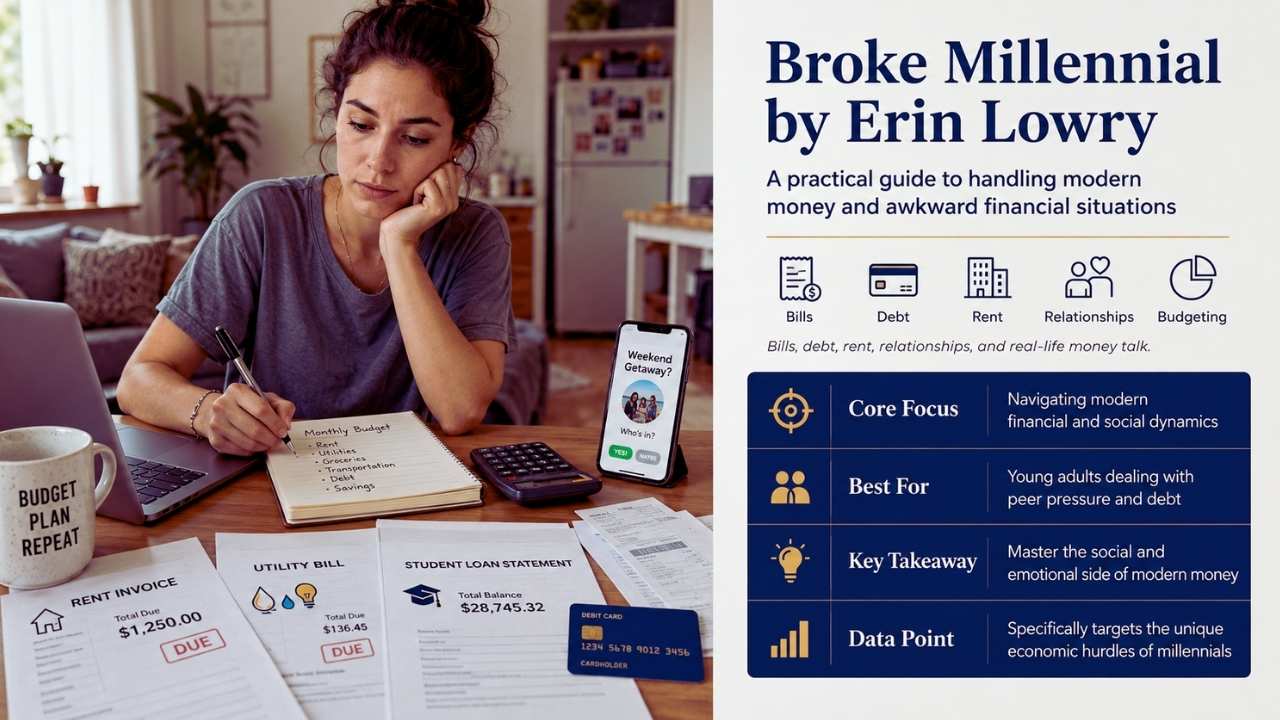
Erin Lowry tackles the awkward, real-world money situations that older finance books completely ignore. She speaks directly to a generation navigating a tough economic climate, brutal rent costs, and flat wages. Lowry covers how to split bills with friends who earn double what you do, how to talk to your partner about a terrible credit score, and how to handle the anxiety of student loans.
It reads exactly like advice from a financially savvy friend who actually understands modern social dynamics. She does not just tell you to save. She tells you exactly what to say when your friends invite you to a group trip you cannot afford.
|
Feature |
Details |
|
Core Focus |
Navigating modern financial and social dynamics |
|
Best For |
Young adults dealing with peer pressure and debt |
|
Key Takeaway |
Master the social and emotional side of modern money |
|
Data Point |
Specifically targets the unique economic hurdles of millennials |
8. Get Good with Money by Tiffany Aliche
Tiffany Aliche, known as The Budgetnista, lost everything before building a massive financial empire. Her book breaks money management down into ten manageable steps to achieve what she calls financial wholeness. She covers the bare essentials like budgeting and saving, but tackles critical areas most beginners completely ignore.
This includes securing the right insurance policies and setting up a will. Aliche’s tone is incredibly warm and completely non-judgmental. She helps you build a noodle budget, which is the bare minimum you need to survive if you lose your job tomorrow.
|
Feature |
Details |
|
Core Focus |
Achieving ten-step financial wholeness |
|
Best For |
Anyone feeling overwhelmed or recovering from financial ruin |
|
Key Takeaway |
Focus on wholeness over chasing arbitrary numbers |
|
Data Point |
Reaches millions of followers online with practical advice |
9. When She Makes More by Farnoosh Torabi
As more women become the primary breadwinners in their households, traditional financial advice often misses the mark completely. Torabi dives into the specific challenges faced by high-earning women and offers concrete strategies to structure finances without ruining household dynamics.
She provides practical tips on how to balance the financial load, communicate openly with a partner who earns less, and protect your assets. It is a niche but highly necessary book that tackles the messy intersection of money, ego, and modern relationships. It empowers women to own their financial success.
|
Feature |
Details |
|
Core Focus |
Managing finances as a female breadwinner |
|
Best For |
High-earning women navigating relationship dynamics |
|
Key Takeaway |
Structure accounts and communication to avoid resentment |
|
Data Point |
Addresses a rapidly growing demographic of female earners |
10. Rich Dad Poor Dad by Robert Kiyosaki
Robert Kiyosaki completely redefines what an asset actually is. Most people think their house or their car is their greatest asset. Kiyosaki argues that if it takes money out of your pocket every month, it is a liability. The wealthy do not work for money. They acquire assets that work for them.
This book violently shifts your focus from chasing a higher salary to building streams of passive income through real estate, businesses, and paper assets. It changes how you look at a paycheck. You stop seeing it as money to blow on the weekend, and start seeing it as capital to buy more freedom.
|
Feature |
Details |
|
Core Focus |
Understanding the difference between assets and liabilities |
|
Best For |
Aspiring entrepreneurs and real estate investors |
|
Key Takeaway |
Buy assets that put cash in your pocket |
|
Data Point |
One of the highest-selling personal finance books ever published |
Advanced Investing Strategies and the FIRE Movement
Searching for the best personal finance books 2026 often leads readers directly to the stock market. These titles teach you how to grow your net worth efficiently without constantly stressing over red and green arrows on a screen. They strip away the complexity of Wall Street and hand you the math required to retire early.
11. The Simple Path to Wealth by JL Collins
JL Collins wrote this book based on a series of letters he originally penned for his teenage daughter. He destroys the illusion that investing needs to be complicated. His entire thesis revolves around buying low-cost, broad-market index funds and holding them until you die.
Collins explains the concept of having enough money to walk away from any bad situation. He proves that trying to pick individual stocks is a complete fool’s game. If you want a lazy, stress-free investing strategy that historically beats most active Wall Street managers, you must read this immediately.
|
Feature |
Details |
|
Core Focus |
Low-cost, passive index fund investing |
|
Best For |
Hands-off investors looking for long-term growth |
|
Key Takeaway |
Buy VTSAX or similar broad funds and ignore the noise |
|
Data Point |
Widely considered the investing bible of the FIRE movement |
12. Just Keep Buying by Nick Maggiulli
Nick Maggiulli uses hard data to destroy the myth of timing the market. You will never consistently buy at the bottom and sell at the top. Instead, he proves that the ultimate wealth-building hack is dollar-cost averaging. You literally just keep buying income-producing assets, regardless of what the news says.
Maggiulli shows that even if you only bought stocks at the absolute worst times, right before major crashes, you would still build massive wealth if you never sold and kept buying. This book totally removes the anxiety of wondering if today is a good day to invest.
|
Feature |
Details |
|
Core Focus |
Data-driven proof for continuous investing |
|
Best For |
Investors paralyzed by market news and volatility |
|
Key Takeaway |
Dollar-cost average into the market regardless of conditions |
|
Data Point |
Backed by decades of historical stock market data |
13. Unshakeable by Tony Robbins
Bear markets happen all the time. Economies crash. Tony Robbins wrote this guide to protect you from your own worst impulses when the market bleeds. He breaks down the hidden fees in mutual funds that quietly siphon off your wealth. He interviews top financial minds to extract their defensive strategies.
The book mentally arms you so you view market drops as Black Friday sales rather than reasons to panic. Robbins shows that historically, a bear market occurs every three to five years, and the market always goes back up. You just need to survive the fear.
|
Feature |
Details |
|
Core Focus |
Navigating bear markets and avoiding panic selling |
|
Best For |
Anxious investors prone to checking their portfolios |
|
Key Takeaway |
Market corrections are opportunities, not disasters |
|
Data Point |
Features insights from elite billionaires and fund managers |
14. Buy This, Not That by Sam Dogen
Sam Dogen gives readers a hardcore, tactical look at wealth building. He retired in his thirties after working on Wall Street and uses his background to help you make optimal, math-based financial choices. Dogen tackles the real-world debates. Should you buy a house or keep renting?
Should you pay for private school or invest the tuition money instead? He provides clear formulas for figuring out the best return on investment for your specific life. This book shines because it ditches the fluff and gives you the raw math to justify major life decisions.
|
Feature |
Details |
|
Core Focus |
Maximizing return on investment for major life choices |
|
Best For |
Analytical thinkers facing big financial crossroads |
|
Key Takeaway |
Use math, not emotion, to decide between renting or buying |
|
Data Point |
Written by the founder of the highly popular Financial Samurai |
15. Quit Like a Millionaire by Kristy Shen and Bryce Leung
Kristy Shen grew up in extreme poverty and retired a millionaire at age thirty-one. She did this by following math, not passion. She advocates for choosing college degrees based strictly on return on investment rather than following a vague dream. Shen breaks down the exact mechanics of retiring early.
She explains safe withdrawal rates, moving to cheaper countries to stretch your cash, and how to legally optimize your taxes. If you want a hard-numbers approach to escaping the corporate grind decades early, her incredible story is your ultimate blueprint.
|
Feature |
Details |
|
Core Focus |
The exact mechanics of retiring in your thirties |
|
Best For |
Anyone serious about leaving the traditional workforce early |
|
Key Takeaway |
Optimize your taxes and use geographic arbitrage |
|
Data Point |
Provides mathematical formulas for safe withdrawal rates |
Final Thoughts
Look, reading the best personal finance books 2026 has to offer will not change your bank account unless you actually put the work in. You can memorize every fact about high-yield savings accounts and index funds, but the math only works when you pull the trigger. Pick one book from this list that hits home right now.
Whether you cannot stop impulse buying, you are terrified of the stock market, or you are drowning in debt, just start. Read it, set up the automated systems it suggests, and then step back. True wealth building does not mean glaring at the stock market every hour. It takes patience, a solid strategy, and the discipline to let time do the heavy lifting.
Frequently Asked Questions (FAQs) About Best Personal Finance Books 2026
How many personal finance books do I actually need to read before I start investing?
Honestly, you just need one or two. Books like The Simple Path to Wealth give you enough knowledge to open a brokerage account and buy your first index fund today. Do not fall into analysis paralysis. The best way to learn is by putting fifty bucks into the market and watching how it behaves over a few months.
Are audiobooks just as good as physical books for financial literacy?
Yes, but it depends heavily on the book format. For story-driven books like The Psychology of Money, audiobooks are absolutely perfect. But for step-by-step guides like I Will Teach You to Be Rich, grab a physical copy. You will want to highlight action steps, reference the data tables, and actually fill out the worksheets provided.
What is the best book if I have an irregular freelance income?
While not on the top 15 list above, Finance for the People by Paco de Leon is incredible for irregular income. She deeply understands the feast-or-famine cycle of freelance work and helps you build a cash buffer so you never panic during a dry month. Broke Millennial also has great advice for managing side hustles.
Do I still need to read these if I watch financial videos online?
Yes, absolutely. Short-form videos give you great quick tips, but their algorithms reward clickbait and panic. Books give you a structured, distraction-free framework vetted by professionals. You get a complete system from start to finish, not just disconnected fragments of advice that might contradict each other.
Is the advice in older books like The Richest Man in Babylon still relevant today?
Absolutely. The technology changes rapidly, but human behavior does not change at all. The fundamental rule of saving a portion of your income before you spend it on junk remains the single most critical step to building wealth, whether it is 1926 or 2026.