


Your phone rings, and you see the recruiter’s name flash on the screen. After weeks of tweaking your resume, surviving endless interview rounds, and waiting by the phone, you finally got the job. You feel a massive wave of relief wash over you. Then, they drop the salary number.
Sometimes the number hits exactly what you wanted. Usually, it falls short. Figuring out how to negotiate salary offer details scares a lot of people. You might think asking for more money makes you look greedy, or you might worry they will pull the offer entirely.
Stop worrying right now. Employers fully expect you to push back. When I hire professional writers for my own team, I intentionally leave a 10% to 15% buffer in the initial offer because I expect a counteroffer. Recent 2026 hiring data shows that 88% of professionals feel confident negotiating when given a job offer, and hiring managers anticipate this exact move. If you accept the first number blindly, you leave thousands of dollars on the table.
Why You Shouldn’t Accept the First Number?
Talking about money feels awkward for almost everyone. However, you have to remember that hiring you is simply a business transaction for the company. You sell your unique skills, and they purchase them to solve their business problems. You need to price yourself right to avoid long-term financial loss. Skipping the negotiation hurts your wallet for decades, because every future raise, annual bonus, and retirement match relies on your starting base pay.
Recent 2026 data shows that 78% of candidates who negotiated their initial offer walked away with a better compensation package. Furthermore, candidates who negotiate average an 18.8% pay increase compared to the initial offer. If you start $5,000 behind today, you lose tens of thousands of dollars over the lifespan of your career. Plus, negotiating actively sets the tone for your future working relationship. It proves to your new boss that you stand up for yourself and handle high-pressure business conversations smoothly. We all respect an employee who knows their worth and advocates for it professionally.
|
The Choice You Make |
What Happens If You Accept the First Offer |
What Happens If You Negotiate (Targeting 10-15% More) |
|
Immediate Cash Flow |
You earn exactly the baseline budget amount set by HR. |
You instantly boost your monthly income and living standard. |
|
Annual Merit Raises |
Standard 3% raises compound slowly on a lower base pay. |
Percentage raises yield higher actual dollars every single year. |
|
Future Job Hunts |
Next employers base your new pay on a lower salary history. |
You set a permanently higher compensation floor for your career. |
|
Workplace Respect |
You show management you just accept whatever gets handed down. |
You prove you possess sharp business instincts and confidence. |
The Exact Percentage You Should Ask For
Do not pull a random number out of thin air when making your counteroffer. You must ground your request in logic and verified market data to maintain credibility. Asking for a 50% bump looks completely ridiculous and out of touch with reality, but asking for a mere 2% leaves entirely too much money behind. You should base your ask heavily on your current negotiation leverage and the demand for your specific skill set. If you possess rare skills, like closing complex B2B sales or scaling global marketing campaigns, you hold all the cards and can aim higher.
2026 market statistics reveal that 74% of hiring managers actively worry about keeping up with candidate pay expectations, giving you a distinct advantage. If you are switching to a brand-new industry with zero competing offers, you must tread a little lighter and stick closer to standard market medians. Candidates with multiple competing offers should confidently push for a 15% to 20% increase, knowing employers desperately want to avoid restarting the expensive hiring process. Always factor in your unique value proposition when deciding exactly how much more to request.
|
Your Negotiation Leverage |
Recommended Counteroffer Ask |
When This Specific Strategy Fits Best |
|
Low Leverage |
5% to 8% Increase |
You have zero competing offers and you are entering a new field. |
|
Medium Leverage |
10% to 15% Increase |
You hold one competing offer and boast a solid track record. |
|
High Leverage |
15% to 20%+ Increase |
You juggle multiple offers and possess highly specialized technical skills. |
When to Talk About Money?
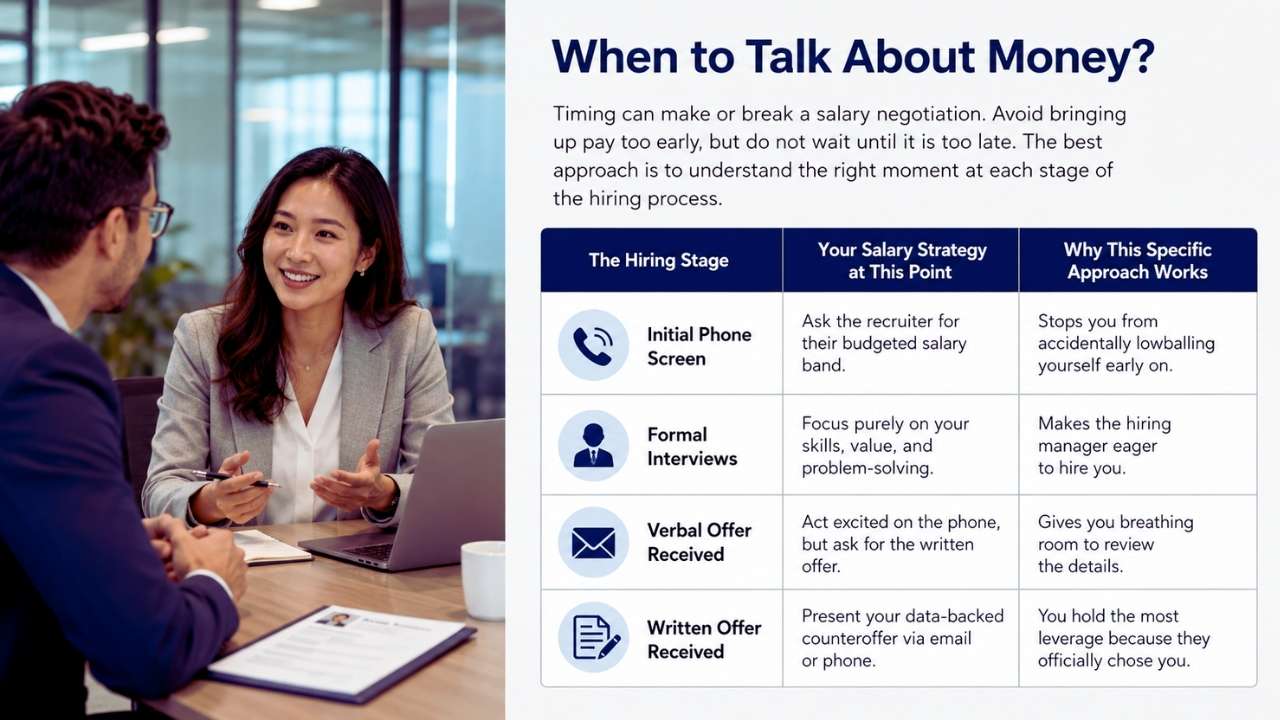
Timing dictates a massive part of a successful negotiation strategy. If you bring up your salary requirements in the first five minutes of an introductory call, you look greedy and entirely focused on the paycheck rather than the role. Conversely, if you wait until your first day on the job, it is obviously way too late to change the terms. The initial phone screen is strictly a vibe check to ensure you and the employer align on basic expectations.
If the recruiter directly asks for your target salary, you should politely flip the question back to them and ask for their approved budgeted range instead. The real, high-stakes negotiation kicks off only after you receive the official written offer in your inbox. At this specific moment, they have already picked you over every other candidate. They absolutely do not want to start the tedious, expensive search process all over again. You hold peak leverage right now, making it the perfect time to present your well-researched counteroffer.
|
The Hiring Stage |
Your Salary Strategy at This Point |
Why This Specific Approach Works |
|
Initial Phone Screen |
Ask the recruiter for their budgeted salary band. |
Stops you from accidentally lowballing yourself early on. |
|
Formal Interviews |
Focus purely on your skills, value, and problem-solving. |
Makes the hiring manager incredibly eager to hire you. |
|
Verbal Offer Received |
Act excited on the phone, but ask for the written offer. |
Gives you the breathing room needed to review the details. |
|
Written Offer Received |
Present your data-backed counteroffer via email or phone. |
You hold all the leverage because they officially chose you. |
Step-by-Step Guide on How to Negotiate Salary Offer
You need a rock-solid game plan before you hit send on a negotiation email or pick up the phone. Relying on objective market data wins arguments every single time, whereas emotional pleas usually fail. Telling a hiring manager that your rent went up simply will not work, but proving that market data commands a higher rate absolutely will. According to a recent 2026 workforce report, professionals who cite actual market data during negotiations increase their chances of a better offer by 40%.
Start by pulling factual salary numbers from reputable sites like Glassdoor, Payscale, and the Bureau of Labor Statistics. Look at competitors’ active job postings in states with strict pay transparency laws to see actual numbers. Once you gather this data, define your anchor number, your realistic target, and your absolute walk-away point. You must also factor in the cost of commuting if the company demands a full-time return to the office. Taking these precise steps ensures you remain confident, professional, and entirely data-driven throughout the entire conversation.
|
The Preparation Step |
What It Actually Means for You |
How to Use It During Negotiations |
|
Market Average |
The standard, verified pay rate for your specific job title. |
Use this as hard proof to back up your counteroffer request. |
|
The Anchor Number |
The optimistic, top-end number you pitch initially. |
Gives the hiring manager plenty of room to negotiate down. |
|
The Walk-Away Number |
Your absolute financial floor and minimum requirement. |
Stops you from making a terrible financial decision out of fear. |
|
The Location Premium |
The hard costs associated with on-site versus remote work. |
Lets you strategically trade cash for flexibility, or vice versa. |
Word-for-Word Negotiation Scripts
A lot of highly qualified professionals freeze right here because writing a negotiation email feels incredibly unnatural. You need to treat this exact moment like any other normal, professional business chat. Keep your tone upbeat, highly collaborative, and undeniably firm regarding your expectations. Begin by expressing genuine enthusiasm for the role and appreciation for the initial offer they extended.
Next, make a clear case for a higher salary by highlighting your specific experience, unique skills, and the exact value you bring to their team. Make sure you state a specific number or a very tight range rather than being vague about what you want. We see that candidates who clearly explain their value and use direct language experience far more success than those who hesitate. If you happen to hold a competing offer, mention it respectfully to create urgency and prove your market demand. Use the proven scripts outlined in the table below, tweak them to fit your unique scenario, and send them off with complete confidence.
|
Negotiation Scenario |
The Best Delivery Method |
The Exact Script or Core Message to Use |
|
Standard Counteroffer |
Email or Phone Call |
“I am thrilled about the role, but market data supports a $X base. Can we align on this?” |
|
Using a Competing Offer |
Phone Call, then Email |
“You are my top choice, but I have a higher offer for $X. I will sign today if you match it.” |
|
Internal Promotion Request |
|
“I am excited for the new title. Let’s adjust the pay to $X to match external market rates.” |
|
The In-Office Premium |
Phone Call |
“Commuting five days a week requires a higher base pay to offset my transit costs.” |
How to Handle Employer Pushback?
You sent the pitch, and now you have to wait for their response. Mastering the art of handling employer pushback separates the seasoned pros from the nervous rookies. You will rarely get a fast, easy “yes” without encountering at least a little bit of friction along the way. Companies frequently push back by citing strict internal equity rules or claiming their departmental budgets are completely capped for the quarter. When this happens, you must remain calm, professional, and ready to pivot your strategy.
Do not take their initial “no” as the final answer; instead, view it as an invitation to explore alternative compensation methods. If they truly lack the budget for a higher base salary, immediately pivot your ask toward a one-time signing bonus or a guaranteed six-month performance review. You should always prepare responses for their most common objections so you never freeze on a phone call. Handling pushback smoothly proves to the hiring manager that you possess strong problem-solving skills and emotional intelligence.
|
The Employer Objection |
What It Really Means Behind Closed Doors |
Your Best Strategic Pivot |
|
“We have absolutely no budget.” |
The base salary band is currently capped for this quarter. |
Pivot and ask for a one-time signing bonus instead. |
|
“We must maintain internal equity.” |
HR refuses to let you out-earn current tenured staff. |
Negotiate for extra paid time off or flexible remote days. |
|
“This is a take it or leave it offer.” |
You are dealing with a rigid, highly aggressive corporate culture. |
Evaluate if you truly want the job, and be ready to walk away. |
|
“Let me check with leadership.” |
The manager fully supports you but needs final HR approval. |
Say thank you and wait patiently without double-texting them. |
Negotiating Beyond the Base Pay
Sometimes the base salary truly will not budge no matter how well you present your case. When you hit a solid wall regarding base pay, you must immediately pivot to the rest of the compensation package. You have to look closely at the paid time off, signing bonuses, retirement match, and remote work flexibility. A $75,000 job offering fully paid healthcare premiums and four weeks of vacation easily beats an $80,000 job with awful, expensive benefits and zero flexibility.
Hiring managers often say “yes” to granting extra vacation days because it costs their specific department zero actual cash dollars. Current 2026 labor data shows that 50% of hiring managers actively plan to add new benefits and perks to attract top-tier talent when salary budgets run tight. You can also negotiate for a flexible hybrid schedule, professional development stipends, or even a guaranteed severance clause if you are taking a senior leadership role. Evaluating the total package ensures you secure the best possible lifestyle upgrade, even if the base salary remains locked.
|
Benefit You Can Negotiate |
How to Actually Ask for It |
The Likelihood of Approval |
|
The Signing Bonus |
“Since the base is locked, can we agree on a $5,000 signing bonus?” |
High (It represents a one-time cost, not a recurring payroll expense). |
|
Extra Paid Time Off |
“Could we add one extra week of vacation to the package?” |
High (It costs the hiring department zero actual cash dollars). |
|
Early Performance Review |
“Can we guarantee a salary review at the 6-month mark?” |
Medium (Requires the manager to follow through and get HR approval). |
|
Executive Severance |
“I would like a 3-month severance clause built into my contract.” |
Low (Usually reserved exclusively for senior executive leadership). |
Final Thoughts
Advocating for yourself requires stepping out of your comfort zone, but it is entirely necessary for your financial future. Mastering how to negotiate salary offer terms is a fundamental life skill that pays massive dividends year after year.
Remember the core rules: Complete your market research, never accept the first number right on the spot, keep your tone collaborative, and always establish a walk-away number beforehand. You hold the leverage. The company spent significant time and resources looking for the exact right person, and they decided that person is you.
Do not join the massive group of candidates who leave money behind out of fear. Rely on the scripts provided, adapt them to your specific industry, and confidently ask for the compensation you actually deserve.
Frequently Asked Questions (FAQs) About How to Negotiate Salary Offer
Can an employer pull the job offer if I try to negotiate?
It is exceedingly rare. An employer will almost never pull an offer simply because you politely asked for more money using a data-backed script. Offers usually get pulled only when a candidate acts arrogantly, makes wildly aggressive demands, or continually moves the goalposts after the company already agreed to a counteroffer. If a company revokes an offer over a polite, professional negotiation, you just dodged a highly toxic workplace.
Should I negotiate an internal promotion offer?
Absolutely. Treat an internal promotion exactly like an external job offer. Do your market research and present the data. Do not accept a minor 5% bump if the external market rate for your new title commands a 20% increase.
What if they ask for my W-2 or current salary history?
In many US states and localities (including California, New York, Washington, and Massachusetts), it is strictly illegal for an employer to ask for your salary history. If a recruiter asks, firmly but politely deflect. Say, “I prefer to focus on the exact value I will bring to this specific role and what the current market rate is for these responsibilities, rather than discussing my past compensation.”
Does negotiating delay my start date?
Usually, no. Negotiating a salary might extend the offer acceptance timeline by a day or two while HR gets approval. That slight delay is entirely worth the permanent boost to your annual paycheck.