

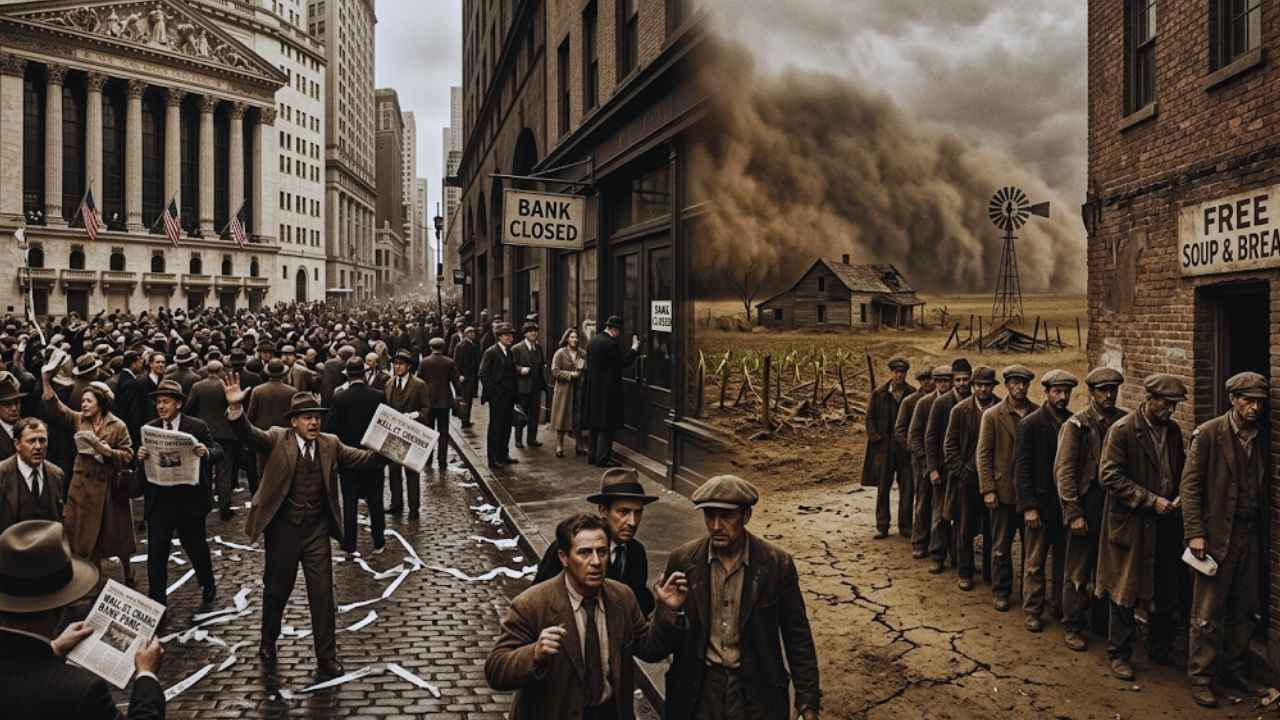
The Great Depression didn’t begin on one terrible day. The Wall Street crash of October 1929 gets most of the attention. It produced unforgettable images of frightened investors, collapsing prices, and crowds gathering outside financial institutions. But the U.S. economy had already started shrinking before stocks crashed. The worst damage came later.
The crisis unfolded in stages. Stock losses frightened families and businesses. Spending slowed. Factories reduced production. Banks then began to fail, taking savings and local credit networks down with them. As loans disappeared, healthy companies struggled to pay workers or buy supplies. Falling prices made old debts harder to repay. More borrowers defaulted. Those defaults damaged banks, which responded by cutting even more credit.
The Federal Reserve failed to stop that cycle. Its leaders made some decisions that tightened financial conditions and failed to take other steps that could have protected the banking system. The gold standard also restricted the country’s choices and carried financial pressure across borders.
By 1933, the results were staggering. Current annual data from the U.S. Bureau of Economic Analysis show that real U.S. GDP fell from $1.191 trillion in 1929 to $877.4 billion in 1933, measured in chained 2017 dollars. That was a 26.3% decline. Unemployment reached 24.9%. More than 12 million people had no work. Around 9,000 banks suspended operations from 1930 through 1933. Consumer prices fell sharply, and the supply of money contracted by nearly 30%.
Great Depression Explained Through the Main Facts
The Great Depression was the deepest and longest economic collapse in modern U.S. history. It began in August 1929, reached its lowest point in March 1933, and continued to shape economic life for the rest of the decade. Historical figures don’t always match across sources. That doesn’t necessarily mean one source is wrong. Researchers may use different definitions, data revisions, or starting points.
The current annual BEA series shows a 26.3% decline in real GDP between 1929 and 1933. Older educational summaries often place the fall closer to 29% or 30%. Those estimates may use older data, gross national product, or a different peak-to-trough method. Unemployment figures also need context. The modern monthly household survey didn’t exist in the early 1930s. Researchers reconstructed the numbers later from census records, employment reports, and other historical material.
Banking totals vary for another reason. A permanent failure wasn’t the same as a temporary suspension. Some banks closed forever. Others stopped operating, reorganized, merged, or eventually reopened. None of these measurement questions changes the central story. The country lost more than one-quarter of its real output, roughly one worker in four had no job, and thousands of financial institutions stopped operating.
|
Economic indicator |
Verified figure |
What it means |
|
Real U.S. GDP, 1929–1933 |
Down 26.3% |
The economy lost more than one-quarter of its real output |
|
Real GDP in 1929 |
$1.191 trillion |
Measured in chained 2017 dollars |
|
Real GDP in 1933 |
$877.4 billion |
The lowest annual level of the collapse |
|
Unemployment in 1933 |
24.9% |
Roughly one worker in four lacked a job |
|
Number unemployed |
More than 12 million |
A nationwide employment disaster |
|
Money supply contraction |
Nearly 30% |
Money and credit disappeared from the economy |
|
Dow decline |
89% |
Measured from its 1929 peak to its 1932 low |
|
Bank suspensions, 1930–1933 |
Around 9,000 |
Thousands of communities lost financial institutions |
|
World trade, 1929–1934 |
Down around 66% |
The crisis became a global collapse |
How the Great Depression Unfolded?
The sequence matters because each stage opened the door to the next one. During 1928 and 1929, Federal Reserve officials became worried about stock-market speculation. They tightened monetary conditions to slow the use of borrowed money in securities markets. The policy also affected ordinary businesses and households.
The U.S. economic expansion ended in August 1929. That was two months before the famous market crash. Industrial activity and business investment were already showing signs of weakness. Stock prices reached their peak in September. Panic selling followed in October. The Dow fell nearly 13% on October 28 and almost another 12% on October 29.
The market kept falling after those headline-making days. By July 1932, the Dow had dropped 89% from its peak. It didn’t regain its September 1929 closing high until November 1954. The first large banking panic arrived in late 1930, more than a year after the crash. Another wave hit in 1931. What had looked like a severe but familiar recession became a full financial breakdown.
Britain left the gold standard in September 1931. Investors then feared that the United States might change the dollar’s relationship with gold. Gold flowed out of the country, and the Federal Reserve raised rates to protect its reserves. By early 1933, several states had restricted withdrawals or closed banks. Roosevelt declared a national bank holiday on March 6. Congress passed the Emergency Banking Act three days later, allowing regulators to examine banks before they reopened.
|
Date |
Major event |
Why it mattered |
|
1928–1929 |
The Federal Reserve tightened credit |
Economic activity weakened beyond Wall Street |
|
August 1929 |
The recession began |
The economy was already shrinking |
|
September 1929 |
Stock prices peaked |
The speculative boom reached its limit |
|
October 1929 |
Wall Street crashed |
Wealth, confidence, and spending fell |
|
Late 1930 |
First major banking panic |
A recession became a financial crisis |
|
September 1931 |
Britain left the gold standard |
Pressure on U.S. banks and gold reserves increased |
|
1932 |
Limited federal support expanded |
Relief came but didn’t restore lasting stability |
|
March 1933 |
Nationwide bank holiday |
The immediate banking panic began to ease |
Why the 1920s Boom Was More Fragile Than It Looked?
The 1920s brought real progress. Factories produced cars, radios, refrigerators, and other consumer goods on a huge scale. Electricity reached more homes. Manufacturing became faster and more efficient. The stock market rose with the mood. Newspapers celebrated wealthy investors and fast-growing companies. Credit made expensive products easier to buy. Yet the boom didn’t reach every household or industry in the same way. Farmers had been struggling for much of the decade.
American agriculture expanded during World War I to supply food to Europe. Farmers borrowed money for new land and equipment. When European production recovered after the war, demand for American crops weakened and prices fell. Farm debts didn’t fall with crop prices. Many rural borrowers found themselves earning less while owing the same amount. Local banks that depended heavily on agricultural loans faced growing losses.
The banking system itself was unusually fragmented. Thousands of small banks served limited areas and couldn’t spread their risks across many regions or industries. A bad harvest or a fall in local land prices could threaten an entire institution. Consumers also relied more heavily on instalment credit. Monthly payments worked while people had jobs. Once income disappeared, those obligations became another source of pressure.
|
Hidden weakness |
What was happening |
Why it became dangerous |
|
Farm debt |
Farmers owed money from earlier expansion |
Crop prices fell while loan balances stayed fixed |
|
Small local banks |
Many banks served one narrow area |
Local economic trouble could destroy the whole institution |
|
Margin buying |
Investors borrowed to purchase stocks |
Falling prices triggered forced sales |
|
Consumer instalment plans |
Families bought goods through monthly payments |
Job losses made those debts difficult to manage |
|
Uneven income growth |
Prosperity wasn’t shared equally |
Many households had little financial protection |
|
Industrial overcapacity |
Factories could produce huge volumes |
Falling demand left businesses with unsold goods |
|
Weak financial oversight |
Market and banking rules were limited |
Speculation and hidden risks grew more easily |
Did the 1929 Stock Market Crash Cause the Great Depression?
The crash played a major part. It wasn’t the complete cause. It destroyed an enormous amount of financial wealth. Investors who had borrowed to buy stocks could lose their original money and still owe their brokers. The damage extended beyond individual traders. Banks, investment trusts, businesses, and middle-class savers also held securities.
The crash then changed how people behaved. Families postponed buying cars, homes, and appliances. Businesses delayed construction, machinery purchases, and hiring. Fear mattered almost as much as direct financial loss. Nobody knew how far prices would fall or whether a nearby company or bank might fail next. Still, the banking system didn’t collapse in October 1929. The New York Federal Reserve supplied liquidity after the crash and helped contain the immediate panic.
The economy even showed signs that the downturn might stabilize before bank failures spread in late 1930. That later banking crisis changed the scale and character of the recession. A market crash can hurt investment and confidence without causing a decade-long depression. The danger grows when that crash is followed by failing banks, frozen credit, collapsing prices, and repeated policy errors.
|
Effect of the crash |
What happened |
Was it enough to cause the full depression? |
|
Loss of stock wealth |
Investors and institutions lost money |
Important, but not enough on its own |
|
Margin calls |
Borrowers had to provide cash or sell shares |
Pushed stock prices lower |
|
Falling confidence |
Families and businesses became cautious |
Reduced consumption and investment |
|
Greater uncertainty |
Major purchases and projects were delayed |
Deepened the early downturn |
|
Damage to financial firms |
Some institutions suffered large losses |
Increased financial weakness |
|
Reduced business investment |
Companies cancelled expansion plans |
Lowered demand and employment |
|
Later bank panics |
Money, savings, and lending collapsed |
Turned the recession into a catastrophe |
How Bank Runs Turned a Recession Into a Disaster?
The banking panic sits at the centre of the Great Depression story. There was no nationwide federal deposit insurance system in 1929. A customer who kept money in a failed bank could lose some or all of it. Banks didn’t store every deposited dollar in their vaults. They lent much of that money to farmers, homeowners, shops, and factories.
Those loans might be valuable over time, but they couldn’t always be converted into cash at a moment’s notice. If hundreds of customers demanded their savings on the same day, the bank could run out of available cash. That made a bank run difficult to stop. Each depositor had an incentive to withdraw before everyone else. Waiting could mean losing access to life savings.
One closure then frightened customers at nearby institutions. They withdrew cash too. Banks responded by making fewer loans and holding larger reserves. Businesses lost working capital. Farmers couldn’t refinance loans. Families struggled to obtain mortgages. Even a profitable company could fail when its normal source of credit vanished.
A bank failure also destroyed local knowledge. Bankers often knew which customers paid reliably and which businesses had good long-term prospects. When that relationship disappeared, sound borrowers had to start again with lenders who didn’t know them.
|
Step in the bank-run cycle |
Immediate result |
Wider economic damage |
|
Rumours spread |
Depositors become nervous |
Crowds begin withdrawing cash |
|
Customers demand money |
Bank reserves fall quickly |
Banks sell assets under pressure |
|
Assets are sold cheaply |
Financial prices decline |
Other banks record losses |
|
Banks restrict loans |
Credit becomes scarce |
Businesses and households cut spending |
|
Borrowers can’t refinance |
Defaults increase |
Bank balance sheets weaken further |
|
Banks suspend operations |
Depositors lose access to savings |
Consumer confidence falls |
|
Panic moves to other banks |
New runs begin |
The crisis keeps feeding itself |
Why Bank Failure Numbers Don’t Always Match?
Readers often see two different figures for the banking collapse. Some reports say roughly 7,000 banks failed. Others say around 9,000 banks suspended operations. The gap comes from definitions. A failure usually means an institution permanently closed, entered receivership, or had its assets liquidated. A suspension was a broader event. A suspended bank might close temporarily. It could later reopen, merge with another institution, or complete a financial reorganization.
Official historical records show that approximately 9,000 banks suspended operations from 1930 through 1933. Narrower counts of permanent failures produce a lower total. The year-by-year pattern also shows how quickly the emergency grew. Around 1,350 banks suspended operations in 1930. The number rose to approximately 2,300 in 1931.
Depositors lost an estimated $1.3 billion during the banking breakdown. That figure represented money families and businesses needed for food, rent, payroll, medical care, and loan payments. The most accurate approach isn’t to choose one total and call every other figure wrong. It’s to identify whether a source is measuring permanent failures, temporary suspensions, mergers, or reorganizations.
|
Banking term |
Basic meaning |
Why the distinction matters |
|
Bank failure |
The institution permanently closes or enters receivership |
Usually produces the narrowest total |
|
Bank suspension |
Operations stop temporarily or permanently |
Produces a broader count |
|
Bank holiday |
Authorities temporarily order banks to close |
Not every bank involved was insolvent |
|
Reorganization |
The bank changes its structure or ownership |
It may later resume business |
|
Merger |
Another institution absorbs the bank |
Customers may retain some services |
|
Liquidation |
Assets are sold to repay claims |
Depositors may wait years for partial recovery |
|
Receivership |
An authority takes control of the failed institution |
Used to manage assets and creditor claims |
Why Deflation Made Everything Worse?
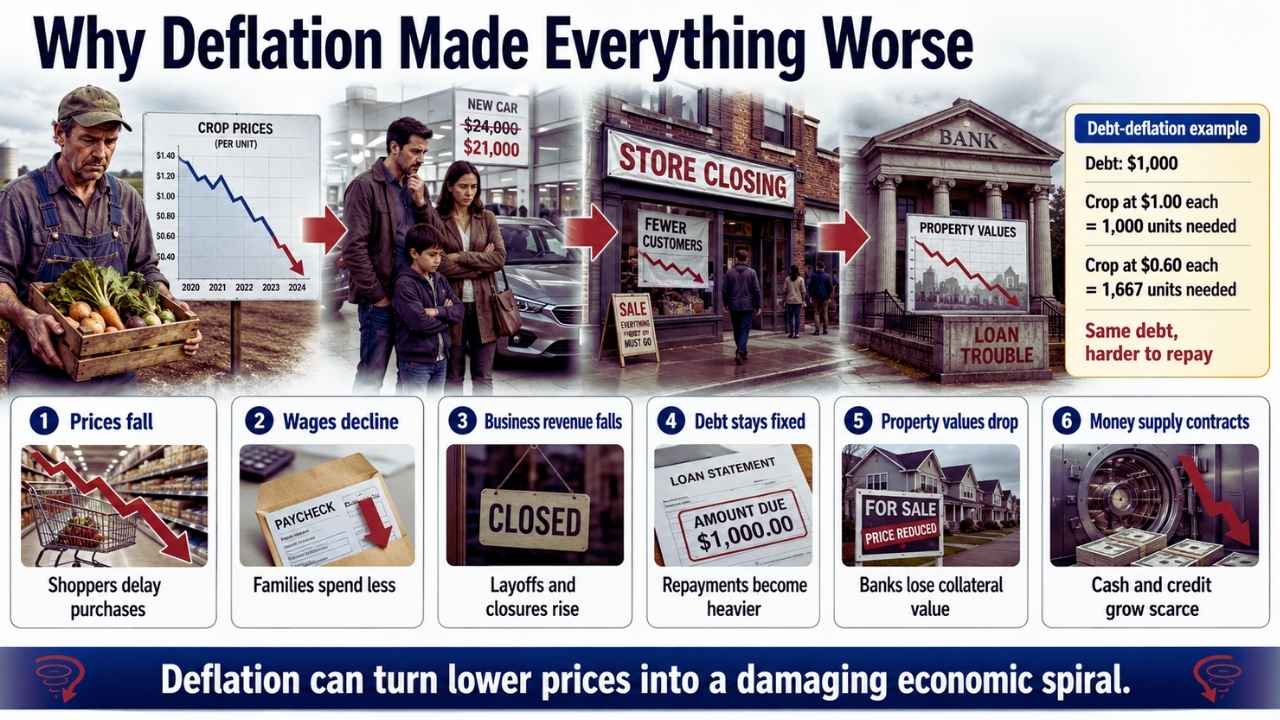
Deflation means a broad decline in prices. Cheaper products may sound helpful. They can become destructive when wages, business income, and asset values fall at the same time. Consider a farmer who owes $1,000. When a crop sells for $1 per unit, the farmer needs revenue from 1,000 units to equal the debt. If the crop price falls to 60 cents, the debt remains $1,000. The farmer must now sell about 1,667 units to produce the same dollar revenue.
The loan hasn’t changed on paper, but it has become much harder to repay. Economists call this debt-deflation. Deflation also encouraged consumers to wait. A family expecting prices to fall further might postpone buying a car or appliance.
That decision made sense for one household. When millions of households waited, business sales collapsed. Falling land, home, and factory values hurt banks as well. The assets offered as security for loans became less valuable. More borrowers defaulted, creating another round of bank losses.
|
Deflationary change |
Immediate impact |
Longer effect |
|
Consumer prices fall |
Goods become cheaper |
Shoppers delay purchases |
|
Wages decline |
Employers lower costs |
Families have less money to spend |
|
Business revenue falls |
Companies struggle to cover expenses |
Layoffs and closures increase |
|
Debt stays fixed |
Monthly obligations become heavier |
Defaults rise |
|
Property values decline |
Loan collateral loses value |
Banks face greater losses |
|
Asset sales increase |
Prices fall further |
Debt pressure becomes worse |
|
Money supply contracts |
Cash and credit become scarce |
Deflation continues |
How the Federal Reserve Made the Crisis Worse?
The Federal Reserve didn’t intend to create mass unemployment. Its leaders faced a crisis without modern data, clear emergency rules, or decades of central-banking experience. Even so, its decisions and failures to act played a major part. The Fed tightened policy during 1928 and 1929 because officials wanted to curb stock speculation. That policy also slowed ordinary borrowing and investment.
Once bank panics began, the Fed failed to serve effectively as a lender of last resort. It didn’t provide enough liquidity to stop the destruction of the banking system. The institution’s structure made action harder. Regional Federal Reserve Banks and the Federal Reserve Board didn’t always agree. Different districts could follow conflicting approaches.
Some officials believed failing banks were weak institutions that should be allowed to disappear. Others felt little responsibility for banks that didn’t belong to the Federal Reserve System. Published interest rates also gave policymakers a misleading picture. Rates appeared low, which made money look easy. But prices were falling, loans were difficult to obtain, and the inflation-adjusted cost of borrowing remained high.
When Britain left the gold standard in 1931, the Federal Reserve raised rates to defend U.S. gold reserves. That decision protected the dollar’s gold value while placing more pressure on American borrowers and banks.
|
Federal Reserve problem |
What officials did or failed to do |
Economic result |
|
Concern about speculation |
Tightened conditions before the crash |
Slowed broader economic activity |
|
Weak crisis coordination |
Regional officials disagreed |
Emergency action came slowly |
|
Limited support for banks |
Failed to supply enough liquidity |
Bank panics continued |
|
Focus on member banks |
Gave less attention to nonmember institutions |
Much of the banking system remained exposed |
|
Misreading interest rates |
Treated low nominal rates as easy money |
Underestimated real financial pressure |
|
Defence of gold reserves |
Raised rates during the downturn |
Credit became tighter |
|
Early withdrawal of support |
Ended some expansionary measures too soon |
Contraction returned |
How the Gold Standard Spread the Depression Worldwide?
Under the gold standard, governments linked their currencies to fixed quantities of gold. The system promised stable exchange rates. During a financial panic, that promise could trap policymakers. When investors feared that a government might leave gold, they moved funds overseas or exchanged paper currency for metal. That drained gold from central-bank reserves.
Officials often answered by raising interest rates. Higher rates could attract foreign money and slow gold losses. They also made borrowing more expensive and weakened domestic businesses. A policy designed to defend the currency could increase unemployment. The problem didn’t stop at national borders. When the United States tightened monetary conditions, other countries faced pressure to do the same.
A country that kept lower rates risked losing money and gold to markets offering higher returns. The result was an international cycle of tightening and deflation. Countries that left gold gained more freedom. They could lower rates, let their currencies adjust, and expand their money supplies without constantly protecting a fixed gold value.
|
Gold-standard feature |
Intended purpose |
Depression-era problem |
|
Fixed currency values |
Support exchange-rate stability |
Reduced policy flexibility |
|
Currency-to-gold conversion |
Build public confidence |
Encouraged runs on gold reserves |
|
Interest-rate defence |
Attract or retain capital |
Hurt borrowing and employment |
|
International linkage |
Connect major currencies |
Spread monetary contraction |
|
Limited money creation |
Protect gold backing |
Made bank rescues more difficult |
|
Fear of devaluation |
Keep currencies credible |
Triggered capital and gold outflows |
|
Leaving the standard |
Restore policy freedom |
Often allowed recovery to begin sooner |
How Trade and International Debt Spread the Damage?
The crisis became global because trade, lending, war debts, and currency systems connected national economies. European countries owed money to the United States after World War I. Germany also faced reparations payments to European governments. American banks helped keep those payments moving by lending money abroad. Once U.S. credit weakened, the international payment system came under pressure.
Trade then collapsed alongside finance. President Herbert Hoover signed the Smoot-Hawley Tariff Act in June 1930. The U.S. recession had already begun, and the stock market had already crashed. That means the tariff didn’t start the Great Depression. It did raise import barriers during an international emergency.
Other countries introduced or expanded restrictions of their own. Exporters lost foreign customers at the same time that domestic demand was disappearing. U.S. exports to Europe fell from $2.341 billion in 1929 to $784 million in 1932. Imports from Europe fell from $1.334 billion to $390 million. World trade declined by around 66% between 1929 and 1934.
|
International pressure |
How it operated |
Economic result |
|
U.S. foreign lending declined |
Overseas borrowers lost financing |
Debt payments became harder |
|
War debts remained |
European governments owed the United States |
National budgets stayed under pressure |
|
German reparations continued |
Germany owed European powers |
Financial stress moved between countries |
|
Smoot-Hawley raised tariffs |
Imports became more expensive |
Trading partners faced lower access |
|
Foreign retaliation followed |
Other governments increased barriers |
U.S. exporters lost markets |
|
Trade credit disappeared |
Banks became unwilling to finance shipments |
International commerce slowed |
|
Commodity prices collapsed |
Export earnings declined |
Farming and commodity economies suffered |
What the Depression Felt Like for Ordinary Families?
Economic statistics can make suffering look neat and measurable. Daily life wasn’t. Millions of workers lost jobs in a country without a nationwide unemployment-insurance system. Savings and local charity became the first lines of support. Those resources disappeared quickly. A family could use years of savings within months. Charities couldn’t keep up when whole communities needed help.
People who kept their jobs weren’t necessarily secure. Employers reduced hours, cut wages, or placed workers on irregular schedules. Bank failures added a second blow. A person could lose a job and then discover that the bank holding the family’s emergency savings had closed.
Housing became unstable. Families lost farms and homes through foreclosure. Some moved in with relatives. Others rented rooms to strangers or entered makeshift settlements.
Marriage and childbirth were often postponed. Young adults remained with parents because they couldn’t afford independent households. The emotional cost was also serious. Long periods without work could bring shame, anxiety, family conflict, poor health, and loss of social standing.
|
Household problem |
What families experienced |
Common response |
|
Job loss |
Regular income disappeared |
Relied on savings or relatives |
|
Wage cuts |
Employed workers earned less |
Reduced food and household spending |
|
Bank closure |
Savings became unavailable or were lost |
Delayed bills and loan payments |
|
Foreclosure |
Families lost homes or farms |
Moved in with relatives or migrated |
|
Weak local relief |
Charities ran out of resources |
Joined bread lines or sought public aid |
|
Delayed marriage |
Couples couldn’t afford a home |
Postponed starting families |
|
Long-term stress |
Anxiety and family pressure increased |
Sought work in other towns or states |
Why the Crisis Hit Some Communities Harder?
The depression touched nearly every part of American society, but it didn’t treat everyone equally. By 1932, approximately half of Black Americans were out of work. Discrimination meant Black workers were often among the first dismissed and the last rehired. In some Northern cities, white residents openly demanded that employers remove Black workers while white people remained unemployed. Racial violence also increased during parts of the period.
New Deal programs provided employment and support to many Black families. Yet some programs continued to permit local discrimination or delivered unequal benefits. Mexican immigrants and Mexican American citizens faced another threat. During the 1930s, hundreds of thousands of people of Mexican origin were sent or pressured to move to Mexico.
Some accepted transportation voluntarily because they saw little chance of finding work. Others were tricked, coerced, or removed without fair legal treatment. U.S. citizens were among those affected. Women also faced conflicting pressures. Many communities argued that scarce jobs should go to male breadwinners. Married women who worked outside the home could face public criticism.
At the same time, families depended heavily on women’s paid and unpaid work. Women took in laundry, rented rooms, preserved food, managed household budgets, and accepted whatever paid work remained available.
|
Community |
Additional pressure |
Long-term importance |
|
Black Americans |
Higher unemployment and open hiring discrimination |
Helped reshape political loyalties and civil-rights activism |
|
Mexican immigrants |
Repatriation and deportation pressure |
Separated families and removed U.S. citizens |
|
Mexican Americans |
Often treated as foreigners regardless of citizenship |
Exposed weak legal protections |
|
Women |
Pressure to leave jobs for male workers |
Increased reliance on informal and domestic work |
|
Children |
Poor nutrition and disrupted schooling |
Created lasting health and educational effects |
|
Older people |
Few reliable retirement protections |
Strengthened demand for federal social insurance |
|
Disabled workers |
Limited employment and assistance |
Increased dependence on family and local relief |
How the Dust Bowl Made Rural Hardship Worse?
The Dust Bowl and the Great Depression weren’t the same event. The Great Depression was a financial and economic crisis. The Dust Bowl was an environmental and agricultural disaster centred in the Great Plains. The two crises overlapped and reinforced one another.
Years of heavy cultivation had removed large areas of native grass. Those grasses had deep roots that helped hold soil in place. A long drought began in 1931. Dust storms followed in 1932. With little moisture or vegetation, exposed topsoil blew away.
Farmers had already faced low crop prices and heavy debts. The drought destroyed their ability to produce the crops needed to repay those loans. Some owners lost their land to banks. Tenant farmers and farm workers could be displaced when landowners reduced operations.
Thousands of families moved west, especially toward California. They often arrived to find low wages, poor housing, intense competition, and far fewer jobs than expected.
|
Dust Bowl factor |
What happened |
Connection to the depression |
|
Heavy cultivation |
Native grasslands were ploughed |
Soil became more exposed |
|
Weak soil conservation |
Few protective practices were used |
Erosion became more severe |
|
Drought beginning in 1931 |
Crops failed across affected areas |
Farm income collapsed |
|
Dust storms from 1932 |
Topsoil blew away |
Land became difficult to farm |
|
Existing farm debt |
Borrowers still owed banks |
Foreclosures increased |
|
Migration west |
Families searched for agricultural work |
Labour competition rose |
|
Poor migrant conditions |
Housing and wages remained weak |
Poverty followed families across states |
How Hoover Responded to the Collapse?
Herbert Hoover is often described as a president who did nothing. That isn’t accurate. Hoover encouraged employers to maintain wages, expanded federal construction, supported mortgage institutions, signed banking legislation, and created the Reconstruction Finance Corporation.
His response still fell far short of what the crisis required. Hoover believed local government, private charity, and voluntary business cooperation should carry much of the relief burden. That approach assumed communities could support their own residents.
It broke down as unemployment spread. Local tax revenue fell at the exact moment that demand for assistance exploded. Public works offered some employment. Large construction projects, however, took time to design, fund, and build.
The Reconstruction Finance Corporation began operating in 1932. It lent money to banks, railroads, and other major institutions. The RFC helped prevent some failures, but it arrived after the crisis had become severe. Banks could also fear that asking for assistance would signal weakness and trigger a run.
Hoover’s deeper problem was that he treated the disaster as a temporary emergency that could be managed through confidence, limited loans, and cooperation. The collapse demanded far more direct federal action.
|
Hoover-era response |
Intended purpose |
Main weakness |
|
Voluntary wage agreements |
Protect workers’ purchasing power |
Employers abandoned them as losses grew |
|
Private and local relief |
Support struggling families |
Resources became overwhelmed |
|
Federal public works |
Create jobs and infrastructure |
Projects moved too slowly |
|
Reconstruction Finance Corporation |
Lend to major institutions |
Arrived after banking distress had spread |
|
Banking Act of 1932 |
Expand Federal Reserve lending power |
Didn’t end nationwide panic |
|
Federal Home Loan Bank system |
Support mortgage finance |
Couldn’t quickly stop foreclosures |
|
Confidence campaigns |
Encourage spending and investment |
Words couldn’t replace lost money and credit |
What Roosevelt and the New Deal Changed?
Franklin D. Roosevelt took office on March 4, 1933, during the worst stage of the banking crisis. His first task was to stop panic. The national bank holiday temporarily closed banks and prevented further withdrawals. Congress passed the Emergency Banking Act on March 9. Regulators examined institutions and allowed those considered sound to reopen.
By March 15, banks controlling 90% of the country’s banking resources had resumed operations. Deposits far exceeded withdrawals. That shift mattered. People who had spent months taking money out of banks began putting it back. The Banking Act of 1933 created the Federal Deposit Insurance Corporation. Federal insurance began on January 1, 1934, covering up to $2,500 per depositor. The limit rose to $5,000 in July 1934.
The wider New Deal funded relief, public employment, farming programs, housing measures, and financial regulation. The Civilian Conservation Corps hired young men for conservation work. The Works Progress Administration employed people in construction, education, public services, and the arts.
The Social Security Act of 1935 created old-age benefits and a federal-state unemployment-compensation system. Its original coverage remained limited and excluded agricultural and domestic work, leaving around half of American workers outside the main old-age insurance program.
|
New Deal measure |
Main purpose |
Lasting effect |
|
National bank holiday |
Stop panic withdrawals |
Gave authorities time to examine banks |
|
Emergency Banking Act |
Reopen sound institutions |
Restored confidence quickly |
|
FDIC |
Insure eligible deposits |
Reduced the incentive for bank runs |
|
Securities regulation |
Improve market oversight |
Required stronger financial disclosure |
|
Civilian Conservation Corps |
Employ young men |
Completed conservation projects |
|
Works Progress Administration |
Provide large-scale work relief |
Built roads, schools, parks, and public facilities |
|
Social Security Act |
Create social insurance |
Established retirement and unemployment systems |
Did the New Deal End the Great Depression?
The answer depends on what “ended” means. The economy stopped collapsing in 1933. Banks stabilized, prices stopped falling as sharply, and production began to increase. Current BEA data show real GDP rising from $877.4 billion in 1933 to $1.195 trillion in 1936. That was an increase of more than 36% in three years.
Aggregate real GDP had regained its 1929 annual level by 1936. Yet the population had grown, the economy remained below its earlier growth path, and unemployment stayed painfully high.
Moving away from the gold standard gave the government more room to expand the money supply. Gold inflows and changes in the dollar’s value helped reduce real interest rates and support investment. New Deal relief and public works placed money into households. Banking and securities reforms rebuilt trust. These changes clearly helped stabilize the country and reduce hardship.
They didn’t restore full employment. The federal spending programs, while large by earlier standards, weren’t large enough to replace all the private demand lost during the collapse. A new recession in 1937 and 1938 proved how weak the recovery remained. Real GDP fell 10%, unemployment reached 20%, and industrial production dropped 32%.
The most balanced answer is that the New Deal stopped the financial free fall, supported recovery, reduced suffering, and built lasting institutions. It didn’t fully eliminate mass unemployment.
|
Measure of success |
What happened |
Fair assessment |
|
Banking panic |
Ended rapidly in March 1933 |
Major success |
|
Depositor confidence |
Improved after reform and insurance |
Major success |
|
Real GDP |
Grew strongly after 1933 |
Clear recovery |
|
Unemployment |
Remained high for years |
Incomplete recovery |
|
Household relief |
Reached millions of people |
Reduced immediate hardship |
|
Public infrastructure |
Expanded across the country |
Created lasting assets |
|
Full employment |
Didn’t return before wartime mobilization |
New Deal alone didn’t finish the job |
Why the Economy Fell Back in 1937?
By 1936, the recovery looked strong enough for officials to worry about inflation, government deficits, and excess bank reserves. Policy then became less supportive. The Federal Reserve doubled bank reserve requirements in stages. Officials believed banks had too much unused cash and could create excessive credit.
The Treasury also began sterilizing gold inflows. That meant incoming gold no longer produced the same expansion in the monetary base. Fiscal policy tightened at the same time. New payroll taxes began, some veterans’ payments ended, and the federal budget moved toward a less expansionary position.
The combined effect was severe. The recession lasted from May 1937 through June 1938. Real GDP fell 10%. Industrial production dropped 32%. Unemployment returned to 20%. The downturn became one of the clearest warnings against withdrawing economic support before a recovery has become secure.
|
1937 policy change |
Intended goal |
Actual result |
|
Higher reserve requirements |
Prevent excessive lending |
Banks protected cash instead of expanding credit |
|
Gold sterilization |
Control reserve growth |
Monetary expansion slowed |
|
Reduced fiscal support |
Limit government deficits |
Demand weakened |
|
New payroll taxes |
Fund social insurance |
Reduced some current purchasing power |
|
Lower government transfers |
Normalize federal spending |
Household income support fell |
|
Tighter combined policy |
Return to ordinary conditions |
Recovery reversed sharply |
|
Later policy reversal |
Restart expansion |
Growth resumed after 1938 |
How the Great Depression Finally Ended?
The depression didn’t finish on one clear date. The banking panic ended in 1933. Real GDP then grew quickly. Aggregate output returned to its 1929 annual level by 1936. The 1937 recession interrupted that recovery. Growth resumed in 1938, but millions of people still lacked work.
Events in Europe then began to affect the U.S. economy. Political fear and war risk sent gold and capital toward the United States. American defence production increased before the country officially entered World War II. Foreign governments ordered aircraft, weapons, vehicles, and other supplies.
After the attack on Pearl Harbor in December 1941, federal spending rose on an enormous scale. Factories operated at full capacity. Millions of people entered military service. The war created extraordinary demand for labour. Women entered industrial jobs in larger numbers, and workers moved to production centres.
It’s fair to say recovery began in 1933, major output losses were reversed during the 1930s, and wartime mobilization completed the return to full employment.
|
Stage of recovery |
Main development |
What changed |
|
March 1933 |
Banking panic ended |
Confidence and deposits returned |
|
1933–1936 |
Money and output expanded |
Strong economic growth resumed |
|
1934 onward |
Gold inflows increased |
Money supply grew |
|
New Deal years |
Relief and regulation expanded |
Families and institutions received support |
|
1937–1938 |
Policy tightened |
Recovery suffered a major setback |
|
1939–1941 |
Defence demand increased |
Industrial orders and hiring rose |
|
World War II |
Full mobilization began |
Mass unemployment finally disappeared |
What Economists Agree On?
Economists still debate how much weight to give each cause. Few serious accounts blame only one event. Most agree that the stock crash damaged wealth, confidence, and spending. There is also broad agreement that banking panics made the downturn much worse. When banks failed, they destroyed money, savings, and lending relationships.
Economists widely recognize that deflation increased the real burden of debt. Falling prices didn’t simply reflect the depression. They helped deepen it. The Federal Reserve’s failure to stop the money and banking collapse also carries broad support. The institution itself now acknowledges that its mistakes contributed to the disaster.
International research has strengthened the case against the interwar gold standard. The system linked national policies and pressured countries to defend currencies during deep unemployment. Scholars also agree that recovery began after major policy changes in 1933, including banking stabilization and the loosening of the dollar’s connection to gold.
The remaining debate is mainly about relative importance. How much came from monetary expansion? How much came from government spending, regulatory reform, improved expectations, or the economy’s own adjustment?
|
Area of agreement |
Main finding |
|
Stock-market crash |
Damaged wealth, spending, and confidence |
|
Banking panics |
Turned a severe recession into a deeper collapse |
|
Monetary contraction |
Reduced spending and intensified deflation |
|
Debt-deflation |
Made fixed debts harder to repay |
|
Gold standard |
Spread contraction across countries |
|
Federal Reserve errors |
Allowed banking and money problems to worsen |
|
Policy change after 1933 |
Helped start and sustain recovery |
What Economists Still Debate?
The monetary explanation places the collapse of money and credit at the centre of the story. Milton Friedman and Anna Schwartz argued that the Federal Reserve allowed bank failures and cash withdrawals to reduce the money supply. In their view, a recession became a depression because the central bank didn’t stop that contraction.
Ben Bernanke added a credit-market explanation. A failed bank didn’t only remove money. It also destroyed knowledge and relationships between lenders and borrowers. The gold-standard explanation looks at the international system. Barry Eichengreen, Peter Temin, and other historians argue that countries harmed themselves by defending fixed exchange rates rather than domestic employment.
Irving Fisher’s debt-deflation theory focuses on borrowers. Falling prices raised the real value of debt, forcing people to sell assets and pushing prices down again. Keynesian explanations place more weight on lost demand. Consumers stopped buying, businesses stopped investing, and early government spending didn’t fill the gap.
Research on uncertainty adds another element. Families and businesses delayed decisions because nobody could tell how far prices, income, or employment might fall. These arguments can all be partly true. The Great Depression was large enough to involve several mechanisms working together.
|
Economic interpretation |
Central idea |
What it helps explain |
|
Monetary contraction |
The money supply collapsed |
Deflation and falling spending |
|
Banking disruption |
Failed banks destroyed credit relationships |
Why good borrowers also lost financing |
|
Gold-standard constraint |
Currency rules forced tighter policy |
Why the crisis spread internationally |
|
Debt-deflation |
Falling prices increased real debt |
Defaults and forced asset sales |
|
Demand collapse |
Spending and investment disappeared |
Falling production and employment |
|
Uncertainty |
Fear encouraged people to wait |
Weak durable-goods spending |
|
Structural weakness |
Agriculture and banking were already fragile |
Why some sectors failed early |
Common Myths About the Great Depression
The first myth is that the stock crash caused the whole crisis. It was a major shock, but the later bank panics and monetary contraction caused much of the deeper damage. Another myth says most Americans lost money directly in the market. Many households owned no stocks. They suffered through lost jobs, failed banks, falling wages, and collapsing local businesses.
Hoover is often described as taking no action. He did act, but his policies remained too limited and too dependent on voluntary cooperation. Roosevelt didn’t fix the entire economy within weeks. He helped stop the bank panic quickly, but high unemployment continued for years.
Smoot-Hawley didn’t start the recession. The economy had already turned downward. The tariff made international trade and cooperation worse. The Dust Bowl didn’t cause the national financial collapse. It was a separate environmental emergency that deepened rural poverty.
The New Deal wasn’t a total success or a total failure. It restored financial stability, created jobs, built infrastructure, and established social programs. It didn’t produce full employment before the war.
|
Popular myth |
What the evidence shows |
|
The stock crash caused everything |
Banking, money, debt, and policy failures also mattered |
|
Everyone owned stocks |
Most suffering came through jobs, wages, banks, and business losses |
|
Hoover did nothing |
He acted, but his response was inadequate |
|
Roosevelt immediately ended the depression |
He ended the bank panic, not mass unemployment |
|
Smoot-Hawley started the crisis |
It worsened a downturn already underway |
|
The Dust Bowl caused the depression |
It was a separate but overlapping disaster |
|
The New Deal solved nothing |
It stabilized finance and reduced suffering |
|
World War II alone created recovery |
Recovery began earlier, but war completed full employment |
Lessons the Great Depression Still Teaches
The great depression explained as a chain reaction offers lessons that still influence modern crisis policy. The first lesson is simple: stop bank panic early. A liquidity problem can destroy an institution that might otherwise survive.
Deposit insurance matters because it changes customer behaviour. People don’t need to race to withdraw protected savings. Central banks must also look beyond published interest rates. Credit can remain extremely tight even when rates appear low.
Deflation deserves serious attention. Falling prices can increase real debts, encourage delayed spending, and produce more bankruptcies. International coordination matters too. Tariffs, currency defence, and capital flight can send economic damage from one country to another.
The 1937 recession warns against withdrawing support too soon. A recovery can look impressive in headline GDP figures while jobs, wages, and financial confidence remain weak. Finally, GDP doesn’t tell the whole human story. An economy can return to growth while millions of families still face unemployment, insecure housing, and lost savings.
|
Depression-era lesson |
Modern policy meaning |
|
Bank runs spread quickly |
Provide emergency liquidity before panic grows |
|
Deposit insurance changes behaviour |
Protect ordinary savers credibly |
|
Low rates can mislead |
Examine lending and real borrowing costs |
|
Deflation raises debt burdens |
Defend price and demand stability |
|
Financial crises cross borders |
Coordinate international responses |
|
Trade retaliation can backfire |
Keep markets open during global stress |
|
Early tightening is risky |
Confirm recovery before removing support |
|
GDP has limits |
Track jobs, wages, housing, and household security |
Final Thoughts
The Great Depression wasn’t one event. It was a chain reaction. The economy began slowing before the stock market crashed. The crash then destroyed wealth and confidence. Bank runs did even greater damage. They wiped out savings, reduced the money supply, and cut businesses and households off from credit. Deflation increased the weight of old debts. Falling income caused defaults. Those defaults hurt banks, which restricted lending even further.
The Federal Reserve failed to break the cycle. The gold standard limited policy choices and spread financial pressure to other countries. Trade barriers, international debts, agricultural weakness, and the Dust Bowl added more strain. Recovery began when banking confidence returned, the dollar’s gold restrictions loosened, and the money supply expanded. New Deal reforms reduced suffering and rebuilt major institutions. Wartime production finally removed mass unemployment.
That’s the Great Depression explained without the easy myths. The 1929 crash mattered, but banking collapse, deflation, debt, global pressure, and policy failure turned a recession into the worst economic disaster in modern American history.
Frequently Asked Questions (FAQs) About Great Depression Explained
Why is it called the Great Depression?
The word “great” refers to the crisis’s unusual depth, length, and international reach. Earlier downturns were also called depressions, but none produced the same combination of banking collapse, deflation, lost output, and mass unemployment.
When did the Great Depression begin?
The U.S. economic contraction began in August 1929. The stock market crashed in October, but the first major banking panic didn’t arrive until late 1930.
When did the Great Depression reach its lowest point?
The downturn reached its lowest point in March 1933. The nationwide banking crisis and bank holiday marked the end of the steepest contraction.
When did the Great Depression end?
Recovery began in 1933. Aggregate real GDP regained its 1929 annual level in 1936, but high unemployment continued. Full employment returned during World War II.
Why do GDP estimates range from 26% to 30%?
Sources use different historical data series, revisions, definitions, and peak-to-trough methods. The current annual BEA series shows a 26.3% decline between 1929 and 1933.
Why do bank-failure totals differ?
Some sources count only permanent failures. Others include temporary suspensions, mergers, reorganizations, and institutions that later reopened.