


You prepped for days. You nailed the hard questions. You walked out of the building feeling untouchable. Then, the waiting game begins. Days pass. Your inbox stays painfully empty. You start wondering if you should reach out, but a massive fear holds you back. You do not want to look desperate. Figuring out exactly how to follow up after interview rounds feels like walking a tightrope.
Push too hard, and you become the annoying candidate they flag in their system. Stay too quiet, and they might assume you just do not care about the job. We see the backend of professional communication every single day here at Editorialge. We know what gets ignored, what gets a reply, and what gets forwarded to the hiring team with a note saying to hire this person. This guide strips away the fluff.
We break down exactly what to say, when to hit send, and the psychology behind a perfect post-interview check-in. We rely on hard 2026 hiring data to show you how recruiters actually think. Let us get your name back at the top of the pile while keeping your professional dignity completely intact.
Why Your Follow-Up After-Interview Strategy Actually Matters
Most job seekers think the interview ends the second they close the video call or walk out the door. That is completely wrong. The interview officially ends when you sign the offer letter. The way you handle the post-interview silence is a live, real-time test of your actual communication skills. Hiring managers watch your habits closely. They want to see how you handle uncertainty.
They want to know how you treat colleagues and how you will talk to clients when things do not go according to plan. A sharp, well-timed message proves you stay organized under pressure. It also gives a gentle nudge to a stressed-out manager who probably just forgot to hit send on a status update. The numbers back this up completely. Recent 2026 hiring surveys reveal that 68 percent of employers say receiving a thank-you note directly impacts their final hiring decision.
On top of that, nearly a quarter of hiring managers will flat-out dismiss a candidate who skips the post-interview note. They assume if you will not follow through now, you will not follow through on the job. You leave money on the table when you stay quiet. You simply cannot assume a company runs perfectly behind the scenes. Sending a quick message puts you back in control of the situation.
|
Factor |
What It Tells the Hiring Manager |
The Hard Data (2026) |
|
Professionalism |
You understand modern workplace norms. |
25 percent of managers dismiss candidates who skip notes. |
|
Drive |
You want this specific job, not just any job. |
68 percent of employers let it sway their final decision. |
|
Communication |
You can write clear, unscripted emails. |
Highlights your real-world soft skills in action. |
|
Visibility |
You bring your name back to their attention. |
Cuts through the noise of their crowded inbox. |
The Psychology Behind the Perfect Follow-Up Timeline
Timing decides whether your message feels like a polite check-in or a demanding interruption. Send an email too early, and you look panicked. Send it too late, and they already hired someone else. The modern hiring process moves at a glacial pace. According to recent 2026 reporting, the average time to hire across industries has jumped to 41 days. Hiring managers juggle budget freezes, scheduling conflicts, and endless internal approval chains.
To you, five days of silence feels like a month. To them, five days feels like an afternoon. Getting the timeline right for a solid follow up after interview check-in is half the battle. The golden rule for your initial thank-you note is 24 hours. You want this email to land while they are actively typing up their feedback notes about you. If they give you a specific deadline, do not reach out before that exact date. Respecting their timeline proves you listen to instructions.
Give them a tiny buffer by waiting until two days after their deadline to send your check-in. If they give no timeline, the standard waiting period is one to two full weeks after your thank-you note. Reaching out before five business days just makes you look horribly impatient. Give them enough time to interview the other candidates.
|
Message Type |
When to Hit Send |
The Core Goal |
|
Thank-You Note |
24 hours post-interview. |
Say thanks and highlight one specific thing you discussed. |
|
First Status Check |
5 to 10 business days later. |
Ask for a timeline update without sounding pushy. |
|
Value-Add Nudge |
7 to 10 days after the first check. |
Share a relevant article or resource to stay visible. |
|
The Breakup Note |
3 to 4 weeks of total silence. |
Close the loop like a pro and move on. |
Stop Guessing: Choose the Right Communication Channel
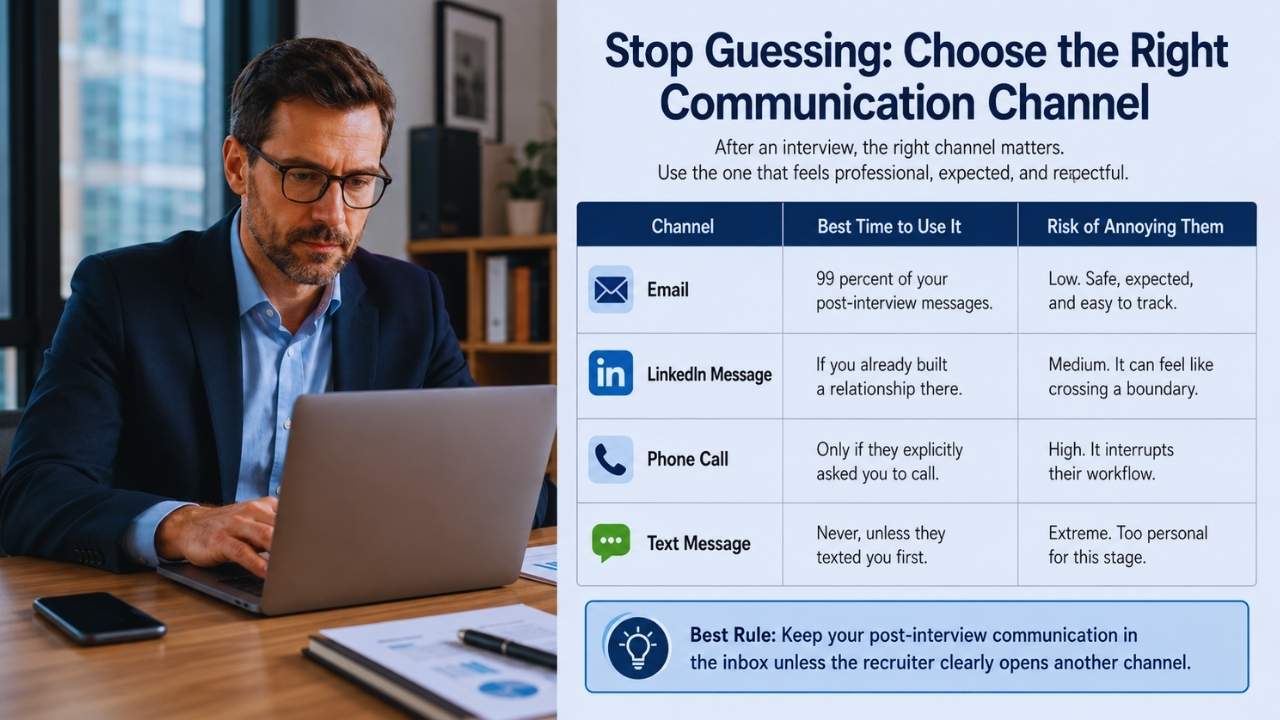
We have a million ways to talk to each other now. But when it comes to hiring, recruiters have strict boundaries. Pick the wrong app, and you instantly annoy the person holding the keys to your new job. Email reigns supreme. It stays out of the way, it is easy to search, and the manager can reply when they actually have a free second. HR departments love email because it leaves a clean paper trail they can log in their internal applicant tracking systems.
If it is not in the system, it did not happen. LinkedIn sits in a gray area. Did you spend weeks chatting with the recruiter on LinkedIn before the interview? Then a quick thank-you there works perfectly fine. But if you only communicated via email, do not track down the hiring manager on LinkedIn to ask about the job. It feels incredibly invasive. And phone calls? Avoid them entirely.
Unless the recruiter specifically looked you in the eye and asked you to call, stay off the phone. Calling interrupts their workflow and puts them on the spot. Never text a recruiter unless they texted you first. Keep it strictly professional and keep your entire conversation in the inbox.
|
Channel |
Best Time to Use It |
Risk of Annoying Them |
|
|
99 percent of your post-interview messages. |
Low. It is safe, expected, and logged in their system. |
|
LinkedIn Message |
If you already built a relationship there. |
Medium. It can easily feel like crossing a boundary. |
|
Phone Call |
Only if they explicitly asked you to call. |
High. It stops their work and forces an awkward chat. |
|
Text Message |
Never, unless they text you first. |
Extreme. It is highly unprofessional for this stage. |
Proven Email Templates You Can Steal Right Now
Staring at a blank screen causes unnecessary stress. Having a solid template ensures you hit the right notes without overthinking every single word. A great message does three specific things. It stays short, it provides clear context, and it ends with a soft ask. Keep your word count aggressively low. Hiring managers scan emails; they do not read them like novels. Keep it under 150 words.
Your subject line must be painfully clear. They need to know exactly what the email is about before they even click it. Use the Momentum Builder template the day after your interview. It sets the baseline and adds immediate value by bringing up a specific point from your conversation. Use the Missed Deadline template when they promised an answer by Friday, and it is now Tuesday.
Use a zero-pressure statement to take the weight off their shoulders. Tell them you understand priorities shift. Finally, use the Radio Silence template when they gave no deadline, and two weeks just vanished into thin air. Acknowledge how busy they are, reiterate your interest, and confidently leave the ball in their court.
|
Which Template to Use |
The Vibe You Want |
When to Actually Send It |
|
Momentum Builder |
Grateful, sharp, helpful. |
24 hours after you walk out the door. |
|
Missed Deadline |
Patient, understanding, low-pressure. |
2 days after they miss their own deadline. |
|
Radio Silence |
Polite, brief, confident. |
7 to 10 business days after the interview. |
|
Post-Rejection |
Classy, forward-looking. |
1 to 2 days after you get the rejection email. |
Huge Mistakes That Kill Your Chances
There is a razor-thin line between being persistent and being a pest. You cross that line the second you let anxiety take the wheel. Firing off a panicked email at midnight on a Friday makes you look completely frantic. The biggest mistake out there is the guilt trip. Never write that you assume you did not get the job because you have not heard back.
This forces a busy manager to stop what they are doing and comfort you. It screams immaturity and immediately turns them off. Another massive red flag is going rogue. If an HR recruiter set up your interview, direct your messages to them. Hunting down the hiring manager’s personal email or sliding into the CEO’s direct messages to ask for an update looks incredibly sneaky.
It shows you do not respect the company’s internal process. Finally, quit double-texting. If you send an email on Monday morning, do not send another one on Wednesday asking if they saw Monday’s email. Give them enough room to breathe. It usually takes a recruiter a few days just to wrangle basic feedback from the entire interview panel.
|
The Mistake |
Why It Fails |
The Fix |
|
The Guilt Trip |
Sounds passive-aggressive. |
Keep your tone aggressively neutral and positive. |
|
Bypassing HR |
Shows zero respect for process. |
Route all questions through your main HR contact. |
|
Double-Texting |
Makes you look impatient. |
Wait at least one full week between any emails. |
|
Over-apologizing |
Looks weak and unconfident. |
Own it. You have every right to ask for a status update. |
How to Handle the Ghosting Epidemic?
Sometimes, you play a perfect game. You crush the interview, send the flawless follow-up note, wait exactly seven days, and then get absolute silence. Ghosting happens constantly today. In 2026, fresh hiring data shows a staggering 53 percent of job seekers experienced employer ghosting in the past year. Furthermore, a solid 20 percent of candidates get ghosted after completing a full interview. It hurts, and it is incredibly frustrating. But you need to realize something important.
It almost never has anything to do with you. Budgets get slashed. Internal hires suddenly take priority. The hiring manager quits. When a company ghosts you after a great interview, it usually exposes a massive breakdown in their internal communication. You might have just dodged a wildly toxic work environment.
If you sent your thank-you note and two polite check-ins over three weeks, and you still hear nothing, stop typing. It is over. Send one final closing the loop email. Tell them you assume they moved in a different direction, thank them for their time, and say you would love to stay in touch for future roles. This protects your sanity and keeps you moving forward.
|
Weeks of Silence |
What You Should Do |
Where Your Head Should Be |
|
Week 1 |
Send the first polite check-in email. |
They are busy. This is a normal delay. |
|
Week 2 |
Send the second nudge. |
They are disorganized. Keep your cool. |
|
Week 3 |
Send the final moving on email. |
The process died. Time to mentally let it go. |
|
Week 4 and beyond |
Stop contacting them entirely. |
Silence is an answer. Keep hustling elsewhere. |
Final Thoughts
Nailing your follow-up after-interview strategy really just comes down to empathy and patience. Put yourself on the other side of the desk. That hiring manager is trying to do their actual day job while dealing with the exhausting process of interviewing strangers. Your goal is to be a pleasant reminder of your value, not another headache in their inbox.
Stick to the timeline rules. Keep your emails punchy and short. Always use a soft, low-pressure ask. By keeping your anxiety in check and sticking to a clean, structured plan, you protect your professional brand. Keep moving forward, keep your tone upbeat, and let your professionalism do the heavy lifting. You’ve got this.
Frequently Asked Questions (FAQs) About Follow Up After Interview
Should I reach out if I know I completely bombed the interview?
Yes. Send the 24-hour thank-you note anyway. We are terrible judges of our own performance. What felt like a total disaster to you might have just looked like normal interview jitters to them. Plus, managers respect people who maintain their professionalism even when a meeting goes off the rails.
What if the recruiter is out of the office on vacation?
Check their out-of-office reply. If they list a backup contact for “urgent matters,” do not email that person for a status update. Your job application is not a fire drill. Wait for the recruiter to get back from the beach, give them one full day to catch up on their inbox nightmare, and then send your note.
Can I connect with the interviewers on LinkedIn right after we talk?
Hold off. Firing a LinkedIn request from the lobby right after you leave the building feels aggressive. Wait until they make a final hiring decision. If you land the job, connect away. If you don’t, send a polite request a few weeks later saying you enjoyed meeting them and want to follow their work.
How do I handle a panel interview with five different people?
Do not send one massive group email. It looks incredibly lazy. Take the extra five minutes to email each person separately. Keep the core message similar, but change at least one sentence in each email to reference something specific you discussed with that exact person. Trust me, they will compare notes, and personalization always wins.