

You tap your piece of plastic, grab your coffee, and walk out. It feels like magic. But behind the scenes, a complex financial engine is running at full speed. When your statement arrives, that five-dollar coffee suddenly costs more thanks to a sneaky finance charge. If you clear your balance every month, you never have to deal with the extra math. But carry a balance, and the clock starts ticking immediately.
The bank starts charging you for the privilege of holding their money. Treat your finances like a masterclass in focus. To win this game, you need the resilience and laser-sharp attention to detail of Sachin Tendulkar facing a fast bowler. You block out the noise and zero in on the mechanics of the game. You have to grasp exactly how credit card interest works. It isn’t just a yearly percentage slapped on your bill. Banks use a specific, daily formula to squeeze out those charges. Let’s strip away the jargon, look at the real numbers, and learn how to beat the banks at their own game.
The Core Concept: How Credit Card Interest Works
You sign up for a card and agree to an annual percentage rate, better known as the APR. Let’s say your approved rate sits at exactly 19.35 percent, which is the national average as of July 2026. You probably think the bank simply charges a flat 19.35 percent on whatever you owe at the end of the year. That assumption is entirely wrong and incredibly dangerous for your wallet.
Credit card companies absolutely do not wait a full year to figure out your charges. They calculate your interest on a daily basis. When the economy shifts and the Federal Reserve moves market rates, your credit card APR usually adjusts within a billing cycle or two. Keeping track of these numbers is the baseline for understanding how credit card interest works. Every single day you hold onto debt, you pay a small fraction of that annual number. Here is a quick cheat sheet for the terms hitting your statement every single month.
|
Term |
Simple Definition |
Why It Matters |
|
APR |
Annual Percentage Rate. |
The baseline number used to calculate your daily interest. |
|
Statement Balance |
The total you owe at the end of a billing cycle. |
Paying this in full stops all interest charges. |
|
Billing Cycle |
The time between your last statement and your current one. |
Interest is calculated based on the days in this window. |
|
Finance Charge |
The actual dollar amount of interest added to your account. |
This is the hard cash you lose to the bank every month. |
Converting Your APR to a Daily Rate
Because banks charge you every single day, they actively convert your yearly APR into a daily number. We call this tiny fraction the daily periodic rate, or DPR for short. Finding this secret number is actually quite easy if you know the formula. You just take your APR and divide it by 365 days.
Some sneaky banks divide by 360, but 365 is the absolute industry standard. To really grasp the mechanics of this system, you have to do this division yourself. Let us take that current national average of 19.35 percent for a test drive. Turn that percentage into a decimal, which gives you 0.1935. Divide that by 365, and your daily rate becomes 0.000530. It looks incredibly tiny on paper, but that tiny fraction chips away at your bank account every single day.
|
Annual Percentage Rate (APR) |
Divided By |
Daily Periodic Rate (DPR) |
|
15.00% |
365 |
0.000410 |
|
19.35% |
365 |
0.000530 |
|
23.79% |
365 |
0.000651 |
|
29.99% |
365 |
0.000821 |
The Average Daily Balance Method
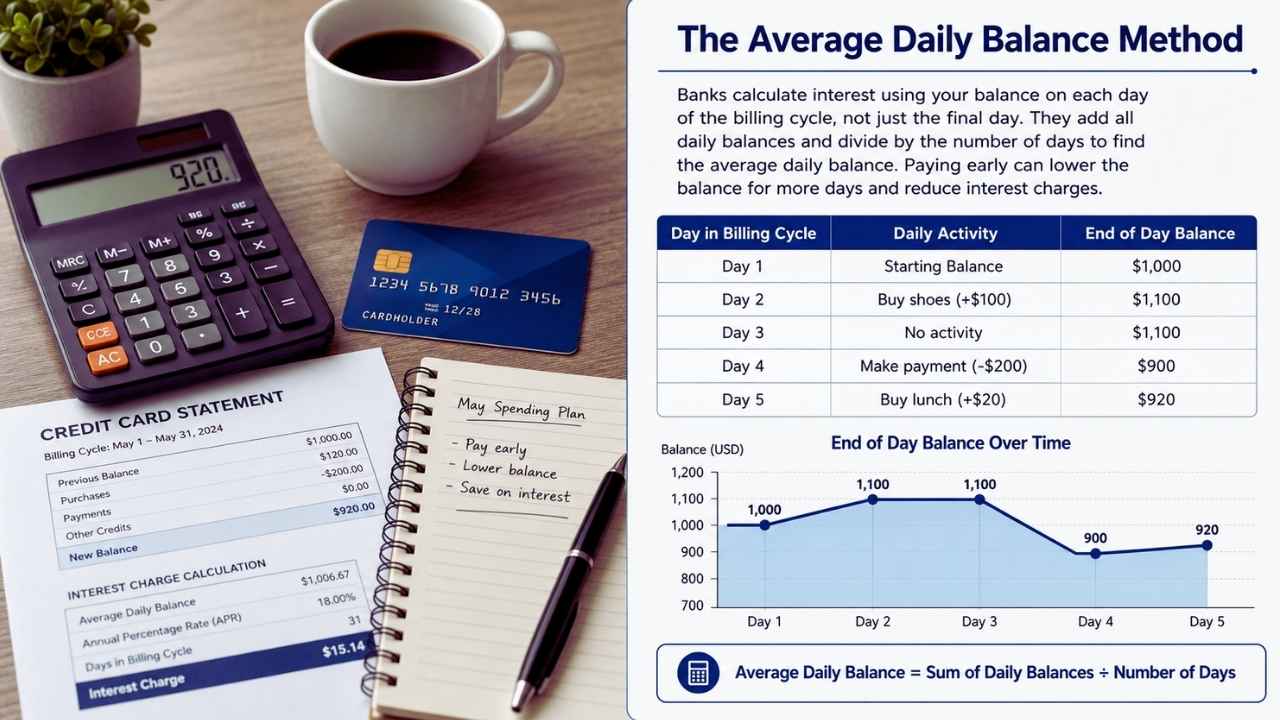
Banks don’t just check your balance on the last day of the month. If they did, you could just pay it off on day 29 and completely cheat the system. Instead, they rigorously track exactly what you owe on every single day of your billing cycle. The industry calls this the Average Daily Balance method.
Here is the play-by-play of how it actually goes down. On Day 1, you owe a flat $1,000. On Day 2, you buy some $100 shoes, bumping your balance to $1,100. Day 3, you don’t shop at all, so the number stays put. Day 4, you log in and pay off $200, dropping your daily balance to $900.
The bank logs that ending number for all 30 days, adds them up, and divides by 30 to get your average. This is exactly why making an early payment is a massive power move. An early payment lowers your balance for the remaining 25 days, which means less money for the bank.
Read Also: How the 2008 Financial Crisis Happened: Plain English Guide
|
Day in Billing Cycle |
Daily Activity |
End of Day Balance |
|
Day 1 |
Starting Balance |
$1,000 |
|
Day 2 |
Buy shoes (+$100) |
$1,100 |
|
Day 3 |
No activity |
$1,100 |
|
Day 4 |
Make payment (-$200) |
$900 |
|
Day 5 |
Buy lunch (+$20) |
$920 |
The Final Math: Putting It Together
Now we have our two magic numbers ready to go. We have the daily rate, and we have the average daily balance. The bank multiplies them together, then multiplies that resulting number by the days in your cycle. Let us use a real-world example to see the damage.
Right now, in 2026, the average American consumer carries a balance of exactly $6,659. We will use that 19.35 percent APR average, which gives us a daily rate of 0.000530. Multiply your $6,659 balance by 0.000530, and your daily interest is about $3.53.
Multiply that $3.53 by a 30-day billing cycle. Your finance charge for that single month is $105.90. The bank adds that cash straight to your balance, meaning next month you pay interest on that $105.90 too. This compounding effect is the true secret of how credit card interest works.
|
Step |
Action |
Example Numbers |
|
Step 1 |
Find the Daily Periodic Rate |
19.35% APR ÷ 365 = 0.000530 |
|
Step 2 |
Find Average Daily Balance |
Sum of all daily balances ÷ 30 days = $6,659 |
|
Step 3 |
Multiply it out |
$6,659 × 0.000530 = $3.53 (Daily Interest) |
|
Step 4 |
Multiply by days in cycle |
$3.53 × 30 days = $105.90 (Total Finance Charge) |
The Grace Period Safety Net
Wait, if interest ticks daily, why don’t you pay it when you clear your bill on time? Meet the grace period, your absolute best financial friend. Almost all cards offer a quiet window between the end of your cycle and your due date. By law, if a grace period exists, it must be at least 21 days long. Pay your full statement balance, and the bank entirely waives the interest on new purchases.
You essentially get a free short-term loan from a massive financial institution. But this safety net is incredibly fragile and completely unforgiving. Leave even a single dollar unpaid, and the grace period vanishes instantly. Suddenly, your new purchases gather interest the exact second you swipe your card. To get that safety net back, you usually have to pay in full for two straight months.
|
User Behavior |
Grace Period Status |
Interest Charged? |
|
Pays full statement balance on time |
Active |
No interest charged on new purchases. |
|
Pays only the minimum payment |
Lost |
Interest charged daily on carried balance and new purchases. |
|
Pays late |
Lost |
Late fees apply, interest charged, grace period revoked. |
|
Pays full balance after carrying debt |
Recovering |
Usually takes 1 to 2 billing cycles to fully restore. |
The Trap of Compounding Interest and Surging Rates
Debt spirals out of control entirely because of compounding interest. When you carry a balance, the bank adds unpaid interest to your principal balance. The very next day, the bank calculates interest on that new, higher number. You literally pay interest on your past interest. Pay only the minimum, and your cash mostly covers last month’s finance charges while barely touching the actual stuff you bought.
This is exactly why total U.S. credit card debt skyrocketed to a massive $1.25 trillion by early 2026. Different age groups feel this trap differently, too. Generation X holds the highest average debt at $9,600, while Millennials sit at $6,961. Gen Z has the lowest balances at $3,493, but their debt is growing faster than anyone else’s. Understanding how credit card interest works is the only way to stop feeding this trillion-dollar machine.
|
Month |
Starting Balance |
Interest Added (Assuming 1.6% monthly) |
Ending Balance (If no payments made) |
|
Month 1 |
$6,659.00 |
$106.54 |
$6,765.54 |
|
Month 2 |
$6,765.54 |
$108.24 |
$6,873.78 |
|
Month 3 |
$6,873.78 |
$109.98 |
$6,983.76 |
|
Month 4 |
$6,983.76 |
$111.74 |
$7,095.50 |
Not All APRs Are Created Equal
A massive mistake people make is assuming their piece of plastic only carries one interest rate. Take a hard look at your card agreement today. You probably have at least three or four different rates lurking in the fine print. The purchase APR is the standard rate for the things you buy, like groceries and gas.
Pull cash from an ATM with your credit card, and you trigger the cash advance APR. This cash rate is almost always higher, and worse, there is zero grace period. The interest starts piling up the absolute second the cash hits your hand. Miss a payment, and the bank punishes you heavily with a penalty APR. Penalty rates can easily hit 29.99 percent or higher. Once the bank locks you into a penalty rate, getting them to lower it feels like fighting a brick wall.
|
Transaction Type |
Typical APR Range |
Is There a Grace Period? |
|
Standard Purchases |
19% to 24% |
Yes (if previous balance paid in full). |
|
Balance Transfers |
0% (Promo) then 19% to 24% |
Varies, usually tied to the promo terms. |
|
Cash Advances |
25% to 30%+ |
No. Interest begins immediately. |
|
Penalty Rate |
29.99%+ |
No. Triggered by late payments. |
Final Thoughts
Credit card debt is expensive on purpose. The entire banking system relies heavily on daily tracking and compounding math to keep you paying. But now you know the playbook. You know the annual rate is actually a daily trap. You know carrying a balance completely kills your grace period. And you know early payments actively destroy your average daily balance.
The best strategy is incredibly simple pay your statement balance in full every single month. Keep your financial discipline sharp. Now that you know exactly how credit card interest works, you hold the power. Let the banks handle the complicated math—you just keep your money exactly where it belongs.
Frequently Asked Questions (FAQs) About How Credit Card Interest Works
Do pending transactions gather interest?
No. When you swipe, the charge sits in “pending” for a day or two. The bank ignores pending charges for your daily balance. Interest only kicks in once the charge officially posts.
Is interest charged on my card’s annual fee?
Yes. If your card has a $95 fee, it acts just like a regular purchase. Don’t pay off the statement it appears on, and you’ll pay interest on the fee itself.
Does paying multiple times a month save money?
Absolutely. Because banks average your daily balance, paying early actively lowers your final number. Making two smaller payments a month instead of one physically reduces your final finance charge.
What is residual interest (trailing interest)?
Say you carry a balance for months, then finally pay it all off. Next month, you get a bill for a few bucks. This is residual interest. It’s the money that accumulated daily between the day your statement printed and the day your payment actually cleared. Always ask your bank for a “payoff quote” to get the exact, to-the-penny amount.