


Back in 2019, you could throw a basic text slogan onto a cheap black t-shirt, run twenty dollars’ worth of Facebook ads, and make quick sales before lunch. Everyone and their neighbor jumped into the business. Fast forward to today, and the entire game looks completely different.
Online marketplaces are packed with millions of copy-paste listings, and automated software generates thousands of generic graphics every single minute. Customers simply ignore low-effort designs. If you are thinking about starting your own shop right now, it makes total sense that you might hesitate. You are probably staring at all this intense competition, looking at rising advertising costs, and asking yourself a very logical question: Is print on demand profitable in 2026?
Here is the honest truth: yes, it absolutely makes money, but the easy money era is completely gone. Customers refuse to buy low-effort t-shirts from random shops anymore. They want unique, high-quality pieces that match their specific identity, aesthetic, or niche hobby. If you treat this business like a lottery ticket and spam generic designs, you will lose money fast. But if you treat it like a lean, modern e-commerce business focused on real brand value and premium products, you can build a highly sustainable, high-margin income stream. Let us break down the exact numbers, look at the actual profit margins, and map out the specific playbooks that actually work right now.
What Exactly Is Print on Demand Today?
The Core Fulfillment Mechanism
Print on demand is an order fulfillment method where you design custom graphics, list them on merchandise, and only print those items after a customer buys them. You set up a digital storefront on platforms like Shopify or Etsy. When a shopper places an order, your shop automatically beams the digital design file and the shipping address directly to a massive production partner like Printify or Printful. Your partner prints the graphic onto a blank garment, packages the item, and ships it directly to your customer’s doorstep under your brand’s specific label. The entire process runs on automated software integrations behind the scenes. You never touch cardboard shipping boxes, you never buy industrial printing machinery, and you never stack unsold inventory in your living room or garage.
Why It Appeals to Modern Entrepreneurs
The massive appeal of this business model remains its near-zero barrier to entry. Because you do not hold physical stock, the financial risk drops dramatically compared to opening a physical retail store. You do not need thousands of dollars to buy bulk stock upfront hoping that a specific color or size will eventually sell. Your main jobs focus entirely on designing unique graphics, marketing your brand to the right targeted audience, and providing excellent customer service. The supplier handles all the messy logistics, warehousing, and global shipping. This hands-off approach frees up your schedule, allowing you to run the entire operation from a laptop while traveling or working a standard full-time job.
Print on Demand vs. Standard Dropshipping
Many beginners confuse this model with regular dropshipping from overseas factories, but they are incredibly different animals. Standard dropshipping usually involves reselling generic, mass-produced manufactured goods from places like AliExpress. You have absolutely no control over the product design, and dozens of other sellers are pushing the exact same item. Print on demand allows you to build a completely original brand with your own custom artwork and highly personalized products. No one else can legally sell your specific artistic creations, which instantly protects you from the ruthless price wars that destroy traditional dropshipping stores. You own the intellectual property and control the creative direction of the entire catalog.
|
Business Model |
Upfront Inventory Cost |
Who Fulfills the Order? |
Control Over Product Design |
Risk of Unsold Stock |
|
Print on Demand |
Zero dollars |
Third-party print facility |
Full control over custom art |
None |
|
Traditional Dropshipping |
Zero dollars |
Overseas factory supplier |
Zero control over generic items |
None |
|
Traditional Retail |
Thousands of dollars |
You or your hired warehouse |
Full control over manufacturing |
Extremely High |
Global E-commerce Shift: Analyzing the Current Market Data
Exploding Market Valuation and Future Growth
To understand where the industry actually stands, you need to look at hard market research rather than social media hype. The sector is growing rapidly. According to verified data from Grand View Research, the global print on demand market size was valued at 10.8 billion dollars in 2025 and is projected to jump to 13.1 billion dollars in 2026. Industry experts project that by 2033, the market will skyrocket to over 57.5 billion dollars, compounding at an annual growth rate of 23.6 percent. Other analytical firms project even higher numbers, estimating the market could reach 84 billion dollars by 2034. This massive sustained growth proves that the industry is nowhere near dead; it is simply maturing and attracting much larger buyer demographics worldwide.
Regional Growth and Global Adoption Rates
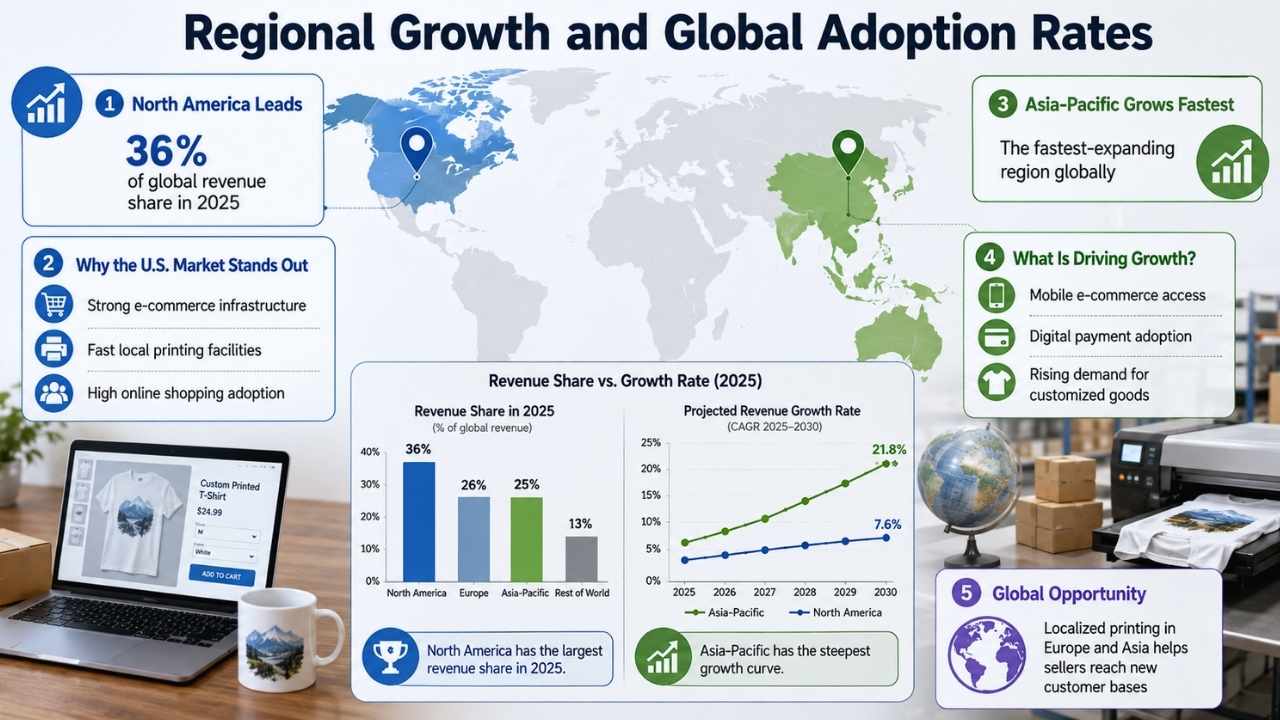
Right now, North America dominates the global landscape, claiming a massive 36 percent of the total revenue share in 2025. The United States market alone boasts incredible e-commerce infrastructure, fast local printing facilities, and extremely high online shopping adoption rates. However, the Asia-Pacific region is currently experiencing the absolute fastest expansion globally. As mobile e-commerce access and digital payment solutions surge across emerging economies, international buyers are flocking to customized goods. Sellers who partner with global fulfillment networks to offer localized printing in Europe and Asia are seeing their revenue numbers multiply rapidly because they tap into entirely fresh, untouched customer bases that local competitors completely ignore.
Drastic Changes in Consumer Purchasing Behavior
This financial growth directly correlates to how modern people prefer to buy goods. Shoppers, especially Generation Z and Millennials, actively reject off-the-rack mass retail clothing found in giant department stores. They want unique, highly personalized items that speak directly to their specific hobbies, aesthetics, and personal values. Custom apparel still dominates the space by holding nearly 40 percent of the total market share, but categories like custom home decor and personalized drinkware are climbing faster than ever. Government e-commerce statistics consistently show that online retail spending remains structurally higher than previous years, reinforcing the permanent shift toward flexible, on-demand customized production rather than wasteful bulk manufacturing.
|
Market Metric |
Current 2026 Data |
Projected Future Value |
Key Growth Catalyst |
|
Global Industry Size |
13.1 Billion Dollars |
57.5 Billion Dollars by 2033 |
Better digital printing tech |
|
Annual Growth Rate |
23.6 Percent |
Consistent 24 Percent |
Shift toward personalized items |
|
Dominant Regional Market |
North America |
Asia-Pacific rising fastest |
High online shopping penetration |
|
Top Product Category |
Custom Apparel |
Home Decor and Wall Art |
Wearable self-expression trends |
Is Print on Demand Profitable 2026? The Honest Math
The Danger of Low-Margin Pricing Traps
Let us cut through the noise and look at the actual unit economics to answer if print on demand profitable 2026. Sellers who struggle constantly make the fatal mistake of racing to the bottom on price. They pick a cheap, thin, basic unisex t-shirt, price it at 18 dollars to compete with high-volume discount sellers, and end up with margins so razor-thin that a single return wipes out their profit for the entire week. If your base blank shirt and printing cost is 11 dollars, and standard shipping is 5 dollars, your net profit sits around 2 dollars after credit card processing fees. If you spend even 5 dollars on social media advertising to acquire that customer, you are instantly losing money on every single sale. You simply cannot build a functional business on two-dollar margins.
The Highly Lucrative Premium Quality Strategy
Successful store owners completely flip this script by targeting a 45 to 65 percent gross profit margin on every single item. They achieve this by completely ignoring cheap promotional t-shirts and focusing entirely on premium retail-grade goods. When you sell an oversized heavyweight fleece streetwear hoodie for 65 dollars, your total production and shipping cost might sit around 32 dollars. That leaves you with roughly 33 dollars in gross profit per order. With that much financial breathing room, you can easily pay for marketing campaigns, cover your monthly software platform fees, and still walk away with healthy net income. Consumers gladly pay higher prices when the fabric feels incredibly thick, soft, and durable right out of the package.
Realistic Monthly Profit Expectations for Sellers
Profitability depends heavily on your product choices and your marketing channels. Data shows that standard sellers average around a 20 percent net margin, but top performers utilizing specialized niches easily reach 30 to 40 percent net margins. A beginner relying entirely on organic marketplace search traffic might take three to six weeks to see their first organic sale, earning maybe 100 to 300 dollars a month initially. Conversely, a serious brand owner who publishes consistent, high-quality collections, runs effective Pinterest SEO campaigns, and sells premium canvases or heavy hoodies can scale to 3,000 to 10,000 dollars in monthly net profit within a year or two. It requires intense consistency and excellent niche research.
|
Product Type |
Average Base Cost |
Realistic Retail Price |
Target Gross Margin |
Estimated Profit per Unit |
|
Standard Unisex T-Shirt |
10 to 13 Dollars |
24 to 28 Dollars |
45 to 55 Percent |
8 to 12 Dollars |
|
Heavyweight Streetwear Hoodie |
22 to 30 Dollars |
55 to 75 Dollars |
45 to 55 Percent |
25 to 38 Dollars |
|
Framed Canvas Wall Art |
18 to 26 Dollars |
55 to 85 Dollars |
55 to 70 Percent |
30 to 55 Dollars |
|
Spiral Custom Notebooks |
4 to 6 Dollars |
12 to 18 Dollars |
50 to 65 Percent |
6 to 10 Dollars |
Hidden Expenses That Sneak Up on Store Owners
E-commerce Platform and Transaction Fees
Keeping your store healthy requires aggressively tracking your daily overhead. Even though you avoid buying inventory upfront, running an online storefront comes with very real operating expenses. If you build an independent website on Shopify, you will pay a monthly subscription fee starting around 39 dollars, plus a credit card processing fee of roughly 3 percent per transaction. If you opt for a marketplace like Etsy to gain access to their built-in audience, you skip the monthly subscription but get hit with a 20-cent listing fee per item, plus a 6.5 percent transaction fee on the total order value. If you ignore these micro-costs and fail to calculate them into your final retail pricing, they will quietly eat away your profits before you even notice.
Essential Design and Software Subscriptions
Unless you are already a professional graphic designer with a massive hard drive full of original fonts and vectors, you will need reliable software to create production-ready graphics. Subscriptions to user-friendly layout tools like Canva Pro cost around 15 dollars a month and handle basic typography perfectly. More advanced vector tools like Kittl or Adobe Illustrator run between 15 and 35 dollars monthly and are absolutely essential for creating complex vintage lettering or detailed illustrations. Furthermore, you need high-quality lifestyle mockup generators like Placeit to show your designs on real human models, which costs another 15 dollars monthly. These tools are completely non-negotiable if you want your storefront to look professional and trustworthy.
Mandatory Quality Control and Sample Orders
You should never, under any circumstances, sell a physical product you have not personally held in your own hands. Ordering samples allows you to rigorously check whether the fabric feels cheap and scratchy, carefully inspect the color saturation of the direct-to-garment ink, and thoroughly test how the printed graphic holds up after five heavy cycles in a washing machine. Budgeting at least 50 to 100 dollars per month for sample testing prevents catastrophic bad reviews down the line. Plus, ordering samples allows you to shoot authentic, organic lifestyle photos with your smartphone for your TikTok or Instagram pages, which converts significantly better than using standard digital mockups.
|
Cost Category |
Estimated Monthly Expense |
Is It Mandatory? |
How to Keep It Low |
|
Store Platform Fees |
20 Cents to 39 Dollars |
Yes, required |
Start on free marketplaces initially |
|
Design Software Tools |
15 to 35 Dollars |
Highly Recommended |
Use free open-source tools first |
|
Sample Quality Orders |
50 to 100 Dollars |
Yes, absolutely crucial |
Order samples only for top sellers |
|
Custom Web Domain |
15 Dollars per year |
Yes, for Shopify stores |
Buy via standard cheap registrars |
Battle-Tested Strategies to Stand Out and Succeed
Targeting Deep, Untapped Micro-Niches
Broad categories like dog lovers, fitness junkies, or travel enthusiasts are completely oversaturated right now. Massive retail chains already sell those generic designs for 12 dollars at the local mall. To win, you must go three layers deeper into specific subcultures. Instead of targeting generic fitness, build a store specifically for masters division powerlifters over the age of 40. Instead of targeting coffee drinkers, create merchandise exclusively for night-shift emergency room nurses who survive on dark roast. When a shopper stumbles across a design that speaks directly to their highly specific daily life and inside jokes, all price sensitivity completely disappears. They buy the item immediately because it feels entirely custom-made for their unique identity.
Leveraging AI-Driven Personalization
Customizable products currently convert up to 30 percent better than static, unchangeable designs. Buyers gladly pay an extra 10 to 15 dollars to seamlessly add their pet’s name, their family home coordinates, or a custom anniversary date directly onto a product. You can use automated personalization applications that connect your digital store straight to your print provider. The customer types their specific text directly into your storefront, views an instant live digital preview, and the finished print file sends automatically to the manufacturer without any manual editing on your end. Copycats and art thieves cannot easily replicate a custom fulfillment process, which deeply protects your store from intellectual property theft.
Building Strong Organic Traffic Channels
Relying solely on paid Facebook or TikTok advertising with a tiny beginner budget is incredibly risky. Rising click costs can completely wipe out your entire net margin overnight if a campaign fails. Instead, focus heavily on organic distribution channels that cost nothing but your time. Create visually appealing Pinterest pins linking directly to your product pages; pins have a multi-month shelf life and generate steady, passive traffic long after you post them. Write incredibly descriptive product titles and detailed listing descriptions answering real questions your customers search for on Google. Organic search engine optimization takes longer to build momentum, but it compounds massively over time and provides the highest return on investment possible.
Read Also: How to Refinance a Mortgage: Complete 2026 Guide
|
Growth Strategy |
The Amateur Approach |
The Professional 2026 Approach |
|
Niche Selection |
Generic themes like “Fishing shirts” |
Deep niches like “Pacific Northwest kayak anglers” |
|
Product Customization |
Static, unchangeable graphic files |
Live preview text and name personalization |
|
Traffic Acquisition |
Burning cash on unoptimized ads |
Organic Pinterest, TikTok clips, and SEO |
|
Apparel Selection |
Cheap, scratchy promotional tees |
Ring-spun cotton and heavyweight fleece |
Top High-Margin Products to Sell Right Now
Premium Heavyweight Apparel and Streetwear
Apparel still captures the absolute largest market share in the industry, but 2026 has shifted focus dramatically toward premium fit, soft feel, and dense fabric quality. Roomier silhouettes, drop-shoulder cuts, and heavyweight fleece hoodies dominating the streetwear trends are mandatory for modern stores. A heavy hoodie weighing over 350 grams per square meter feels incredibly substantial when a customer unboxes it. You can manufacture these premium garments for around 25 dollars and easily retail them between 55 and 75 dollars, securing excellent 50 percent gross margins. Customers happily pay premium pricing when the clothing matches the quality found in high-end boutique retail stores.
Giclée Print Canvases and Premium Wall Art
Wall art is consistently one of the most lucrative categories in the entire e-commerce ecosystem because art possesses absolutely no fixed retail price tag. A large, beautiful Giclée canvas print utilizing archival inks might cost you 20 dollars to manufacture and ship. However, depending entirely on the perceived value of your artwork, you can easily sell that exact same canvas for 75 to 120 dollars or more. These massive 60 to 80 percent gross margins allow you to scale your advertising budgets aggressively. Furthermore, wall art completely avoids the massive headache of clothing size returns, drastically reducing your customer service workload and keeping your cash flow incredibly stable throughout the year.
Insulated Drinkware and Specialized Accessories
Custom drinkware remains a massive, constantly recurring gifting category all year round, completely ignoring seasonal fashion dips. Massive 40-ounce stainless steel vacuum tumblers featuring laser engraving or full-wrap vivid color prints offer incredible daily utility to the buyer. They boast extremely low return rates because they are durable and size-agnostic. Producing a large tumbler costs roughly 18 dollars, and they reliably retail for 40 to 48 dollars. Furthermore, items like custom spiral notebooks or personalized pet bandanas cost practically nothing to produce but sell for 15 to 20 dollars, offering insane 60 percent profit margins while acting as the perfect cross-sell items to boost your average order value.
|
Product Category |
Recommended Base Item Specs |
Avg. Base Cost |
Retail Target Price |
Est. Profit Margin |
|
Heavy Streetwear |
350+ GSM Drop-Shoulder Fleece |
24 to 30 Dollars |
60 to 75 Dollars |
50 to 55 Percent |
|
Wall Art Canvases |
Stretched Pine Canvas 1.25 inch |
18 to 26 Dollars |
55 to 90 Dollars |
60 to 70 Percent |
|
Insulated Drinkware |
40 oz Stainless Vacuum Tumblers |
17 to 22 Dollars |
38 to 48 Dollars |
48 to 55 Percent |
|
Stationery Gifts |
Hardcover Journals and Notebooks |
4 to 6 Dollars |
14 to 18 Dollars |
55 to 65 Percent |
Choosing the Right Fulfillment Partner
Printful for In-House Reliability and Quality
Your production partner handles the most critical, vulnerable part of your entire business model: physical product quality and actual delivery speed. Printful is widely considered the premium gold standard in the industry today. They own and operate their own massive fulfillment centers across North America, Europe, and Latin America. Because they manage their own machines and staff directly, their print consistency is absolutely top-tier, maintaining an astonishingly low error reshipment rate under a quarter of one percent. While their base product costs are slightly more expensive than competitors, the completely headache-free fulfillment process and flawless reputation make them the favorite choice for serious premium clothing lines.
Printify for Maximum Profit Margins and Variety
Printify operates on a completely different business model. They act as a massive open marketplace software, connecting your store to hundreds of independent, vetted print shops located all around the world. Because these various print shops constantly compete against each other for your daily business volume, you can consistently find the absolute lowest wholesale base prices in the entire industry here. This setup is incredibly excellent for maximizing your net profit margins. However, the sheer variety means you must manually order samples and rigorously check the ratings of individual print providers inside their network to ensure they meet your brand’s strict quality standards before selling their goods.
Gelato for Localized Global Eco-Friendly Printing
If you plan to sell internationally and care deeply about sustainability, Gelato is an absolute powerhouse fulfillment network. Rather than shipping packages across oceans, they focus heavily on localized global printing. With partnered production hubs spread across over 30 different countries, their software automatically routes your customer’s order to the print shop physically closest to the buyer’s home address. This brilliant logistics strategy drastically cuts down shipping transit times to just a few days, massively reduces your brand’s carbon footprint, and entirely eliminates nasty, unexpected customs duties or import taxes that usually anger overseas customers and lead to rejected packages.
|
Fulfillment Provider |
Primary Business Model |
Strongest Platform Feature |
Best Suited Seller Profile |
|
Printful |
In-house owned facilities |
Flawless print consistency |
Premium brands wanting zero stress |
|
Printify |
Global supplier network |
Lowest wholesale product costs |
Sellers maximizing profit margins |
|
Gelato |
Distributed local hubs |
Rapid regional global shipping |
Eco-brands and international sellers |
|
Awkward Styles |
In-house specialized hub |
Fast apparel turnaround times |
Trendy streetwear and fashion lines |
Final Thoughts
The entire e-commerce ecosystem moves incredibly fast, and the exact tactics that worked a few years ago will absolutely fail today. The pessimistic sellers who constantly complain on forums that the industry is dead are usually the exact same individuals aggressively refusing to adapt to the new, quality-driven rules of the game.
So, if a friend or family member asks you, is print on demand profitable in 2026? You can confidently look them in the eye and say yes. The global market is officially projected to reach tens of billions of dollars over the coming decade and is currently growing at a massive 24 percent annual rate. Everyday shoppers are actively, desperately looking for unique, highly personalized, and premium-quality items that accurately reflect exactly who they are and what they love.
Frequently Asked Questions (FAQs) About
Do I need advanced design skills to start a POD business?
No, you do not need to be a professional graphic designer. The market has shifted toward accessible design. Free and low-cost tools like Canva, Kittl, and AI generators allow you to create stunning graphics. You can also hire affordable freelance illustrators to create exclusive assets for your brand.
What are the biggest challenges POD sellers face right now?
The biggest hurdles in 2026 are intensifying price competition at the bottom of the market and managing customer expectations around shipping speeds. Buyers are used to two-day shipping from massive retailers. If your POD provider takes over a week to print and ship, you will lose repeat customers.
How fast do global POD providers actually ship?
It varies wildly by provider. Standard providers might take 2 to 5 days to print, plus another 3 to 7 days for shipping. However, modern platforms utilizing local microfactories are speeding this up dramatically. Some specialized providers can now complete production in as little as 4 hours and deliver globally within 24 to 72 hours.
Is it better to sell on a marketplace like Etsy or my own Shopify store?
Both have distinct advantages. Etsy has a built-in audience of millions of active buyers looking for custom goods, making it easier to get your first sale without an ad budget. Shopify requires you to drive your own traffic, but you own your customer list, pay lower transaction fees, and can build a standalone brand identity.