


Let’s get one thing straight right away. Building an online shop isn’t a get-rich-quick scheme. You have probably scrolled past viral videos claiming you can upload a few generic digital files and wake up to thousands of dollars in passive income. While that sounds amazing, the reality of running a shop takes actual work, strategy, and patience. If you want to make money on Etsy 2026, you need a solid grasp of what buyers actually want right now.
You also need to understand how the current fee structure eats into your profits and what the platform’s latest rules mean for new sellers. Over the last couple of years, Etsy aggressively cracked down on low-effort drop-shipping and cheap resale items. They want original, creative, and high-quality goods that buyers can’t simply find on mass-market retail sites. This guide strips away the hype and the fake promises.
I will walk you through exactly what works today, the hidden costs you need to watch out for, and a clear path to building a profitable shop from scratch. Let’s look at the real data, the actual math, and the strategies that separate the shops that close after a month from the ones that replace a full-time salary.
Is It Actually Worth Selling on Etsy Right Now?
Yes, but you have to play by the new rules. The pandemic boom days of throwing up a generic digital planner and making massive profits with zero effort are completely dead. Today, you are entering a curated, highly competitive marketplace. As of early 2026, Etsy boasts over 96 million active buyers on its core marketplace, while the active seller count sits at approximately 7.5 million. That means the platform generated a staggering $13.2 billion in annual gross merchandise sales recently.
The ratio is now roughly 13 buyers for every single active seller, meaning the opportunity is massive if you know what you are doing. Etsy now enforces strict “creativity standards” across the board. Everything you sell must fit one of four distinct labels: made by you, designed by you, handpicked vintage (20 plus years old), or craft supplies. You can no longer buy cheap clip art, slap it on a mug, and call it handmade. Furthermore, they introduced a mandatory $15 onboarding fee for new sellers, which can climb up to $29 depending on your specific region.
Nobody likes paying just to open an account, but this tiny barrier to entry keeps out the automated scammers. It protects your shop from cheap copycats who try to steal your designs and flood the market with garbage. If you treat your shop like a genuine business, you have a massive advantage over the people looking for a quick cash grab.
Read Also: How to Refinance a Loan: When It Saves Money and When It Doesn’t?
|
Feature |
The Old Etsy |
The Reality in 2026 |
|
Opening a Shop |
Totally free for everyone |
$15 to $29 one-time identity verification fee |
|
Drop-shipping |
Often flew under the radar |
Strictly banned unless you created the original design |
|
Market Size |
Cluttered with 9 million sellers |
Curated down to 7.5 million active sellers |
|
Buyer Demand |
High, but unpredictable |
Massive: Over 96 million active global buyers |
What to Sell: Top Products to make money on Etsy 2026
Picking the right product category is half the battle when you want to figure out how to make money on Etsy 2026. Your choice dictates your daily workload, your upfront costs, and your long-term profit margins. Buyers flock to this platform specifically for custom, personalized items. Customized goods currently make up a massive chunk of Etsy’s total sales, so you need to lean into personalization. Digital downloads remain highly attractive because you create a digital file once and sell it forever.
There are no shipping boxes, no post office runs, and profit margins sit comfortably above 85 percent. However, the competition in digital goods is ruthless, requiring serious design skills and a remarkably tight niche to survive. Print-on-demand is another fantastic route for creative types. You design the graphic, and a partner like Printify or Gelato prints and ships it when a customer orders, which fits perfectly under Etsy’s “designed by a seller” rule.
Handmade and physical goods remain the true heart of the platform, where buyers gladly pay premium prices for things you make with your own hands, 3D printers, or laser engravers. Just remember that physical goods require you to trade your physical time for money. If a video goes viral and your shop blows up overnight, you have to physically build and ship every single order, which can quickly lead to severe burnout if you do not have a system in place.
|
Business Model |
Average Profit Margin |
Setup Effort |
Best Fit For |
|
Digital Downloads |
85% to 98% |
High upfront, very low ongoing |
Designers, highly organized planners |
|
Print-on-Demand |
40% to 55% |
Medium upfront, low ongoing |
Digital artists, clever trend spotters |
|
Handmade Goods |
50% to 70% |
High physical labor |
Traditional crafters, 3D printing hobbyists |
|
Vintage & Supplies |
30% to 70% |
Constant sourcing effort |
Dedicated thrifters, bulk wholesale buyers |
The Real Cost: 2026 Etsy Seller Fees Broken Down
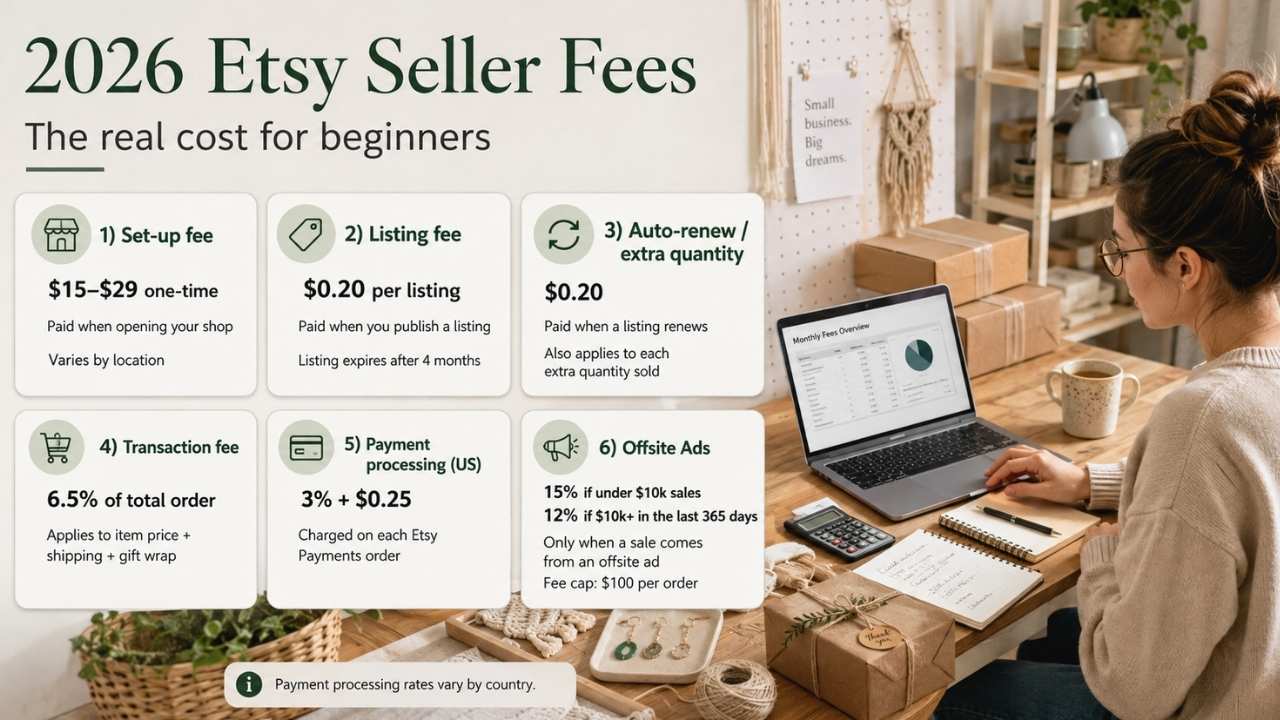
Let’s talk about the money. I consistently see beginners blindly copy their Shopify pricing over to Etsy and end up losing cash on every single sale. Selling here is a pay-as-you-go system, and the fees stack up quickly before you even realize it. First, you pay a one-time setup fee of $15 to $29 when you open your store to verify your identity. Next comes the listing fee. You pay a flat $0.20 just to publish a product, and that listing lives for four months.
If it sells, you pay another $0.20 to automatically renew it. The biggest hit is the transaction fee, where Etsy takes a 6.5 percent cut of the total order. Yes, that 6.5 percent includes the shipping cost you charge the customer. You cannot cheat the system by charging one dollar for the item and twenty dollars for shipping. To handle the credit card securely, Etsy takes 3 percent plus $0.25 per order in the United States.
Finally, Etsy runs offsite ads for your products on Google and Instagram. If a buyer clicks one and buys from you within thirty days, Etsy takes 15 percent of the total sale. If your shop eventually pulls in over $10,000 a year, you cannot turn this off, but the ad fee fortunately drops to 12 percent.
|
Fee Type |
Amount Charged |
When You Actually Pay It |
|
Setup Fee |
$15 to $29 (one-time) |
During initial shop creation and verification |
|
Listing Fee |
$0.20 per item |
Every time you publish or auto-renew an item |
|
Transaction Fee |
6.5% of total order |
On the total sale price (including shipping) |
|
Payment Processing |
3% plus $0.25 (US) |
On every single completed transaction |
|
Offsite Ads |
12% to 15% |
Only if a buyer buys via an Etsy-placed external ad |
How to Set Up Your Shop (The Right Way)
Opening your store takes ten minutes, but getting it ready to actually capture buyer attention takes real strategy. Do not guess what people want to buy based on your own preferences. Type a broad idea into the Etsy search bar and watch the auto-suggest drop-down list. Those specific phrases are exactly what real people search for every single day. Do not just sell generic candles; sell soy candles specifically formulated for dog owners.
Skeptical buyers inspect your profile before handing over their credit cards, so you need to upload a crisp logo and a banner showing your best items in a real-life setting. Fill out your “About” section to tell your authentic story, and explicitly list any production partners you use to stay compliant with the new rules.
Make sure your shipping and return policies are crystal clear to protect yourself from unreasonable refund requests down the line. Your main photo is your storefront window. If it looks dark, blurry, or cluttered, absolutely no one will click on it. Use all ten photo slots to show the item in use, add a size scale next to a common object, and upload a short video showing the texture and movement.
|
Phase |
Core Task |
The Real Goal |
|
Week 1: Strategy |
Pick a specific niche and pay the setup fee. |
Establish a clear, trustworthy brand identity. |
|
Week 2: Production |
Create your first 10 to 20 distinct products. |
Build enough inventory to look like an active, serious store. |
|
Week 3: Visuals |
Shoot bright photos and format digital mockups. |
Win clicks on the crowded, competitive search page. |
|
Week 4: Trust |
Fill out policies, add a banner, get initial feedback. |
Convert your hard-earned organic traffic into cash. |
Etsy SEO: Getting Buyers to Find Your Stuff
“Search engine optimization” sounds incredibly complicated, but it really just means using the exact words your buyers type into the search bar. You cannot list a product and wait for magic to happen. You have to actively feed the algorithm what it wants to see. Lead your product title with your strongest, most relevant keywords. “Personalized Leather Dog Collar” beats “Fido’s Favorite Neckwear” every single time because nobody searches for the latter.
Clear titles get clicks, and Etsy explicitly rewards listings that actually convert browsers into paying buyers. Next, use all thirteen backend tags and make them multi-word phrases. Do not tag a generic word like “mug”; tag “funny accountant coffee mug” instead. Furthermore, fill out every single attribute drop-down when categorizing your item, including color, occasion, material, and dimensions.
The more data you hand over, the better Etsy matches you with a buyer holding a credit card. Respond to customer messages quickly and ship your items on time to maintain a strong shop score, as Etsy pushes reliable shops higher in the search rankings.
|
SEO Element |
What You Should Do |
The Rookie Mistake |
|
Titles |
Lead with the most relevant, descriptive keyword. |
Using clever names nobody actually searches for. |
|
Tags |
Use all 13 tags as 2 to 3 word descriptive phrases. |
Repeating words or using single broad terms like “gift.” |
|
Attributes |
Fill out every relevant drop-down box provided. |
Skipping the section entirely to save five minutes. |
|
Service Metrics |
Answer messages fast and ship on time. |
Ignoring messages, which immediately tanks your ranking. |
Pricing Your Products for Actual Profit
Pricing on gut feeling ruins businesses faster than almost anything else. To consistently make money on Etsy 2026, you have to run the math backwards. Let’s say you sell a custom hoodie through a print partner, and it costs you $18 to print and ship. You list it for $25, thinking you just made seven dollars.
However, Etsy takes about $2.50 in standard base fees, bringing your actual profit down to $4.50. But wait, what if that buyer clicked an offsite ad? Etsy takes another $3.75 from your total. You just walked away with 75 cents on a $25 sale, which is completely unsustainable for a real business.
Stop competing on price and start pricing for profit. Price that exact same hoodie at $34 and offer incredible value through highly unique designs and premium visual mockups. Even if an Offsite Ad fee hits you unexpectedly, you still walk away with a healthy profit margin. You want buyers who care about quality, not bargain hunters who complain about every minor detail.
|
Financial Metric |
What It Actually Means |
Why It Matters for Pricing |
|
Cost of Goods |
What you pay to create the item (materials, POD cost). |
You can never price below this plus your baseline fees. |
|
Base Platform Fees |
The standard cut Etsy takes (around 9.5% plus $0.45). |
Must be baked into your baseline retail price. |
|
Offsite Ads Buffer |
The potential 12% to 15% hit from an external ad. |
Price your items assuming this fee will occasionally happen. |
|
Net Profit Margin |
The actual cash you put in your bank account. |
Aim for 30% to 40% on physical goods, and 80%+ on digital. |
Driving Your Own Traffic (And Why It Pays Off)
Etsy gives you fantastic built-in traffic, but you absolutely should not rely solely on their search engine. You leave serious money on the table if you ignore external marketing. Plus, Etsy actually rewards you for hustling through their Share & Save program. If you drive a sale through your own custom link, Etsy refunds you 4 percent of the transaction fee.
TikTok and Instagram Reels are incredible tools for showing the messy behind-the-scenes process. People love buying from real humans, and authentic video builds trust instantly. Pinterest acts like a visual search engine, not just a social media platform. A well-designed pin can drive high-quality traffic to your shop for years.
Finally, capture emails by offering a discount code to your social media followers. You own that email list forever, meaning you can launch new product lines straight to past buyers without paying a single dime in advertising fees. If you build an audience off the platform, you insulate yourself from sudden algorithm changes.
|
Traffic Source |
Effort Level |
Potential Impact |
Best Action Strategy |
|
TikTok / Reels |
High |
Massive short-term spikes |
Post authentic behind-the-scenes process videos. |
|
|
Medium |
High and long-term |
Pin aesthetic lifestyle photos of your products. |
|
Email List |
High |
Extremely High |
Offer a discount code in exchange for emails. |
|
Etsy Ads (Internal) |
Low |
Highly variable |
Only run paid ads on your proven best-sellers. |
Final Thoughts
Building a successful storefront takes serious grit and determination. You will spend your first month tweaking keywords, fixing bad photos, and adjusting prices. Do not panic if you do not get a sale on day one. The sellers who truly make money on Etsy in 2026 treat their shop like a real brand, not a weekend hobby.
They know their exact profit margins, adapt to policy changes quickly, and create high-quality items that solve a problem for a specific niche. Start small, focus purely on quality, and trust the math. You have everything you need to start building a real income stream today.
Frequently Asked Questions (FAQs) About Make Money on Etsy 2026
Can I get the Etsy setup fee waived?
Sometimes. Etsy occasionally runs promos that waive the 15-29 onboarding fee for new sellers. You’ll see exactly what you owe on the final setup screen before you confirm your payment info.
Will using AI art get my shop suspended?
No, but you have to be honest about it. The updated creativity standards allow AI creations (like DALL-E or Midjourney), but you must disclose it in your listing. You can’t claim an AI image was hand-painted with physical watercolors.
Do I actually have to make Print-on-Demand products myself?
Not physically. Under the “Designed by a seller” rule, you can create the original graphic and use a third-party company (like Gelato or Printify) to print and ship it. Just make sure you list them as a production partner in your shop settings.