

Most people don’t need another loud productivity quote. They need a system that works when Monday gets messy. They need something that still helps when the inbox is full, the phone keeps buzzing, and three small problems hit before lunch.
That’s why the best productivity books still matter. A good productivity book doesn’t tell you to wake up at 5 a.m. and act like a machine. It helps you understand why your day feels scattered. It shows why habits break, why focus fades, why goals disappear, and why small tasks often eat the whole day.
Modern work has made this harder. Microsoft’s 2025 Work Trend Index found that heavy Microsoft 365 users were interrupted every two minutes during core work hours by meetings, emails, or chats. Asana’s work research also shows that many knowledge workers spend 60% of their time on “work about work,” such as chasing updates, searching for files, switching tools, and sitting in unnecessary coordination loops.
That means productivity today isn’t just about doing more. It’s about protecting your attention. It’s about choosing better tasks. It’s about making progress without burning out.
Why the Best Productivity Books Still Matter in 2026
Productivity has changed. A clean to-do list helps, but it’s not enough anymore. Most people now deal with constant notifications, meeting overload, app switching, unclear priorities, and low mental energy. Many workers don’t fail because they’re lazy. They fail because their workday is built to interrupt them.
That’s why productivity books still matter. The right one can give you a simple operating system for your day. It can help you choose better, start faster, and stop carrying every task in your head.
Gallup’s 2026 workplace report found that global employee engagement fell to 20% in 2025. Low engagement affects focus, energy, output, and follow-through. So the productivity problem is not only personal. It is also tied to how people work, lead, plan, and communicate.
The best books in this category do not promise magic. They do not fix your life overnight. But they can help you build better habits, reduce friction, set clearer priorities, and protect time for important work. The real value comes when you apply one idea at a time. Don’t read ten books and change nothing. Pick one book, choose one method, and test it for at least two weeks.
|
Modern Productivity Problem |
Why It Happens |
What the Right Book Helps You Do |
|
Too many tasks |
Everything feels urgent |
Build a trusted task system |
|
Constant interruptions |
Messages and meetings split attention |
Protect focus time |
|
Procrastination |
Big tasks feel vague or uncomfortable |
Start with a clear first action |
|
Weak routines |
Habits rely too much on motivation |
Design better triggers and environments |
|
Overcommitment |
Saying yes becomes automatic |
Set stronger filters |
|
Goal drift |
Annual goals feel too far away |
Use shorter planning cycles |
|
Burnout risk |
People confuse busyness with progress |
Work with more honest limits |
|
Poor follow-through |
Plans stay too abstract |
Track actions weekly |
Best Productivity Books: Quick Comparison
Before choosing a book, it helps to know what each one does best. Some productivity books focus on habits. Some focus on time management. Some focus on deep concentration, goal execution, or distraction control. The best choice depends on your biggest pain point right now.
If your tasks feel messy, Getting Things Done may help first. If you can’t focus, Deep Work or Indistractable may fit better. If you keep saying yes to everything, Essentialism is a strong pick. If you want better daily routines, Atomic Habits is hard to beat.
This list includes both practical systems and deeper mindset books. That balance matters. You need tools for the day, but you also need better judgment about what deserves your time.
The keyword here is “actually.” These books work because they give readers methods they can use. They are not just motivational. They help you change your calendar, your habits, your focus, and your decisions.
Here is the full list of the best productivity books before we break them down.
|
Rank |
Book |
Author |
Best For |
Main Skill |
|
1 |
Atomic Habits |
James Clear |
Building better routines |
Habit formation |
|
2 |
Getting Things Done |
David Allen |
Managing tasks and projects |
Task organization |
|
3 |
Deep Work |
Cal Newport |
Focused knowledge work |
Deep concentration |
|
4 |
Essentialism |
Greg McKeown |
Doing fewer things better |
Prioritization |
|
5 |
The 7 Habits of Highly Effective People |
Stephen R. Covey |
Long-term growth |
Personal leadership |
|
6 |
Eat That Frog! |
Brian Tracy |
Beating procrastination |
First-task discipline |
|
7 |
Make Time |
Jake Knapp and John Zeratsky |
Daily focus |
Attention design |
|
8 |
Four Thousand Weeks |
Oliver Burkeman |
Time anxiety |
Time realism |
|
9 |
The ONE Thing |
Gary Keller and Jay Papasan |
Narrowing priorities |
Leverage thinking |
|
10 |
The 12 Week Year |
Brian P. Moran and Michael Lennington |
Goal execution |
Short-cycle planning |
|
11 |
Indistractable |
Nir Eyal |
Digital distraction |
Attention control |
|
12 |
The Power of Habit |
Charles Duhigg |
Habit science |
Habit loops |
1. Atomic Habits by James Clear
Atomic Habits is the easiest book on this list to recommend to almost anyone. James Clear takes a big topic, behavior change, and makes it feel simple. His core message is that small habits compound. You don’t need to rebuild your entire life in one weekend. You need tiny actions you can repeat.
That idea matters because most people fail by starting too big. They plan an intense workout routine, a perfect morning schedule, or a huge writing goal. Then life gets busy, and the whole plan falls apart.
Atomic Habits helps you lower the starting line. It teaches you to make good habits obvious, attractive, easy, and satisfying. It also shows how to make bad habits invisible, unattractive, hard, and unsatisfying.
The book also explains identity-based habits. Instead of saying, “I want to write more,” you start thinking, “I’m a person who writes.” Instead of saying, “I want to get fit,” you act like someone who trains. That small identity shift can make habits feel more natural.
This book works well for students, writers, creators, professionals, parents, and anyone who wants steadier routines. It is not just a productivity book. It is a behavior design book. If you read only one book from this list, Atomic Habits is one of the safest starting points.
|
Key Idea |
What It Means |
How to Apply It |
|
Tiny habits compound |
Small actions grow over time |
Start with a two-minute version |
|
Environment shapes behavior |
Your space influences choices |
Keep good habits visible |
|
Identity drives action |
You act like the person you believe you are |
Use “I am” statements |
|
Friction kills habits |
Hard actions get delayed |
Make the first step easy |
|
Tracking builds momentum |
Progress becomes visible |
Mark each successful day |
|
Bad habits need friction |
Make unwanted actions harder |
Remove triggers from your space |
Practical example: If you want to read more, don’t start with a goal of 50 pages a night. Put a book on your pillow and read one page before sleep. Once the habit is alive, you can build from there.
2. Getting Things Done by David Allen
Getting Things Done, often called GTD, is one of the most respected task-management systems ever written. Its biggest strength is simple: it gets tasks out of your head and into a trusted system. That matters because your brain is terrible at storing open loops. It reminds you about groceries during a meeting and reminds you about work while you’re trying to rest.
David Allen’s system has five steps: capture, clarify, organize, reflect, and engage. You collect everything that has your attention. You decide what each item means. You put it where it belongs. You review the system often. Then you choose what to do next.
This book is especially useful for people who manage many projects at once. Editors, managers, founders, freelancers, marketers, and busy professionals can get a lot from it. The power of GTD is not that it makes you do everything. It helps you see everything clearly. Once you see your commitments, you can make better choices.
It also reduces mental stress. You stop walking around with that nagging feeling that you forgot something important. GTD works best when you keep it simple. You don’t need fancy software. A notebook, calendar, task app, or spreadsheet can work if you use it consistently.
|
GTD Step |
What It Means |
Real-Life Example |
|
Capture |
Collect everything that has your attention |
Add tasks, ideas, and reminders to one inbox |
|
Clarify |
Decide what each item means |
Ask if it needs action |
|
Organize |
Put it in the right place |
Calendar, next-action list, project list |
|
Reflect |
Review your system often |
Do a weekly review every Friday |
|
Engage |
Choose the right task |
Pick based on time, energy, and priority |
|
Next action |
Define the first physical step |
“Email Sarah” instead of “handle project” |
Practical example: Instead of writing “website update,” write the next action: “Send homepage draft to editor.” That turns vague pressure into a clear move.
3. Deep Work by Cal Newport
Deep Work is one of the best productivity books for people who need serious focus. Cal Newport defines deep work as focused effort on a cognitively demanding task without distraction. That sounds simple, but it feels rare now. Most workdays are cut into tiny pieces by messages, meetings, email, and tool switching.
Deep Work argues that concentration is becoming more valuable because fewer people protect it. If you can focus deeply, you can learn hard things faster and produce better work in less time. This book is especially useful for writers, developers, designers, analysts, researchers, editors, students, and creators. Any work that needs thinking benefits from deep work.
The book does not say you should ignore every message forever. It says you should protect blocks of time for the work that creates real value. That is an important difference. Deep Work is not about being unavailable. It is about not letting shallow tasks eat your best mental hours.
The method works best when you define the goal before the session starts. Don’t sit down and say, “I’ll work.” Say, “I’ll draft 800 words,” or “I’ll solve this one technical issue.” Focus improves when your brain knows what finish line it is moving toward.
|
Deep Work Practice |
Why It Helps |
Simple Starting Point |
|
Time blocking |
Protects hard thinking |
Block 60 to 90 minutes |
|
Phone-free work |
Reduces attention switching |
Keep the phone in another room |
|
Clear output goal |
Gives focus direction |
Define one result before starting |
|
Distraction list |
Captures random thoughts |
Write distractions down, then return |
|
Shutdown ritual |
Helps recovery |
Write tomorrow’s first task |
|
Shallow work limits |
Prevents busywork from taking over |
Batch email and admin tasks |
Practical example: Set a 90-minute block for your hardest task. Turn off notifications. Put your phone away. Start with one clear output. That one block may beat four scattered hours.
4. Essentialism by Greg McKeown
Essentialism is for people who are busy but not always effective. Greg McKeown’s message is sharp: do less, but better. That sounds simple until you try to live it. Most people say yes too quickly. They accept meetings, side requests, small favors, new projects, and extra responsibilities. Then their most important work gets squeezed into the leftover time.
Essentialism helps you stop treating every request as equally important. It teaches you to ask what truly matters and what can go. This book is powerful because it makes trade-offs visible. Every yes costs something. It costs time, focus, energy, or attention. Sometimes it costs the work that would have mattered most.
Essentialism is not about becoming selfish. It is about becoming honest. You cannot give your best effort to everything. The book is especially useful for managers, founders, creators, parents, consultants, and anyone whose calendar fills up too fast.
It also helps with decision fatigue. Once you know your priorities, it becomes easier to decline work that does not fit.
|
Essentialist Practice |
What It Means |
How to Use It |
|
Explore |
Think before committing |
Pause before saying yes |
|
Evaluate |
Decide what truly matters |
Ask if this is a top priority |
|
Eliminate |
Remove low-value work |
Cancel, delegate, or reduce |
|
Execute |
Make important work easier |
Create routines and systems |
|
Trade-off thinking |
Accept that every yes costs something |
Choose consciously |
|
Clear no |
Decline without long excuses |
Be polite and direct |
Practical example: Before accepting a new project, ask: “If I say yes to this, what am I saying no to?” That question can save weeks of stress.
5. The 7 Habits of Highly Effective People by Stephen R. Covey
The 7 Habits of Highly Effective People is more than a productivity book. It is a personal effectiveness book. Stephen R. Covey focuses on responsibility, values, priorities, communication, relationships, and renewal. That is why the book has lasted for decades. It does not depend on one app, one trend, or one work style.
Some books teach speed. Covey teaches direction. That matters because moving faster does not help if you are moving toward the wrong thing. The most useful productivity habit is “Put First Things First.” It asks you to organize life around importance, not just urgency. Many people spend the day reacting to messages, requests, and small fires. Covey pushes you to protect what matters before urgency takes over.
The book also works well for leadership. It helps readers think about trust, collaboration, listening, and long-term growth. It is not the fastest read on this list. It is best read slowly. You can take one habit at a time and apply it for a week. This book is ideal for professionals who want more than hacks. It is for people who want better judgment.
|
Habit |
Core Lesson |
Productivity Value |
|
Be Proactive |
Own your choices |
Stop blaming everything outside you |
|
Begin With the End in Mind |
Know your direction |
Work with purpose |
|
Put First Things First |
Prioritize important work |
Protect meaningful tasks |
|
Think Win-Win |
Build mutual benefit |
Improve teamwork |
|
Seek First to Understand |
Listen first |
Reduce rework and conflict |
|
Synergize |
Use different strengths |
Create better team results |
|
Sharpen the Saw |
Renew yourself |
Avoid burnout |
Practical example: Write your top three work priorities. Then check your calendar. If your calendar does not reflect those priorities, change one block this week.
6. Eat That Frog! by Brian Tracy
Eat That Frog! is short, simple, and easy to remember. The “frog” is your hardest and most important task. Brian Tracy’s advice is to do that task first. Not after email. Not after social media. Not after ten tiny tasks. First. This book works because procrastination often hides behind busyness. You answer emails, clean your desk, check updates, and handle easy tasks. By the end of the day, the big task still sits there.
Eat That Frog! cuts through that pattern. It asks you to identify the task with the biggest impact and attack it early. The book is especially useful for beginners, students, salespeople, writers, freelancers, and anyone who struggles with task avoidance.
Its strength is not complexity. Its strength is clarity. You can understand the main idea in one minute and apply it tomorrow. The method also gives emotional relief. Once the hardest task is done or moving, the rest of the day feels lighter.
|
Frog Rule |
What It Means |
How to Use It |
|
Choose the biggest task |
Find the task with real impact |
Pick one “frog” each night |
|
Do it first |
Start before the day gets noisy |
Work before email or social media |
|
Break it down |
Make big tasks less scary |
Start with a 25-minute block |
|
Avoid fake productivity |
Don’t hide in easy tasks |
Delay low-value admin work |
|
Start before ready |
Action creates momentum |
Begin with the first small step |
|
Repeat daily |
Build a first-task habit |
Make it a morning rule |
Practical example: If your frog is writing a report, don’t start with “finish report.” Start with “draft the first section for 25 minutes.” The smaller action gets you moving.
7. Make Time by Jake Knapp and John Zeratsky
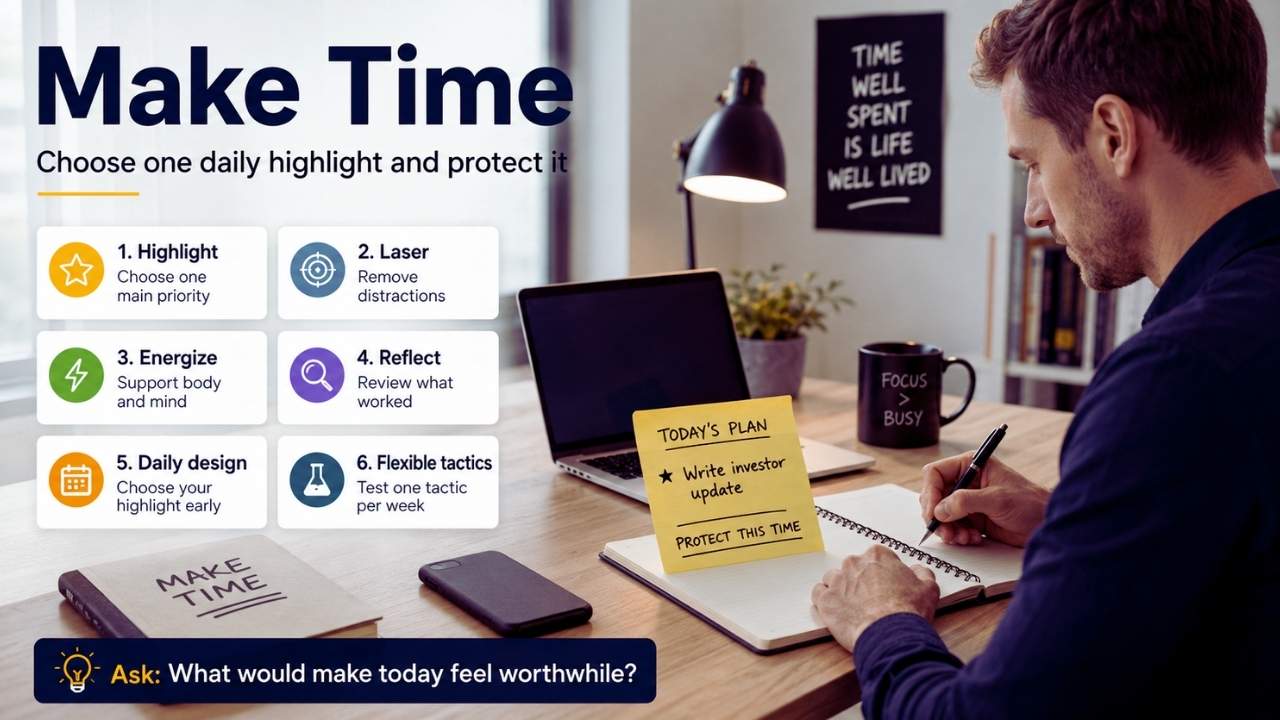
Make Time feels practical because it works at the level of one day. Jake Knapp and John Zeratsky do not ask you to become a productivity machine. They ask you to choose one daily highlight and protect it. That makes the system easy to use even when life is busy.
The core method has four parts: Highlight, Laser, Energize, and Reflect. You choose what matters, remove distractions, support your energy, and review what worked. This book is helpful for people who feel reactive. If your day gets taken over by messages, meetings, and other people’s priorities, Make Time gives you a way to take back at least one important part of the day.
It also treats energy seriously. That matters because productivity is not only about time. You can have time and still feel too tired to use it well. The book offers many tactics, but you do not need to use all of them. You can test one small change at a time. Make Time is especially useful for remote workers, creators, managers, students, and digital workers.
|
Make Time Step |
What It Means |
Simple Action |
|
Highlight |
Choose one main priority |
Pick one thing that makes the day worthwhile |
|
Laser |
Remove distractions |
Turn off key notifications |
|
Energize |
Support body and mind |
Move, sleep, eat better, take breaks |
|
Reflect |
Review what worked |
Write one note at day’s end |
|
Daily design |
Shape the day before it shapes you |
Choose your highlight early |
|
Flexible tactics |
Use what fits your life |
Test one tactic per week |
Practical example: Before opening your inbox, ask: “What would make today feel worthwhile?” Write that answer down. Protect time for it.
8. Four Thousand Weeks by Oliver Burkeman
Four Thousand Weeks is different from most productivity books. It does not promise that you can do everything if you just plan better. It says you can’t do everything. That may sound harsh, but it is also freeing. The title comes from a rough estimate of an 80-year life. If you live to 80, you get about 4,000 weeks. That number makes time feel real.
Oliver Burkeman pushes against the endless optimization mindset. He argues that many people use productivity systems to chase control. They try to clear every task, answer every message, and optimize every minute. But life does not work that way.
This book helps readers accept limits. Once you accept that you cannot do everything, you can choose more honestly. It is especially useful for anxious high achievers, perfectionists, overplanners, and burned-out professionals. The book does not make you less ambitious. It makes your ambition more grounded.
|
Core Idea |
What It Means |
Why It Helps |
|
Time is limited |
You cannot do everything |
Forces honest choices |
|
Limits are real |
Control has boundaries |
Reduces false pressure |
|
Busyness can hide avoidance |
Activity can replace meaning |
Helps you face real work |
|
Choice matters |
You must let some things go |
Protects better priorities |
|
Rest matters |
You are not a machine |
Supports long-term energy |
|
Closed lists help |
Limit daily commitments |
Prevents endless task creep |
Practical example: Make a closed list of three tasks for tomorrow. Do not add a fourth unless you remove one. Limits create better decisions.
9. The ONE Thing by Gary Keller and Jay Papasan
The ONE Thing is built around one powerful question: What is the one thing you can do such that by doing it, everything else becomes easier or unnecessary? That question works because it forces focus. Most to-do lists make every task look equal. But tasks are not equal. Some create leverage. Some only create motion.
This book is useful for people who chase too many goals at once. It helps you narrow your attention until the most important action becomes obvious. The method works well for business owners, marketers, writers, students, sales teams, and anyone building a long-term project.
The book also connects focus with results. Big progress often comes from fewer priorities, not more. It does not mean you ignore everything else forever. It means you identify the action that unlocks the next stage. When used well, this book can make your day feel cleaner and sharper.
|
Use Case |
One Thing Question |
Possible Answer |
|
Business |
What action drives revenue? |
Follow up with warm leads |
|
Writing |
What section matters most today? |
Draft the main argument |
|
Fitness |
What habit helps everything else? |
Train three mornings a week |
|
Study |
What topic needs the most work? |
Review the weakest chapter |
|
Career |
What skill creates leverage? |
Improve communication or analysis |
|
Personal life |
What one change reduces stress? |
Sleep earlier or plan meals |
Practical example: Look at your task list and circle the one task that makes the biggest difference. Do it before you touch low-value work.
10. The 12 Week Year by Brian P. Moran and Michael Lennington
The 12 Week Year is built for people who set goals but lose momentum. Annual goals often feel too far away. January feels exciting. March gets messy. June becomes busy. By October, many goals have faded into the background. This book fixes that by shrinking the planning window. Instead of treating 12 months as the main cycle, it treats 12 weeks as the year.
That shorter deadline creates urgency. It also makes progress easier to measure. You cannot hide behind “later” for long when the cycle lasts only 12 weeks. The system works best when you choose a small number of goals. Too many goals will weaken the method.
It is especially useful for entrepreneurs, sales teams, content teams, marketers, students, and creators who need execution discipline. The 12 Week Year is not just about planning. It is about weekly action and scorekeeping.
|
12 Week Year Tool |
What It Does |
Why It Works |
|
12-week goal |
Creates a shorter target |
Builds urgency |
|
Weekly plan |
Turns goals into actions |
Reduces vague planning |
|
Scorekeeping |
Tracks execution |
Shows if you followed through |
|
Review rhythm |
Keeps progress visible |
Allows quick correction |
|
Fewer goals |
Protects focus |
Avoids overload |
|
Accountability |
Adds pressure and support |
Improves consistency |
Practical example: Pick one 12-week goal, such as publishing 24 articles, gaining 20 clients, or finishing a course. Then write the weekly actions needed to reach it.
11. Indistractable by Nir Eyal
Indistractable is one of the most useful books for digital workers. Many people blame their phones for distraction. That is partly fair. Apps are designed to pull attention. But Nir Eyal adds a deeper point: distraction often starts inside us.
We reach for the phone because we feel bored, stuck, stressed, uncertain, lonely, or uncomfortable. The device is the tool. The trigger often comes from emotion. That makes the book more useful than basic advice like “delete your apps.” It helps you understand why you escape the task in the first place.
The Indistractable framework has four parts: master internal triggers, make time for traction, hack back external triggers, and block out distraction. This book works well for remote workers, students, entrepreneurs, parents, and anyone who feels pulled by screens.
It also helps you build better boundaries. If you do not plan your time, other people and platforms will plan it for you.
|
Indistractable Pillar |
What It Means |
How to Apply It |
|
Master internal triggers |
Notice the feeling behind distraction |
Name the discomfort |
|
Make time for traction |
Schedule what matters |
Put priorities on the calendar |
|
Hack back external triggers |
Reduce alerts and interruptions |
Turn off nonessential notifications |
|
Block out distraction |
Use rules and pacts |
Set app limits or focus rules |
|
Understand urges |
Don’t react automatically |
Pause before reaching for the phone |
|
Plan your day |
Create structure |
Timebox key activities |
Practical example: The next time you grab your phone during work, pause and ask: “What feeling am I trying to avoid?” That tiny question can break the loop.
12. The Power of Habit by Charles Duhigg
The Power of Habit explains why habits stick. Charles Duhigg popularized the habit loop: cue, routine, reward. That simple model helps you understand repeated behavior without blaming yourself. A cue triggers the habit. A routine is the action you take. A reward is what your brain gets from it. Once you see the loop, you can change it.
For example, if you snack every afternoon, the cue might be low energy. The routine is buying a snack. The reward may be a break, comfort, or quick energy. Once you know that, you can test a better routine. This book is more story-driven than Atomic Habits. It covers personal habits, company habits, and social habits.
It is useful for readers who want the “why” behind behavior change. It also helps leaders understand how routines shape teams and organizations. If Atomic Habits is a practical field guide, The Power of Habit is a deeper explanation of how habit loops work.
|
Habit Loop Part |
What It Means |
Example |
|
Cue |
The trigger |
Feeling tired at 3 p.m. |
|
Routine |
The behavior |
Buying a snack |
|
Reward |
The payoff |
Comfort, energy, or a break |
|
Craving |
The expected reward |
Wanting relief or pleasure |
|
Change method |
Replace the routine |
Take a walk or drink tea |
|
Diagnosis |
Study the pattern |
Track when and why the habit happens |
Practical example: Pick one habit you want to change. Write down the cue, routine, and reward. Then keep the cue and reward but test a better routine.
How to Choose the Right Productivity Book?
The best productivity books are not all right for the same person. A student does not need the same first book as a founder. A manager does not need the same system as a freelancer. A burned-out professional may need a different message from someone who simply needs better task organization.
So don’t choose a book only because it is famous. Choose the book that solves your current bottleneck. If your tasks are scattered, start with Getting Things Done. If your focus keeps breaking, start with Deep Work or Indistractable. If you need better routines, start with Atomic Habits. If you feel overwhelmed by commitments, start with Essentialism.
This approach saves time. It also helps you apply the book faster because the advice matches your pain. Do not read all 12 books at once. That becomes another form of procrastination. Read one. Use one method. Review the results. The best book is the one that changes your next week, not the one that looks impressive on your shelf.
|
Your Current Problem |
Best Book to Start With |
Why It Fits |
|
I can’t stay consistent |
Atomic Habits |
Builds tiny repeatable habits |
|
My tasks are scattered |
Getting Things Done |
Creates a trusted task system |
|
I can’t focus |
Deep Work |
Protects concentration |
|
I say yes too much |
Essentialism |
Strengthens priority filters |
|
I procrastinate |
Eat That Frog! |
Builds first-task discipline |
|
My days feel reactive |
Make Time |
Helps design one meaningful day |
|
I feel anxious about time |
Four Thousand Weeks |
Builds healthier time realism |
|
I chase too many goals |
The ONE Thing |
Narrows focus |
|
I fail to execute plans |
The 12 Week Year |
Builds weekly accountability |
|
I’m always distracted |
Indistractable |
Handles triggers and attention |
|
I want habit science |
The Power of Habit |
Explains habit loops |
|
I need long-term direction |
The 7 Habits |
Builds principle-based effectiveness |
A Practical 30-Day Plan to Use One Productivity Book
Reading a productivity book feels productive. But reading alone will not change your day. That is why you need a simple application plan. The goal is not to extract every idea from the book. The goal is to test one useful method in real life. Start by reading enough to understand the core system. Then pick one method that fits your current problem. Use it daily or weekly for 30 days. At the end, review what changed.
This works because it keeps the process small. Most readers fail because they try to apply 20 ideas at once. That creates pressure, not progress.
A good rule is: one book, one method, 30 days.
For example, use habit stacking from Atomic Habits. Try a weekly review from GTD. Block one Deep Work session each day. Pick one daily highlight from Make Time. Remove one low-value commitment from Essentialism.
Do less, but actually do it.
|
Week |
What to Do |
Goal |
|
Week 1 |
Read the first 25 to 30% |
Understand the main idea |
|
Week 2 |
Choose one method |
Avoid idea overload |
|
Week 3 |
Test it daily or weekly |
Build real experience |
|
Week 4 |
Review and adjust |
Keep what works |
|
End of month |
Decide whether to continue |
Turn the method into a routine |
|
Next month |
Add one new idea if needed |
Build slowly |
Common Mistakes People Make With Productivity Books
Many people buy the right book and still get no result. The problem is usually not the book. It is the way they use it. They highlight half the pages, feel inspired for two days, then return to the same habits.
Another common mistake is reading too many productivity books at once. That creates the feeling of progress without actual change. You collect ideas but don’t build behavior. Some readers also copy the author’s routine exactly. That rarely works. Your life, work, energy, family schedule, and responsibilities are different. The better move is to adapt the principle.
Productivity books work best when you treat them like toolkits. Take one tool. Try it. Keep it if it helps. Drop it if it doesn’t. Also, don’t chase motivation. Motivation is useful, but systems last longer. The point is not to become perfect. The point is to make tomorrow easier than yesterday.
|
Common Mistake |
Why It Fails |
Better Approach |
|
Reading too many books |
Creates idea overload |
Finish one and apply one method |
|
Highlighting everything |
Feels useful but changes little |
Write one action after each chapter |
|
Copying full routines |
Ignores your real life |
Adapt the idea |
|
Chasing motivation |
Motivation fades |
Build systems and triggers |
|
Quitting too soon |
No method works instantly |
Test for at least two weeks |
|
Using books to avoid work |
Reading becomes procrastination |
Read less and act sooner |
|
Buying more tools |
Tools don’t fix weak systems |
Fix the method first |
Best Productivity Books by Reader Type
Different readers need different starting points. Students often need focus, study routines, and procrastination help. Writers and creators need deep work and creative consistency. Entrepreneurs need sharper priorities and execution systems. Managers need task clarity, communication, and better delegation.
Remote workers often need boundaries. Digital workers need distraction control. Burned-out high achievers need healthier time expectations. That is why this list includes more than one kind of productivity book. No single book solves every problem.
If you are new to the topic, start with Atomic Habits. If you manage many tasks, start with GTD. If your attention feels broken, start with Deep Work or Indistractable. If your schedule feels overloaded, try Essentialism or Four Thousand Weeks. The right book should feel like it understands your actual problem. If it sounds smart but does not fit your current life, save it for later.
|
Reader Type |
Best Picks |
Why These Fit |
|
Students |
Atomic Habits, Deep Work, Eat That Frog! |
Better study habits, focus, and procrastination control |
|
Writers and creators |
Deep Work, Make Time, The ONE Thing |
Protects creative output |
|
Entrepreneurs |
The 12 Week Year, Essentialism, The ONE Thing |
Builds focus and execution |
|
Managers |
GTD, The 7 Habits, Essentialism |
Improves clarity and leadership |
|
Remote workers |
Make Time, Indistractable, Deep Work |
Helps with boundaries and focus |
|
Overwhelmed professionals |
GTD, Essentialism, Four Thousand Weeks |
Reduces mental clutter |
|
Habit builders |
Atomic Habits, The Power of Habit |
Builds routines and explains behavior |
|
Procrastinators |
Eat That Frog!, The ONE Thing |
Creates action and priority |
|
Digital workers |
Deep Work, Indistractable, Make Time |
Protects attention |
|
Burned-out high achievers |
Four Thousand Weeks, Essentialism |
Builds healthier limits |
Final Thoughts
The best productivity books do not tell you to become busier. They help you become clearer. If you want better habits, start with Atomic Habits. If your tasks feel scattered, read Getting Things Done. If distraction keeps winning, choose Deep Work or Indistractable. If you feel overcommitted, essentialism may hit hard in the best way. If time anxiety drains you, Four Thousand Weeks gives a calmer and more honest view.
The goal is not to read all 12 books. The goal is to find one idea that changes your next week. Pick one book. Apply one method. Track the result. Keep what works and ignore what doesn’t. That is how productivity books actually work.
Frequently Asked Questions (FAQs) About Best Productivity Books
Do productivity books really work?
Yes, but only when you apply them. Reading gives you ideas. Action gives you results. Choose one method and test it for 30 days before jumping to another book.
What is the best productivity book for beginners?
Atomic Habits is the easiest starting point for most beginners. It uses simple language, clear examples, and practical steps. You can use it for work, study, fitness, writing, or personal routines.
Should I read Atomic Habits or The Power of Habit first?
Read Atomic Habits first if you want action steps. Read The Power of Habit first if you want to understand habit loops in more depth. Both are useful, but they serve different needs.
Which productivity book is best for ADHD-style distraction?
Indistractable and Make Time can help with triggers, attention, and daily structure. Deep Work can also help with focus practice. Still, books are not medical treatment. If attention issues affect daily life, professional support can help.
Which productivity book is best for business owners?
The 12 Week Year is strong for execution. The ONE Thing helps with priority setting. Essentialism helps business owners avoid spreading themselves too thin.
Are old productivity books still worth reading?
Yes. Books like Getting Things Done and The 7 Habits still work because they deal with timeless problems: priorities, responsibility, planning, focus, and follow-through.
Are productivity apps better than productivity books?
Apps help you track tasks. Books help you think better. If your system is broken, a new app will not fix it. Start with the method. Then choose the tool.
Can I combine ideas from different productivity books?
Yes, but keep it simple. You could use GTD for task capture, Deep Work for focus blocks, and Atomic Habits for routines. Just don’t mix too many systems at once.