


Discipline feels easy when life is calm. You set a goal. You make a plan. You tell yourself, “This time, I’ll stick to it.” Then the day gets messy. You sleep badly. Work runs late. Your phone keeps buzzing. Stress piles up. The task you planned yesterday now feels too heavy to start.
That’s why people search for building discipline, not motivation. They don’t need another “just work harder” quote. They need a real system for the days when motivation disappears. Here’s the truth. Motivation helps, but it’s not reliable. It changes with your mood, sleep, stress, energy, confidence, workload, and surroundings. Some days, it shows up. Some days, it doesn’t.
Discipline works better when you don’t depend on how you feel. You don’t build discipline by forcing yourself to feel ready. You build it by making the right action easier to repeat. You lower the starting point. You remove distractions. You use triggers. You keep promises small enough to follow through on bad days.
Why Motivation Fails When You Need It Most?
Motivation is a good spark. It can help you start. But it’s not strong enough to carry every goal. You may feel motivated after watching a video, reading a book, hearing a success story, or setting a new target. The feeling is real. But it fades when the work gets boring, slow, repetitive, confusing, or uncomfortable.
That’s not a personal failure. That’s normal human behavior. Habit research shows that habits don’t form after one magic number of days. A well-known University College London study found that habit formation took 66 days on average, but the range was wide. Some people formed habits much faster. Others took several months.
So the “21 days to build a habit” idea is too neat. Real discipline takes repetition, context, and patience. Motivation also gets weaker under stress. When your brain feels overloaded, it looks for relief. That’s why scrolling, snacking, delaying, and “I’ll do it later” feel so tempting. The easy option gives quick comfort, even if it creates more pressure later.
|
Key Point |
What It Means |
What to Do Instead |
|
Motivation rises and falls |
You won’t feel driven every day |
Build a routine that works on low-energy days |
|
Habits take time |
Discipline grows through repetition |
Repeat small actions long enough to make them familiar |
|
Stress affects action |
A tired brain avoids hard tasks |
Lower the starting pressure |
|
Easy rewards win fast |
Phones, food, and entertainment offer quick relief |
Add friction to distractions |
|
Progress creates energy |
Action often comes before motivation |
Start with the smallest useful step |
Motivation Often Comes After Action
Most people wait to feel motivated before they start. That’s the trap. Many times, motivation appears after the first few minutes. You don’t feel like cleaning. Then you clear one table, and the room looks better. That small win gives you energy.
You don’t feel like writing. Then you write one rough paragraph, and the next sentence feels easier. You don’t feel like walking. Then you step outside, and your body wakes up a little. The first step usually feels the hardest. So don’t ask, “Do I feel motivated?”
Ask this instead:
“What’s the smallest useful thing I can do right now?”
That question puts control back in your hands.
Low Motivation Doesn’t Always Mean Laziness
Low motivation can come from many places. You may be tired. The task may be unclear. The goal may feel too big. You may be stressed. You may fear failure. You may not see progress yet. Your environment may be full of distractions. The reward may feel too far away. Calling yourself lazy won’t fix any of that. It only adds shame.
A better move is to study what blocks action. Then fix that block. If the task feels too big, shrink it. If the task feels unclear, define the first step. If your phone keeps pulling you away, move it. If you keep failing in the morning, check your sleep. Discipline is not only about trying harder. It’s about removing the things that make action harder than it needs to be.
Build Discipline No Motivation: Start Smaller Than Your Ego Wants
The fastest way to break discipline is to start too big. People often make huge promises when they feel inspired. They decide to work out every day, study for three hours, wake up early, eat perfectly, stop scrolling, read more, save money, and change their whole life at once.
That plan feels exciting for two days. Then real life hits. Real discipline starts smaller. Much smaller. Small actions may not feel impressive, but they work because they lower resistance. They make it easier to show up again tomorrow. They train your brain to trust your own promises. A big goal can inspire you. A small action actually moves you.
|
Goal |
Too Big |
Better Starting Point |
|
Fitness |
Work out for one hour daily |
Walk for 10 minutes |
|
Writing |
Write 2,000 words |
Write 150 words |
|
Study |
Study all evening |
Study 20 minutes |
|
Reading |
Read 50 pages |
Read 5 pages |
|
Cleaning |
Clean the whole house |
Clear one surface |
|
Money |
Fix all finances |
Track spending for 5 minutes |
|
Sleep |
Change your whole night routine |
Put your phone away 20 minutes earlier |
|
Focus |
Work deeply for 4 hours |
Do one 25-minute focus block |
Use the Minimum Honest Action
A minimum honest action is the smallest version of a habit that still counts. It should be easy enough to do on a bad day. But it should still move you forward.
Examples:
Walk for five minutes. Write three sentences. Read two pages. Do 10 squats. Review one study note. Wash five dishes. Open your project file and edit one paragraph. This works because discipline grows through proof.
Every small action tells your brain, “I follow through.” At first, that matters more than intensity. You’re not trying to become perfect. You’re trying to become reliable.
Make the First Step Clear
A vague goal creates resistance.
- “I’ll be productive” sounds nice, but it doesn’t tell you what to do.
- “At 9 a.m., I’ll open the article draft and write 100 words” works better.
- “I’ll get fit” is too broad.
- “After brushing my teeth, I’ll do 10 squats” is clear.
- “I’ll study more” is vague.
- “After dinner, I’ll review chapter 3 for 20 minutes” gives your brain a real target.
The clearer the first step, the less you need to debate. And the less you debate, the more likely you are to act.
Turn Discipline Into a System, Not a Feeling
Discipline feels hard when every task becomes a debate. Should I work out today? Should I study now? Should I write later? Should I clean tomorrow? Should I start after one more video? That inner debate drains energy.
A system removes the debate. It tells you when to act, where to act, and what to do first. Good systems are boring in the best way. They reduce decisions. They make action predictable. They stop you from rebuilding your plan every morning. This matters because willpower gets weaker when your day is full of choices, stress, noise, and interruptions. A simple routine protects your energy.
|
System Part |
Example |
Why It Helps |
|
Trigger |
After morning coffee |
Starts the habit without extra thinking |
|
Tiny action |
Write 100 words |
Lowers resistance |
|
Environment |
Phone in another room |
Protects focus |
|
Backup plan |
Write three sentences |
Keeps the habit alive on hard days |
|
Review |
Sunday check-in |
Helps you improve the system |
|
Reward |
Tea after study |
Makes repetition more pleasant |
|
Boundary |
No social apps before work |
Reduces distraction |
|
Reset rule |
Never miss twice |
Stops one bad day from becoming a bad week |
Use If-Then Planning
If-then planning is simple and useful.
The format looks like this:
If this happens, then I will do that.
Examples:
- If I finish breakfast, then I’ll walk for 10 minutes.
- If I sit at my desk, then I’ll open my task list.
- If I feel like skipping, then I’ll do the five-minute version.
- If I pick up my phone during deep work, then I’ll place it across the room.
- If I miss one day, then I’ll restart the next day.
This works because your brain gets a script. You don’t need to negotiate with yourself every time.
Research by Peter Gollwitzer and Paschal Sheeran found that if-then plans can support goal achievement. That makes sense in daily life. When the next step is already decided, you waste less energy thinking about it.
Attach New Habits to Existing Habits
You already have daily routines. Use them. Attach your new habit to something you already do. After brushing your teeth, do 10 squats. After morning coffee, write 100 words. After lunch, walk for 10 minutes. After dinner, review notes. Before bed, read two pages.
This is one of the easiest ways to build discipline, not motivation, because the trigger already exists. You don’t need to rebuild your whole life. You only need to add one small action to a routine you already follow.
Design Your Environment So Discipline Feels Easier
Your environment is always pushing you toward something. A phone on your desk pushes you toward checking messages. A messy workspace pushes you toward delay. Running shoes by the door push you toward movement. A book on your pillow pushes you toward reading.
Discipline gets easier when your space supports the action you want. This is important because modern life is built to steal attention. Apps, videos, alerts, and feeds are designed to keep you clicking. DataReportal’s 2026 global data shows that the typical social media user spends 18 hours and 36 minutes per week using social platforms and video-centered apps.
That’s a lot of attention. So don’t rely only on self-control. Change the setup.
|
Problem |
Environment Fix |
Result |
|
Phone distraction |
Keep phone in another room |
Fewer impulse checks |
|
Skipping workouts |
Lay clothes out at night |
Easier start |
|
Late-night scrolling |
Charge phone away from bed |
Better sleep routine |
|
Avoiding study |
Keep notes open on desk |
Faster start |
|
Junk snacking |
Keep better food visible |
Better default choice |
|
Messy desk |
Clear it before sleep |
Easier morning focus |
|
Too many tabs |
Use one working window |
Less mental clutter |
|
Random TV time |
Watch after the habit |
Leisure becomes intentional |
Add Friction to Bad Habits
You don’t need to beat every temptation with willpower. Make the wrong action harder. Log out of distracting apps. Move social apps off your home screen. Keep your phone outside your work area. Use website blockers during focus blocks. Turn off non-essential notifications. Put snacks out of sight. Keep the TV remote away from the sofa.
Small barriers can break automatic behavior. Even a few seconds of extra effort can make a bad habit less attractive. That pause gives your brain time to choose.
Reduce Friction for Good Habits
Now make the right action easier. Keep workout clothes ready. Put your book where you’ll see it. Keep water on your desk. Open tomorrow’s work file before ending today. Prepare a simple breakfast at night. Keep study materials in one place. Place your journal beside your bed.
The goal is not to become superhuman. The goal is to make the next good step obvious. When the good habit is easy to start and the bad habit is slightly harder to reach, discipline stops feeling like a daily fight.
Build Energy Before You Demand Willpower
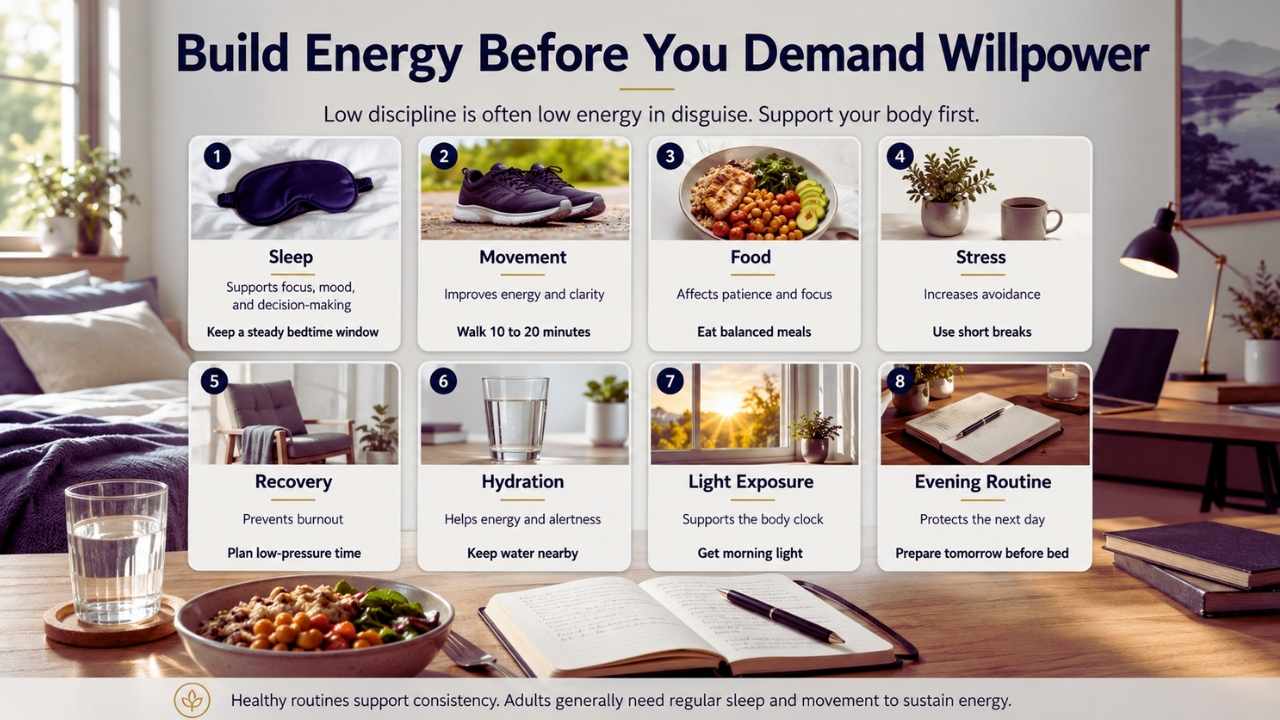
Low discipline is often low energy in disguise. It’s hard to stay consistent when you’re sleep-deprived, stressed, hungry, or burned out. You can push through sometimes, but you can’t build a stable life on exhaustion. A good discipline system respects your body.
This does not mean you need a perfect health routine. It means you stop pretending your body has no limits. Sleep, food, movement, stress, and recovery all affect how easy it feels to follow through.
CDC guidance says adults need at least 150 minutes of moderate-intensity physical activity per week, plus two days of muscle-strengthening activity. CDC sleep guidance also says adults aged 18 to 60 need seven or more hours of sleep per night. These are not just health facts. They affect discipline. A tired body makes every habit harder.
|
Energy Area |
Why It Matters |
Simple Action |
|
Sleep |
Supports focus, mood, and decision-making |
Keep a steady bedtime window |
|
Movement |
Improves energy and clarity |
Walk 10 to 20 minutes |
|
Food |
Affects patience and focus |
Eat balanced meals |
|
Stress |
Increases avoidance |
Use short breaks |
|
Recovery |
Prevents burnout |
Plan low-pressure time |
|
Hydration |
Helps energy and alertness |
Keep water nearby |
|
Light exposure |
Supports the body clock |
Get morning light |
|
Evening routine |
Protects the next day |
Prepare tomorrow before bed |
Sleep Comes First
Sleep is not a luxury. It affects your focus, mood, memory, and decision-making. If your morning discipline keeps failing, check your night routine first. Many people blame their character when the real issue is sleep debt.
Try this:
Keep your wake-up time steady. Reduce screens before bed. Avoid heavy meals late at night. Keep your room dark and cool. Charge your phone away from bed. Prepare your first task before sleeping. Better sleep makes discipline easier because you start the day with more control.
Movement Supports Discipline
Exercise doesn’t need to be intense to help. If you’re starting from zero, don’t obsess over the full weekly target. Start with 10 minutes of walking, five minutes of stretching, 10 squats, one short home workout, taking stairs instead of the lift, or standing up every hour.
Small movement can improve energy. Better energy makes discipline easier. This is why a short walk can fix more than your step count. It can clear your head, lower tension, and make the next task feel less heavy.
Stop Fighting Procrastination the Wrong Way
Procrastination is not just poor time management. It’s often emotional. People delay tasks because the task feels unpleasant. It may feel boring, confusing, risky, stressful, or tied to fear of failure.
Avoiding it gives quick relief. But that relief creates more pressure later.
Researchers Fuschia Sirois and Timothy Pychyl describe procrastination as a short-term mood repair problem. Put simply, people often delay tasks because they want to feel better now, even if it hurts them later. That explains why advice like “just do it” often fails. It ignores the emotional weight of the task.
|
Procrastination Trigger |
What It Feels Like |
Better Response |
|
Task is unclear |
“I don’t know where to start” |
Define the first step |
|
Task is too big |
“This will take forever” |
Use a 10-minute block |
|
Fear of failure |
“What if I mess up?” |
Make a rough first draft |
|
Boredom |
“This is dull” |
Use a timer |
|
Perfectionism |
“It must be excellent” |
Make version one messy |
|
Low confidence |
“I’m not good at this” |
Practice one small skill |
|
No deadline |
“I can do it later” |
Create a mini-deadline |
|
Too many options |
“Where do I begin?” |
Pick one task only |
Use the 10-Minute Rule
Tell yourself, “I only have to do this for 10 minutes.” After 10 minutes, you can stop. This lowers resistance. Many times, you’ll keep going because starting was the hardest part. Even if you stop, you still trained action.
Use it for writing, studying, exercise, cleaning, admin work, emails, reading, and skill practice. The trick is to mean it. Don’t secretly demand two hours. Give yourself permission to stop after 10 minutes. That makes starting feel safer.
Make the Task Less Emotional
A task feels heavier when you attach drama to it.
- Instead of saying, “I must finish this perfectly,” say, “I’ll make a rough first version.”
- Instead of saying, “I need to change my whole life,” say, “I’ll do one useful thing today.”
- Instead of saying, “I always fail,” say, “I’m practicing follow-through.”
Your words change the emotional weight of the task. Discipline gets easier when the task stops feeling like a test of your worth.
Build Identity-Based Discipline
Discipline becomes stronger when it connects to identity. This doesn’t mean pretending. It means building self-trust through repeated action. You don’t become disciplined by thinking about discipline. You become disciplined by keeping small promises often enough.
Identity-based discipline sounds like this:
- “I’m someone who moves daily.”
- “I’m someone who writes before scrolling.”
- “I’m someone who studies even when the session is short.”
- “I’m someone who restarts quickly.”
Those lines matter because they focus on who you are becoming, not just what you are forcing yourself to do.
|
Old Thought |
Better Identity-Based Thought |
|
I’m trying to exercise |
I’m someone who moves daily |
|
I need to write |
I’m someone who writes before scrolling |
|
I always quit |
I’m practicing consistency |
|
I’m bad at focus |
I protect my attention |
|
I failed yesterday |
I restart quickly |
|
I’m not disciplined |
I keep small promises |
|
I don’t have time |
I protect time for what matters |
|
I need perfect conditions |
I can start with what I have |
Connect Discipline to Values
Rules can help. But values make discipline meaningful.
Ask yourself:
Why does this goal matter? What problem am I trying to prevent? Who benefits if I become consistent? What future version of me needs this habit? What would I respect myself for doing today?
A student may study because they want more freedom. A parent may exercise because they want more energy for family. A writer may write because they want to build a body of work. A founder may stay disciplined because other people depend on their decisions.
When discipline connects to values, it feels less like punishment. It becomes a way to protect what matters.
Use Autonomy, Competence, and Connection
Self-Determination Theory, a major motivation framework from Edward Deci and Richard Ryan, says people are more likely to stay motivated when three needs are supported: autonomy, competence, and relatedness.
In simple terms, autonomy means you choose something that matters to you. Competence means the task is small enough to win. Relatedness means you have support, accountability, or connection.
That’s a more human way to build discipline. You’re not just forcing yourself. You’re creating the right conditions. This matters when you want to build discipline, not motivation, because a system that feels meaningful is easier to repeat than a system built only on pressure.
Track Progress Without Becoming Obsessed
Tracking helps because it makes progress visible. But it can become unhealthy if you treat every missed day like failure. The goal is not a perfect streak. The goal is a stronger pattern.
Track enough to learn. Don’t track so much that the habit becomes another source of stress. A simple checkmark on a calendar can work. A one-line journal can work. A weekly review can work. You don’t need a complicated dashboard to become consistent.
|
Tracking Method |
Best For |
How to Keep It Simple |
|
Calendar X |
Daily habits |
Mark completed days |
|
Notebook |
Reflection |
Write one line |
|
Habit app |
Multiple habits |
Track 1 to 3 habits only |
|
Weekly review |
Long-term goals |
Review every Sunday |
|
Scorecard |
Work or study |
Rate effort from 1 to 5 |
|
Timer log |
Focus blocks |
Count completed sessions |
|
Workout note |
Fitness |
Record movement only |
|
Money check |
Budgeting |
Review spending once a week |
Track Inputs, Not Just Results
Results can take time. Inputs are actions you control. Track workouts, not weight only. Track study blocks, not grades only. Track words written, not published articles only. Track sales calls, not revenue only. Track spending reviewed, not savings total only.
This keeps your attention on what you can do today. Results matter, but they lag. Inputs are the daily proof that you’re showing up.
Use the Never Miss Twice Rule
Missing one day is normal. Missing two days can become a new pattern.
The rule is simple:
Miss once. Restart fast. If you skip Monday, return Tuesday. If you miss a workout, do the short version next time. If your morning routine breaks, restart tomorrow morning.
This is one of the best ways to build discipline, not motivation, because it removes the all-or-nothing mindset. One missed day is a pause. It is not a collapse.
Create a Low-Motivation Backup Plan
You need two versions of every important habit. One version is for normal days. The other is for hard days.
Hard days will come. If your plan only works when life is easy, it’s not a real plan. A backup plan protects consistency. It gives you a way to keep the habit alive without pretending every day is the same. This is not weakness. It’s smart planning.
|
Normal Plan |
Low-Motivation Backup |
|
45-minute workout |
Five-minute walk |
|
Write 1,000 words |
Write 100 words |
|
Study two hours |
Study 15 minutes |
|
Clean the room |
Clear one table |
|
Cook a full meal |
Make a simple healthy plate |
|
Read 20 pages |
Read two pages |
|
Full morning routine |
Do one anchor habit |
|
Deep work session |
Work for 10 minutes |
The Backup Plan Still Counts
Many people dismiss small actions. They think, “What’s the point of five minutes?” The point is continuity. The point is identity. The point is staying connected to the habit.
A five-minute workout won’t transform your body in one day. But it keeps you from becoming the person who quits when the day gets hard. That matters. Discipline is not only built on your best days. It’s built on the days when you almost skipped but still did something.
Create a Bad-Day List
Make a list before you need it. If I’m tired, I will walk for five minutes. I will write three sentences. I will read two pages. I will clean one small area. I will review one note. I will prepare tomorrow’s first task.
When you’re drained, you don’t want to invent a plan. You want to follow one. A bad-day list removes pressure. It gives you a small door back into action.
Build Discipline at Work, Study, Fitness, and Home
Discipline looks different in different areas. A student needs a different system than a manager. A parent needs a different system than a freelancer. But the principle stays the same: make the next right action clear and repeatable.
Gallup’s State of the Global Workplace 2026 report found that global employee engagement fell to 20% in 2025. It also estimated that low engagement cost the world economy about $10 trillion in lost productivity.
That matters because many people are trying to stay disciplined while feeling tired, distracted, or disconnected at work. So don’t rely on passion alone. Build structure.
|
Area |
Common Problem |
Practical System |
|
Work |
Too many distractions |
Time blocks and phone control |
|
Study |
Starting late |
Fixed study trigger |
|
Fitness |
Low energy |
Short movement habit |
|
Money |
Avoiding numbers |
Weekly money check |
|
Home |
Mess builds up |
10-minute evening reset |
|
Content creation |
Waiting for inspiration |
Daily draft habit |
|
Sleep |
Late-night scrolling |
Phone outside the bedroom |
|
Relationships |
No time for people |
Schedule small check-ins |
For Work
Use one focused work block before reactive tasks. Start with the hardest task. Use a 25-minute timer. Keep only one tab open. Turn off notifications. Write down distractions instead of following them.
This is simple, but it works because it protects your best attention before the day fills with other people’s requests. Work discipline is not about loving every task. It’s about giving the important task a protected space.
For Studying
Study discipline improves when the task is specific.
- “Study biology” is too vague.
- “Review chapter 3 diagrams for 20 minutes and answer 10 practice questions” is better.
Use flashcards, practice questions, timed sessions, short reviews, study groups, and a fixed desk setup. The clearer the task, the easier it is to start.
For Fitness
Fitness discipline should begin with consistency, not punishment. Start with movement you can repeat: walking, bodyweight exercises, stretching, cycling, resistance bands, or short home workouts.
Don’t build your identity around intensity. Build it around showing up. A short workout done often beats a perfect plan you never repeat.
For Home and Personal Life
Home habits matter because your space affects your mind. Try a 10-minute evening reset. Pick one laundry day. Clear your desk before sleep. Meal prep twice a week. Plan your week every Sunday. Clean one small area each day.
Small order reduces daily stress. You don’t need a spotless house. You need a space that doesn’t fight you every morning.
Use Time Data to Fix Your Daily Routine
Many people say, “I don’t have time.” Sometimes that’s true. Work, family, caregiving, commuting, and health problems can make time tight. But sometimes the problem is not time. It’s leakage.
The U.S. Bureau of Labor Statistics American Time Use Survey 2025 found that watching TV took 2.6 hours per day on average and made up half of all leisure time. Average leisure and sports time was 5.2 hours per day.
This doesn’t mean everyone has free time. It means many routines have hidden pockets that can be redesigned. The goal is not to remove rest. Rest matters. The goal is to stop unconscious time loss from running your day.
|
Time Leak |
Better Use |
Small Discipline Move |
|
Random scrolling |
Planned break |
Use a 15-minute timer |
|
TV by default |
Intentional viewing |
Watch after the habit is done |
|
Unplanned mornings |
Simple routine |
Prepare the night before |
|
Long task switching |
Focus block |
Batch similar tasks |
|
Late-night phone use |
Sleep support |
Charge phone away from bed |
|
Waiting time |
Micro-learning |
Read or review notes |
|
Random errands |
Weekly batch |
Group small tasks |
|
Endless planning |
Quick action |
Start with 10 minutes |
Find Your Hidden Time
Don’t start by cutting everything you enjoy. Start by watching your day for one week. Notice where time slips away. Notice when you feel most focused. Notice which habit gets pushed aside first. Then make one change.
Maybe you put your phone away for the first 30 minutes of the morning. Maybe you stop watching TV before your walk. Maybe you prepare tomorrow’s task before bed. Maybe you batch errands instead of spreading them across the week. Small time changes can create big discipline changes.
Don’t Cut All Leisure
Discipline does not mean removing joy. You need rest. You need fun. You need recovery. The goal is not to delete leisure. The goal is to choose it on purpose.
When leisure is planned, it refreshes you. When it happens by accident for hours, it often leaves you tired and annoyed with yourself. Protect time for both: your goals and your recovery.
A 14-Day Plan to Build Discipline No Motivation Needed
You don’t need a perfect life plan. You need a simple test. Use the next 14 days to build proof. Pick one habit. Keep it small. Track it. Adjust it.
The goal is not to transform your whole life in two weeks. The goal is to prove that you can act even when motivation is low. That proof matters. Once you trust yourself with one small habit, bigger habits become easier.
|
Day |
Action |
Purpose |
|
Day 1 |
Pick one habit |
Build focus |
|
Day 2 |
Choose a tiny version |
Reduce friction |
|
Day 3 |
Attach it to a trigger |
Create routine |
|
Day 4 |
Prepare your space |
Support action |
|
Day 5 |
Remove one distraction |
Protect focus |
|
Day 6 |
Use a 10-minute timer |
Beat resistance |
|
Day 7 |
Review what worked |
Improve the system |
|
Day 8 |
Repeat the same habit |
Build consistency |
|
Day 9 |
Create a backup version |
Plan for bad days |
|
Day 10 |
Track effort |
Make progress visible |
|
Day 11 |
Add one small reward |
Reinforce action |
|
Day 12 |
Share with one person |
Add accountability |
|
Day 13 |
Practice never miss twice |
Recover fast |
|
Day 14 |
Review and upgrade slightly |
Build momentum |
Example 1: Writing Habit
- Goal: Write more often.
- Tiny version: 150 words.
- Trigger: After morning coffee.
- Backup: Three sentences.
- Tracking: Calendar checkmark.
- Upgrade after 14 days: 250 words.
This works because writing becomes a daily action, not a mood-based event.
Example 2: Fitness Habit
- Goal: Move daily.
- Tiny version: 10-minute walk.
- Trigger: After lunch.
- Backup: Three-minute indoor walk.
- Tracking: Step note.
- Upgrade after 14 days: Add two bodyweight exercises.
This works because the habit starts with movement, not pressure.
Example 3: Study Habit
- Goal: Study consistently.
- Tiny version: 20 minutes.
- Trigger: After dinner.
- Backup: Five flashcards.
- Tracking: Study log.
- Upgrade after 14 days: Add one practice test weekly.
This works because the task is clear and short enough to start. This is the practical heart of build discipline no motivation. Make the habit small enough to repeat. Then let repetition build confidence.
Common Mistakes That Break Discipline
Most people don’t fail because they lack character. They fail because the system is too vague, too strict, too emotional, or too dependent on perfect conditions.
Discipline breaks when you expect every day to feel easy. It also breaks when you treat one missed day like proof that you failed. A better approach is to expect resistance. Plan for it. Then keep the next step small enough to do anyway.
|
Mistake |
Why It Breaks Discipline |
Better Move |
|
Starting too big |
Creates pressure fast |
Start tiny |
|
Depending on mood |
Mood changes |
Use triggers |
|
Tracking too much |
Creates stress |
Track 1 to 3 habits |
|
No backup plan |
Bad days break routine |
Create a small version |
|
Chasing perfection |
Causes delay |
Make rough starts |
|
Ignoring sleep |
Lowers self-control |
Protect rest |
|
Comparing yourself |
Creates shame |
Track your own progress |
|
Changing too much |
Splits attention |
Build one habit first |
Don’t Turn Discipline Into Self-Hate
Discipline should help your life work better. It should not become a way to attack yourself. Shame may push you for a day. It rarely builds a stable routine.
Use firm but fair self-talk:
- “I don’t feel ready, but I can start small.”
- “One missed day is not failure.”
- “I’m building the habit, not proving my worth.”
- “I can return today.”
- “Small progress still counts.”
This kind of self-talk is not soft. It’s practical. It keeps you moving without adding emotional weight.
Don’t Add Too Many Habits at Once
One solid habit beats five abandoned habits. Start with one area: sleep, fitness, study, work, money, reading, cleaning, or writing.
Once it feels normal, add another. Discipline grows better through focus. When you spread your energy across too many changes, everything feels hard.
Final Thoughts
Discipline is not about feeling strong every day. It’s about having a plan for the days you don’t. You won’t always feel focused. You won’t always feel excited. You won’t always wake up ready to chase your goals.
That’s normal. The real skill is learning how to act anyway. Start small. Use triggers. Design your environment. Protect your sleep. Track effort. Build backup plans. Return quickly after missed days.
That’s how to build discipline no motivation needed. Not through guilt. Not through fake intensity. Through small promises kept often enough that action becomes your default. Choose one habit today. Make it tiny. Attach it to a clear trigger. Do it even if you don’t feel like it. That’s where discipline starts.
Frequently Asked Questions (FAQs) About Building Discipline When Motivation Is Gone
Why am I motivated at night but not in the morning?
At night, planning feels easy because the effort sits in the future. In the morning, your energy, sleep quality, and environment matter more. Fix this by preparing the night before. Set out clothes. Open your work file. Write tomorrow’s first task. Make the morning decision smaller.
Can I build discipline if I have ADHD or poor focus?
Yes, but you may need more structure. Use visual reminders, timers, body doubling, shorter work blocks, and fewer steps. If focus problems seriously affect your work, study, relationships, or daily life, speak with a qualified professional. Discipline systems can help, but they can’t replace clinical support when you need it.
Is discipline better than motivation?
Discipline and motivation work best together. Motivation gives energy. Discipline gives structure. The problem starts when you expect motivation to stay high every day. It won’t. Discipline fills that gap.
Why do I lose discipline after one mistake?
That usually comes from all-or-nothing thinking. You see one missed day as proof that the whole plan failed.
Use this rule: never miss twice. Restart with the smallest version.
How do I build discipline when I feel burned out?
Start by reducing the demand. Burnout needs recovery, not punishment. Use smaller habits, shorter work blocks, better sleep, and clearer boundaries. If burnout feels severe or long-lasting, seek support from a qualified health professional.
Should I reward myself for discipline?
Yes, if the reward supports the habit. Good rewards include a relaxing walk, a favorite podcast, a good meal, a short break, or a movie after completing weekly goals. Avoid rewards that undo the habit or create a new problem.