

Life has a funny way of throwing unexpected expenses at you when you least expect them. You might face a sudden tech layoff, a massive spike in healthcare premiums, or a critical repair for your home. The financial world shifted massively over the last few years, making old-school savings advice feel completely out of touch.
Relying on a credit card for surprises is a guaranteed way to accumulate long-term debt, especially with modern interest rates sitting so high. Your cash reserve is your personal insurance policy that ensures a bad week does not turn into a decade of financial struggle. We need a plan that works for today’s fast-paced economy. This guide breaks down exactly how to build an emergency fund 2026 so you can stop stressing about money and start living with real security.
Why an Emergency Fund is Essential Today?
The days of assuming your job is perfectly secure and your living costs will remain flat are long gone. We are seeing incredibly frequent shifts in the job market and basic expenses that simply refuse to drop back to historic lows. You need cash on hand to handle these bumps without derailing your entire life.
Protecting Against Income Volatility
The modern work environment shifts faster than ever, making long-term job security feel like a thing of the past. We see more people taking on freelance contracts, project-based gigs, or moving between startups that might pivot at a moment’s notice. This constant shuffling means your monthly paycheck could vanish temporarily while you secure your next position. Relying on credit cards during these gaps is incredibly risky because high interest rates quickly snowball small balances into massive debts.
Having a dedicated cash reserve acts as a personal financial bridge to keep you afloat. It covers your rent, groceries, and utilities without forcing you into panic mode or making you accept a terrible job offer just to survive. You retain the power to negotiate your next career move properly because you are not operating out of desperation. A solid cash buffer literally buys you the time and mental clarity needed to survive unpredictable income streams.
|
Income Risk Factor |
Financial Consequence |
2026 Mitigation Strategy |
|
Gig Economy Shifts |
Fluctuating monthly income |
Aim for six to nine months of expenses |
|
Sudden Layoffs |
Complete loss of primary salary |
Keep liquid cash in high-yield accounts |
|
Contract Delays |
Invoices paid 60 days late |
Build a one-month buffer specifically for cash flow |
|
Industry Pivots |
Skills become temporarily obsolete |
Use savings to fund short-term retraining |
Managing Rising Costs of Living
Inflation might not be making daily headlines like it did a few years ago, but the baseline cost for essentials like housing, food, and insurance is much higher now. A safety net that felt massive three years ago likely will not cover your basic needs today. Your savings target has to reflect the actual cost of your lifestyle right now, not what it cost back in 2021. When a car repair or medical bill hits, the raw dollar amount is simply larger than it used to be.
If you do not adjust your cash reserves upward, you will find yourself coming up short when the mechanic hands you the invoice. You have to regularly calculate your actual spending and bump up your savings to match these new economic realities. Failing to account for this silent price creep leaves you vulnerable exactly when you think you are completely protected.
|
Living Cost Category |
Historical Baseline |
2026 Reality |
|
Housing & Utilities |
Predictable annual increases |
Sharp spikes in property taxes and energy |
|
Basic Groceries |
Low volatility |
Sustained high prices on staple goods |
|
Auto Maintenance |
Standard hourly labor rates |
Premium costs for complex EV and tech repairs |
|
Healthcare |
Standard deductibles |
Higher out-of-pocket maximums across all plans |
Evaluating Your Current Financial Health
You cannot build a solid savings account without knowing exactly where your money goes every single week. Most people think they know their spending habits, but checking the actual data often tells a completely different story. Taking a cold look at your bank statements is the very first step toward total financial freedom.
Tracking Monthly Expenses
Look back at the last ninety days of your checking account and credit card statements to get an accurate average of your spending. You need to categorize everything into strict needs and optional wants to see the real picture. Needs include your rent, mortgage, groceries, basic utilities, and health insurance premiums. Wants are the endless streaming subscriptions, dining out, weekend trips, and impulse buys you make online.
This exercise almost always reveals a few hidden leaks in your budget that you can plug and redirect into your savings immediately. Do not judge your past purchases during this step; simply gather the raw numbers so you know what you are dealing with. Understanding exactly how much it costs to keep your life running for thirty days is the foundational number for your entire emergency fund strategy.
|
Expense Category |
Typical Examples |
Savings Action Plan |
|
Fixed Essentials |
Rent, Mortgage, Insurance |
Maintain payments but shop for lower insurance rates |
|
Variable Essentials |
Groceries, Gas, Electricity |
Reduce through better daily consumption habits |
|
Discretionary |
Streaming, Dining, Concerts |
Pause temporarily to accelerate initial savings |
|
Hidden Budget Leaks |
Unused apps, Forgotten gym memberships |
Cancel immediately and route funds to savings |
Debt vs. Savings Strategy
The debate over whether to pay off credit card debt or save cash has a very clear middle ground right now. If you have absolutely zero savings, a single flat tire will force you to swipe a high-interest credit card, setting your debt repayment back by months. The smartest move is to build a starter fund of about two thousand dollars while paying the minimums on your existing debt.
Once you have that initial cash cushion sitting safely in the bank, you can pivot and throw all your extra money at those high-interest balances. This hybrid approach stops the bleeding and prevents you from falling further into the credit card trap when life happens. It gives you psychological momentum and actual financial protection simultaneously. After the bad debt is completely gone, you return to building your emergency cash until it reaches the full six-month target.
|
Financial Phase |
Primary Focus |
Action Required |
|
Phase 1: Vulnerable |
Starter Savings |
Save $2,000 cash immediately |
|
Phase 2: Stabilization |
Debt Elimination |
Attack high-interest credit cards aggressively |
|
Phase 3: Security |
Full Emergency Fund |
Save three to six months of living expenses |
|
Phase 4: Growth |
Wealth Building |
Begin investing in index funds and retirement |
Calculating Your Target Goal
People constantly ask for the exact dollar amount they need to save to feel secure. There is no magic number that applies to everyone, but there is a reliable formula that works based on your specific life situation. Your goal should be large enough to give you peace of mind but realistic enough that you do not quit after the first month.
Factors Influencing Your Savings Goal
Your target number heavily depends on your personal risk profile and family situation. If you are single and work in a highly stable government or healthcare job, a basic three-month buffer might be plenty. However, if you own a home, have kids, or run your own business, your target absolutely needs to be higher to account for unexpected home repairs or dry spells in revenue.
Homeowners frequently face massive surprise costs like a leaking roof or a broken water heater that renters never worry about. You also need to look closely at your health insurance policy to find your out-of-pocket maximum. Your emergency fund must be large enough to cover that worst-case medical scenario without draining your ability to buy groceries that same month.
|
Household Situation |
Recommended Buffer |
Primary Risk Factor |
|
Single Renter |
3 Months |
Basic job loss or minor medical issue |
|
Homeowner |
6 Months |
Major appliance failure or structural repair |
|
Freelancer / Founder |
9 to 12 Months |
Extended income loss or client churn |
|
Parent / Caregiver |
6 to 9 Months |
Dependents requiring sudden medical or care costs |
Doing the Math
Finding your specific target is simple once you know your monthly survival number. You take your total essential monthly expenses and multiply them by the number of months you want to cover. Then, you add your highest insurance deductible to that total to ensure you are fully protected from a medical or auto disaster.
For example, if your bare-bones living costs are four thousand dollars a month and you want six months of coverage, that equals twenty-four thousand dollars. If your health insurance deductible is two thousand dollars, your final goal becomes twenty-six thousand dollars. Having a highly specific, mathematically sound number turns a vague desire to save into a concrete mission you can track every single payday.
|
Math Variable |
Description |
Example Calculation Value |
|
Monthly Essentials |
Bare minimum to survive 30 days |
$4,000 |
|
Target Months |
Time needed to find a new job |
6 |
|
Deductible Buffer |
Maximum out-of-pocket insurance cost |
$2,000 |
|
Total Fund Goal |
(Essentials x Months) + Deductible |
$26,000 |
Choosing the Right Financial Vehicle
Keeping your emergency fund in a standard checking account is a terrible idea because it is far too easy to spend and earns zero interest. You need an account that keeps your money completely safe while actually paying you a decent yield every month. The goal is to find a balance between rapid accessibility and growth that outpaces basic inflation.
High-Yield Savings Accounts
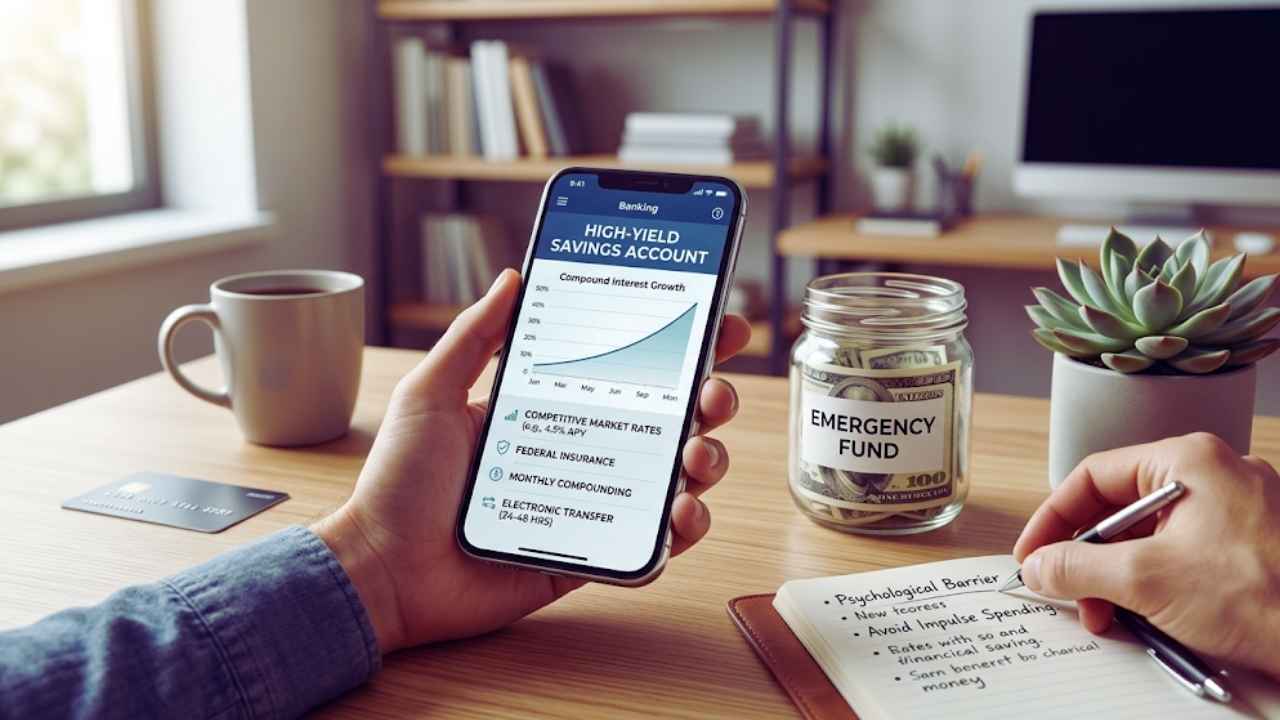
Digital-first banks provide some of the best interest rates available today because they do not have the overhead costs of physical branches. These high-yield accounts are fully federally insured, meaning your money is completely backed by the government and cannot be lost in a bank failure. The biggest advantage of using a separate digital bank is that it creates a psychological barrier between your spending money and your safety net.
Because you cannot see the balance every time you buy coffee, you are far less likely to dip into it for a weekend trip or a random impulse purchase. The interest payments also compound monthly, which means your emergency fund actually grows itself slightly over time without any extra effort on your part.
|
Account Feature |
Standard Checking |
High-Yield Savings Account |
|
Average Interest Rate |
Near 0.01% |
Highly competitive market rates |
|
Accessibility |
Instant swipe or cash |
24 to 48 hour electronic transfer |
|
Psychological Barrier |
None |
High barrier to impulse spending |
|
Monthly Fees |
Often requires minimums |
Usually zero fees |
Money Market Accounts
These accounts act as a fantastic hybrid between a traditional savings account and a daily checking account. They typically offer interest rates that rival high-yield savings while providing you with a debit card or check-writing privileges. This instant access is incredibly useful if you need to pay a tow truck driver or an emergency plumber on the spot at two in the morning.
However, you have to read the fine print because many money market accounts require a higher minimum balance to avoid monthly maintenance fees. If you already have a substantial amount of cash saved up, this is a brilliant place to park it for maximum flexibility and solid returns.
|
Money Market Feature |
Benefit to Saver |
Potential Drawback |
|
Debit Card Access |
Pay for absolute emergencies instantly |
Temptation to use for non-emergencies |
|
Check Writing |
Great for contractors who do not take credit |
Limited number of checks allowed per month |
|
Interest Yield |
Keeps up with basic inflation |
Rates fluctuate based on federal policies |
|
Balance Requirements |
Perks are excellent for high balances |
Penalties apply if balance drops too low |
Avoiding Locked Accounts
It is incredibly tempting to chase higher returns by putting your cash into a Certificate of Deposit or a short-term bond. You must resist this urge because the primary purpose of an emergency fund is immediate liquidity, not investment growth.
If your money is locked away in an account that charges a massive penalty for early withdrawal, it completely defeats the purpose of having a safety net. You cannot wait six months for a CD to mature when your car engine blows up today. Keep your core emergency savings strictly in cash-equivalent accounts that you can access within forty-eight hours without paying a single dime in fees or penalties.
|
Investment Type |
Liquidity Status |
Why It Fails for Emergencies |
|
Certificate of Deposit |
Locked for 6 to 60 months |
Heavy financial penalties for early withdrawal |
|
Stock Market Index |
Liquid but highly volatile |
Balance could crash exactly when you lose your job |
|
Retirement 401k |
Locked until retirement age |
Massive tax penalties and withdrawal fees |
|
Real Estate |
Completely illiquid |
Takes months to sell and access the cash |
How to Build an Emergency Fund 2026 Step-by-Step?
Knowing the math is great, but execution is where the vast majority of people fail. To actually build an emergency fund 2026, you need a system that runs quietly in the background of your daily life. You have to treat your savings account exactly like a mandatory bill that must be paid before you buy anything else.
Step-by-Step Execution
The very first action you take is opening that dedicated high-yield account at a completely different bank than your checking account. Next, you sit down and calculate a realistic dollar amount you can afford to transfer every single time you get paid. Even if you can only manage fifty dollars a paycheck right now, the habit is far more important than the amount.
Once the account is open, look for a quick win to jumpstart your balance, like selling old electronics on eBay or working a few extra overtime hours. Getting that first thousand dollars into the account provides a massive psychological boost that proves to yourself you can actually do this.
|
Execution Step |
Action Item |
Expected Timeline |
|
Step 1 |
Open external high-yield savings account |
Day 1 |
|
Step 2 |
Calculate recurring contribution amount |
Day 2 |
|
Step 3 |
Fund the account with a quick cash sprint |
Week 1 to 2 |
|
Step 4 |
Monitor first month of transfers |
Month 1 |
Leveraging Technology
Financial applications are incredibly smart right now and can do the heavy lifting for you. You should immediately connect your new savings account to a budgeting app that monitors your spending patterns. Many of these modern tools analyze your daily cash flow and automatically sweep small amounts of excess cash into your savings without you even noticing.
If the app sees you spent less on groceries this week than usual, it quietly moves the difference over to your emergency fund. This automated micro-saving strategy works brilliantly because it removes human error and laziness from the equation entirely.
|
Technology Tool |
Function |
Impact on Savings |
|
AI Spending Analyzers |
Finds hidden excess cash |
High impact for variable spenders |
|
Auto-Sweep Algorithms |
Moves money intelligently based on balance |
Medium impact, removes friction |
|
Budget Tracking Apps |
Visualizes progress toward goals |
High psychological motivation |
|
Rate Alert Services |
Notifies you if better yields exist |
Keeps returns optimized |
Automating Your Savings Habit
The secret to building actual wealth is not having a massive salary; it is having brutal consistency. If you have to actively remember to log in and move money every month, you will eventually find an excuse to skip it. Automation takes all the willpower out of the equation so you succeed by default.
Set Up Direct Deposit
The single most powerful financial move you can make is asking your payroll department to split your direct deposit. You instruct them to send a specific dollar amount or percentage directly to your new high-yield savings account before the rest hits your checking.
When the money never touches your daily spending account, your brain never registers it as available to spend. You naturally adjust your lifestyle to live off whatever is left over, completely forgetting that you are saving hundreds of dollars a month. This is the definition of paying yourself first, and it is the only guaranteed way to hit your emergency fund goals.
|
Direct Deposit Strategy |
Pros |
Cons |
|
Fixed Dollar Amount |
Highly predictable growth |
Does not scale when you get a raise |
|
Fixed Percentage |
Grows automatically with income |
Math fluctuates slightly each check |
|
Bonus Routing |
Captures 100% of extra pay |
Requires manual HR updates sometimes |
|
Sinking Fund Split |
Funds multiple goals at once |
Can overly complicate payroll setup |
Micro-Savings and Round-Ups
If a massive automated transfer feels too terrifying for your budget right now, you need to start small. Turn on the round-up feature offered by almost every major financial institution today. Every time you buy a coffee for four dollars and fifty cents, the bank charges you five dollars and moves the fifty cents into savings.
It feels completely painless because you are only losing spare change, but those micro-transactions compound rapidly. Over the course of a year, an active spender can easily accumulate five hundred dollars or more using this method alone without ever feeling a pinch in their daily budget.
|
Micro-Saving Method |
How It Works |
Best Used For |
|
Debit Round-Ups |
Rounds up every swipe to the nearest dollar |
Everyday active spenders |
|
Weekly Fixed Micro |
Transfers exactly $10 every Friday |
People afraid to start big |
|
Weather Rules |
Transfers $5 every time it rains (App based) |
Making saving a fun game |
|
Step Trackers |
Links savings to fitness goals |
Dual-habit building |
Strategies to Fast-Track Your Progress
Sometimes you are tired of waiting and want to hit your target number as quickly as humanly possible. If you are starting from absolutely zero and the financial anxiety is keeping you up at night, you need a period of high intensity. This means slashing your budget ruthlessly and driving up your income for a short, focused window of time.
Identifying The Leakage
Almost every adult has at least three digital subscriptions they completely forgot they were paying for. Between niche streaming services, premium app features, and cloud storage plans, these phantom expenses drain your checking account quietly every month.
You need to sit down, pull up your bank app, and ruthlessly cancel anything you have not used in the last fourteen days. Redirecting just seventy-five dollars a month from useless subscriptions to your emergency fund adds almost a thousand dollars to your safety net over a year. It takes ten minutes of effort to permanently fix this cash leak.
|
Leakage Source |
Average Monthly Cost |
Difficulty to Cancel |
|
Unused Streaming Services |
$15 to $30 |
Very Easy (One click) |
|
Forgotten Gym Memberships |
$40 to $100 |
Moderate (Often requires a phone call) |
|
Premium App Subscriptions |
$5 to $15 |
Very Easy (Manage via phone settings) |
|
Subscription Boxes |
$30 to $60 |
Easy (Account settings online) |
Utilizing Windfalls
Throughout the year, you will likely receive chunks of money outside of your normal paycheck, such as a tax refund, an annual work bonus, or even birthday cash. Human nature tells us to treat this money as a lottery winning and blow it on a vacation or a new television.
You must override this impulse and immediately transfer at least eighty percent of that windfall directly into your emergency fund. Using surprise money to buy financial security is infinitely more valuable than any consumer product you could purchase. It accelerates your timeline by months and gets you out of the danger zone instantly.
|
Windfall Source |
Typical Timing |
Action to Take |
|
Tax Refund |
Spring (March/April) |
Route 80% to emergency fund immediately |
|
Annual Performance Bonus |
Late Winter / End of Year |
Send fixed cash amount straight to savings |
|
Cash Gifts |
Holidays / Birthdays |
Put 100% toward the starter fund |
|
Selling a Vehicle |
Random |
Keep cash liquid until next car purchase |
When to Use the Fund (and When Not To)?
The fastest way to destroy your financial progress is falling victim to emergency creep. This happens when you start rationalizing terrible spending decisions by calling them emergencies. You need ironclad rules about what actually qualifies for a withdrawal so you protect the cash you worked so hard to save.
Valid Emergencies
A genuine emergency is an event that directly threatens your physical health, your ability to earn a living, or the structural safety of your home. If your transmission blows out and you literally cannot drive to the office, you use the fund. If you have severe dental pain and need an immediate root canal, you use the fund.
If you are laid off without warning, you use the fund to buy groceries and keep the lights on. You never need to feel guilty about spending this money on actual crises because that is exactly what you built it for.
|
Situation Type |
Emergency Status |
Appropriate Action |
|
Sudden Job Termination |
Valid Emergency |
Use fund to cover basic living expenses |
|
Emergency Room Visit |
Valid Emergency |
Pay the immediate deductible to avoid debt |
|
Failed Home Furnace |
Valid Emergency |
Replace immediately to protect home and health |
|
Major Auto Breakdown |
Valid Emergency |
Fix vehicle to maintain employment |
Non-Emergencies
An expense that you should have seen coming is absolutely not an emergency. Your annual car registration, holiday gift shopping, and routine medical checkups are predictable events that belong in your monthly budget.
Similarly, finding an incredible flash sale on flights to Europe does not qualify as a crisis, no matter how much you need a vacation. Using your safety net for consumer desires or poor planning leaves your bank account completely exposed when a real disaster actually strikes.
|
Situation Type |
Emergency Status |
Appropriate Action |
|
Holiday Shopping |
Not an Emergency |
Use a separate sinking fund |
|
Last Minute Travel Deal |
Not an Emergency |
Save cash specifically for travel |
|
Annual Property Taxes |
Not an Emergency |
Budget monthly for the yearly bill |
|
New Phone Release |
Not an Emergency |
Keep old phone until you save cash |
Maintaining and Scaling Your Fund
Hitting your massive target number is a huge victory, but your work is not entirely finished. As your life progresses and your income grows, your financial responsibilities will inevitably increase alongside it. You have to treat your savings strategy as a living system that requires minor adjustments to stay relevant.
The Annual Review
You need to set a calendar reminder right now for the first week of January every single year to review your spending baseline. If your landlord raised your rent by two hundred dollars and your grocery bill went up, your six-month survival number is suddenly much higher.
You have to calculate the difference and spend the next few months topping off the account to match your new reality. Allowing inflation to secretly erode the purchasing power of your safety net is a massive mistake that you only discover when it is too late.
|
Review Component |
What to Check |
Action Required if Changed |
|
Current Rent / Mortgage |
Has housing cost increased? |
Adjust monthly baseline calculation |
|
Dependents |
Did you have a child or take in a parent? |
Increase total month target (e.g., 3 to 6) |
|
Health Insurance |
Did your out-of-pocket max change? |
Update the deductible buffer amount |
|
Bank Yield |
Is your HYSA still paying top rates? |
Move cash to a better bank if rates dropped |
Replenishing the Fund
When a disaster strikes and you are forced to drain a portion of your account, you cannot panic. Once the crisis is resolved, you must immediately shift your financial focus back to saving until the balance is fully restored.
Treat the replenishment phase exactly like paying off a high-interest credit card, cutting discretionary spending ruthlessly until you hit your target again. You cannot allow yourself to return to normal lifestyle spending while your emergency fund sits half-empty and vulnerable.
|
Replenishment Step |
Focus |
Timeline |
|
Step 1: Pause Spending |
Stop all non-essential purchases |
Immediate |
|
Step 2: Redirect Cash Flow |
Send all extra money back to the HYSA |
Weekly until full |
|
Step 3: Hustle Extra Income |
Sell items or take extra shifts |
Temporary burst |
|
Step 4: Resume Normalcy |
Return to standard budget and investing |
Once fully funded |
Common Pitfalls to Avoid
Even highly disciplined people make structural mistakes that undermine their financial security. Knowing these traps ahead of time ensures you do not sabotage your own progress when things get tough.
Over-accessibility vs. Under-accessibility
The most common error is keeping the cash too close to your daily checking account. If you can transfer money to cover a bar tab with a single swipe on your phone, you will eventually do it.
Conversely, putting the money in a complex investment vehicle that takes weeks to liquidate is just as dangerous. You want an online bank that takes about two business days to process a transfer, which kills impulse spending but handles true emergencies perfectly.
|
Accessibility Level |
Example Account |
Risk Assessment |
|
Too High |
Connected savings at main bank |
Extreme risk of impulse spending |
|
Perfect Balance |
Unlinked online HYSA |
Takes 48 hours; kills impulses |
|
Too Low |
Physical CDs or Bonds |
Funds stuck when emergency strikes |
|
Zero Access |
Real Estate Equity |
Requires bank approval to access |
Over-saving Risks
It sounds strange, but you can actually hoard too much cash in a savings account. Once you hit a full twelve months of living expenses, every dollar you add after that is losing massive potential growth in the stock market.
Cash is safe, but it does not build generational wealth or beat long-term inflation. Once your emergency fund is fully capped out, you must pivot your strategy and start funneling that extra cash into index funds and retirement accounts.
|
Savings Level |
Focus |
Next Financial Move |
|
0 to 3 Months |
High Danger |
Cash hoarding in HYSA |
|
3 to 6 Months |
Secure Base |
Evaluate debt vs investing balance |
|
6 to 12 Months |
Maximum Security |
Stop hoarding cash |
|
12+ Months |
Over-saving |
Aggressively shift funds to investments |
Final Thoughts
Mastering how to build an emergency fund 2026 completely changes your relationship with money and stress. You stop waking up terrified of what might break next because you already have the cash sitting there waiting to fix it. This is not about expecting terrible things to happen; it is about preparing yourself so that minor inconveniences do not destroy your life.
By auditing your spending, setting up automatic transfers, and keeping your hands off the money, you construct an unbreakable financial shield. Start with whatever small amount you can afford today, stay relentless with your consistency, and give yourself the ultimate luxury of true financial peace of mind.
Frequently Asked Questions (FAQs) About Build Emergency Fund
1. What is the absolute first step to build an emergency fund 2026?
The very first action is opening a high-yield savings account at a completely separate bank from where you do your daily checking. This creates the necessary psychological distance so you do not accidentally spend your safety net on daily wants.
2. Is $1,000 still considered a good starter emergency fund?
A thousand dollars used to be the gold standard, but it simply does not cover modern repair costs or medical bills anymore. You should aim for a baseline starter fund of at least two thousand dollars to handle the reality of modern inflation before you aggressively tackle your credit card debt.
3. Should I pause my 401k contributions while I save cash?
If you have zero cash to your name, you should pause extra retirement investing briefly, but you should always contribute enough to get your employer match. Walking away from a company match is literally throwing away free money that doubles your investment instantly.
4. What if I am a freelancer with a highly unpredictable income?
Freelancers carry much higher risk than salaried employees and cannot rely on a three-month buffer. You need to aim for nine to twelve months of cash reserves so you can essentially pay yourself a salary during slow months and rebuild the account when big client invoices clear.
Keeping two or three hundred dollars in a fireproof safe is smart for absolute emergencies like regional power outages, but the bulk of your money belongs in a bank. Hiding thousands of dollars at home exposes you to fire and theft, and it guarantees your money loses value daily to inflation since it earns zero interest.
6. What happens if I have an emergency but my fund is only half full?
You use whatever cash you have available to cover the emergency first, and only rely on credit cards for the remaining balance. Having half an emergency fund is infinitely better than having zero, as it drastically reduces the amount of interest you will end up paying on the crisis.