


Picking where to park your cash in 2026 feels a lot different than it did five years ago. We are seeing a shift where AI isn’t just a buzzword but a core driver of corporate earnings. Interest rates have finally stopped their wild swings and settled into a “new normal.”
If you are staring at your brokerage account wondering whether to go all-in on tech stocks, play it safe with bonds, or find a middle ground with mutual funds, you aren’t alone. Everyone is looking for that perfect balance between growth and safety.
This guide isn’t about giving you a generic answer that works for everyone. We are going to dig into the mechanics of these three heavy hitters. We will look at how they perform in today’s market and how you can use them to build a portfolio that actually helps you sleep at night. Understanding the core differences in Stocks vs Bonds vs Mutual Funds 2026 is the first step toward making your money work as hard as you do.
Understanding the Fundamentals: What Are You Actually Buying?
Before we look at the charts, we need to talk about what these things actually are. Every time you move money into an investment, you are entering into a specific type of financial contract. You are either becoming a part-owner, a lender, or a member of a collective. In 2026, the way we access these assets has become incredibly fast, but the underlying rules of the game haven’t changed much.
Stocks: Ownership and The Quest for Growth
When you buy a stock, you are buying a slice of a company. If that company wins big by launching a new product or expanding into a new country, your slice becomes more valuable. You are an owner, which means you get a front-row seat to the growth. In 2026, many investors are focused on “smart ownership,” looking for companies that have integrated automation and AI to protect their profit margins.
Bonds: Lending for Income
Bonds are the opposite of stocks in terms of your relationship with the issuer. Instead of being an owner, you are a lender. You give money to a government or a corporation, and they promise to pay you back with interest. It is a predictable way to earn money. In the current 2026 economic environment, bonds have become attractive again because they offer a guaranteed “floor” of income that was missing during the era of zero-percent interest rates.
Mutual Funds: The Power of the Crowd
Mutual funds are essentially a “basket” of investments. Instead of you picking one stock or one bond, a professional manager or an algorithm pools money from thousands of investors to buy a massive variety of assets. This gives you instant diversification. If you buy a mutual fund that holds 500 different stocks and one of them goes bust, the other 499 keep your portfolio afloat. It is the go-to choice for people who don’t want to make trading a full-time hobby.
Comparison of Fundamentals
|
Feature |
Stocks |
Bonds |
Mutual Funds |
|
Legal Status |
You are an owner |
You are a lender |
You are a pool participant |
|
Typical Goal |
Capital growth |
Income and safety |
Diversified growth/income |
|
Control |
You pick the specific company |
You pick the specific debt |
You pick the theme/manager |
|
Minimum Entry |
Very low (fractional shares) |
Moderate to high |
Low to moderate |
Stocks: The High-Octane Engine of Your Portfolio
If you want to build serious wealth over the next decade, stocks are usually the main engine. They have historically outperformed almost every other asset class, but they don’t come without a bit of a roller coaster ride. In 2026, the stock market is less about “hype” and more about “delivery.” Investors are rewarding companies that show real earnings growth rather than just fancy promises.
Why Investors Love Stocks in 2026?
The main draw is the unlimited upside. A stock can theoretically double, triple, or go even higher over a few years. Beyond just the price going up, many established companies pay out dividends. These are quarterly cash payments sent straight to your account just for holding the stock. In a world where inflation still lingers, these dividends and price jumps are essential for keeping your purchasing power alive.
The Real Risks of Individual Stock Picking
The danger with stocks is what we call concentration risk. If you put too much money into one “hot” tech stock and that company faces a massive lawsuit or a failed product launch, your savings can take a massive hit. Stocks are also very sensitive to the news. A single headline about a central bank decision or a geopolitical shift can cause a stock’s price to swing 5% to 10% in a single day. You need a strong stomach to handle that kind of volatility.
Stock Market Dynamics 2026
|
Benefit/Risk |
Description |
2026 Impact |
|
Capital Gains |
Profit from selling at a higher price |
High potential in AI/Tech sectors |
|
Dividend Income |
Periodic cash payments from profits |
Stabilizes portfolio during flat markets |
|
Market Volatility |
Price swings based on news/economy |
Higher due to high-frequency AI trading |
|
Liquidity |
Ease of selling for cash |
Almost instant on modern platforms |
Bonds: The Stabilizer and Income Generator
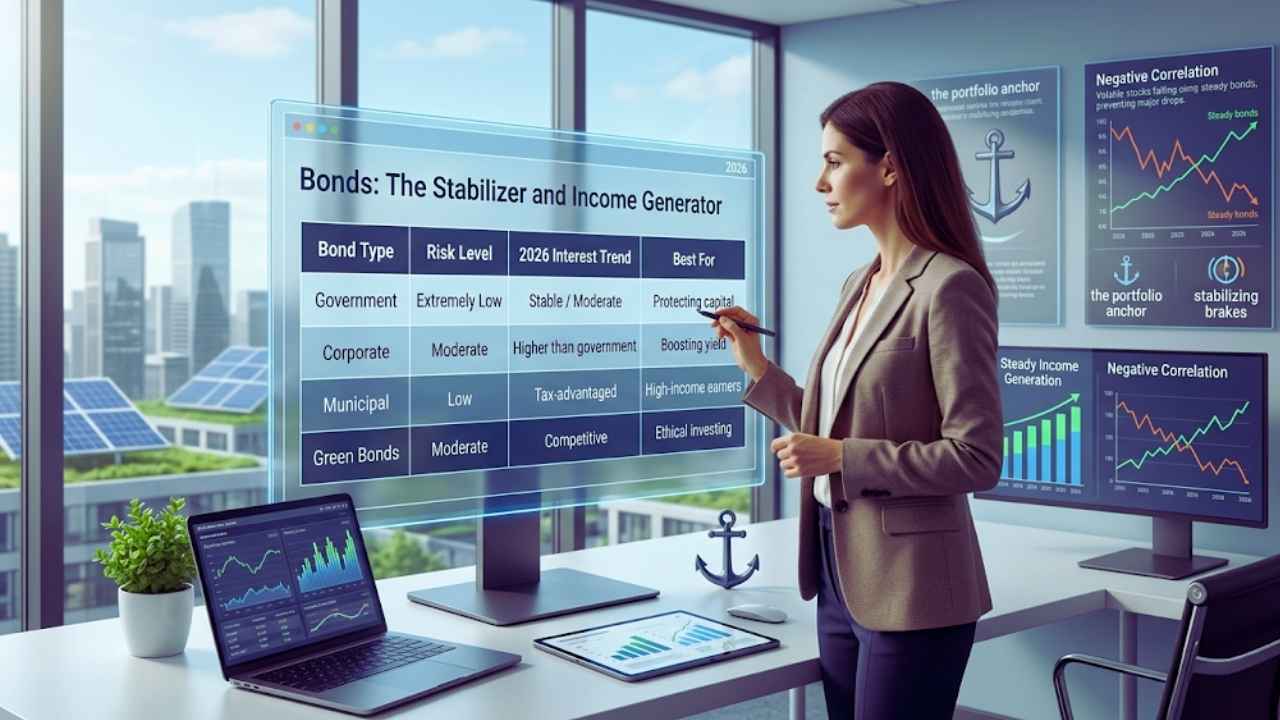
Bonds have had a major comeback story leading into 2026. For years, they were overlooked because they paid almost nothing. But now that interest rates have leveled off at a higher point, bonds are doing their job again. They act as the “anchor” that keeps your portfolio from drifting away during a storm. If stocks are the accelerator, bonds are the brakes that keep you from crashing.
Types of Bonds to Watch
Not all bonds are created equal. Government bonds (Treasuries) are considered the safest because they are backed by the government’s ability to tax. Corporate bonds are issued by companies and pay a bit more interest because there is a slightly higher risk the company might struggle. In 2026, we are also seeing more “Green Bonds” which fund environmental projects, allowing you to earn interest while supporting sustainability.
Why Bonds Matter Now?
In a balanced portfolio, bonds provide the cash flow you need for everyday life or for reinvesting. When the stock market gets shaky, people tend to sell stocks and buy bonds, which often causes bond prices to rise when stocks are falling. This “negative correlation” is the secret to a portfolio that doesn’t lose its value overnight. For the 2026 investor, holding a mix of short-term and long-term bonds provides a steady stream of predictable income.
Bond Characteristics 2026
|
Bond Type |
Risk Level |
2026 Interest Trend |
Best For |
|
Government |
Extremely Low |
Stable / Moderate |
Protecting capital |
|
Corporate |
Moderate |
Higher than government |
Boosting yield |
|
Municipal |
Low |
Tax-advantaged |
High-income earners |
|
Green Bonds |
Moderate |
Competitive |
Ethical investing |
Mutual Funds: Diversification Simplified
If the idea of researching 50 different companies sounds exhausting, mutual funds are your best friend. They allow you to buy a whole sector or even the entire market with one click. In 2026, the cost of owning these funds has dropped significantly, making them accessible to everyone from college students to retirees. It is essentially outsourcing your investment decisions to the experts.
Active vs. Passive Funds
This is a big debate right now. Active funds have a human manager who tries to beat the market by picking winners. They charge a higher fee for this service. Passive funds, often called index funds, simply track a list of companies like the S&P 500. Because there is no expensive manager to pay, the fees are tiny. In 2026, most data shows that passive funds continue to outperform the majority of human managers over the long run.
The Convenience Factor
The best thing about mutual funds is that they handle the “boring” stuff. They automatically reinvest your dividends, they rebalance your holdings to make sure you aren’t taking too much risk, and they provide easy tax reporting. For many, a “Target Date Fund” is the ultimate 2026 strategy. You just pick the year you want to retire, and the fund automatically shifts from risky stocks to safe bonds as you get closer to that date.
Mutual Fund Breakdown
|
Fund Type |
Fee Structure |
Risk Level |
Management Style |
|
Index Fund |
Very Low |
Matches the market |
Automated / Passive |
|
Active Fund |
Higher |
Higher potential/risk |
Human Manager |
|
Sector Fund |
Moderate |
High (Specific industry) |
Targeted |
|
Target Date |
Low to Moderate |
Decreases over time |
Lifecycle management |
Stocks vs Bonds vs Mutual Funds 2026: The Ultimate Matchup
When we put these three side-by-side in the 2026 landscape, the choice usually comes down to your personal timeline. There is no “winner” in a vacuum; there is only a winner for your specific goal. Stocks are currently benefiting from the massive productivity gains brought on by the second wave of the AI revolution. Bonds are providing a reliable 4% to 5% yield that actually beats inflation. Mutual funds are the bridge that allows you to have a little bit of everything without the headache of managing it yourself.
In Stocks vs Bonds vs Mutual Funds 2026, the key difference is how they handle market stress. Stocks will drop the most in a recession, but they will also jump the most during a recovery. Bonds will stay steady and keep paying interest regardless of what the “talking heads” on the news say. Mutual funds will give you a smoothed-out version of the market’s performance. Most successful investors this year aren’t picking just one; they are building a strategy that uses all three.
Comparative Matchup Table
|
Category |
Stocks |
Bonds |
Mutual Funds |
|
2026 Outlook |
Growth-oriented |
Income-focused |
Balanced / Easy |
|
Time Horizon |
5+ Years |
1-5 Years |
Any (Depends on fund) |
|
Inflation Protection |
High |
Low |
Moderate |
|
Ease of Use |
Moderate |
Moderate |
High |
The 2026 Economic Context: Why This Year is Different
You can’t talk about investing without looking at the world around us. 2026 is a year of “stabilization.” We are no longer dealing with the chaotic supply chain issues of the early 2020s. However, we are dealing with a world where the workforce is changing rapidly due to automation. This affects which companies are profitable and how much interest the government has to pay on its debt.
Inflation and Your Purchasing Power
Inflation is the silent killer of wealth. If your money is sitting in a traditional savings account, it is likely losing value every day. In 2026, stocks are a great hedge because companies can raise their prices when their costs go up. Bonds are a bit trickier; if inflation spikes, the “fixed” interest you get from a bond doesn’t buy as much as it used to. This is why having a mix of assets is so vital to protect your lifestyle.
The Role of Technology
Technology has moved from being a “sector” to being the “infrastructure” of everything. Even a traditional farming company in 2026 is using satellites and AI to manage crops. This means that when you buy a “Total Market” mutual fund, you are getting exposure to massive technological shifts whether you realize it or not. The lines between “tech” and “non-tech” have blurred, making broad-based mutual funds more tech-heavy than they were a decade ago.
2026 Market Factors
|
Factor |
Influence on Stocks |
Influence on Bonds |
Influence on Funds |
|
AI Integration |
Boosts profit margins |
Minimal impact |
Drives index performance |
|
Interest Rates |
Valuations stay steady |
Yields are attractive |
Affects fund expenses |
|
Global Trade |
Focus on regional hubs |
Affects currency bonds |
Diversifies geographic risk |
How to Choose: A Practical Strategy for You?
Deciding how to split your money between these three depends on two simple things: when you need the money and how much stress you can handle. We call this your time horizon and your risk tolerance. It is easy to say you love risk when the market is going up 20% a year. The real test is what you do when you see your account balance in the red for three months in a row.
The Time Horizon Rule
If you need your money in less than two years—maybe for a wedding or a house down payment—keep it away from stocks. A sudden market dip right before you need the cash could ruin your plans. In this case, short-term bonds or a very conservative mutual fund are the way to go. If you are saving for something 20 years away, like retirement, you should lean heavily into stocks. You have plenty of time to ride out the inevitable dips to get those higher long-term returns.
The Sleep Test
This is a simple psychological trick. If you find yourself checking your brokerage app five times a day and feeling anxious when the numbers drop, you are likely “over-leveraged” in stocks. You need to move some of that money into bonds or balanced mutual funds. Your investment strategy should be something that runs in the background of your life, not something that keeps you awake at 2:00 AM. 2026 is about “low-friction” investing that lets you focus on your career and family.
Decision Matrix
|
Your Profile |
Recommended Move |
Why? |
|
Young / Growth Focus |
80% Stocks / 20% Funds |
Maximize long-term compounding |
|
Near Retirement |
40% Stocks / 60% Bonds |
Protect what you have earned |
|
Busy Professional |
100% Mutual Funds |
Low maintenance, high diversity |
|
Wealth Preservation |
70% Bonds / 30% Stocks |
Focus on income and safety |
Building a Balanced Portfolio in 2026
The old “60/40” portfolio (60% stocks, 40% bonds) was criticized for a few years, but in 2026, it is officially back in style. Why? Because bonds are actually paying interest again. You are getting paid to wait. A balanced portfolio ensures that no matter what happens in the economy—whether we have a tech boom or a sudden recession—parts of your portfolio are always working for you.
A modern 2026 portfolio might look like this:
- A “Core” of low-cost index mutual funds that cover the whole market.
- A “Satellite” of individual stocks in sectors you believe in (like robotics or energy).
- A “Buffer” of high-quality bonds to provide cash flow and stability.
This structure allows you to capture the growth of the stock market while using bonds as a safety net. It is the most robust way to handle the unique challenges and opportunities of the current year.
Modern Portfolio Structure
|
Component |
Asset Type |
Purpose |
|
The Core (50%) |
Total Market Mutual Funds |
Steady, broad-market growth |
|
The Safety (30%) |
Gov & Corp Bonds |
Income and volatility dampening |
|
The Growth (20%) |
Individual Tech/AI Stocks |
Outperforming the averages |
Final Thoughts
Investing in 2026 doesn’t have to be a confusing mess of numbers and jargon. At the end of the day, it is about matching your money to your goals. Stocks are for your future self, bonds are for your security, and mutual funds are for your peace of mind. By spreading your money across these three areas, you aren’t just betting on one outcome; you are preparing for any outcome.
The most important thing you can do is simply start. Whether you have $50 or $50,000, the magic of compounding only works if you are in the game. Use the stability of bonds to keep you grounded, the growth of stocks to build your wealth, and the ease of mutual funds to keep it all manageable. If you stay consistent and ignore the short-term noise, you will find that Stocks vs Bonds vs Mutual Funds 2026 is less about a competition and more about a collaboration to secure your financial future.
Frequently Asked Questions (FAQs) Stocks vs Bonds vs Mutual Funds
1. Which of these has the lowest fees in 2026?
Generally, index-based mutual funds and ETFs have the lowest fees. Buying individual stocks is often “commission-free” on most apps, but you spend “time” researching them. Bonds can sometimes have hidden markups, so index funds remain the most cost-effective way for the average person to invest.
2. Can I lose all my money in a mutual fund?
It is almost impossible to lose all your money in a diversified mutual fund unless every single company in the world goes to zero. While the value can go down significantly during a market crash, the diversity of the fund protects you from a total loss. This is the main advantage over buying a single stock.
3. How often should I check my Stocks vs Bonds vs Mutual Funds 2026 portfolio?
For most people, checking once a quarter (every three months) is plenty. If you check every day, you are more likely to make emotional decisions based on short-term price swings. 2026 markets move fast, and sometimes the best thing you can do is just look away and let your strategy work.
4. Are bonds still relevant if I’m under 30?
Yes, but in a smaller dose. Even if you are young, having a small amount in bonds (like 10%) can give you “dry powder”—cash that stays stable—which you can use to buy more stocks when the market eventually dips.
5. Is it better to invest a lump sum or a little bit every month?
In 2026, “Dollar Cost Averaging” (investing a set amount every month) is still the gold standard. It takes the emotion out of the process and ensures you are buying more shares when prices are low and fewer when prices are high.