


If you have ever worked a Black Friday shift, closed a store at midnight, or smiled through a ten-minute rant over an expired coupon, you already have the skills to thrive at a desk job. The hard part is getting a hiring manager to see that. Trading the sales floor for a cubicle or a remote workspace is a huge jump.
But corporate life looks entirely different today. Software handles the boring, repetitive tasks. Companies want real human skills. They need your patience, your emotional intelligence, and your grit.
Your background is a goldmine. You just need to translate your floor experience into corporate currency. To pull off a retail-to-office career move this year, you need a smart strategy. You cannot just hand in the same resume you used for a floor manager job and wait for the phone to ring. You have to completely rebrand yourself. Let’s break down exactly how to make this transition realistic, actionable, and successful in 2026.
The Data Behind the Pivot: Why 2026 is Your Year?
The retail industry is notorious for high turnover, currently running at an exhausting 60 percent annually. This is almost double the national average across all other sectors. When you factor in the physical toll of the job, the constantly shifting hours, and the lack of weekend flexibility, the reasons for this mass exodus become glaringly obvious.
According to the Bureau of Labor Statistics, retail sales workers earn a median annual wage of $34,730, which often caps out very quickly unless you reach regional management levels. On the flip side, transitioning to a desk job completely changes your lifestyle and financial trajectory. General office clerks and administrative support roles boast a median pay of $43,630, along with standard business hours and physical comfort.
Furthermore, with approximately two million administrative job openings annually, the demand for reliable support staff remains incredibly high. Companies are actively recognizing that remote models attract better talent, giving you the chance to work from your own living room. You are not just gaining a steady paycheck; you are reclaiming your time, energy, and long-term sanity.
|
Feature |
Retail Floor |
Corporate Office / Remote |
|
Schedule |
Messy, nights, weekends |
Fixed, standard business hours |
|
Job Openings |
High turnover, seasonal swings |
Approximately 2 million administrative openings yearly |
|
Physical Toll |
Constant moving, heavy lifting |
Desk-bound, remote, or hybrid options |
|
Median Pay |
$34,730 per year |
$43,630+ for admin support |
Identifying Your Transferable Skills for a Retail to Office Career
You already possess the precise skills that hiring managers are desperately looking for, even if you do not realize it yet. The recruitment landscape has undergone a massive shift, with recent data showing that 85 percent of companies now utilize skills-based hiring instead of strictly requiring four-year degrees.
Corporate recruiters know that hiring for practical skills is actually five times more predictive of long-term job performance than relying on formal education. This means your emotional intelligence, conflict resolution tactics, and ability to stay calm under intense pressure are your absolute biggest assets. When a customer screams at you over a rigid return policy, you learn exactly how to de-escalate the situation while protecting the store’s bottom line.
In a corporate environment, this translates directly to high-stakes crisis management and client retention. Furthermore, your daily routine of managing inventory, auditing the stockroom, and tracking loss prevention perfectly prepares you for office-based supply chain logistics and database management. Making a retail-to-office career jump just requires you to reframe your floor experiences into boardroom value.
|
What You Did in Retail |
How It Sounds in Corporate |
|
Handled angry customers |
Conflict resolution & crisis management |
|
Managed the back room |
Inventory control & supply chain operations |
|
Hit monthly sales goals |
KPI tracking & revenue generation |
|
Trained seasonal hires |
Onboarding & team leadership |
|
Survived sudden rushes |
Adaptability & rapid problem-solving |
Reskilling Without Going Back to School
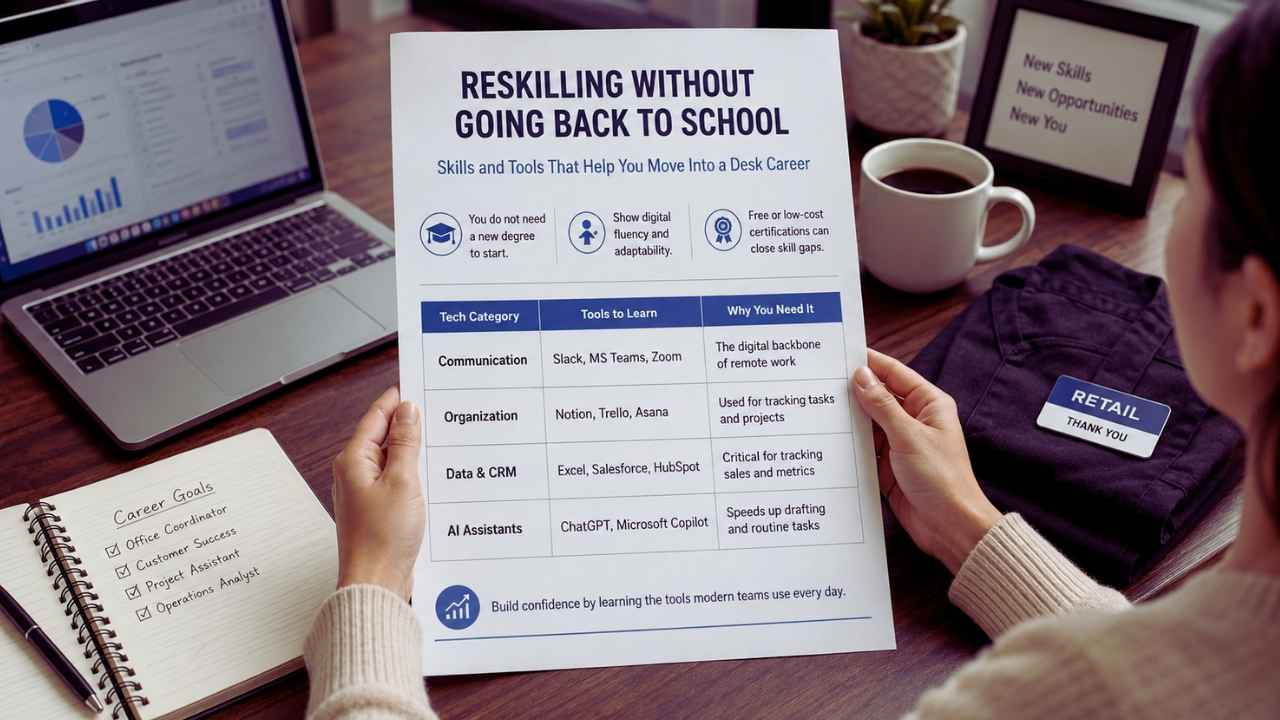 You do not need to pause your life and incur massive student loan debt to land a comfortable desk job. Because a staggering percentage of organizations have dropped degree requirements for entry-level roles, you simply need to demonstrate digital fluency and a willingness to adapt.
The modern remote or hybrid office relies heavily on specific communication hubs, project management software, and customer relationship databases. You must familiarize yourself with tools like Slack, Microsoft Teams, Asana, and Salesforce to prove you can navigate a digital workspace seamlessly. Knowing how these platforms interact is the baseline for modern corporate communication.
Furthermore, artificial intelligence has completely transformed how entry-level corporate tasks are executed on a daily basis. Generative AI assistants like ChatGPT and Microsoft Copilot are now standard tools used to draft emails, summarize long meetings, and organize basic data sets. By dedicating just a few weeks to completing free or low-cost certifications online, you can easily bridge any existing knowledge gaps and confidently showcase your modern technical proficiency to potential employers.
|
Tech Category |
Tools to Learn |
Why You Need It |
|
Communication |
Slack, MS Teams, Zoom |
The digital backbone of remote work |
|
Organization |
Notion, Trello, Asana |
Used for tracking tasks and projects |
|
Data & CRM |
Excel, Salesforce, HubSpot |
Critical for tracking sales and metrics |
|
AI Assistants |
ChatGPT, Microsoft Copilot |
Speeds up drafting and routine tasks |
The Best Bridge Roles for Former Retail Workers
You will probably not step directly into a senior management position, and that is completely fine when you are pivoting industries. Your primary goal is to secure a solid bridge job, which is an entry-level corporate role that heavily values your customer-facing experience while teaching you standard office operations.
Customer Success Specialist is a massively growing field where your ability to read people and build trust makes you an immediate asset, as you help clients proactively utilize products they already purchased. If you thrived on upselling and hitting daily store targets, Business Development Representative roles offer lucrative commission structures and rely entirely on your grit and persistence.
For those who preferred organizing the back room over dealing with angry shoppers, general office clerk positions are incredibly abundant, with over 2.6 million jobs currently in the market. These critical administrative roles demand the exact same meticulous organizational skills you used to keep a retail stockroom fully compliant for sudden district audits.
|
Job Title |
Estimated Salary |
Why It Fits Your Background |
|
Customer Service Rep |
$42,830 |
Relies heavily on de-escalation and empathy |
|
General Office Clerk |
$43,630 |
Taps into inventory, data entry, and organization |
|
Business Development Rep |
$45,000 + Commission |
Perfect if you are target-driven and love selling |
|
Accounting Clerk |
$49,210 |
Great if you balanced cash drawers and daily ledgers |
Rewriting Your Resume and LinkedIn Profile
Your current retail resume likely reads like a basic list of daily chores, which will not grab the attention of a corporate hiring manager. To secure interviews, you must completely overhaul your professional history to highlight your tangible business wins and measurable impact.
The very first step is aggressively deleting retail-specific jargon like “planogram,” “endcap,” and “register,” replacing them with corporate equivalents like “visual merchandising strategy” and “point-of-sale systems.” Corporate culture lives and dies by hard metrics, so you must quantify your achievements to prove your actual competence and reliability.
Instead of writing that you simply rang up customers, state that you processed hundreds of daily transactions with absolute accuracy while managing a large cash drawer. You also need to heavily leverage LinkedIn to network your way out of the dreaded digital resume pile. Connect strategically with former coworkers who have already made a successful retail to office career pivot, follow your target companies, and politely message recruiters about open administrative positions.
|
Weak (Retail Focus) |
Strong (Corporate Focus) |
|
“Worked the cash register during the holidays.” |
“Managed high-volume POS transactions, serving 200+ clients daily during peak seasons.” |
|
“Unpacked boxes in the back room.” |
“Streamlined inventory receiving processes, reducing stockout rates by 15%.” |
|
“Trained new staff on the floor.” |
“Led onboarding and training for 15+ employees, improving team retention.” |
|
“Dealt with customer complaints.” |
“Resolved escalated client issues proactively, maintaining a 95% customer satisfaction rate.” |
Nailing the Interview: Beating Imposter Syndrome
Securing the interview is only half the battle; once you are speaking with the hiring manager, you must confidently prove that you belong in that environment. Imposter syndrome hits incredibly hard when you transition into an unfamiliar industry, and you might feel anxious because you do not know all the corporate acronyms yet.
However, you must remember that a company can easily teach a new hire how to navigate a software platform in a matter of days. What they cannot teach is the real-world grit, emotional regulation, and deep empathy you developed while handling chaotic store rushes. When the interviewer inevitably asks about your lack of traditional office experience, do not dodge the question or apologize for your background.
Instead, frame your floor experience as your ultimate secret weapon for staying completely calm when office operations inevitably break down. Tell them directly that your years of face-to-face customer interactions have made you a master of reading the room, communicating clearly, and solving problems on the fly.
|
The Question |
Your Retail-Powered Answer Strategy |
|
“Tell me about a difficult client.” |
Share a story of de-escalating a highly agitated in-store shopper. |
|
“How do you handle tight deadlines?” |
Describe managing a massive inventory audit or a sudden floor flip. |
|
“Why the career change?” |
Focus on wanting a larger scale of impact, career growth, and new challenges. |
|
“What is your biggest weakness?” |
Mention a lack of specific CRM experience, but highlight how fast you learn. |
Final Thoughts
Leaving the sales floor takes effort, thick skin, and a willingness to learn. But the payoff is worth it. By recognizing the true value of your transferable skills, picking up a few modern tech certifications, and rewriting your resume to speak corporate language, you can absolutely secure a desk job this year.
Your time dealing with chaotic holiday shifts, messy schedules, and tough customers wasn’t a waste. It was a rigorous boot camp for the business world. Start networking, update your LinkedIn profile, and take the first step toward your new workspace. A successful retail to office career transition is entirely within your reach.
Frequently Asked Questions (FAQs) About Retail to Office Career
Do I need to take a pay cut to get into an office?
Sometimes, yes. If you are a store manager pulling in $65,000, an entry-level operations job might offer $48,000. But look at the trade-offs. You get your weekends back. The benefits usually beat retail. And the corporate ladder goes much higher. You might take one step back to take five steps forward over the next three years.
Can a temp agency actually help me pivot?
Absolutely. Temp agencies fill short-term admin, data entry, and reception roles. A three-month contract job gives you legitimate corporate experience to put on your resume. It erases the “no office experience” gap instantly. Plus, many temp roles turn into full-time jobs if you work hard.
How do I explain a massive gap in corporate experience if I am an older worker?
Focus entirely on your leadership, reliability, and crisis management. If you spent 15 years in retail, you have seen every single type of human behavior. Pitch yourself as a seasoned pro who brings maturity and elite communication skills to a younger corporate team. In an AI-driven world, your deep human experience is incredibly valuable.
Will my lack of a college degree stop me from getting an office job?
Not anymore. A massive shift toward skills-based hiring means many top companies drop degree requirements for entry-level admin and sales roles. If you hold the right certifications and a strong resume, your work ethic will outshine a piece of paper.