


You just hit “send” on a client email. Two minutes later, your boss is in your Slack DMs asking, “Did they reply? Make sure you CC me on the follow-up.” It feels completely exhausting. You feel like a teenager dealing with a helicopter parent, not a hired professional capable of running your own day.
Your heart races every time their name pops up on your screen or you hear their footsteps approach your desk. Working under someone who constantly breathes down your neck kills your productivity and drains your daily energy. But you cannot just quit right now. You have rent to pay, bills to cover, and long-term career goals you want to hit. If you want to keep your job and save your sanity, you need a highly specific game plan. Let us look at exactly how to deal with a micromanaging boss so you can reclaim your workday and your confidence.
Let’s Look Inside the Micromanager’s Head
Before you try to fix the problem, you need to figure out why it keeps happening. Your boss is not micromanaging you because they secretly hate you or want you to fail. Most of the time, this destructive behavior comes from a place of pure panic and insecurity. Companies often promote people because they rocked their last job as an individual contributor, not because they actually know how to lead humans. They suddenly lose control over the day-to-day work, and that lack of control terrifies them.
When executives put the squeeze on them to hit quarterly targets, they turn around and squeeze you. Sometimes, they carry heavy baggage from a past employee who totally dropped the ball on a major project. Knowing this does not excuse their toxic behavior, but it changes your playbook entirely. You quickly realize their hovering is a “them” problem, not a “you” problem. When you finally understand they operate from fear rather than malice, you get the upper hand in managing the dynamic.
|
The Real Cause |
What It Actually Is |
How It Looks at Work |
|
New Manager Panic |
Promoted too fast, unsure how to manage people. |
Doing your work for you instead of giving feedback. |
|
Executive Heat |
Facing intense pressure from the higher-ups. |
Demanding hourly updates on basic projects. |
|
Past Burn |
Traumatized by a former employee who failed. |
Refusing to hand over even simple, routine tasks. |
|
Perfectionism |
Thinking there is only one “right” way to work. |
Endlessly tweaking your final drafts over subjective stuff. |
The Data: How Micromanagement Destroys Teams?
If you think micromanagement is just a minor annoyance, the hard data tells a much darker story about the modern workplace. Tight grips destroy teams from the inside out. A massive workplace study found that 79% of professionals have suffered under a micromanager at some point in their careers. Worse, an overwhelming 85% of those workers said it absolutely crushed their daily morale, and 71% admitted it actively tanked their actual work performance.
This behavior creates a vicious cycle where poor results cause managers to tighten their grip even more. The financial impact is staggering, with disengaged workers now costing the global economy a massive $8.9 trillion every single year. It completely crushes creativity because employees who feel constantly scrutinized eventually stop taking risks. They stop bringing fresh ideas to the table because they know the boss will just override them anyway. The bottom line is undeniable: when bosses hover relentlessly, they push their absolute best talent right out the door.
|
The Workplace Stat |
What It Means for the Team |
Real-World Impact |
|
79% Experience Rate |
Massive prevalence across industries. |
It is a systemic workplace issue, not just one bad apple. |
|
85% Morale Drop |
Destroys team energy and enthusiasm. |
Employees stop caring and default to doing the bare minimum. |
|
71% Performance Hit |
Slows down actual daily output. |
Waiting for constant approvals creates massive bottlenecks. |
|
$8.9 Trillion Cost |
The global price of disengagement. |
Companies bleed money through lost productivity and turnover. |
Red Flags You Have a Micromanager
Micromanagement usually creeps up on you slowly. At first, you think you just have a “detail-oriented” or “hands-on” manager who cares about the output. Then, you suddenly realize you cannot breathe without asking for permission. You need to watch exactly how they handle delegation. Do they hand you a project but strip away all your actual decision-making power? Do they demand CCs on mindless daily emails just so they can monitor your inbox?
Do they rip apart your documents over a font choice or subjective phrasing instead of looking at the actual data? Another massive red flag is daily priority whiplash. Because they live deep in the weeds of every single task, they panic and change your tasks every morning before you can finish yesterday’s work. You never hit a flow state because you are constantly reacting to their latest anxiety spike. Catch these signs early, and you can figure out how to deal with a micromanaging boss before you totally burn out.
|
Category |
A Great Hands-On Leader |
A Toxic Micromanager |
|
Delegation |
Gives you the goal and trusts your process. |
Dictates every single step to reach the goal. |
|
Check-ins |
Asks for major milestones and blockers. |
Demands daily reports and CCs on everything. |
|
Mistakes |
Treats errors as a chance to coach you. |
Freaks out and takes the project away entirely. |
|
Feedback |
Looks at the final impact and results. |
Fixates on formatting, fonts, and subjective word choices. |
The Nightmare of Remote Micromanagement
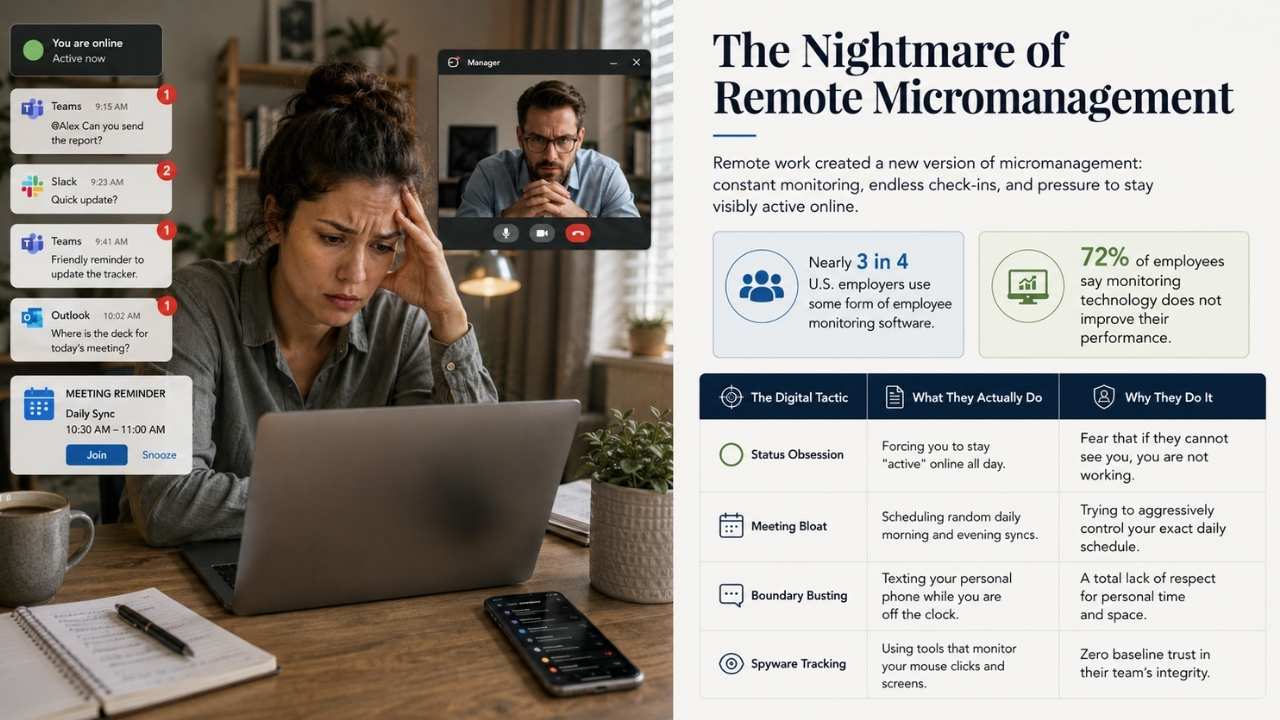
Remote work brought us a brand new monster to fight: the digital micromanager. Because they cannot physically stare at your desk from across the office, their anxiety goes completely off the charts. They demand your Slack or Teams dot stays green permanently, panicking if you step away for five minutes. They ambush you with “quick syncs” that ruin your deep focus and chop your day into useless segments.
Right now, nearly three-quarters of U.S. employers use some form of employee monitoring software to track their remote teams. Yet, an incredible 72% of employees openly state that this monitoring technology does absolutely nothing to improve their actual performance. It is surveillance, pure and simple. It completely ruins the flexibility that makes remote work appealing and keeps you chained to your keyboard out of pure paranoia. Instead of measuring your actual output and results, they measure your keystrokes.
|
The Digital Tactic |
What They Actually Do |
Why They Do It |
|
Status Obsession |
Forcing you to stay “active” online all day. |
Fear that if they cannot see you, you are not working. |
|
Meeting Bloat |
Scheduling random daily morning and evening syncs. |
Trying to aggressively control your exact daily schedule. |
|
Boundary Busting |
Texting your personal phone while you are off the clock. |
A total lack of respect for personal time and space. |
|
Spyware Tracking |
Using tools that monitor your mouse clicks and screens. |
Zero baseline trust in their team’s integrity. |
Proven Ways to Deal With a Micromanaging Boss
When you try to deal with a micromanaging boss, your first instinct is usually to hide from them. You go quiet, keep your head down, and hope they go away. You have to stop doing that right now. Silence makes a micromanager’s anxiety so much worse, and they will absolutely hunt you down for updates. Instead, use a brilliant corporate trick called “managing up.” You have to beat them to the punch.
If they normally ask for a status update at 10:00 AM, send it to them at 9:30 AM. Flood their inbox with proactive communication. Fire off a quick bulleted list at the end of the day detailing exactly what you finished and what you are tackling tomorrow. It feels annoying to write, but it buys you hours of uninterrupted peace the next day. Deliver great work, and deliver it early. When you pitch an idea, answer the who, what, when, and how upfront so you leave them with zero questions to ask.
|
The Strategy |
The Action You Take |
Why It Works So Well |
|
Proactive Updates |
Send status reports before they ever ask. |
Kills their anxiety instantly and proves you are on it. |
|
Answer Early |
Include all details in your initial pitches. |
Gives them absolutely nothing to poke holes in. |
|
Ask Preferences |
Figure out exactly how they like to chat. |
Shows you respect their specific communication workflow. |
|
Beat Deadlines |
Turn in phase one of a project early. |
Proves you are incredibly reliable and fast. |
Set Boundaries Without Getting Fired
You desperately need boundaries to survive this environment. Micromanagers love to blur the lines between your professional duties and your personal life. They text on Saturdays and expect detailed email replies at 9:00 PM. You have to push back, but you must keep it incredibly polite and completely firm. If they hand you a ten-step guide for a basic task you do in your sleep, acknowledge the goal but claim the process for yourself.
Try saying, “I see we need this by Friday. I will use my usual workflow and have it to you by Thursday at 3 PM.” You shift the focus right back to the finish line where it belongs. If they text you at night, ignore it until morning unless the company servers are literally on fire. You have to train them on your response times. People treat you exactly how you allow them to treat you, so start guarding your time today.
|
The Problem Scenario |
Do Not Say This |
Say This Instead |
|
Dictating tasks |
“I know how to do my job, leave me alone.” |
“I got the goal. I will handle the steps and deliver by 3 PM.” |
|
Late night texts |
Replying immediately to fix the issue. |
Ignore until 8 AM. “Morning! Saw this, getting on it now.” |
|
Interrupting work |
“I am busy right now, stop bugging me.” |
“I am blocking two hours for deep work. Let’s touch base at noon.” |
|
CC obsession |
“That clutters my inbox for no reason.” |
“To keep things clean, I will send you one daily recap instead.” |
Having the Hard Conversation
If the early updates and the polite boundaries completely fail, you have to talk to them directly. It sounds terrifying, but avoiding the conversation just leads to a total mental meltdown. Keep the chat strictly about the work itself. Do not mention your hurt feelings and do not tell them they drive you crazy. Make it entirely about hitting company goals and boosting your productivity.
Grab a quick 15-minute meeting with them. Anchor the chat on shared success: “I know we both want this product launch to absolutely crush it.” Then state the problem objectively: “I notice we spend an hour reviewing minor email drafts, and it slows down my daily output.” Finally, ask for some space: “I work best with deep block time. Can we try a weekly check-in instead so I can move faster?” Listen to their fears, suggest a two-week trial period, and then knock the work out of the park.
|
Conversation Step |
The Main Goal |
What to Actually Say |
|
1. Find common ground |
Show you are an ally, not an enemy. |
“We both want to hit our Q3 targets and look good.” |
|
2. State the facts |
Point out the bottleneck objectively. |
“I have noticed we spend hours reviewing minor updates.” |
|
3. Pitch your style |
Sell autonomy as a productivity tool. |
“I get way more done when I have uninterrupted focus.” |
|
4. Offer a trial run |
Suggest a low-risk compromise. |
“Could we try a single weekly check-in for this next project?” |
Protect Your Headspace
Working under a microscope fries your central nervous system. It spikes your cortisol daily and breeds massive imposter syndrome. You start genuinely believing you do not know how to do your job because they keep fixing things that are not even broken. You have to detach your self-worth from their weird management style immediately. This is critical because 69% of employees openly admit their manager has the greatest influence on their overall mental health—more than company policies or even their paycheck.
Keep a “brag folder” hidden on your desktop. Fill it with client compliments, big wins, and solid performance metrics. Open it up and read it when your boss goes wild over a tiny typo. Hard disconnect on Fridays. Delete your work apps from your phone before the weekend starts. Hit the gym, see your friends, and do not let their unchecked anxiety ruin your Sunday afternoon.
|
Mental Health Practice |
Why You Need It Right Now |
How to Actually Do It |
|
The Brag Folder |
Fights off creeping imposter syndrome. |
Screenshot praise and save it in a private desktop folder. |
|
Hard Disconnect |
Forces physical and mental space. |
Log out of Slack and email on Friday at 5 PM sharp. |
|
Peer Venting |
Validates that you are not going crazy. |
Grab coffee with a trusted mentor outside your department. |
|
Control Your Side |
Stops you from feeling totally helpless. |
Focus entirely on making your actual work undeniable. |
When It’s Time to Walk Away
Sometimes, absolutely nothing you try works. Some bosses lack all self-awareness and flat-out refuse to change their controlling habits. If the micromanagement crosses the line into active bullying, public humiliation, or wrecks your sleep schedule, pack your bags. Look at the wider company culture around you.
Does the CEO act the exact same way? If so, the place is toxic from the top down and it will never get better. Polish your resume, quietly start networking on LinkedIn, and find a team that treats you like an adult. You are not alone in making this call. In fact, 36% of employees have changed jobs specifically to escape a micromanaging boss. Leaving a terrible manager is not quitting; it is a highly strategic career upgrade. You deserve to work somewhere that trusts the talent they hired.
|
The Situation |
Your Action Plan |
Why This is the Right Move |
|
Boss respects boundaries |
Stay and keep managing up. |
They have the capacity for growth and self-correction. |
|
Good company, bad boss |
Transfer internally to a new team. |
The manager is the sole problem, not the organization. |
|
It turns into bullying |
Plan your exit immediately. |
Your long-term mental health is worth more than a paycheck. |
|
Toxic leadership everywhere |
Start job hunting quietly today. |
The controlling behavior is permanently baked into the company DNA. |
Final Thoughts
Nobody likes being watched under a microscope all day long. But figuring out how to deal with a micromanaging boss just takes patience and a rock-solid strategy. You cannot magically rewire their anxious personality, but you can entirely change how you react to them.
Beat them to the punch with proactive updates, set highly polite boundaries, and tie your need for space directly to the team’s ultimate success. Take control of your day, protect your mental health at all costs, and remember your professional worth is not defined by someone else’s inability to let go.
Frequently Asked Questions (FAQs) About
Why do I feel physically drained after dealing with a micromanaging boss?
It triggers your deep “fight or flight” response. Constantly monitoring your own behavior to avoid their criticism burns massive amounts of cognitive energy. That severe mental strain turns into intense physical exhaustion by 5 PM.
Should I report my micromanaging boss to HR?
Usually, no. Unless they are actively harassing, discriminating, or bullying you, HR mostly stays out of “management style” disputes. Going to HR just makes you look difficult to work with. Try managing up and setting boundaries first.
How do I talk about leaving a micromanager in job interviews?
Never use the word “micromanager” out loud. Keep it strictly positive. Say, “I am looking for a role with more ownership where I can take a major project from start to finish. I really thrive in high-trust environments.”
Is it possible I am the reason they are micromanaging me?
Honestly, yes. If you frequently miss deadlines, drop the ball on client communication, or make messy mistakes, a good manager will step in close to fix it. Look in the mirror first before blaming their style entirely.
Does micromanagement ever actually work for the company?
No. They might catch a stray typo, but the data proves micromanagement kills innovation and slows down real output. People stop thinking for themselves because they assume the boss will just redo the work anyway.