
You have probably seen headlines hyping up something that sounds like a science fiction superpower. Scientists are curing inherited diseases, creating crops that easily survive severe droughts, and designing completely new therapies for cancer. At the absolute center of all this excitement is CRISPR gene editing. People call it the most massive biological breakthrough of our lifetime.
The scientists who figured it out even snagged a Nobel Prize for their hard work. For anyone outside a research laboratory, the mechanics of how this technology actually functions can feel totally out of reach. We hear lots of complicated buzzwords but rarely get a straightforward explanation. Genetics is naturally a dense subject loaded with confusing jargon. Once you strip away the complex terms, the core concept driving this technology is brilliantly simple.
Changing the DNA of a living thing used to be an absolute nightmare for researchers. Scientists relied on older genetic tools that were wildly expensive, painfully slow, and not very accurate. Imagine trying to fix a single typo in a ten thousand page book using a messy bottle of white out while wearing thick winter gloves. You could technically do it, but you would probably ruin the pages around your target.
This new technology completely flipped the script. It handed scientists a digital search and replace function for human and plant DNA. You find the exact typo causing a problem, snip it out cleanly, and type in the correct genetic letter with pinpoint precision. From curing rare blood disorders to tackling massive climate change issues, we are barely scratching the surface of what this tool can accomplish.
CRISPR Technology
The journey to understanding this biological marvel is a fascinating story of accidental discovery and scientific curiosity. For decades, researchers studying the genetics of yogurt bacteria noticed weird repeating sequences but dismissed them as genetic junk. It was not until the early two thousands that a few brilliant minds connected the dots between these repeating patterns and a highly effective viral defense system. This realization sparked a massive race among geneticists across the globe to map out the exact chemical mechanisms driving the process.
They quickly understood that if a simple bacterium could program a biological machine to find and destroy specific viral invaders, humans could theoretically reprogram that exact same machine. They realized they could use it to target any genetic sequence in any living organism. This profound shift from observing a natural phenomenon to engineering a programmable medical tool completely changed the trajectory of modern biology forever. We essentially borrowed an ancient survival trick from the microscopic world and turned it into the ultimate genetic remote control.
|
Concept |
Description |
|
Origin of technology |
Ancient immune system found naturally in bacteria |
|
Purpose in nature |
Defends bacteria against invading viruses |
|
Main advantage |
Replaces slow genetic tools with a precise search and replace function |
|
Nobel Prize recognition |
Awarded in 2020 for developing this system into a programmable genetic tool |
What Does CRISPR Stand For?
The name is a massive acronym that stands for Clustered Regularly Interspaced Short Palindromic Repeats. I know that sounds like a random collection of dense science terminology, but it simply describes what the DNA physically looks like under a powerful microscope. When researchers first started mapping the genetic code of specific bacteria, they noticed a completely bizarre pattern in the genome. They saw short blocks of genetic code that repeated over and over again in a highly organized way.
Even more interesting, these blocks read the exact same way forwards and backwards, which is what the word palindromic means. Sandwiched right between these repeating blocks were distinct, random looking pieces of DNA that did not match the rest of the bacterium’s genetic material. For years, scientists completely ignored these strange, repetitive patterns because nobody had a clue what they were actually doing inside the cells. It took a while to realize these random pieces were actually the key to an ancient biological mystery.
The Discovery of a Bacterial Immune System
The massive breakthrough happened when researchers finally figured out that those random pieces of DNA wedged between the repeating blocks were not random junk at all. They were actually exact genetic matches to viruses that love to attack and destroy bacteria. This meant the bacteria were essentially keeping a scrapbook of their deadliest enemies. When a virus attacks a bacterium, the surviving bacterium steals a tiny snippet of the invading virus’s DNA.
It takes that stolen snippet and pastes it right into its own genome, specifically between those repeating palindromic blocks. The bacterium basically creates a biological mugshot of the invader. If that exact type of virus ever tries to launch another attack, the bacterium checks its internal mugshot collection. It instantly recognizes the threat and deploys special proteins to chop the invading virus into harmless pieces. Once scientists understood this ancient system, they realized they could hijack it to power CRISPR gene editing in humans.
The Core Components of CRISPR
You might expect a biological tool capable of rewriting the foundation of life to be incredibly complex and chaotic. Instead, the sheer elegance of CRISPR gene editing lies in its absolute biological simplicity. Older genetic engineering methods relied on massive, clunky proteins that scientists had to build entirely from scratch for every single new experiment. Building those older tools took months of frustrating laboratory work and often ended in complete failure.
This modern system completely threw out that outdated playbook by relying on just two simple, highly interchangeable parts. Scientists keep the heavy lifting machinery exactly the same every single time and only swap out a tiny, easily manufactured navigation molecule to change targets. This modular design makes the technology incredibly cheap, wildly fast, and accessible to thousands of research laboratories around the world instead of just a few wealthy institutions. It democratized genetic engineering almost overnight and gave researchers everywhere the power to run complex experiments.
|
Component |
Function |
Analogy |
|
Guide RNA |
Scans the genome to find the exact target sequence |
A highly specific GPS navigator |
|
Cas9 Protein |
Unzips the DNA and makes a precise physical cut |
A pair of programmable molecular scissors |
|
Combined System |
Binds to the target and severs the double helix |
A targeted search and destroy team |
Guide RNA: The Genetic GPS
The first critical piece of the puzzle is a molecule called RNA. RNA is essentially a chemical cousin to DNA that carries messages around the cell. In a natural bacterial setting, the bug creates an RNA copy of the viral mugshot it saved to hunt down infections. In a modern laboratory setting, scientists manufacture a synthetic, custom version of this molecule called a guide RNA. Think of the guide RNA as a highly programmed GPS coordinate system.
It is just a customized string of genetic letters that usually stretches about twenty characters long. Scientists program this guide RNA to perfectly match the exact sequence of the gene they want to edit. It does not matter if that gene belongs to a human patient, a stalk of corn, or a laboratory mouse. The guide RNA floats through the cell and scans the massive landscape of DNA until it finds the exact matching sequence and latches on.
Cas9: The Molecular Scissors
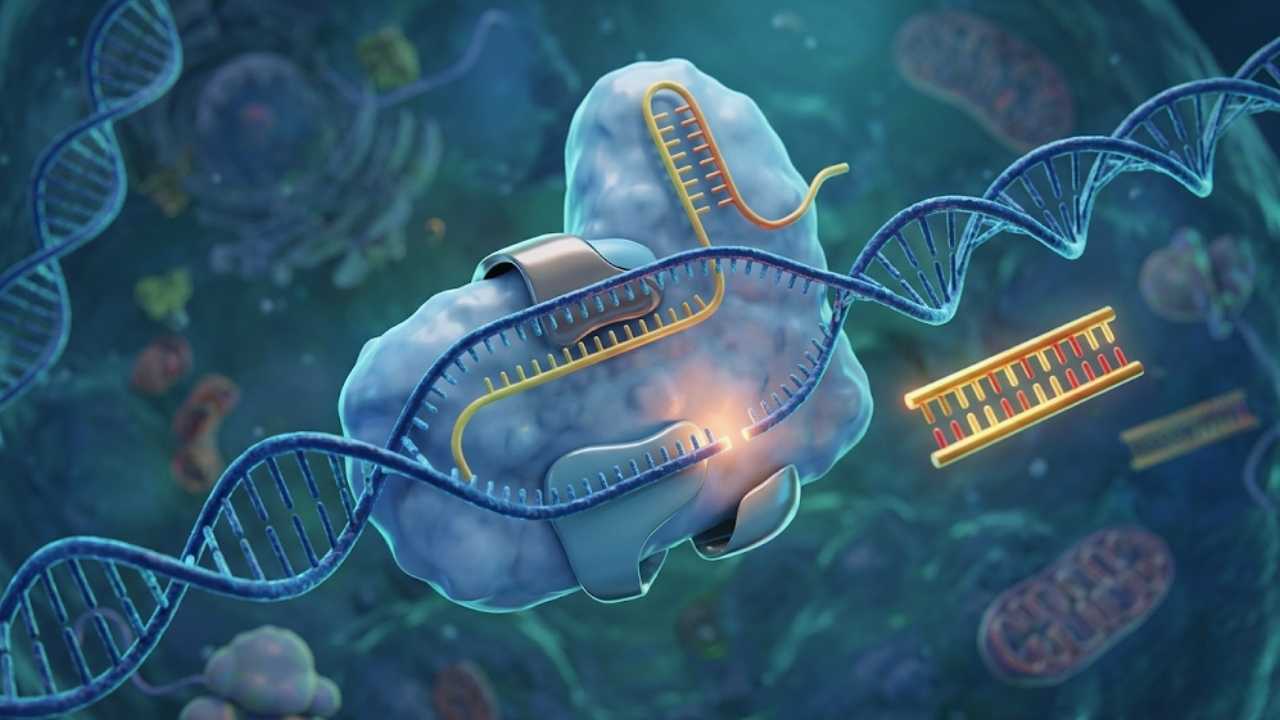
The second half of the operation is a protein called Cas9. If the guide RNA is the navigation system, Cas9 is the hardware that actually does the heavy lifting once they arrive at the destination. Cas9 is an enzyme that functions exactly like a microscopic pair of scissors. The Cas9 protein physically hitches a ride on the guide RNA. As the guide navigates and scans the genome, the Cas9 enzyme travels with it quietly.
When the guide RNA finds its perfect target match and binds tightly to the DNA strand, the Cas9 enzyme wakes up. It clamps down on the DNA helix, pulls the two individual strands apart, and makes a clean, precise cut entirely across the DNA molecule. That specific physical cut is the absolute trigger that sets the whole CRISPR gene editing process into motion.
Step by Step: How CRISPR Works in the Lab
If you picture a modern genetics laboratory, you might imagine massive supercomputers and highly dramatic chemical reactions happening everywhere. In reality, the actual physical process of executing an edit is incredibly meticulous and involves working with microscopic amounts of clear liquids in tiny plastic tubes. Scientists spend the vast majority of their time on computers carefully designing the experiment before they ever touch a physical pipette.
Once the digital design is finished, they move to highly sterile benches to mix the biological components together in strictly controlled environments. The actual molecular cutting happens completely invisibly inside a dark incubator over the course of several quiet days. Researchers then have to run complex chemical analyses just to prove the invisible edits actually worked the way they intended. It is a slow, highly methodical process of absolute trial and error. This rigorous testing phase demands extreme patience and absolute precision from the scientists running the experiments to ensure complete safety.
|
Step |
Action Taken |
Result |
|
1. Identify Target |
Find the exact genetic typo causing the issue |
Knowing the exact coordinates for the edit |
|
2. Design Guide |
Create a synthetic RNA that matches the target |
Preparing the GPS navigator |
|
3. Deliver Tools |
Insert the RNA and Cas9 into the living cell |
Getting past the cell membrane |
|
4. Make Cut |
The system finds the target and severs the DNA |
Triggering the cell’s panic repair response |
Step 1: Identifying the Target DNA Sequence
You cannot fix a problem if you do not know exactly where it is located. Before any physical lab work happens, scientists have to map the territory they want to change. They study the genome of the organism and pinpoint the exact gene responsible for the disease or physical trait they want to alter.
Let us say they want to treat a genetic blood disorder. First, they sequence the patient’s DNA to find the exact mutation causing the issue inside the red blood cells. They write down the specific string of genetic letters at that exact location. This string of letters becomes the target coordinate they will program into their tools. If they get the sequence wrong by even one letter, the entire operation will fail to find the right spot.
Step 2: Designing and Delivering the Guide RNA
With the exact coordinates locked in, scientists use specialized software to design the guide RNA. They manufacture this custom RNA sequence in the lab so it perfectly mirrors the target DNA. Designing the tools is actually the easy part of the job. The hardest challenge in genetic medicine is getting these tools safely inside a living cell. Cells are naturally suspicious and they do not just let foreign objects float through their protective membranes.
Scientists have to get creative with their delivery methods. Sometimes they hollow out harmless viruses, pack the genetic tools inside, and let the virus infect the cell to drop off the payload. Other times, they wrap the tools in tiny fat bubbles called lipid nanoparticles. These microscopic bubbles easily slip through the cell wall and dump the editing machinery safely inside the nucleus.
Step 3: Making the Cut
Once the delivery is successful, the machinery gets straight to work inside the nucleus where the DNA lives. The guide RNA starts rapidly scanning through the incredibly long, tightly coiled strands of DNA. It is specifically looking for a very tiny marker called a PAM sequence. The PAM sequence is just a two to three letter tag sitting right next to the target site on the genome.
Cas9 absolutely needs to see this tiny tag to know it is safe to act. If the tag is missing, the scissors stay completely closed to prevent random damage. When the guide RNA confirms the perfect match and the Cas9 spots the specific PAM tag, the system locks in. The Cas9 enzyme slices cleanly through both sides of the DNA ladder, breaking the entire strand in two pieces.
Step 4: Cellular DNA Repair Mechanisms
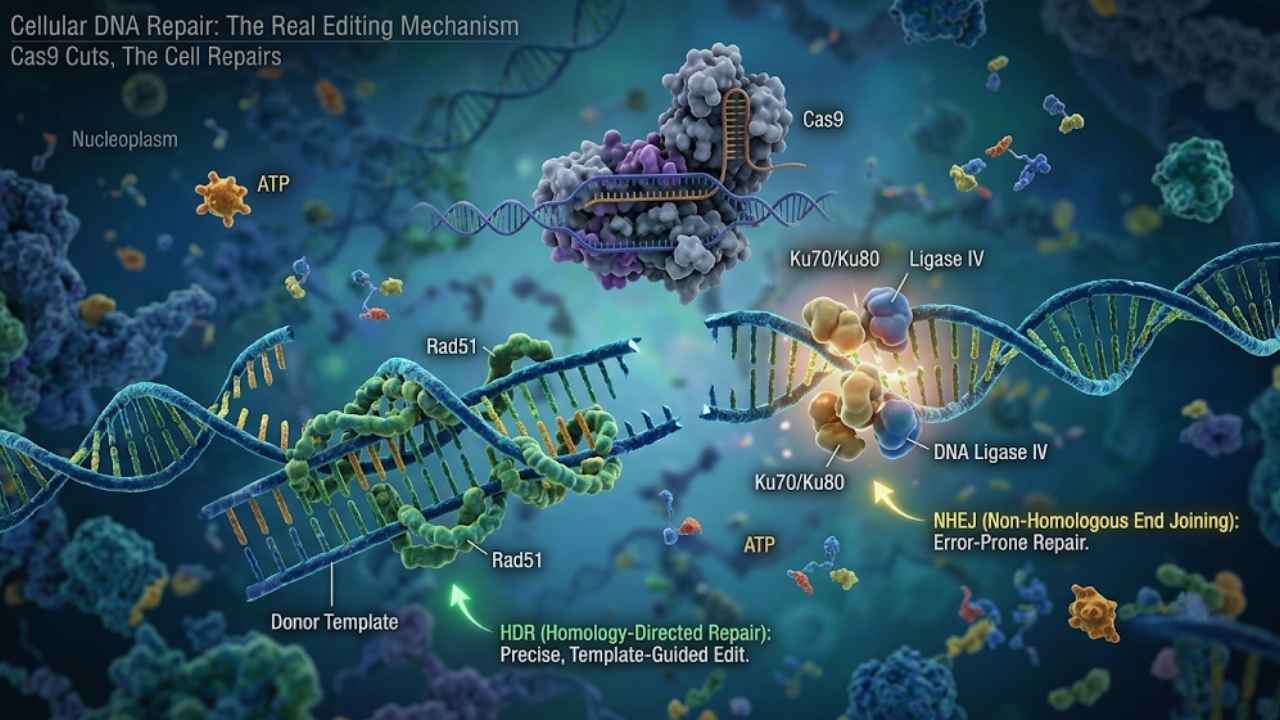
This is the part that trips people up the most. The Cas9 scissors do not actually do the editing. They only do the cutting. The real editing happens strictly because of the cell’s own built in repair crew. A broken strand of DNA is a catastrophic emergency for any living cell.
If left broken, the cell could die or easily mutate into a dangerous cancer. The moment the cut happens, the cell hits the panic button and frantically tries to patch the break. Scientists exploit this natural panic response to force the exact genetic changes they want to see.
Non Homologous End Joining
The absolute fastest and most common way a cell fixes a broken DNA strand is a quick and dirty process called non homologous end joining. This is literally a blind panic repair. The cell grabs the two severed ends of the DNA and blindly glues them back together as fast as possible. Because the cell is rushing to survive, the repair job is incredibly sloppy. It usually deletes a few random genetic letters or accidentally crams extra random letters into the repair site.
A sloppy repair might sound like a failure, but scientists absolutely love it. Changing even one genetic letter completely ruins the instructions that specific gene provides. By forcing the cell to make a sloppy repair, scientists effectively break the gene on purpose. This technique permanently knocks out bad genes that cause terrible diseases or unwanted physical traits.
Homology Directed Repair
Sometimes simply breaking a bad gene is not enough. If scientists want to actually fix a genetic typo instead of just turning it off, they use a completely different repair pathway. Along with the guide RNA and the molecular scissors, scientists smuggle a brand new, highly customized piece of DNA directly into the cell. When the scissors make the cut, the panicking cell looks around for a blueprint to help it stitch the ends together perfectly.
It stumbles across the new piece of DNA the scientists sneaked in and uses it as a master instruction manual. The cell copies the new, corrected sequence directly into the break point. This incredibly clever trick lets researchers completely correct inherited diseases or insert entirely new genetic traits that the organism never had before.
Beyond Cutting: Advanced CRISPR Techniques
The initial version of the molecular scissors was a monumental breakthrough, but scientists are famously perfectionists who never stop tinkering with their toys. They immediately recognized that chopping completely through the fragile DNA ladder was a pretty violent way to fix a delicate microscopic problem. The resulting panic from the cell could sometimes cause massive genetic rearrangements that researchers definitely did not want to happen.
To solve this major issue, the brightest minds in bioengineering started heavily modifying the original proteins to create much safer, far gentler versions of the tool. We have basically moved from the crude sledgehammer phase of genetic modification straight into the highly refined scalpel phase. These advanced next generation techniques allow researchers to interact with the genome in incredibly subtle ways without triggering massive cellular alarm bells.
This rapid evolution of the base technology drastically reduced the chances of dangerous biological errors occurring during the repair process. It is exactly what gave regulators the massive confidence boost they needed to start approving human clinical trials.
|
Advanced Technique |
How It Works |
Primary Benefit |
|
Base Editing |
Chemically converts one DNA letter to another |
No double strand cuts, minimizing massive errors |
|
Prime Editing |
Writes new genetic info directly into the site |
Acts like a precise word processor search and replace |
|
CRISPRa and CRISPRi |
Parks a broken Cas9 on a gene without cutting |
Turns the volume of a gene up or down temporarily |
Base Editing and Prime Editing
Slicing straight through both strands of a chromosome can sometimes cause the cell to make chaotic, completely unintended changes during the frantic repair phase. To fix this dangerous problem, scientists invented base editing. If the original tool is a pair of scissors, base editing is a pencil with an eraser. This system uses a mutated version of Cas9 that only nicks the DNA instead of fully severing it. It then uses a highly specific chemical reaction to smoothly convert one genetic letter straight into another.
It can effortlessly turn a C into a T without ever causing the cell to panic. An even newer upgrade is called prime editing. This acts exactly like a true search and replace function on your laptop. It can write entirely new genetic information straight into a specific targeted site without relying on the cell to randomly patch up a break. Because prime editing completely avoids severing the double helix, scientists consider it vastly safer and far more accurate.
CRISPRa and CRISPRi: Turning Genes On and Off
Researchers also figured out they could intentionally break the cutting feature of the Cas9 enzyme to do something completely different. They engineered a specific version called dead Cas9. This heavily modified protein still uses the guide RNA to navigate directly to a specific spot on your genome, but the scissors are completely jammed. It literally cannot cut anything.
Instead, scientists attach different signaling molecules to this dead protein. When it parks on the target gene, it just sits there blocking traffic. Depending on what is attached to it, this roadblock can either highly encourage the cell to read that gene much more often, or it can physically block the cell from reading it at all. This lets doctors temporarily dial the activity of a specific gene up or down without making any permanent, risky changes to the underlying DNA structure.
Real World Applications of CRISPR Gene Editing
It is incredibly rare for a scientific discovery to jump from a basic laboratory concept into tangible real world products in less than a single decade. The sheer speed at which this technology has been commercialized is completely unprecedented in the entire recorded history of modern science.
We are no longer dealing in theoretical science fiction scenarios or distant promises of future cures that might happen fifty years from now. Actual patients are currently walking out of medical facilities completely free from chronic genetic diseases they inherited at birth. Massive commercial farms are already testing drought resistant crops in open fields right now to secure our global food supply chains against extreme weather events.
Dozens of highly funded startup companies are raising billions of dollars specifically to commercialize these biological tools for completely new industries we never even considered before today. The massive wave of practical applications is accelerating every single month across the globe. This tool is heavily touching everything from the renewable fuel we put in our cars to the specialized medicine we take in hospitals.
|
Industry |
Current Application |
Real World Example |
|
Human Medicine |
Curing inherited genetic disorders |
Casgevy therapy approved for sickle cell disease |
|
Oncology |
Engineering immune cells to fight tumors |
Modified CAR T cells hunting specific cancer types |
|
Agriculture |
Creating resilient, high yield crops |
Wheat and corn designed to survive severe droughts |
|
Environment |
Controlling disease spreading insect populations |
Gene drives to crash mosquito populations carrying malaria |
Revolutionizing Human Medicine and Gene Therapy
Medicine is exactly where this tool shines the brightest right now. We finally saw the first government approved therapy based entirely on this technology hit hospitals. The drug is actively curing patients with severe sickle cell disease and beta thalassemia. Doctors extract stem cells straight from the patient’s bone marrow, edit those cells in a highly sterile lab to fix the broken hemoglobin instructions, and infuse the newly repaired cells right back into the body.
People who spent their entire lives suffering from agonizing pain and relying on constant hospital blood transfusions are walking away practically cured. Companies are pushing aggressive clinical trials for cardiovascular diseases right now. Instead of taking cells out of the body, these new therapies are injected directly into the patient’s bloodstream to naturally edit the liver and permanently lower bad cholesterol levels.
Advancing Agriculture and Crop Resilience
While the massive medical breakthroughs grab all the front page headlines, the agricultural sector is quietly undergoing its own absolute revolution. Extreme climate change is making global farming incredibly difficult. Searing heat, unpredictable brutal droughts, and aggressive new plant diseases constantly threaten the global food supply chain. Traditional, old school farming methods just cannot adapt fast enough to keep up with a booming global population.
Scientists are using precise genetic modifications to gently tweak the DNA of staple crops like wheat, rice, and soybeans. Instead of violently mashing different species together, they simply adjust the genes the plant already naturally possesses. They have developed tough crops that yield way more food, require drastically less water, and easily fight off devastating fungal infections. Researchers have even successfully edited the DNA of pigs to make them completely immune to deadly viral outbreaks.
Environmental Conservation and Beyond
The life saving applications absolutely do not stop at local hospitals and massive commercial farms. Researchers are currently deploying these tools to fix massive environmental and public health crises around the globe. One of the most fascinating applications is something called a genetic drive. Scientists are literally editing the DNA of wild mosquitoes that spread deadly malaria to make them completely sterile. By releasing these modified insects into the wild jungles, the sterility gene spreads rapidly through the breeding population.
This quickly crashes the number of disease carrying bugs in that entire region. In the clean energy space, scientists are heavily modifying the genomes of basic algae. They are tweaking the internal cellular machinery of these microscopic plants to force them to produce massive amounts of rich lipids. These lipids are then safely harvested and processed into clean, highly renewable biofuels to eventually replace heavily polluting fossil fuels.
Ethical Considerations and The Future of Genome Editing
We are collectively stepping into incredibly uncharted territory as a species now that we hold the absolute power to direct our own biological evolution. This profound level of control naturally brings up terrifying questions about exactly who gets to decide what a normal or healthy human genome should actually look like.
Many sociologists and prominent ethicists warn that without incredibly strict global oversight, this technology could easily be abused to create devastating societal divides. It directly forces us to confront highly uncomfortable philosophical questions about human enhancement, the true definition of disability, and the core ethical limits of medical intervention. To navigate this massive minefield safely, we absolutely need everyday citizens to understand how the underlying science actually works.
We cannot leave these massive decisions entirely in the hands of wealthy pharmaceutical companies or isolated politicians who might not grasp the long term biological consequences of their actions. An educated public is the absolute best defense against the reckless misuse of genetic engineering. Every single person deserves a voice in deciding how we deploy this incredible power.
|
Ethical Concern |
Description |
Current Status |
|
Germline Editing |
Making permanent changes to human embryos |
Strictly prohibited by the global scientific community |
|
Unintended Mutations |
The scissors accidentally cut the wrong DNA site |
Technology is rapidly improving to minimize errors |
|
Accessibility and Cost |
Treatments are far too expensive for average people |
Therapies cost millions, but prices will eventually drop |
|
Designer Babies |
Wealthy parents paying for enhanced traits |
Remains a massive ethical boundary regulators enforce |
The Debate Over Human Embryo Editing
The absolute biggest red line in the scientific community tightly revolves around editing human embryos. We have to clearly separate somatic editing from germline editing to understand the danger. Every medical treatment happening today is a somatic edit. That means the genetic changes happen only in the body of a consenting adult patient. Those specific changes die with the patient and do not get passed down to their future kids. Germline editing is a completely different, highly dangerous beast.
This involves editing the core DNA of a human embryo, sperm, or egg. If you edit a living embryo, that specific genetic change is locked deeply into every single cell of that future person’s body forever. Even wilder, that person will eventually pass the newly edited gene down to their own children, permanently altering the human gene pool without their consent. The global consensus agrees germline editing for reproductive purposes is strictly off limits.
Accessibility and Regulation
Even when we strictly stick to safe, adult treatments, the brutal financial reality is pretty grim for most folks. Developing highly targeted genetic therapies takes years of incredibly stressful research and massive corporate funding from pharmaceutical companies. Because of this, the very first approved CRISPR therapies carry a jaw dropping price tag. Treating a single patient with the sickle cell cure currently costs over two million dollars.
There is a very valid, deep fear that this incredible medical revolution will dramatically widen the gap between the rich and the poor. We risk building a dystopian society where life saving genetic cures are exclusively reserved for the ultra wealthy elites. Governments are scrambling to build regulatory frameworks that actually make sense. They need to ensure that injecting programmable molecular scissors into a human body is perfectly safe without creating so much red tape that it kills the innovation entirely.
Final Thoughts
We are standing right in the middle of a massive biological revolution that will change how we view life itself. CRISPR gene editing has rapidly evolved from a weird microscopic curiosity found in bacteria to a dominant tool that is fundamentally changing human medicine and global agriculture. The sheer fact that we can literally reprogram the operating system of biology opens up possibilities that previous generations could only dream about.
Whether we are completely erasing a brutal hereditary blood disorder, designing tough crops that survive extreme climate change, or engineering immune cells to hunt down cancer, the future potential is staggering. We definitely have to navigate the scary ethical boundaries carefully and make absolutely sure these million dollar cures actually reach the people suffering the most today. Our ability to edit the genetic code is here to stay permanently, and it will radically reshape the entire future of human health.
Frequently Asked Questions (FAQs) About How CRISPR Works
What is the difference between CRISPR and traditional GMOs?
When everyday people hear about genetically modified organisms, they usually picture the old school, highly controversial methods. Traditional GMOs were often made by ripping a massive chunk of DNA from one completely different species and forcefully shoving it into the genome of a plant. This new gene editing tool is radically different and far more precise. Most of the time, scientists do not introduce any foreign DNA at all. They just use the molecular scissors to make tiny, exact tweaks to the genes the plant or animal already possesses naturally.
Can CRISPR cure cancer?
It is definitely not a magical, single pill that wipes out all forms of cancer forever. However, it is an incredibly powerful new weapon for brilliant oncologists. Right now, doctors mostly use it to engineer a patient’s own natural immune system. They extract white blood cells, completely upgrade their targeting systems using gene editing, and put them back in the body to aggressively hunt down specific hidden tumors. This exact immunotherapy approach is showing massive success in treating tricky blood cancers.
Is CRISPR safe for humans?
The basic safety profile has improved massively since the early experimental days, which is exactly why regulators are finally approving these therapies. It is not completely risk free though. The absolute biggest headache for scientists is something called off target effects. This happens when the molecular scissors get highly confused and accidentally slice the wrong part of the genome, which could theoretically trigger a brand new disease. Newer versions of the tools are incredibly accurate and minimize this risk.
How much does a CRISPR treatment cost?
Right now, the price of admission is totally astronomical for the average family. Because these therapies are highly individualized and require taking cells out of your body to edit in a sterile lab, they cost a massive fortune. The very first approved cure for sickle cell disease hit the public market at over two million dollars per patient. Experts firmly believe that as the technology scales up and becomes a standard injection, those massive costs will eventually come crashing down.
Can I do CRISPR gene editing at home?
The idea of biohacking in your garage sounds really exciting to some people, but it is an incredibly bad idea. You can technically buy very basic educational kits online to edit harmless bacteria in a petri dish. Attempting to edit your own human cells at home is highly dangerous and largely impossible without millions of dollars in highly specialized lab equipment. You cannot just whip up a custom guide RNA in your kitchen blender and safely inject it.
Does CRISPR leave a permanent scar on the DNA?
This really depends entirely on which cellular repair method the scientists decide to trigger. If they use the quick and dirty panic repair method to purposefully break a bad gene, the cell absolutely leaves a messy scar. It usually deletes a few letters or crams extra junk DNA into the break point. If scientists use the highly precise template repair method to fix a typo, the final edit is incredibly clean. It replaces the bad code so smoothly that it leaves absolutely zero trace or scar behind.