


Mention the stock market, and most people immediately think of one specific strategy. They imagine buying shares in a company, crossing their fingers the price goes up, and eventually selling those shares to lock in a profit. But you do not actually have to sell your shares to make money in the modern market.
There is a completely different approach that puts cash directly into your pocket while you simply hold onto your investments for the long haul. I am talking about dividends. Think of a dividend as a cash reward a company pays you just for owning its stock. You buy the shares, sit back, and the company drops money right into your brokerage account on a regular schedule. Sounds like a cheat code, right?
But if you really want to build a reliable passive income stream, you need to look under the hood. You have to understand exactly how dividend stocks work. You need to know which numbers actually matter, why an insanely high payout is usually a trap, and how the stock market payout calendar physically functions. Let us cut the jargon and look at the actual mechanics of dividend investing, check out real market data for 2026, and show you how to build a compounding income machine.
What Exactly Is a Dividend?
At its core, a dividend is a direct cash payout of corporate profits given to shareholders. When a publicly traded company makes money, the executive team and the board of directors face a tough choice. They can pump all that cash back into the business to build new factories, launch new products, or buy up smaller competitors. Alternatively, they can hand a chunk of that cash over to the actual owners of the company.
Most highly profitable, established businesses do a mix of both to keep investors happy. They keep what they need to keep growing and pay out the rest to investors as a reward for holding the stock. If you invest in the US market, you should expect most of these companies to pay dividends quarterly, which means four times a year. However, if you look at real estate investment trusts or some international stocks, you might actually see monthly or annual payout schedules.
Let us put real numbers to it so you can see the math in action. Say you buy 100 shares of a company that pays a two-dollar annual cash dividend per share. You will make 200 dollars for the entire year without lifting a finger. Since they pay quarterly, you will see a 50-dollar deposit hit your brokerage account every three months. You literally do nothing to claim it because the cash shows up automatically as long as you own the stock by the required deadline.
|
Type of Dividend |
Simple Definition |
How You Actually Get It |
|
Cash Dividend |
Cold, hard cash paid out from corporate profits. |
Deposited straight into your brokerage account. |
|
Stock Dividend |
Paid as additional shares instead of cash. |
Extra shares magically appear in your portfolio. |
|
Special Dividend |
A rare, one-off bonus payment. |
Paid as cash, usually after a record profit year. |
|
Property Dividend |
Paid in physical assets or products. |
Super rare; physical delivery or spin-off shares. |
The Mechanics: how dividend stocks work
To really get how dividend stocks work, you need to wrap your head around the corporate calendar and the recent changes to the stock market. Companies do not just wire money to anyone holding a share on a random Tuesday morning. The stock market trades billions of shares daily, which means ownership changes hands in milliseconds. To keep things organized and prevent chaos, Wall Street uses a strict timeline to determine exactly who gets paid.
If you are investing in 2026, you absolutely need to know about the new settlement rules that have taken over the market. In May 2024, the US stock market switched to a faster settlement cycle, meaning trades now settle in one business day instead of two. This drastically shifted the payout timeline because the ex-dividend date and the record date now typically land on the exact same business day.
Everything kicks off when the board of directors issues a press release stating the exact cash amount of the dividend and the payout dates. The ex-dividend date is the single most important day on the calendar because it dictates who gets the cash. If you buy shares on or after this date, you get the stock, but the seller gets the upcoming dividend. You must purchase the stock at least one business day prior to get paid, and your broker handles the rest when payday arrives.
|
Timeline Event |
What It Means for You |
Action Required |
|
Declaration Date |
The company announces the dividend and the payout dates. |
None. Just read the news. |
|
Ex-Dividend Date |
The cutoff. You must buy the stock before this day. |
Buy at least one day before this date. |
|
Record Date |
The company checks its books for official owners. |
None. Matches the Ex-Date under T+1 rules. |
|
Payment Date |
Payday. The cash hits your account. |
Decide to spend it or reinvest it. |
Why Do Companies Even Pay Dividends?
Understanding how dividend stocks work gives you a look into a chief executive officer’s mind and corporate strategy. You rarely see fast-growing tech startups paying dividends because they need every dime to hire engineers, run ads, and steal market share. Giving cash to shareholders would be a massive mistake for a young company trying to conquer a new industry. So why do giants like Coca-Cola, Apple, or Procter and Gamble pay out billions of dollars every single year?
These massive corporations have already won their respective races and dominate the globe, printing money every single quarter. Because they are so massive, they no longer have endless opportunities for explosive growth. Building a fifth factory in a city that already drinks enough soda will not magically double their revenue. Instead of sitting on dead cash or blowing it on a terrible business acquisition, they give it back to the owners.
A growing dividend is the ultimate corporate flex because you can manipulate earnings reports with clever accounting, but you cannot fake actual cash. Paying a dividend every single quarter, even when the economy tanks, proves to Wall Street that a company’s business model is bulletproof. Historically, dividends do the heavy lifting for your portfolio, anchoring your wealth even when stock prices get wild.
|
Reason |
The Reality |
Who Cares? |
|
Shareholder Reward |
Gives investors a return without forcing them to sell. |
Long-term holders and retirees. |
|
Financial Muscle |
Proves the business generates real, unmanipulated cash. |
Institutional funds. |
|
Capital Discipline |
Stops CEOs from wasting excess cash on stupid ideas. |
Value investors. |
|
Market Reality |
Massive companies cannot grow 50 percent a year anymore. |
Income investors. |
The Numbers: Key Metrics You Need to Track
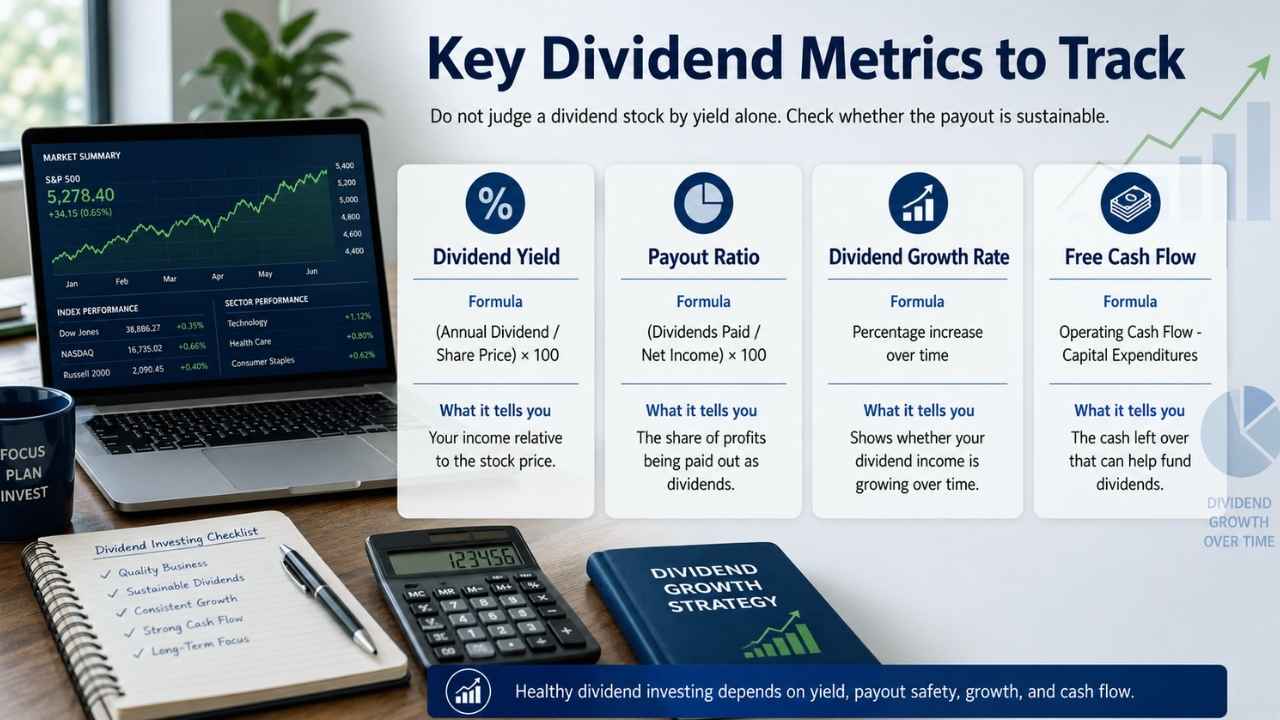
Do not just open a stock screener, sort by the highest yield, and blindly buy the top ten names you see. That is the fastest way to lose your shirt in the stock market because you have to verify the dividend is safe. Yield shows how much cash a company pays out each year relative to its stock price. Remember that yield moves in the opposite direction of the stock price, so a plunging stock will artificially inflate the yield number.
For context, by mid-2026, the average yield for the broad market hovered around 1.05 percent according to recent financial tracking data. Your ultimate safety gauge is the payout ratio, which tells you what percentage of a company’s earnings goes toward covering the dividend. If a company makes ten dollars a share and pays you four dollars, they have plenty of cash left over to handle emergencies.
But if they make two dollars a share and pay out three dollars, they are literally borrowing money to pay you. You should look for standard companies with a healthy payout ratio between thirty and sixty percent. Furthermore, the best companies do not just pay dividends; they raise them every year to outpace inflation. A stock with a low starting yield but a massive annual growth rate will eventually pay you way more cash.
|
Metric |
The Math |
What It Actually Tells You |
|
Dividend Yield |
(Annual Dividend / Share Price) x 100 |
Your income relative to the stock price. |
|
Payout Ratio |
(Dividends Paid / Net Income) x 100 |
The chunk of profits going out the door. |
|
Dividend Growth Rate |
Percentage increase over time. |
Shows if your income is beating inflation. |
|
Free Cash Flow |
Operating Cash – Capital Expenditures |
The actual cash left over to pay you. |
The Elite Tier: Dividend Aristocrats
If you do not want to spend hours crunching numbers, Wall Street built a brilliant cheat sheet for you called the Dividend Aristocrats. To join this exclusive club, a company has to be in the main index and must have raised its base dividend every single year for at least 25 consecutive years. Think about how incredibly hard that is for a business to pull off in the real world. A company has to raise its payout through the dot-com crash, the 2008 housing crisis, a global pandemic, and periods of massive inflation.
As of 2026, exactly 69 companies hold the Aristocrat title, standing out as the most reliable income generators on the planet. Recent financial data shows that this list includes boring but brilliant businesses like Clorox and McCormick, alongside newer additions like Eversource Energy, Erie Indemnity, and FactSet Research Systems. Investors absolutely love these companies because a management team will do almost anything to avoid cutting an Aristocrat’s dividend.
They know perfectly well that breaking a quarter-century streak will cause funds to dump the stock and tank the share price overnight. These executives protect that payout with their lives, making these stocks a cornerstone for anyone building a long-term passive income portfolio. By focusing on Aristocrats, you completely bypass the risky startups and invest straight into proven winners.
|
Category |
The Rule |
2026 Reality |
|
Dividend Aristocrat |
25+ straight years of dividend hikes. Must be in S&P 500. |
69 companies make the cut. |
|
Dividend King |
50+ straight years of dividend hikes. |
Elite subset of the Aristocrats. |
|
Dividend Contender |
10 to 24 straight years of hikes. |
The up-and-comers. |
|
Dividend Challenger |
5 to 9 straight years of hikes. |
Just getting started. |
The Snowball Effect: DRIPs
Here is where we get to the absolute best part of how dividend stocks work over a long period of time. You do not actually have to take the cash and spend it right away. Instead, you can set up a Dividend Reinvestment Plan, commonly known as a DRIP, to supercharge your portfolio. A DRIP tells your broker to take your cash payout and instantly buy more shares of that exact same stock.
Most modern brokers do this for free and even allow you to buy fractional shares, so every single penny goes to work immediately. When you do this, your share count grows automatically without you ever lifting a finger or depositing new money from your paycheck. Because your share count constantly grows, your quarterly payouts grow right alongside it in a beautiful compounding loop.
Reinvesting creates a massive snowball effect that turns small initial investments into massive wealth over twenty or thirty years. Financial data tracking back to the 1960s shows that a staggering majority of the market’s cumulative total return came entirely from reinvested dividends. Reinvesting is how you get rich slowly and securely, bypassing the stress of daily market fluctuations entirely.
|
Your Move |
What Happens |
The Long-Term Result |
|
Take the Cash |
Spend it on bills or fun. |
Share count stays flat. Income grows slowly. |
|
Manual Reinvesting |
Let cash sit, buy shares later. |
You forget, or you try to time the market and fail. |
|
DRIP (Automatic) |
Broker buys fractional shares instantly. |
Massive snowball effect. Compounding wealth. |
Avoid the Trap: Risks of Chasing High Yields
If you want to master how dividend stocks work, you must dodge the dangerous high-yield traps that ruin novice investors. I mentioned earlier that sorting by the highest yield is a terrible idea, and here is exactly why that strategy fails. When a yield looks way too good to be true, it is usually a value trap waiting to crush your portfolio. If a company is fundamentally broken, smart institutional investors will start selling the stock aggressively. The stock price plummets, and as the price drops, the yield mathematically shoots up to an incredibly high number.
For example, if a stock traded at one hundred dollars and paid five dollars, the company might lose a massive lawsuit and see its stock tank to twenty-five dollars. Suddenly, that five-dollar dividend looks like an incredible twenty percent yield, but the underlying business is bleeding cash. Management will eventually announce a dividend cut to survive, causing the stock price to crash even further down the drain.
You lose your income stream entirely, and you lose half your initial investment in a matter of days. Always check the payout ratio and revenue trends before buying a double-digit yield to protect your hard-earned capital.
|
Red Flag |
What It Looks Like |
Why You Should Run |
|
Sky-High Yield |
Paying 12 percent while everyone else pays 3 percent. |
The stock price crashed because the business is failing. |
|
Insane Payout Ratio |
Paying out 95 percent or more of profits. |
Zero room for error. One bad month equals a cut. |
|
Shrinking Profits |
Earnings drop year after year. |
They are draining savings to pay you. It will not last. |
|
Debt-Fueled Payouts |
Borrowing cash to pay the dividend. |
Financial suicide. Destroys the stock price eventually. |
Let’s Talk Taxes: What You Actually Keep
You absolutely cannot talk about making money in the stock market without bringing up the tax implications of your investments. Unless you hold your stocks in a tax-advantaged retirement account, you have to pay taxes on your dividends every single year. But there is fantastic news for people who like to buy and hold their investments for the long haul. The government actually rewards long-term dividend investors by classifying their standard payouts as qualified dividends.
This specific classification means the government taxes that money at the much lower long-term capital gains rate instead of your regular income bracket. For most middle-class investors, that rate sits comfortably at fifteen percent, and sometimes even drops to zero depending on your total overall income. To get this massive tax break, you have to hold the stock for more than sixty days during a specific window around the ex-dividend date.
If you try to game the system by buying a stock on Monday, collecting the dividend on Tuesday, and selling on Wednesday, you will fail. The government taxes short-term trades at your normal, higher income tax rate, penalizing day traders who just want a quick buck. Holding your dividend stocks patiently is the smartest way to keep more cash in your own pocket.
|
Dividend Type |
How the Government Treats It |
What You Have to Do |
|
Ordinary Dividends |
Taxed at your normal income tax rate. |
Nothing. Happens automatically on short-term trades. |
|
Qualified Dividends |
Taxed at a lower capital gains rate. |
Hold the stock for over 60 days in a specific window. |
|
Return of Capital |
Delays taxes by lowering your cost basis. |
Mostly applies to complex assets. |
Final Thoughts
Building wealth doesn’t require staring at stock charts all day, trying to guess what the market will do next week. Once you understand exactly how dividend stocks work, you gain a massive psychological advantage. You stop acting like a day-trader and start acting like a business owner collecting your cut of the profits.
Stick to high-quality companies that generate massive free cash flow. Look for a track record of consistent dividend hikes—the Aristocrats are a great place to start. Avoid the shiny object syndrome of massive, double-digit yields, and let the math of a DRIP compound your wealth over time. Whether you eventually spend the cash to cover your mortgage or reinvest it to build a financial fortress, dividend investing is still one of the sharpest ways to build passive income.
Frequently Asked Questions (FAQs) About How Dividend Stocks Work
Are dividends better than stock buybacks?
They just do different things. Dividends put cash in your hand today, but you have to pay taxes on it. Buybacks happen when a company buys its own shares off the open market and destroys them. That makes your remaining shares more valuable without triggering a tax bill. Most mega-cap tech companies use a mix of both.
Why do utilities and REITs pay so much?
Real Estate Investment Trusts (REITs) get a special tax break from the government, but they are legally forced to pay out 90% of their taxable income as dividends to keep it. Utility companies operate monopolies with extremely predictable, boring revenue. Because they know exactly how much money they’ll make next month, they can safely pay out a huge chunk of it to you.