


Interest rates sound boring until they hit your wallet. Your mortgage quote changes. Your credit card balance grows faster. Your car loan payment feels heavier. Your savings account finally pays something worth noticing. A company delays hiring. A homebuyer walks away from a deal.
That’s how rates move from central bank meetings into daily life. Understanding how interest rates affect the economy helps you read financial news with less confusion. It also helps you make smarter choices with debt, savings, housing, business planning, and investing.
The simple idea is this: interest rates are the price of money.
When money gets more expensive, people and businesses borrow less. Spending slows. Demand cools. Inflation may ease. When money gets cheaper, borrowing becomes easier. Spending rises. Businesses invest. Growth may improve.
But it doesn’t happen all at once. Housing feels rate changes quickly. Credit cards react fast. Stock markets move even faster. Jobs and wages take longer. Inflation can take longer still. That delay is why interest rates matter so much.
Latest Interest Rate and Economy Snapshot
As of early July 2026, interest rates remain a major force in the U.S. economy and global markets. The Federal Reserve held its target range for the federal funds rate at 3.50% to 3.75% at its June 17, 2026 meeting. That range matters because it guides many short-term borrowing costs across the economy.
Inflation is still above the Fed’s long-term 2% goal. The Personal Consumption Expenditures price index rose 4.1% year over year in May 2026, while core PCE inflation rose 3.4%. Core PCE excludes food and energy, so economists often use it to see underlying inflation pressure.
The labor market is still holding up. The unemployment rate stayed at 4.3% in May 2026, and employers added 172,000 jobs. That means the economy has not cracked under higher rates, but borrowing pressure remains real.
Housing shows the pain more clearly. The average 30-year fixed mortgage rate was 6.49% on June 25, 2026. New single-family home sales fell to an annual rate of 580,000 in May 2026, down from April and lower than a year earlier.
Here’s the plain-English read. Borrowers still face pressure. Savers may earn better returns. Businesses are more careful. Homebuyers need bigger budgets. Central banks are still trying to cool inflation without damaging jobs.
|
Indicator |
Latest Verified Figure |
What It Means for Readers |
|
Federal funds target range |
3.50% to 3.75% |
The main U.S. policy rate remains restrictive enough to affect borrowing. |
|
Effective federal funds rate |
3.63% on June 30, 2026 |
Overnight bank lending is trading inside the Fed’s target range. |
|
Bank prime loan rate |
6.75% on June 30, 2026 |
Many business loans, credit lines, and consumer products use this as a base. |
|
PCE inflation |
4.1% year over year in May 2026 |
Inflation is still above the Fed’s long-term goal. |
|
Core PCE inflation |
3.4% year over year in May 2026 |
Underlying price pressure remains sticky. |
|
Unemployment rate |
4.3% in May 2026 |
The labor market is steady but not risk-free. |
|
Jobs added |
172,000 in May 2026 |
Hiring remains positive despite higher borrowing costs. |
|
Real GDP growth |
2.1% annual rate in Q1 2026 |
The economy is still growing, though rate pressure continues. |
|
30-year fixed mortgage rate |
6.49% on June 25, 2026 |
Home affordability remains tight for many buyers. |
|
New home sales |
580,000 annual rate in May 2026 |
Housing demand is weaker under higher mortgage rates. |
|
Average credit card rate, all accounts |
21.00% in February 2026 |
Revolving debt remains expensive for households. |
This data matters because interest rates work through real choices. A family may delay buying a home. A business may postpone expansion. A saver may move cash into a higher-yield account. An investor may rethink risk. A government may pay more to borrow. That’s the economy in motion.
What Interest Rates Mean in Plain English?
An interest rate is the cost of borrowing money. If you borrow money, interest is what you pay. If you save money, interest is what you earn. That one idea shapes much of the economy. A bank charges interest on a mortgage, credit card, car loan, or business loan. A bank may also pay interest on a savings account, certificate of deposit, or money market account.
When rates rise, borrowers feel the squeeze. When rates fall, borrowers get relief. But savers often feel the opposite. Higher rates can help them earn more on cash. Lower rates can reduce their savings income. Interest rates also affect asset prices. Bonds, stocks, real estate, currencies, and commodities can all move when rate expectations change.
The key point is simple. Interest rates are not just a banking tool. They are a signal. They tell households, businesses, investors, and governments how expensive money is.
|
Term |
Plain Meaning |
Real-Life Example |
|
Interest rate |
The price of borrowing money |
A 7% loan costs more than a 4% loan. |
|
Borrower |
Someone using money now and paying later |
A homebuyer, car buyer, student, or business owner. |
|
Saver |
Someone earning money on deposits |
A person with cash in a savings account or CD. |
|
Policy rate |
A rate central banks use to guide markets |
The federal funds rate in the United States. |
|
Inflation |
A broad rise in prices |
Groceries, rent, fuel, insurance, and services cost more. |
|
Real interest rate |
Interest rate after inflation |
A 5% return with 4% inflation leaves about 1% real return. |
|
Fixed rate |
A rate that does not change during the loan term |
A 30-year fixed mortgage. |
|
Variable rate |
A rate that can rise or fall |
Many credit cards and business credit lines. |
Nominal Rate vs Real Rate
The nominal rate is the rate you see on paper. A lender may quote a 7% mortgage. A bank may offer a 4% savings rate. A credit card may charge 21%. The real rate adjusts for inflation.
If your savings account pays 4% and inflation is 4.1%, your buying power is roughly flat before taxes. You may have more dollars, but those dollars do not buy much more.
That is why real rates matter. A high nominal rate does not always mean a strong return. You need to compare the rate with inflation.
Fixed Rate vs Variable Rate
A fixed rate stays the same. A variable rate can change. This difference can make a huge difference during a rate-hiking cycle.
A homeowner with a low fixed-rate mortgage may not feel higher rates right away. A credit card borrower may feel them almost immediately. A small business with a floating-rate credit line may see monthly costs rise quickly.
That is why two people can live in the same economy but feel interest rates very differently.
How Interest Rates Affect Economy: The Simple Chain
The easiest way to understand how interest rates affect economy is to follow the chain from borrowing to spending. Higher interest rates make loans more expensive. That makes people less likely to borrow. If people borrow less, they usually spend less. If spending slows, businesses may raise prices more slowly. That can help cool inflation.
But the same brake can slow growth. If customers spend less, businesses may sell less. If sales weaken, companies may delay hiring. If borrowing costs rise too much, investment can slow. If the slowdown becomes deep, unemployment can rise.
Lower rates work in the opposite direction. Cheaper loans encourage borrowing. Borrowing supports spending. Spending helps businesses grow. Businesses may hire more workers. The economy may expand faster.
But cheap money has risks too. It can push people to borrow too much. It can lift home prices too quickly. It can inflate stock prices. It can make risky investments look safer than they are.
|
Rate Move |
First Effect |
What People Do |
What Businesses Do |
Wider Economic Result |
|
Rates rise |
Loans cost more |
Borrow less and spend less |
Delay expansion or hiring |
Demand cools |
|
Rates rise |
Savings pay more |
Save more cash |
Compete harder for customers |
Inflation may ease |
|
Rates rise |
Debt payments increase |
Cut optional spending |
Protect cash flow |
Growth may slow |
|
Rates fall |
Loans cost less |
Borrow and spend more |
Invest and hire more |
Growth may improve |
|
Rates fall |
Savings pay less |
Move money into spending or investments |
Expand faster |
Demand rises |
|
Rates stay too low |
Credit feels easy |
Take on more debt |
Fund risky projects |
Inflation or bubbles may build |
|
Rates stay too high |
Debt becomes painful |
Reduce spending sharply |
Cut jobs or projects |
Recession risk rises |
Think of rates like a brake and gas pedal. Higher rates press the brake. Lower rates press the gas.
But the economy is not a small car. It is more like a huge ship. It turns slowly. A rate change today can affect mortgage quotes this week, credit card bills this month, business plans next quarter, jobs later, and inflation much later.
That delay creates the hard part. Central banks must make decisions before all the effects are visible.
Why Central Banks Raise or Cut Interest Rates?
Central banks use interest rates to guide the economy. In the United States, the Federal Reserve has two main goals: stable prices and maximum employment. In plain language, it wants inflation under control and as many people working as possible.
Those goals can pull in different directions. If inflation is too high, the Fed may raise rates or keep them high. That cools demand but can slow hiring.
If unemployment rises and the economy weakens, the Fed may cut rates. That supports demand but can bring inflation risk back. So rate policy is always a balancing act.
|
Economic Situation |
Likely Central Bank Move |
Why It Happens |
Risk If They Get It Wrong |
|
Inflation is too high |
Raise rates or hold them high |
Slows demand and price growth |
Growth and jobs may weaken |
|
Economy is slowing |
Cut rates |
Supports borrowing and spending |
Inflation may return |
|
Job market weakens |
Cut or pause |
Helps protect employment |
Price pressure may stay sticky |
|
Inflation is sticky |
Hold rates higher for longer |
Keeps pressure on prices |
Borrowers stay under strain |
|
Financial stress rises |
Cut rates or add liquidity |
Keeps credit markets working |
May reward risky behavior |
|
Signals are mixed |
Wait and watch |
Avoids a rushed decision |
Policy may become too late |
|
Inflation and unemployment both rise |
Harder decision |
Both goals are under pressure |
Public trust may weaken |
Why Inflation Drives Rate Decisions?
Inflation hurts people quietly. It reduces buying power. Groceries cost more. Rent rises. Insurance jumps. Fuel bills increase. Services become harder to afford.
If wages do not keep up, people feel poorer even when they still have jobs. That is why central banks take inflation seriously.
The Fed’s long-term inflation goal is 2%. In 2026, inflation remained above that level. That makes quick rate cuts harder to justify.
Why Central Banks Avoid Cutting Too Soon?
Lower rates help borrowers. But they can also restart inflation. If loans become cheaper while prices are still rising too fast, people may spend more again. Businesses may regain pricing power. Inflation may become harder to control.
That is why central banks often sound cautious. They want proof that inflation is cooling before they ease policy too much.
Why Central Banks Avoid Waiting Too Long?
There is another risk. If rates stay high for too long, demand can weaken too much. Businesses may stop hiring. Consumers may cut spending. Defaults may rise. Banks may tighten lending.
The economy can slow faster than expected. This is why central banks watch inflation, jobs, wages, spending, lending, housing, and financial markets at the same time.
How Higher Interest Rates Affect Households?
Households feel higher rates through monthly payments. A mortgage gets harder to afford. Credit card debt grows faster. Car loans become more expensive. Personal loans feel less attractive. Even buy-now-pay-later plans can become harder to manage if budgets are already tight.
When debt costs more, families often cut back. They may delay vacations, electronics, home repairs, furniture, dining out, or a new vehicle. They may also pay down debt faster and keep more cash on hand.
Higher rates can help savers, though. Savings accounts, money market accounts, Treasury bills, and certificates of deposit may offer better returns. So higher rates create winners and losers. Borrowers feel pain. Savers may get relief.
|
Household Area |
Higher Rate Effect |
What It Means in Daily Life |
|
Mortgage |
Monthly payment rises for new buyers |
A family may qualify for a smaller home. |
|
Credit card |
Interest charges grow faster |
Minimum payments may not reduce the balance much. |
|
Auto loan |
Financing cost rises |
Buyers may choose a cheaper car or delay purchase. |
|
Personal loan |
Monthly payment rises |
Debt consolidation becomes less attractive if rates are high. |
|
Savings |
Cash may earn more |
Savers can shop for better bank rates. |
|
Rent |
Indirect pressure can rise |
Landlord financing costs may affect supply and pricing. |
|
Confidence |
People become cautious |
Big purchases get delayed. |
|
Emergency fund |
Becomes more valuable |
Households need more cash cushion when debt is costly. |
Mortgage Example
Mortgage rates show the effect clearly.
On a $300,000 30-year mortgage:
|
Mortgage Rate |
Monthly Principal and Interest |
Difference Compared With 4% |
|
4.00% |
About $1,432 |
No extra cost |
|
6.49% |
About $1,894 |
About $462 more per month |
|
7.00% |
About $1,996 |
About $564 more per month |
That does not include taxes, insurance, homeowner association fees, repairs, or private mortgage insurance. So a buyer may need to lower the budget, bring a bigger down payment, or wait. This is why mortgage rates can cool housing demand even if home prices do not fall much.
Credit Card Example
Credit cards can hurt even faster than mortgages. Many credit cards have variable rates. When market rates rise, card APRs often rise too. At a 21% APR, a $5,000 balance can add about $87.50 in interest in one month before payments and new purchases.
That is why high-interest debt becomes dangerous. It grows quietly. It can drain a household budget even when the borrower stops spending. For many people, paying down credit card debt is one of the smartest moves in a high-rate economy.
How Interest Rates Affect Inflation and Growth?
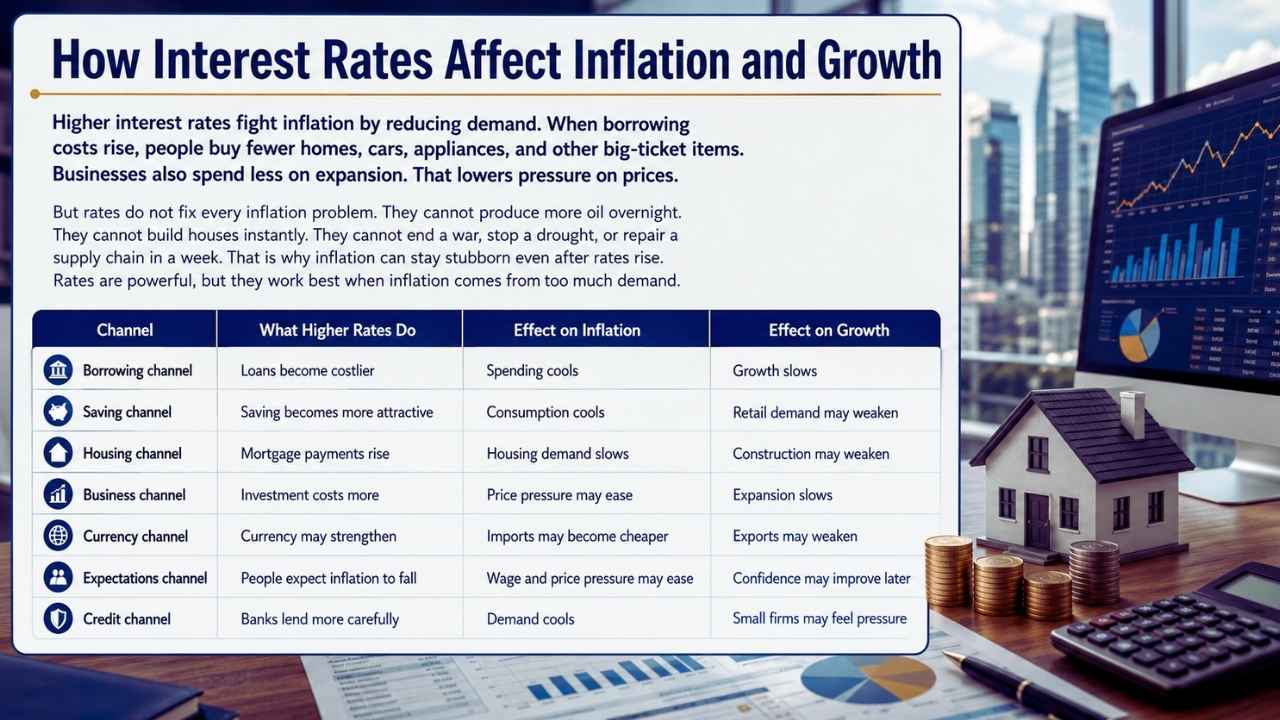
Higher interest rates fight inflation by reducing demand. When borrowing costs rise, people buy fewer homes, cars, appliances, and other big-ticket items. Businesses also spend less on expansion. That lowers pressure on prices.
But rates do not fix every inflation problem. They cannot produce more oil overnight. They cannot build houses instantly. They cannot end a war, stop a drought, or repair a supply chain in a week.
That is why inflation can stay stubborn even after rates rise. Rates are powerful, but they work best when inflation comes from too much demand.
|
Channel |
What Higher Rates Do |
Effect on Inflation |
Effect on Growth |
|
Borrowing channel |
Loans become costlier |
Spending cools |
Growth slows |
|
Saving channel |
Saving becomes more attractive |
Consumption cools |
Retail demand may weaken |
|
Housing channel |
Mortgage payments rise |
Housing demand slows |
Construction may weaken |
|
Business channel |
Investment costs more |
Price pressure may ease |
Expansion slows |
|
Currency channel |
Currency may strengthen |
Imports may become cheaper |
Exports may weaken |
|
Expectations channel |
People expect inflation to fall |
Wage and price pressure may ease |
Confidence may improve later |
|
Credit channel |
Banks lend more carefully |
Demand cools |
Small firms may feel pressure |
Why Inflation Falls Slowly?
Prices do not reset overnight. A restaurant may keep menu prices high because rent, wages, and food costs are still high. A landlord may wait until lease renewal. An insurer may price based on past claims. A grocery store may still face higher fuel and labor costs.
So higher rates often slow price growth first. They do not always make prices drop. That distinction matters. If inflation falls from 4% to 2%, prices are still rising. They are just rising more slowly.
Why GDP Matters?
Gross domestic product measures the economy’s output. When GDP grows, the economy is producing more goods and services. When GDP shrinks, the economy is contracting.
Real GDP grew at a 2.1% annual rate in the first quarter of 2026, after growing 0.5% in the fourth quarter of 2025.
That shows the economy still had momentum. But higher rates can still slow future growth if borrowing, housing, and business investment weaken.
What a Soft Landing Means?
A soft landing means inflation cools without a deep recession. That is the dream outcome.
Prices rise more slowly. Jobs remain steady. Growth slows but does not collapse. Borrowers feel pressure, but the economy keeps moving.
It is hard to achieve because rate hikes work with delays. Central banks can overshoot or undershoot.
How Interest Rates Affect Jobs, Wages, and Businesses?
Jobs usually react later than loans and markets. A rate hike does not make companies lay off workers the next day. Businesses usually move step by step.
First, they review costs. Then they delay projects. Then they slow hiring. Then they cut overtime. If demand keeps weakening, layoffs may follow.
That lag can fool people. The economy may look strong for a while even after rates rise. Then the job market can cool months later.
|
Business Area |
Higher Rate Effect |
What a Company May Do |
|
Bank loans |
Monthly payments rise |
Borrow less or refinance carefully. |
|
Credit lines |
Working capital costs more |
Hold less inventory or delay payments. |
|
Equipment |
Financing becomes expensive |
Repair old machines instead of buying new ones. |
|
Hiring |
Expansion slows |
Freeze hiring or reduce new roles. |
|
Inventory |
Carrying stock costs more |
Keep leaner inventory. |
|
Startups |
Funding becomes harder |
Cut burn rate and chase profitability. |
|
Corporate bonds |
Refinancing costs rise |
Delay acquisitions or expansion. |
|
Cash flow |
Interest expense rises |
Reduce optional spending. |
Small Businesses Feel Rates Fast
Small businesses often depend on bank loans, credit cards, and short-term credit lines. That makes them sensitive to higher rates.
A restaurant may delay a kitchen upgrade. A retailer may order less inventory. A contractor may avoid buying a truck. A local service business may pause hiring.
For small companies, interest rates are not just a macro issue. They affect payroll, rent, inventory, and survival.
Startups Face a Different Problem
Startups often rely on outside funding. When rates rise, safer assets start paying more. Investors can earn a decent return without taking huge risks. That makes them more selective.
Startups then need stronger revenue, cleaner margins, and a clearer path to profit. Easy-money stories become harder to sell.
Wages Can Cool Later
When hiring is strong, workers have more bargaining power.
When hiring slows, wage growth may cool. Employers may still pay raises, but they become more careful. Job switching may slow. Bonuses may shrink.
This is one way higher rates can reduce inflation pressure over time.
How Interest Rates Affect Housing and Real Estate?
Housing is one of the first places people notice rate changes. Most buyers do not shop by home price alone. They shop by monthly payment.
When mortgage rates rise, the same home becomes harder to afford. A buyer who could afford one price at 4% may need to lower the budget at 6.5%.
That reduces demand. But home prices do not always fall quickly. Supply matters too. If few owners list homes, prices can stay firm even when buyers struggle.
|
Housing Area |
Higher Rate Effect |
What Happens in the Market |
|
Buyers |
Purchasing power falls |
Some buyers leave the market. |
|
Sellers |
Fewer buyers qualify |
Homes may sit longer. |
|
Builders |
Construction loans cost more |
New projects may slow. |
|
Homeowners |
Low-rate owners avoid moving |
Housing supply stays tight. |
|
Investors |
Debt costs rise |
Rental property returns shrink. |
|
Renters |
Supply may stay limited |
Rent pressure may remain. |
|
Real estate agents |
Transactions slow |
Commission income may fall. |
|
Local economies |
Housing activity cools |
Furniture, repairs, and moving services feel it. |
The Lock-In Effect
Many homeowners still have low fixed-rate mortgages from earlier years. They may not want to sell a home with a 3% or 4% mortgage and buy another home at 6% or 7%.
So they stay put. This is called the lock-in effect. It reduces the number of homes for sale. It can also keep prices from falling as much as buyers expect.
Builders Face Pressure From Both Sides
Builders deal with buyer affordability and construction costs at the same time. If mortgage rates rise, buyers pull back. If construction financing gets more expensive, builders also face higher costs.
That can lead to smaller homes, sales incentives, slower construction, or fewer new projects. If construction slows too much, future supply can get tighter. That can keep housing expensive even after demand cools.
How Interest Rates Affect Stocks, Bonds, Savings, and Banks?
Financial markets react quickly to interest-rate expectations. Stock prices can move within minutes after a central bank decision. Bond yields can move before the decision, based on what investors expect. Banks change loan pricing. Savers look for better yields.
Interest rates shape the return investors demand. When safe assets pay more, risky assets must work harder to attract money.
|
Asset or Product |
Higher Rate Effect |
Plain-English Meaning |
|
Savings accounts |
May pay more |
Cash can finally earn something. |
|
Certificates of deposit |
May offer higher locked rates |
Savers can lock income for a set period. |
|
Money market funds |
Often become more attractive |
Short-term cash earns higher yield. |
|
Existing bonds |
Prices usually fall |
New bonds offer better yields. |
|
New bonds |
Yields rise |
Investors can earn more income. |
|
Stocks |
Valuations may fall |
Future earnings are worth less today. |
|
Growth stocks |
Often feel more pressure |
Profits are expected far in the future. |
|
Banks |
Lending income may rise |
But defaults can also rise. |
|
Real estate funds |
Financing costs increase |
Property values may face pressure. |
Why Bond Prices Fall When Rates Rise?
Bond prices and interest rates usually move in opposite directions. Here is the simple version.
If you own a bond paying 3%, and new bonds pay 5%, your old bond looks less attractive. Its price usually falls so a buyer can earn a competitive return.
That is called interest-rate risk. Longer-term bonds often move more when rates change because their payments stretch further into the future.
Why Stocks Can Struggle?
Higher rates can hurt stocks in two ways.
First, companies pay more to borrow. That can reduce profits.
Second, investors discount future profits more heavily. That can lower valuations, especially for growth companies.
But stocks do not always fall when rates rise. If earnings are strong and the economy keeps growing, stocks can still perform well.
Why Savers Should Compare Rates?
Higher rates help savers only if they actually earn them. Some banks raise deposit rates quickly. Others do not.
Online banks often compete harder for deposits. Traditional banks may pay less if they already have enough cash from customers.
So savers should compare rates, fees, withdrawal rules, and deposit insurance.
How Interest Rates Affect Government Debt and Global Markets?
Governments borrow money too. When interest rates rise, new borrowing becomes more expensive. Old debt can also become more expensive when it needs refinancing.
That can put pressure on public budgets. More money may go toward interest payments. Less money may be available for roads, schools, health care, defense, public wages, tax relief, or social programs.
Higher global rates can hit developing economies even harder. Countries with weaker credit ratings often pay more to borrow. If global investors demand higher returns, those governments may face rising debt costs and currency pressure.
|
Area |
Higher Rate Effect |
Why It Matters |
|
Government borrowing |
Interest costs rise |
Budget pressure grows. |
|
Debt refinancing |
Old debt may roll over at higher rates |
Future spending gets squeezed. |
|
Emerging markets |
Risk premiums may rise |
Debt stress can increase. |
|
Currency |
Higher rates may attract capital |
Exchange rates can shift. |
|
Imports |
Stronger currency can reduce import costs |
Imported inflation may ease. |
|
Exports |
Stronger currency can hurt competitiveness |
Foreign buyers pay more. |
|
Public services |
Interest payments may crowd out spending |
Citizens feel budget pressure. |
|
Global investors |
Capital moves toward higher returns |
Markets can become volatile. |
Why Developing Economies Feel More Pain?
Developing economies often borrow at higher rates than richer countries. When global rates rise, investors may demand even more return for risk. That can weaken currencies and raise import costs.
For countries that import food, fuel, or medicine, this can hurt households fast. It can also make debt repayment harder.
How Rates Affect Currencies?
Higher rates can attract foreign investors. If investors can earn better returns in one country, they may buy that country’s currency and assets. That can strengthen the currency.
A stronger currency can make imports cheaper. But it can also make exports more expensive for foreign buyers. So interest rates affect trade too.
Why Global Central Banks Matter?
The U.S. is not the only economy that matters. The Bank of England held Bank Rate at 3.75% in June 2026. The European Central Bank raised key rates effective June 17, 2026, with the deposit facility at 2.25%, main refinancing rate at 2.40%, and marginal lending facility at 2.65%.
These moves matter because global money flows across borders. When major central banks change policy, currencies, bond yields, trade conditions, and investment flows can shift.
How Interest Rates Affect Different Groups?
Interest rates do not hit everyone the same way. A saver with no debt may welcome higher rates. A renter trying to buy a first home may feel locked out. A homeowner with a fixed low-rate mortgage may barely notice. A small business with a floating-rate loan may feel immediate pressure.
This is why rate policy can feel unfair. The same rate can help one group and hurt another.
|
Group |
How Higher Rates May Help |
How Higher Rates May Hurt |
|
Savers |
Better returns on cash |
Inflation may still reduce real returns. |
|
First-time homebuyers |
Less competition in some markets |
Monthly payments become harder to afford. |
|
Existing homeowners |
Low fixed-rate mortgages become valuable |
Moving becomes expensive. |
|
Renters |
Demand for buying may cool |
Rent pressure may stay high if supply is tight. |
|
Credit card users |
Little direct benefit |
Interest costs rise quickly. |
|
Small businesses |
Cash deposits may earn more |
Loans and credit lines become expensive. |
|
Retirees |
CDs and money markets may pay more |
Bond prices may fall. |
|
Investors |
Safer assets pay more |
Stocks and real estate may reprice. |
Debt Level Matters
People with heavy debt feel higher rates more. People with cash savings may benefit.
That is why household balance sheets matter. Two families with the same income can feel very different pressure depending on their debt, savings, mortgage type, job security, and spending habits.
Age Matters Too
Younger households often borrow more because they are buying homes, cars, furniture, and raising families.
Older households may hold more savings and fixed-income investments. So high rates can hit younger borrowers harder while helping some retirees earn more on cash.
What Readers Should Watch Before Big Money Decisions?
You do not need to follow every economic report. But a few numbers can help you understand where rates may go next. The most important ones are inflation, jobs, central bank decisions, mortgage rates, bond yields, and lending conditions.
When inflation cools and the job market weakens, rate cuts become more likely. When inflation stays high and jobs remain strong, central banks may keep rates higher for longer.
|
Data to Watch |
Why It Matters |
What It Can Signal |
|
Central bank decision |
Shows policy direction |
Rate hike, pause, or cut. |
|
Inflation data |
Shows price pressure |
Sticky inflation can delay cuts. |
|
Jobs report |
Shows labor strength |
Weak jobs can push cuts closer. |
|
Wage growth |
Shows income and cost pressure |
Fast wage growth can keep inflation sticky. |
|
Mortgage rates |
Shows housing affordability |
High rates can weaken home sales. |
|
10-year Treasury yield |
Guides long-term borrowing costs |
Rising yields can lift mortgage rates. |
|
Credit card rates |
Shows household debt pressure |
High APRs can squeeze consumers. |
|
Bank lending surveys |
Shows credit availability |
Tight lending can slow growth. |
|
Consumer spending |
Shows demand strength |
Strong spending can keep inflation pressure alive. |
|
Oil and energy prices |
Affect headline inflation |
Energy shocks can complicate policy. |
For Homebuyers
Focus on the monthly payment, not just the home price. A lower price does not always mean affordability if mortgage rates are high. Taxes, insurance, repairs, and job stability matter too.
Do not buy only because you hope to refinance later. Refinancing depends on future rates, your credit score, home value, and lender terms.
For Credit Card Users
Treat high-interest debt like a financial fire.
If your card charges around 20%, paying down that balance can beat many investment returns. It is a guaranteed saving.
For Savers
Shop around. Some banks pay much more than others. Check fees, minimum balances, withdrawal rules, and deposit insurance.
Do not let large cash balances sit in accounts earning almost nothing.
For Investors
Do not react to one headline. Markets move on expectations. A rate hike may not hurt stocks if investors expected worse. A rate cut may not help if it signals a weak economy.
Look at inflation, earnings, debt costs, consumer demand, and market valuations together.
Common Myths About Interest Rates
Interest rates create a lot of confusion. Many people think lower rates are always good and higher rates are always bad. That is not true.
Lower rates can help borrowers, but they can also fuel inflation and asset bubbles. Higher rates can hurt borrowers, but they can reward savers and cool prices.
The truth depends on timing, inflation, debt levels, income growth, and the health of the economy.
|
Myth |
Reality |
|
Lower rates are always good |
They can bring back inflation if demand rises too fast. |
|
Higher rates are always bad |
They can help savers and cool price pressure. |
|
The Fed controls all rates |
It mainly guides short-term rates. |
|
Mortgage rates move exactly with Fed rates |
They also depend on bond yields and lender risk. |
|
Inflation falls right after rate hikes |
Rate effects take time. |
|
High rates guarantee recession |
They raise risk, but they do not guarantee one. |
|
Good jobs data always means higher rates |
Inflation, productivity, and growth also matter. |
|
Savers always win with high rates |
Inflation and taxes can reduce real returns. |
Myth: The Fed Directly Sets Mortgage Rates
The Fed does not directly set mortgage rates. Mortgage rates depend more on long-term Treasury yields, inflation expectations, lender margins, and demand for mortgage-backed securities.
The Fed matters, but it is not the only driver.
Myth: Rate Cuts Fix Everything
Rate cuts can help when weak demand is the problem. But they cannot fix supply shortages, poor productivity, weak infrastructure, bad business models, or global shocks.
Cheap money helps most when people and businesses are ready to spend but need lower borrowing costs.
Myth: Higher Rates Only Hurt Poor People
Higher rates can hurt low-income households more because they often have less savings and less room in the budget.
But they also affect middle-income families, small businesses, homebuyers, startups, investors, and governments. The impact depends on debt, income, savings, and exposure to variable rates.
Final Thoughts
Interest rates are one of the strongest forces in the economy. They affect borrowers, savers, workers, investors, business owners, homebuyers, renters, banks, and governments.
Higher rates usually cool demand. Lower rates usually support borrowing and spending. But the real world is messier than that. Housing can react fast. Credit cards can react fast. Stock markets can move before a central bank even acts. Jobs take longer. Inflation can take longer still.
That is the real lesson behind how interest rates affect economy. Rates are not just numbers in a central bank statement. They shape everyday choices. They decide whether a family buys a home now or waits. They influence whether a business hires or freezes plans. They affect whether people save more, spend less, pay down debt, or take investment risks.
Frequently Asked Questions (FAQs) About How Interest Rates Affect Economy
Why do higher interest rates reduce inflation?
Higher rates make borrowing more expensive. That usually slows spending by households and businesses. When demand cools, companies have less room to keep raising prices. Over time, inflation can slow.
Do higher interest rates always bring prices down?
No. Higher rates often slow the rate of price increases. They do not always make prices fall. If inflation drops from 4% to 2%, prices are still rising, just more slowly.
Why do mortgage rates stay high even when the Fed pauses?
Mortgage rates depend on more than the Fed. They also depend on long-term Treasury yields, inflation expectations, lender margins, and demand for mortgage-backed securities. A Fed pause does not automatically mean mortgage rates fall.
How do interest rates affect credit card debt?
Many credit cards have variable rates. When market rates rise, credit card APRs often rise too. That makes unpaid balances more expensive and can cause debt to grow faster.
Are high interest rates good for savers?
They can be. Savings accounts, CDs, Treasury bills, and money market funds may pay more when rates rise. But savers still need to compare returns with inflation and taxes.
Can high interest rates cause a recession?
Yes, if they slow borrowing, spending, investment, and hiring too much. But high rates do not guarantee a recession. The outcome depends on inflation, jobs, wages, consumer spending, and financial conditions.