

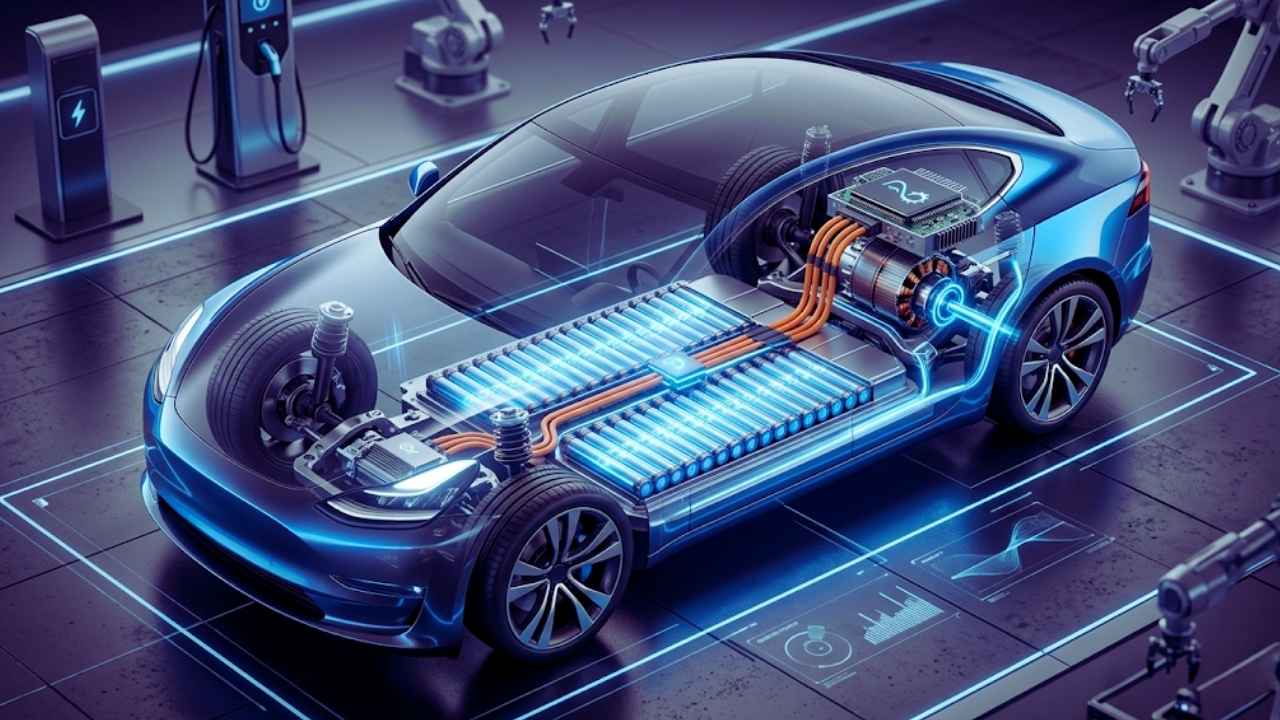
Getting behind the wheel of an electric vehicle for the first time feels a bit like stepping into the future. You press the start button, and instead of the familiar rumble of an engine sparking to life, you get complete silence. It is a completely different way of driving, and the mechanics running quietly underneath the floorboards are entirely different from the gas-powered cars we grew up with.
With electric vehicles taking over the roads globally, you might be wondering what exactly is happening under the hood. Understanding how electric cars work does not require an advanced engineering degree. Once you strip away the technical jargon, the process of turning electricity into forward momentum is incredibly elegant and surprisingly simple.
An electric vehicle runs entirely on electricity rather than relying on an internal combustion engine that burns petrol or diesel. While a traditional car needs thousands of moving parts to function, an electric car operates with incredible simplicity. It uses a large battery pack to store electrical energy and an electric motor to turn that energy into motion. This fundamental shift away from controlled gasoline explosions toward smooth magnetic energy transfer changes everything about how the car drives and how you maintain it. We will break down exactly what happens between the moment you plug your vehicle into a charger and the moment you merge onto the highway.
The Core Components of an Electric Car
At the most basic level, an electric car swaps out the gas tank for a massive battery and the combustion engine for an electric motor. But there are a few other critical pieces of hardware that act as the brains and nervous system of the vehicle. These components work together to ensure all that raw electrical power is handled safely and efficiently. You will find that an electric drivetrain has only a fraction of the parts found in a gas vehicle, which is a big reason why they are so reliable. Let us explore the major elements that make an electric car tick.
The Battery Pack: The Energetic Heart
If you look under the hood of most electric cars today, you will likely find empty storage space instead of a bulky engine. That is because the most important component—the battery pack—is usually hidden away along the very bottom of the car. Placing this heavy battery flat along the floor gives the vehicle an incredibly low center of gravity, which heavily improves handling and keeps the car planted on the road during sharp turns.
Modern vehicles use lithium-ion batteries featuring thousands of individual cylindrical or pouch cells wired together. These cells store electrical energy in the form of direct current. Beyond just holding energy, the battery pack features a complex liquid thermal management system. This setup constantly monitors temperature, voltage, and overall cell health to ensure maximum longevity. The overall capacity is measured in kilowatt-hours, determining your total driving range.
|
Battery Component |
Primary Function |
Traditional Car Equivalent |
|
Lithium-Ion Cells |
Stores raw electrical energy for the vehicle |
Gasoline Fuel |
|
Thermal Management |
Cools or heats cells to maintain optimal efficiency |
Radiator and Coolant |
|
Management System |
Balances voltage across thousands of individual cells |
Fuel Pressure Regulator |
The Electric Motor: From Electricity to Motion
While the battery stores the energy, the electric motor is what actually puts the car into motion. Instead of burning fossil fuels to push heavy metal pistons up and down, an electric motor uses the power of electromagnets. When electricity flows into the motor, it creates a very strong magnetic field. Inside the motor, there is a stationary part called the stator and a rotating part called the rotor.
The magnetic field pushes against the magnets on the rotor, causing it to spin rapidly. This spinning motion is what eventually turns the wheels of the car. Because magnets can engage instantly, the motor delivers full power the exact second you step on the pedal. There is no waiting for an engine to rev up to the right speed, making the car feel extremely responsive and fast off the line.
|
Motor Component |
Primary Function |
Efficiency Rating |
|
Stator |
Creates the stationary magnetic field using copper coils |
Highly Efficient |
|
Rotor |
Spins rapidly when pushed by the magnetic field |
Low Mechanical Wear |
|
Output Shaft |
Transfers the rotational spinning force to the gears |
Zero Lag Time |
The Power Electronics Controller
You can think of the power electronics controller, often called the inverter, as the ultimate translator between the battery and the motor. The battery pack stores direct current electricity, but the electric motor usually needs alternating current electricity to operate smoothly and efficiently. The inverter takes the direct current from the battery, converts it into alternating current, and feeds it directly to the motor. But its job does not stop there. It acts as the absolute brain of the entire drivetrain.
When you press down on the accelerator, the controller calculates exactly how much power to pull from the battery and send to the motor. It happens thousands of times per second, utilizing advanced silicon carbide switches to ensure your acceleration is perfectly smooth and perfectly controlled without any hesitation.
|
Inverter Action |
Input Requirement |
Output Result |
|
Current Conversion |
Direct Current (DC) from the main battery |
Alternating Current (AC) for the motor |
|
Throttle Response |
Digital signal from the driver pedal |
Precise voltage delivery adjustments |
|
Energy Return |
AC power generated during braking |
DC power sent back to the battery pack |
The Single Speed Drivetrain
Traditional gas cars need complex transmissions with five, six, or even ten gears. Gas engines only work efficiently within a narrow range of speeds, so the transmission constantly shifts gears to keep the engine from working too hard or stalling out. Electric motors do not have this problem at all. They can spin incredibly fast—up to twenty thousand revolutions per minute—and they remain highly efficient across that entire range.
Because of this, almost all electric cars use a single-speed transmission. Often called a reducer, this simple component just takes the high-speed spinning of the electric motor and steps it down to the appropriate speed for turning the car wheels. This lack of shifting is what makes driving an electric car feel incredibly seamless, as there are no jerky gear changes interrupting your momentum on the road.
|
Drivetrain Type |
Complexity Level |
Maintenance Required |
|
EV Single-Speed |
Extremely simple with minimal moving parts |
Very low, rare fluid checks |
|
Gas Automatic |
Highly complex with multiple clutch packs |
High, frequent fluid flushes |
|
Gas Manual |
Moderate complexity requiring driver input |
Moderate, clutch replacements |
How Do Electric Cars Move? The Step-by-Step Process
Now that we know what the individual parts do, let us look at how they work together in real time when you decide to take a drive. The entire sequence happens so fast that you never even notice the complex calculations going on behind the scenes. From the moment you unlock the door to the time you reach highway speeds, a highly choreographed dance of electrons makes the journey possible.
Starting the Vehicle
When you unlock the door and press the start button, there is no noisy ignition process. No fuel pump primes, no starter motor cranks, and no spark plugs fire. Instead, the vehicle’s computer simply runs a quick safety check. It verifies that the battery is at a safe temperature, the electrical connections are secure, and the software is ready to go. The 12-volt accessory battery actually wakes up the main high-voltage system.
Once everything checks out, a heavy-duty relay clicks into place, officially connecting the massive high-voltage battery to the rest of the car. A light or icon on the dashboard illuminates to tell you the car is ready to drive, even though the cabin remains completely silent, which often surprises first-time drivers.
|
Start Sequence |
System Action |
Driver Experience |
|
Key Proximity |
Wakes up the low-voltage computer systems |
Door unlocks automatically |
|
Button Press |
High-voltage contactors close safely |
Dashboard powers up |
|
Ready State |
Inverter stands by for throttle input |
Total cabin silence |
Pressing the Accelerator
The moment your foot presses down on the accelerator pedal, a digital signal is sent directly to the power electronics controller. The controller reads how far down you pressed the pedal and immediately demands the corresponding amount of direct current electricity from the battery pack. The controller converts that energy into alternating current and fires it into the electric motor.
The electromagnets inside the motor energize, spinning the rotor with immense force. The rotor spins the single-speed drivetrain, which instantly turns the wheels. This entire communication process happens at the speed of light, which is why an electric vehicle feels so quick off the line. There is absolutely no mechanical delay between your foot moving and the car surging forward.
|
Throttle Input |
System Response |
Physical Outcome |
|
Light Press |
Minimal voltage sent to the stator coils |
Slow, smooth forward crawling |
|
Medium Press |
Moderate current flow calculated by inverter |
Standard city traffic acceleration |
|
Full Press |
Maximum safe amperage pulled from battery |
Instant, high-torque launch |
Cruising and Power Management
As you reach your desired speed and ease off the pedal to cruise, the system instantly scales back its power delivery. The controller reduces the flow of electricity to exactly the amount needed to overcome wind resistance and road friction. At the same time, the battery management system keeps a close eye on all the individual cells inside the floorboard.
It ensures the energy drain is balanced evenly across the entire pack so no single cell overheats or wears out faster than the others. Cruising is where electric vehicles are highly efficient, especially in heavy traffic. Unlike a gas car that wastes fuel idling in traffic jams, an electric car consumes almost zero energy when stopped, drawing only enough power to run the air conditioning and the radio.
|
Driving Condition |
Energy Consumption Rate |
System Focus |
|
Highway Cruising |
Moderate to high due to wind drag |
Maintaining steady inverter output |
|
City Traffic |
Extremely low |
Frequent start-stop management |
|
Stationary Idling |
Near zero |
Running cabin climate control |
The Magic of Regenerative Braking
One of the most fascinating features of an electric vehicle is what happens when you decide to slow down. Traditional cars rely entirely on friction brakes, where brake pads squeeze against a metal disc to create friction, turning your forward momentum into wasted heat. Electric cars do something much smarter to maximize efficiency. By turning the motor into a generator, they can slow the vehicle down while actively recharging the battery at the same time.
Capturing Lost Energy
When you lift your foot off the accelerator in an electric car, the electric motor switches its role entirely. Instead of using electricity to generate motion, it uses the forward motion of the car to generate electricity. The car’s momentum keeps the wheels turning, which spins the motor mechanically. By running in reverse, the motor acts as a generator.
It creates a strong magnetic drag that slows the car down smoothly while simultaneously sending newly generated electricity back through the inverter and straight into the battery pack. This process is called regenerative braking, and it is a brilliant way to recapture kinetic energy that would otherwise be completely lost to the wind. It effectively extends your driving range every time you slow down for a traffic light.
|
Braking Action |
Energy Flow Direction |
Battery Impact |
|
Lift off pedal |
Wheels turn the motor mechanically |
Small energy boost sent to battery |
|
Rolling downhill |
Gravity spins the motor rapidly |
Sustained charging extends range |
|
Hard pedal braking |
Friction brakes engage alongside regen |
Maximum stopping power applied |
One Pedal Driving Explained
Because regenerative braking is so effective at slowing the car down, many modern electric vehicles offer a feature known as one-pedal driving. When you activate this specific software mode, lifting your foot entirely off the accelerator applies heavy regenerative braking, bringing the car to a complete stop all by itself without you touching the brake pedal.
It takes a little bit of practice to get used to, but once you master the timing, you can handle ninety percent of your daily driving just by modulating the accelerator. You still have standard hydraulic friction brakes for emergencies or sudden stops, but because they are used so rarely, the physical brake pads on an electric car can easily last years longer than those on a standard gas vehicle.
|
Pedal Position |
Vehicle Behavior |
Brake Lights Status |
|
Pressed down |
Accelerating or maintaining speed |
Off |
|
Partially lifted |
Slow deceleration |
Off |
|
Fully released |
Aggressive deceleration to a full stop |
Automatically turn on |
Charging an Electric Car: What You Need to Know
Fueling an electric car requires a mental shift for most new owners. Instead of waiting until the tank is empty and making a special trip to a gas station, you charge an electric car much like you charge your cell phone. You plug it in when it is parked, and you wake up to a completely full battery. Depending on your setup and where you are traveling, there are three main speeds, or levels, of charging available to you.
Standard Outlet Charging (Level 1 equivalent)
The most accessible way to charge an electric car is by simply plugging it into a standard 220-volt household wall socket. Because these standard domestic outlets provide a limited flow of electricity—usually maxing out around 2 to 3 kilowatts—the charging speed is extremely slow. This method typically adds about 10 to 15 kilometers of range per hour of charging.
It is perfectly fine for plug-in hybrids with small batteries or drivers who only commute very short distances each day. However, it takes days to fully recharge a large pure electric vehicle this way from empty. Most owners keep a standard charging cord in their trunk just for emergencies or when visiting rural locations without dedicated charging infrastructure.
|
Charging Setup |
Typical Power Output |
Range Added Per Hour |
|
Standard 220V Outlet |
2.3 kW to 3.0 kW |
10 to 15 kilometers |
|
Dedicated Circuit |
Requires specialized heavy-duty wiring |
Steady, safe continuous load |
|
Emergency Cord |
Built-in safety breaker |
Slow but universally accessible |
Dedicated Wallbox Charging (Level 2 equivalent)
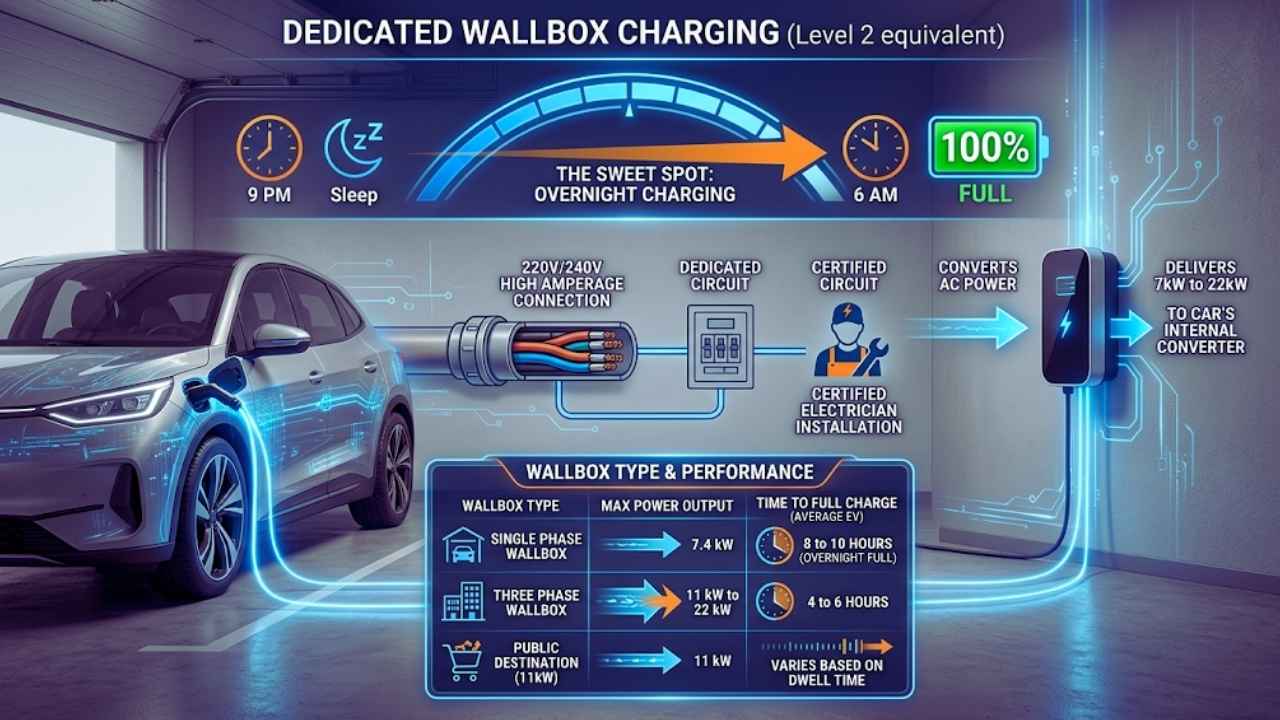
Upgrading to a dedicated home charging wallbox is the absolute sweet spot for everyday electric vehicle owners. This requires a higher amperage 220-volt or 240-volt connection, similar to the industrial circuits used for heavy air conditioning units. Many owners hire a certified electrician to install a dedicated charging box directly in their garage or parking area.
Depending on the charger hardware and the car’s internal converter, this setup delivers anywhere from 7 to 22 kilowatts of power. This means you can plug the car in after a long day of driving, go to sleep, and confidently start the next morning with a one hundred percent full battery. You will also find these chargers at grocery stores and hotels.
|
Wallbox Type |
Typical Power Output |
Time to Full Charge (Average EV) |
|
Single Phase Wallbox |
7.4 kW |
8 to 10 hours overnight |
|
Three Phase Wallbox |
11 kW to 22 kW |
4 to 6 hours |
|
Public Destination |
11 kW |
Varies based on dwell time |
DC Fast Charging
When you are taking a long highway road trip and need to recharge as quickly as possible, you use DC Fast Charging. These massive commercial-grade stations bypass the car’s internal inverter entirely and pump high-voltage direct current directly into the battery pack. Fast chargers can operate at incredibly high power levels, sometimes pushing up to 350 kilowatts into the vehicle.
Under ideal temperature conditions, a modern fast charger can take a car’s battery from ten percent to eighty percent in just twenty to thirty minutes. You typically only use these high-speed stations during long journeys, as frequent daily fast charging can generate a lot of internal heat and slowly degrade the battery lifespan over many years of ownership.
|
Charger Capability |
Architectural Voltage |
10% to 80% Charge Time |
|
Standard DC Fast |
400V Systems (50-150 kW) |
40 to 60 minutes |
|
Ultra-Fast DC |
800V Systems (250-350 kW) |
18 to 25 minutes |
|
Thermal Requirement |
Liquid cooled cables |
Battery must be pre-conditioned |
Different Types of Electric Vehicles
The term “electric vehicle” is actually an umbrella that covers a few different types of technology on the market today. Understanding the mechanical differences is crucial if you are considering buying one. Not everyone is ready to go fully electric, and automakers have designed several middle-ground options to help bridge the gap. Here is exactly how the different variations stack up.
Battery Electric Vehicles (BEVs)
These are the pure electric cars we have been discussing throughout this explainer. They have no gas tank, no exhaust pipe, and absolutely no internal combustion engine. They rely one hundred percent on the electricity stored in their massive under-floor battery packs. Popular examples include vehicles from leading dedicated EV brands and the new pure electric models from traditional legacy automakers.
Because they lack a heavy engine block, designers often push the wheels to the extreme corners of the chassis, maximizing interior cabin space. They offer the longest electric driving range and deliver the absolute highest environmental benefits by producing zero emissions.
|
Powertrain Feature |
Power Source |
Tailpipe Emissions |
|
Pure Electric Motor |
100% Battery Pack |
Zero |
|
Skateboard Chassis |
Under-floor battery |
None |
|
Front Trunk (Frunk) |
Replaces engine bay |
N/A |
Plug-in Hybrid Electric Vehicles (PHEVs)
Plug-in hybrids bridge the technology gap between traditional cars and pure electrics. They feature both an electric motor with a medium-sized battery and a traditional gasoline engine under the hood. You can plug them into a wall charger, and they will typically drive 40 to 80 kilometers purely on electricity without burning a drop of fuel.
Once that battery runs out, the gas engine kicks in automatically, allowing you to continue driving indefinitely as long as you put gas in the tank. They are excellent for people who commute short distances daily in city traffic but occasionally take long cross-country road trips to rural areas without charging infrastructure.
|
Driving Mode |
Primary Power Source |
Range Limitation |
|
EV Mode |
Medium Battery Pack |
40 to 80 kilometers |
|
Hybrid Mode |
Gas Engine + Battery Assist |
Limited by gas tank size |
|
Transition |
Seamless computer control |
Infinite with refueling |
Hybrid Electric Vehicles (HEVs)
Standard hybrids have both a gas engine and a small electric motor, but you cannot plug them into the wall at all. The battery is extremely small, usually just one or two kilowatt-hours in size. It charges itself solely by capturing kinetic energy through regenerative braking and from the gas engine running as a generator.
The electric motor simply assists the gas engine to improve overall fuel economy, especially during stop-and-go city driving. Because they still rely entirely on gasoline for energy and cannot function without fuel, they are generally not considered true electric vehicles in the modern plug-in sense.
|
Powertrain Setup |
Plug-In Capable? |
Primary Benefit |
|
Engine + Small Motor |
No |
Better fuel economy |
|
Closed-Loop Battery |
No |
Captures braking energy |
|
Gas Dependence |
Yes |
Familiar fueling routine |
Why Choose an Electric Car? The Main Benefits
Drivers are switching away from gasoline in record numbers, and the reasons go far beyond just buying into a new tech trend. The architecture of electric vehicles offers huge, measurable advantages over older technology. Consumers are finally realizing the practical everyday benefits of ditching the gas pump and adopting electric drivetrains. Let us look at why so many people are making the jump to battery power.
Environmental Impact and Zero Emissions
The most universally recognized benefit is the positive impact on local air quality and public health. Pure electric vehicles produce absolutely zero tailpipe emissions. There is no smog, no carbon monoxide, and no greenhouse gases emitted into neighborhoods while driving.
Even when you account for the electricity needed to charge them—which is increasingly coming from renewable sources like wind and solar—electric cars are vastly cleaner over their lifespan than gas vehicles. Furthermore, they drastically reduce noise pollution in crowded urban areas, creating quieter, more peaceful city streets for pedestrians and residents alike.
|
Emission Type |
EV Production Output |
Gas Vehicle Output |
|
Tailpipe Smog |
Zero |
High localized pollution |
|
Noise Pollution |
Near silent at low speeds |
Constant engine rumble |
|
Lifecycle Carbon |
Lower after 2-3 years |
Continually increasing |
Lower Maintenance and Running Costs
Without a combustion engine, an electric car completely eliminates the need for routine oil changes, spark plug replacements, new timing belts, or transmission fluid flushes. The electric motor has only a handful of moving parts, compared to the thousands of tiny components vibrating inside a gas engine.
While the tires and windshield wipers still need replacing, the overall cost of maintaining an electric car is incredibly low over a ten-year period. Additionally, charging at home overnight on residential electricity rates is significantly cheaper per kilometer than buying liquid gasoline, keeping more money in your wallet month after month. This makes them a very savvy financial choice.
|
Maintenance Item |
EV Requirement |
Gas Car Requirement |
|
Engine Oil |
Never |
Every 5,000 to 10,000 kilometers |
|
Brake Pads |
Lasts over 100,000 kilometers |
Frequent replacement |
|
Transmission Fluid |
Rare or never |
Scheduled flushing needed |
Instant Torque and Smooth Performance
From a purely driving perspective, electric cars are incredibly fun and relaxing to pilot. The immediate delivery of torque from the electric motor means the car accelerates fast and effortlessly without any lag. Pushing the pedal feels like riding a perfectly smooth, silent rollercoaster.
The lack of harsh engine noise and the total absence of a vibrating mechanical transmission make the cabin peacefully quiet. This dramatic reduction in vibration creates a highly refined daily driving experience that leaves drivers feeling less fatigued after long commutes or stressful traffic jams.
|
Driving Characteristic |
EV Experience |
Traditional Car Experience |
|
Acceleration |
Instant, linear pull |
Revving delay, gear hunting |
|
Cabin Noise |
Wind and tire noise only |
Engine drone, exhaust sounds |
|
Vibration |
Buttery smooth |
Constant mechanical shudder |
The Future of Electric Vehicle Technology
The technology inside electric cars is advancing at a breathtaking pace globally. What we drive today is only the beginning of a massive shift in global transportation logistics. Billions of dollars are being poured into research and development by tech giants to make batteries charge faster, last longer, and cost less to manufacture. By the end of the decade, the landscape of driving will look entirely different.
Solid State Batteries
The next major breakthrough on the engineering horizon is solid-state battery technology. Current lithium-ion batteries use highly flammable liquid electrolytes to move energy back and forth inside the individual cells. Solid-state batteries replace that liquid with a dense solid material.
This chemical change will make batteries much lighter, significantly more energy-dense, and highly resistant to overheating or catching fire. When these batteries hit the mass market, cars will be able to travel much farther on a single charge and recharge entirely in a matter of just a few minutes, mimicking the speed of a gas station visit.
|
Battery Metric |
Current Lithium-Ion |
Future Solid-State |
|
Electrolyte State |
Liquid or gel |
Solid ceramic or polymer |
|
Energy Density |
Moderate |
Extremely high |
|
Safety Profile |
Requires heavy cooling |
Inherently fire resistant |
Smarter Grid Integration
As millions of electric vehicles hit the roads, they are going to become highly active participants in the electrical grid. A technology known as vehicle-to-grid integration will allow cars to give electricity back to the house or the neighborhood during peak demand hours.
Imagine your car powering your home appliances during a massive grid blackout, or automatically selling unused energy back to the power company while you sleep. The electric car of the future will not just be a way to get around town—it will be a mobile power plant helping to stabilize the entire regional energy network.
|
Grid Integration Type |
Energy Flow Path |
Primary Use Case |
|
Vehicle-to-Load (V2L) |
Car to appliance |
Powering laptops or camping gear |
|
Vehicle-to-Home (V2H) |
Car to house panel |
Backup power during grid blackouts |
|
Vehicle-to-Grid (V2G) |
Car to public grid |
Selling energy during peak hours |
Final Thoughts
Understanding exactly how electric cars work is the first crucial step toward embracing the clean future of transportation. By replacing thousands of vibrating, grinding mechanical parts with a simple, intelligent battery pack and an electric motor, these vehicles offer a cleaner, faster, and vastly more reliable way to travel.
From the instant, silent acceleration to the engineering magic of regenerative braking, the benefits of EV ownership are impossible to ignore. As battery technology gets better and dedicated charging stations pop up in every neighborhood, driving on electricity will only get easier and more accessible for everyone.
Frequently Asked Questions (FAQs) About How Electric Cars Work
Do electric cars have a reverse gear?
No, electric vehicles do not have a traditional reverse gear. Because electric motors can spin safely in both directions, the car simply reverses the flow of electricity to spin the motor backward when you want to back up. This removes the need for a complex reverse gear mechanism.
What happens if an EV runs completely out of battery?
Just like a gas car running out of fuel, the car will safely pull over and stop. However, you cannot walk to a station to get a can of electricity. You will need to call a tow truck to bring the vehicle to the nearest charging station. The car gives you dozens of loud warnings long before this ever happens.
Do electric cars use electricity when stuck in traffic?
They use very little energy when stopped. Unlike gas engines that must constantly burn fuel to stay running, an electric motor completely stops spinning when the car stops. The only energy consumed in a traffic jam goes toward running the air conditioning, screens, and radio.
Do electric car batteries lose their range over time?
Just like your cell phone, car batteries do degrade slightly over many years. However, modern thermal management systems protect the cells very well. Most data shows that EVs only lose about ten percent of their original range after a decade of driving. Automakers usually offer long warranties on the battery pack just to be safe.
Can an electric car tow heavy loads like a truck?
Yes, electric motors produce massive amounts of low-end torque, making them excellent for towing heavy trailers. Models from leading truck manufacturers can tow massive loads. The only downside is that towing a heavy load pushes wind resistance up, significantly reducing the driving range.