

Remember when college career counselors hammered the “one-page only” rule into our heads? They told us to shrink our margins, drop the font size to microscopic levels, and cut half our experience just to make it fit. Forget all of that. The strict one-page rule is officially dead for experienced professionals.
If you are updating your professional profile right now, you are probably asking yourself exactly how long a resume should be. The honest answer? It depends entirely on the ground you have covered. Today’s hiring managers do not read stacks of paper. They scroll through digital files on wide monitors and iPhones. They rely on applicant tracking systems that actually prefer more text, not less. Trying to squeeze a ten-year career onto a single sheet of paper strips away the exact context that proves your worth.
You lose the hard numbers, the impact, and the narrative. That said, you do not have a blank check to write a novel. You need to know when to push to page two, when to hold the line at page one, and how to format it so people actually want to read it. Let’s look at the hard, real-time data for 2026.
The Truth About How Long Should Resume Be in 2026?
I still talk to people who panic at the thought of a two-page document. They think a recruiter will toss it in the trash instantly. That mindset is completely outdated. Look at the raw data from recent hiring studies. The average length of a successful job application has naturally grown because screen reading changed everything. We no longer print these documents, which means white space is your absolute best friend. If you cram 600 words onto a single page, it looks like a solid wall of text, and a recruiter will immediately skip it. However, if you spread those same 600 words across two pages with nice, breezy formatting, suddenly it is highly readable and engaging.
Data shows that nearly 90 percent of job applicants now submit either a one-page or two-page document, but the breakdown is revealing. While many still stick to a single page, the average one-page document contains about 287 words. Meanwhile, two-page documents average around 506 words. These numbers tell us that hiring managers expect conciseness, but they also want enough substance to evaluate your actual skills.
So when we ask how long a resume should be, the baseline is simple: you want a word count between 475 and 600 words because this specific range scores an impressive 8.2 percent interview rate. Missing that sweet spot puts you at a huge disadvantage.
|
Application Metric |
The 2026 Reality |
What It Means For You |
|
Most Common Format |
1 to 2 pages |
Two pages is standard for experienced pros. |
|
Average Word Count (1 Page) |
287 words |
Keep descriptions punchy and direct. |
|
Average Word Count (2 Pages) |
506 words |
Use the space for deep context and metrics. |
|
The “Sweet Spot” |
475 to 600 words |
Hits an 8.2% interview rate for top candidates. |
|
Reading Method |
Screen scrolling |
White space matters way more than page limits. |
Resume Length Based on Your Experience Level
The absolute best way to figure out the exact page count you need is to look directly at your work history. The longer you work, the more you have to say. It really is that simple. If you just graduated or only have a couple of years under your belt, stick to one page. You simply do not have enough professional history to justify a second page. When juniors submit two pages, they usually fill the space with high school awards, weak college projects, or basic hobbies that no one cares about.
Keep it tight and highlight your degree, hard skills, and internships. But if you have four to ten years of experience, the shift happens. Here, go with two pages. You have held multiple titles, managed projects, hit sales goals, or launched products. You need space to detail your impact. A two-page spread gives you room to breathe without looking desperate to fill space.
When you cross the decade mark, you have a serious track record, and two pages is fully expected. You might even stretch to three if you have a massive list of board seats or patents. But honestly, keep it to two if you can. Summarize anything older than 15 years into a short previous history section without any bullet points.
|
Experience Level |
Recommended Length |
Core Focus |
|
Entry (0 to 3 years) |
1 page |
Education, hard skills, and solid internships |
|
Mid-Level (4 to 10 years) |
1.5 to 2 pages |
Hard metrics, project leadership, and promotions |
|
Senior (10 to 15 years) |
2 pages |
Strategic impact, revenue generation, team building |
|
Executive (15+ years) |
2 to 3 pages |
Executive summaries, board seats, acquisitions |
What Recruiters Actually Want to See on the Page?
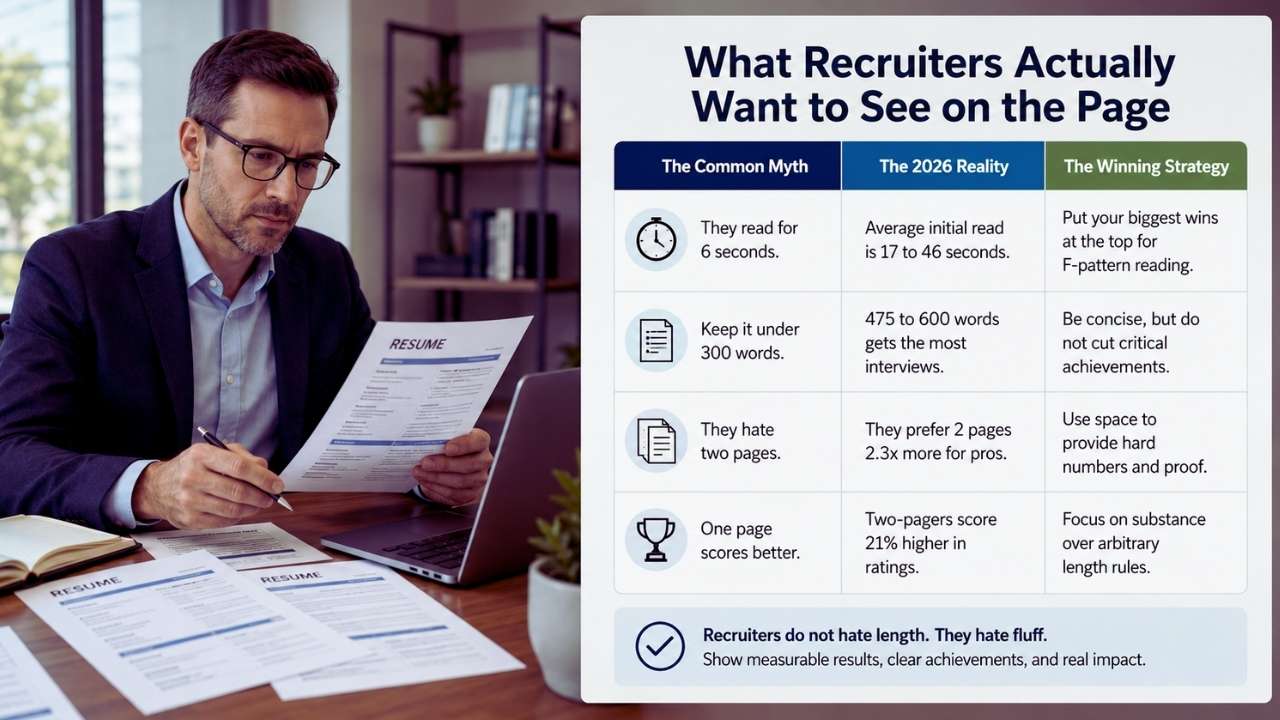
You hear it all the time: recruiters only spend six seconds looking at your application. It is a complete myth. That stat comes from an old, flawed eye-tracking study. Independent tracking proves that real recruiters actually spend between 17 and 46 seconds on a first pass, and if they like what they see, they dig in. In fact, a massive study of over 7,700 simulated hiring processes showed that hiring managers spent an average of 4 minutes and 5 seconds reading two-page documents, compared to just 2 minutes and 24 seconds on single pages.
They do not hate long documents; they hate fluff. That same study revealed recruiters are 2.3 times more likely to prefer a two-pager for candidates with experience. Even for entry-level folks, they slightly favored the extra space because it allowed for better formatting. Two-page documents actually scored 21 percent higher in recruiter ratings, pulling an 8.6 out of 10 compared to a 7.1 for the shorter versions.
Recruiters want proof. They do not want a generic list of daily chores. They want to see the numbers. They want to know you increased traffic by 40 percent, cut costs by twenty grand, or managed a team of twelve. You need space to tell that story correctly.
|
The Common Myth |
The 2026 Reality |
The Winning Strategy |
|
“They read for 6 seconds.” |
Average initial read is 17 to 46 seconds. |
Put your biggest wins at the top for F-pattern reading. |
|
“Keep it under 300 words.” |
475 to 600 words gets the most interviews. |
Be concise, but do not cut critical achievements. |
|
“They hate two pages.” |
They prefer 2 pages 2.3x more for pros. |
Use space to provide hard numbers and proof. |
|
“One page scores better.” |
Two-pagers score 21% higher in ratings. |
Focus on substance over arbitrary length rules. |
How Applicant Tracking Systems View Your File?
You have to write for two very different audiences: the human hiring manager, and the applicant tracking system. When deciding how long should resume be, remember that the software loves text. These systems scan your document for keywords, skills, and job titles to see if you match the job description. A one-page file naturally holds fewer keywords than a two-page file.
Expanding to two pages allows you to weave in more industry-specific terms without sounding like a keyword-stuffed robot. If the software wants to see agile development, Python, and cross-functional leadership, you have the room to place those terms naturally into your bullet points. But layout is incredibly critical. Do not get cute with your formatting. While surveys show over 90 percent of job seekers prefer double-column formats because they look modern, ATS platforms absolutely hate them. Older systems read straight across from left to right.
If you use columns, the system scrambles your text into gibberish, and you get automatically rejected. Stick to a clean, single-column design. You should also ensure you are not padding your word count with nonsense. About 36 percent of applications lack measurable metrics, which ruins your overall score. Give the software data, clean headers, and plenty of exact keyword matches.
|
Formatting Choice |
Human Impact |
ATS Impact |
Verdict |
|
Standard 2-Page Text |
Easy and pleasant to read |
Parses perfectly with high keyword density |
Highly Recommended |
|
Double-Column Layout |
Looks modern and space-saving |
Scrambles text completely left-to-right |
Avoid for online portals |
|
Icons and Graphics |
Visually catchy |
Cannot read them at all |
Avoid completely |
|
Standard Section Headers |
Easy to navigate quickly |
Maps data correctly to the right fields |
Mandatory |
Industry Rules That Change the Game
Your industry dictates the rules just as much as your experience. What works for a software engineer will get a marketing director laughed right out of the room. Always play to your specific crowd. If you work in corporate business and finance, stick to the standard one and a half to two pages. Focus heavily on quantifiable metrics, return on investment, and team leadership. They want to see the bottom line. For tech and IT, two pages is the absolute gold standard.
You need a massive technical skills section at the top, plus space to explain the scope of your projects, the tech stack you used, and links to your code repository. However, if you are in a creative field like graphic design or copywriting, keep it incredibly brief. One page is usually best. Your document is just the introduction; your digital portfolio does the heavy lifting. Make sure your typography is flawless.
Academia, sciences, and medicine throw the rulebook completely out the window. You are writing a CV, and there is no page limit. A six-page document listing every publication, grant, and teaching gig is completely normal. Finally, federal government applications demand extreme detail, often running four to six pages to cover compliance and exact hours worked.
|
Industry Sector |
Expected Length |
Core Focus Areas |
|
Business and Sales |
1 to 2 pages |
Revenue, growth metrics, and team size |
|
Tech and Engineering |
2 pages |
Tech stack, project scope, and repository links |
|
Creative and Design |
1 page |
Typography, brevity, and digital portfolio links |
|
Academia and Medical |
Unlimited (CV) |
Publications, grants, speaking gigs, and research |
|
Federal Government |
4 to 6 pages |
Compliance, granular tasks, and exact hours worked |
What to Cut When You Have Too Much Fluff?
Just because you can use two pages does not mean you should fill them with garbage. Every single word must earn its keep. If you are struggling to figure out how long should resume be because you have too much text, start by ruthlessly cutting the filler. First, delete the objective statement. Nobody cares what you want out of a job; they care what you can do for them. Replace it with a sharp three-line professional summary that highlights your biggest wins.
Next, delete the phrase “references available upon request.” We know you have references, and they will ask for them if needed. Drop it and reclaim the space. You also need to kill off any high school achievements or irrelevant college jobs. If you have a degree and a real job, nobody cares that you poured coffee five years ago. Furthermore, stop listing your daily chores using “responsible for” bullet points.
Start listing your achievements. Do not say you managed social media; say you grew the following by 140 percent. Finally, cap your bullet points at three to five per role. If you have ten bullets under a single job, nobody is reading the bottom five. Pick your absolute best stats and cut the rest.
|
Delete This Item |
Replace It With |
Why It Matters |
|
Objective Statement |
Professional Summary |
Show your value; do not ask for favors. |
|
10+ bullets per job |
3 to 5 strong bullets |
Readers skim quickly. Keep only the heavy hitters. |
|
“Microsoft Word” |
Hard technical skills |
Basic computer literacy is completely assumed today. |
|
Jobs from 15 years ago |
A “Previous Experience” list |
Ancient tasks do not reflect modern skills at all. |
|
“References Available” |
Nothing |
It goes without saying and wastes a line of text. |
Final Thoughts
The job market is fierce, and getting past the initial screen takes strategy. Stop looking for a universal, one-size-fits-all rule. Look at your own career path. If you just walked out of college, own that single page. If you have been driving results for five years, take up space and confidently build a two-pager.
Do not obsess over the exact page count. Obsess over the value of your words. Every bullet point should prove you can solve problems, make money, or save time. Cut the fluff, kill the objective statement, format it for the software, and make it easy on human eyes. Do that, and you will nail exactly how long should resume be every single time.
Frequently Asked Questions (FAQs) About How Long Should Resume be
Is a 1.5-page layout okay?
Yes, but it looks a bit messy. If you land right at a page and a half, try to edit it down to a crisp single page, or expand your metrics slightly to fill out the second page. A document that ends abruptly halfway down page two just looks like you ran out of ideas.
How does ATS determine if my file is too long?
It doesn’t. The software doesn’t care about page count. It cares about keyword density and formatting. But if you pad your file with three pages of fluff, you dilute your keyword density, which lowers your overall match score.
Do I still need a digital profile?
100%. Your PDF is just step one. Recruiters will instantly look up your LinkedIn, personal site, or GitHub. Make sure your digital timeline matches your PDF exactly. If the dates don’t line up, they will assume you are lying and move on.
Does my home address matter if the job is remote?
Don’t put your full street address, but absolutely include your city and state. Even remote companies have tax laws and compliance rules based on where you live. If you leave it off, the ATS might auto-reject you based on location filters.