


You hit a wall. You have more client requests than hours in the day, your calendar is a wreck, and turning down good money actually hurts. This is the exact moment most independent workers decide it is time to make the jump from freelancer to agency. But growing beyond a party of one requires much more than simply hiring a few contractors and updating your title to founder.
You have to completely tear down how you currently price, manage, and deliver your work. If you execute this poorly, the transition will break your spirit and your bank account. If you build the correct systems, it becomes incredibly lucrative and freeing. In 2026, the current market actively rewards highly specialized, lean operations over massive, slow-moving corporations.
The era of the bloated, generalist firm is dead and buried. Today, a lean studio of five focused experts easily out-earns a messy team of fifty people. Let us break down exactly how to pull off this growth successfully. We will look at hard market numbers and actionable steps to help you build a profitable machine that generates cash whether you are sitting at your desk or taking a month off.
The Financial Reality of the Freelancer to Agency Transition
As a solo worker, your time strictly caps your income. You only get twenty-four hours in a single day, and no matter how much you raise your rates, you eventually max out your physical capacity. An agency model breaks that physical link completely. You stop selling your personal hours and start selling a team’s collective output. Before you hire anyone, you must look closely at the financial numbers driving the industry right now.
The average digital agency earned a thirteen percent after-tax net margin last year. But smaller boutique studios with under ten full-time employees are crushing the market with an average nineteen percent net margin. They achieve this because they keep overhead extremely low. They rely on highly specialized skills and operate without the heavy financial drag of corporate middle management.
As agencies scale past fifty employees, fixed costs like software bloat, unused office space, and human resources departments eat into their margins. Your goal is not just to get big. Your goal is to get profitable. Knowing these baseline numbers protects you from making fatal financial errors early on.
|
Financial Metric |
2026 Industry Standard |
What This Means for Your Growth |
|
Boutique Studio Margin |
19 Percent |
Stay small and lean. It drastically lowers your financial risk. |
|
Average Net Margin |
13 Percent |
A solid, realistic target once you survive the initial scaling phase. |
|
Large Agency Margin |
8 Percent |
Hiring too fast destroys your profitability through overhead drag. |
|
Revenue Per Employee |
$172,000 |
Use this number to measure if your new hires are actually profitable. |
1: Validate Demand and Narrow Your Niche
You absolutely cannot scale a messy, generalist freelance business. If you do everything for everyone, hiring a team becomes a logistical nightmare because every single project requires a brand new custom workflow. Moving from freelancer to agency requires you to aggressively narrow your focus. Agencies that reduce their services to a core specialty grow much faster and lock in higher profits.
You need to productize your services immediately. Stop pitching broad concepts like general marketing. Shift your messaging to specific solutions, like building conversion-optimized landing pages for healthcare software startups. This specific clarity kills decision fatigue for your incoming clients. It also makes it incredibly easy to train your new hires. Every service line must earn its keep financially.
If a service confuses buyers or slows down your production team, you need to cut it out of your roster immediately. You have to set strict, unmoving boundaries on exactly what you deliver, how long the project takes, and what it costs the client.
|
Niche Validation Action |
How to Execute It Today |
Expected Business Outcome |
|
Audit Past Projects |
Review your last year of work and calculate the exact profit on each. |
Find your most profitable and enjoyable client deliverables. |
|
Define the Audience |
Pick one specific industry to target exclusively. |
Position your new agency as the absolute go-to expert. |
|
Productize Services |
Package your daily work into fixed-price, rigid tiers. |
Stop wasting your valuable hours writing custom proposals. |
|
Cut the Fat |
Eliminate low-margin, high-friction services entirely. |
Simplify your hiring, speed up delivery, and protect margins. |
2: Establish Agency-Level Pricing Systems
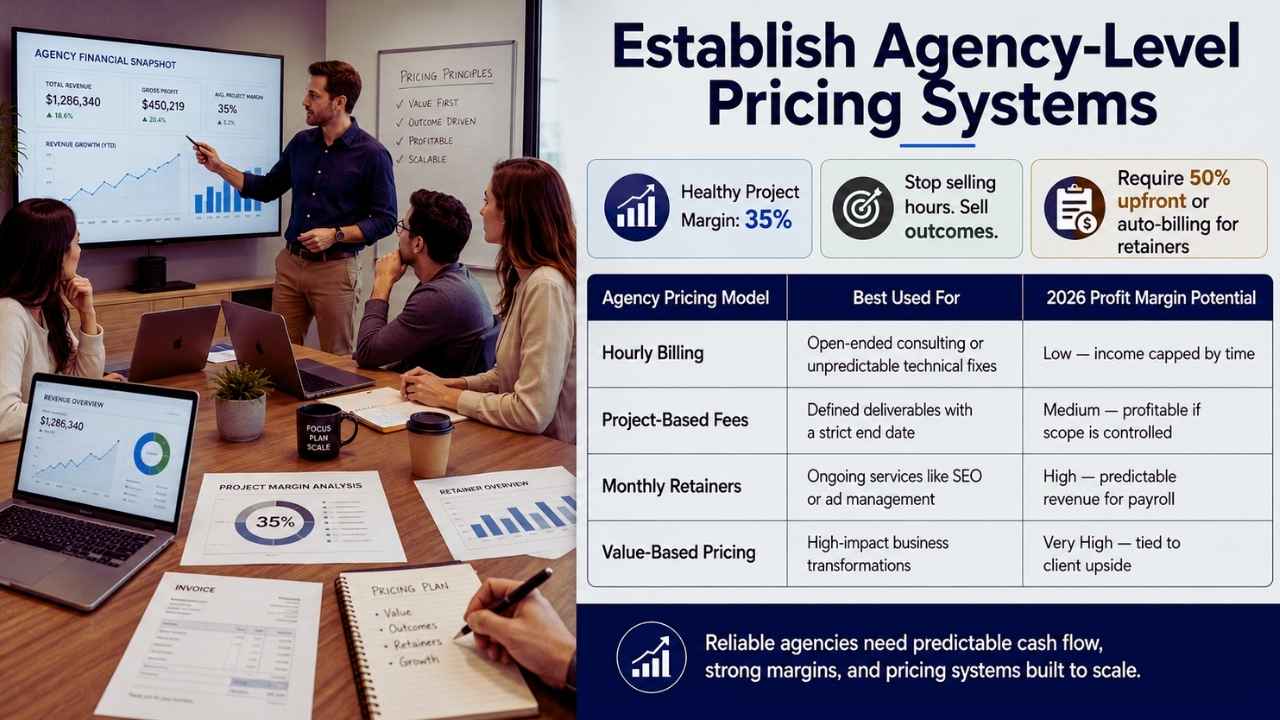
You cannot fund a reliable payroll on old freelance rates. A successful transition means you sell the value of the outcome, not the raw hours spent typing on a keyboard. Agencies operate with completely different economics than solo workers. Net margin measures what is actually left in your bank account after you pay for sales, marketing, software, insurance, and taxes.
Right now, the average healthy project margin sits around thirty-five percent. Drop your hourly billing habits as fast as you can. If you charge seventy-five dollars an hour, your earning potential ends the second you go to sleep. Instead, package your deep expertise into monthly retainers or high-value project fees. Value-based pricing firms consistently hit eighteen percent net margins, while hourly billers stay stuck fighting for scraps.
You also have to ruthlessly control your cash flow. More than half of small businesses suffer from late client invoices, which will destroy an agency that needs to meet a Friday payroll. Demand fifty percent upfront on projects, or require mandatory auto-billing for all monthly retainers.
|
Agency Pricing Model |
Best Used For |
2026 Profit Margin Potential |
|
Hourly Billing |
Open-ended consulting or unpredictable technical fixes. |
Low. Caps your earning potential strictly to the literal clock. |
|
Project-Based Fees |
Defined client deliverables with a strict end date. |
Medium. Profitable only if you ruthlessly manage scope creep. |
|
Monthly Retainers |
Ongoing services like search optimization or ad management. |
High. Creates predictable revenue to safely cover your payroll. |
|
Value-Based Pricing |
High-impact, highly visible business transformations. |
Very High. Ties your fee directly to the client’s financial upside. |
3: Build an Efficient, Scalable Team
When you work alone, you wear every single hat in the business. Moving from maker to manager is the hardest mental hurdle you will face. I learned my first vital lessons in focus and resilience years ago just by watching Sachin Tendulkar at the crease. He possessed absolute tunnel vision and a total refusal to break under pressure. You need that exact same resilient energy when you step back from the daily grind and start leading a team of different personalities.
Start small and subcontract your overflow work to one trusted freelancer before you commit to scary full-time hires. Relying on specialized virtual assistant agencies at first keeps your financial overhead incredibly low. Top-rated staffing agencies boast fantastic client retention rates, and using a firm ensures you are not left scrambling if a single contractor suddenly quits.
Bring in fractional specialists for the specific tasks that drain your creative energy. Keep a close eye on your team’s efficiency numbers. Your creatives and developers should ideally spend seventy-two percent of their working hours on direct, billable client work.
|
Strategic Hire Type |
When to Bring Them On Board |
Why You Need Them Right Now |
|
Freelance Specialists |
Immediately to handle unpredictable project overflow. |
Handles excess work without adding scary fixed payroll costs. |
|
Project Manager |
The minute you hit five active, ongoing client accounts. |
Keeps active projects strictly on track and prevents bottlenecks. |
|
Account Manager |
When you cross twenty thousand in monthly revenue. |
Takes over daily client emails, relationships, and upselling. |
|
Junior Producers |
When your net margins consistently stay above fifteen percent. |
Executes repetitive daily tasks under your documented rules. |
4: Implement Systems to Protect Margins
If you keep everything in your head as a solo worker, you will probably do fine. If you try that with a growing team, your agency will burn to the ground in under a month. Rigid systems separate a real business from a chaotic group project. You must document your processes so quality never depends entirely on you personally touching every final deliverable.
When you build standard operating procedures, you have to get incredibly granular. If you run a content operation, for example, your systems must explicitly dictate the keyword optimization process, the exact content categorization rules, and the precise layout structures of extensive articles. You cannot expect a new writer to simply guess how you want things formatted. You have to hand them the exact blueprint.
Unmanaged scope creep destroys new agencies by inflating delivery costs and ruining your team’s utilization rate. When a client asks for just one more quick change, it wrecks your profitability unless you enforce a formal change-order system. Track your team’s time carefully so you know how long tasks actually take.
Read Also: How to Transition from Military to Civilian Careers?
|
System Category |
Suggested 2026 Tech Tools |
Impact on the Growing Agency |
|
Project Management |
Asana, ClickUp, or standard Notion boards. |
Keeps every task visible, assigned, and entirely deadline-driven. |
|
Time Tracking |
Toggl, Harvest, or Everhour tracking software. |
Measures true profitability against your baseline margin goals. |
|
Workflow Automation |
Zapier or Make connection platforms. |
Automates manual data entry to reduce errors and save hours. |
|
Scope Management |
Formal, mandatory Change Order documents. |
Prevents free work and actively protects your bottom-line cash. |
5: Master Client Acquisition at the Agency Level
The initial hustle that got you freelance gigs will not sustain a consistent agency payroll. You need a dedicated channel that predictably generates fresh leads every single month. Word-of-mouth simply is not enough anymore. You have to build a brand that strongly positions your firm as an undeniable authority in your specific niche. Highly specialized design and marketing agencies currently enjoy the highest average net margins because they sell highly visible, specific business outcomes.
Ditch the traditional resume format and build a proof-of-work portfolio. Highlight the exact business problems you solve, showing the detailed strategy and the hard return on investment numbers. You must also proactively nurture your current client relationships. Offer highly personalized service and run mandatory quarterly strategic reviews.
It is infinitely cheaper to upsell an existing happy client on a brand new retainer than to hunt for a completely new contract from scratch. Securing larger, long-term engagements directly boosts your project margins and provides the cash flow stability you need to grow confidently.
|
Client Acquisition Channel |
Core Strategy for 2026 |
Expected Business Results |
|
Proof-of-Work Portfolios |
Show the deep strategy and ROI, not just pretty pictures. |
Higher conversions with clients seeking specific financial outcomes. |
|
LinkedIn Authority |
Share documented case studies and raw industry data constantly. |
Builds deep trust and passively attracts high-ticket inbound leads. |
|
Client Upselling |
Hold mandatory quarterly strategic reviews with existing clients. |
Increases lifetime value and secures much larger engagements. |
|
Strategic Partnerships |
Partner with non-competing peer agencies for mutual referrals. |
A steady stream of warm, pre-qualified leads with zero ad spend. |
The Biggest Challenges When You Scale
The hardest part of scaling your operation is purely psychological. You have to literally force yourself to stop doing the physical work. If you constantly bottleneck every single design approval or blog post edit, you will never grow. Scaling means accepting the hard truth that eighty percent perfect and successfully shipped beats one hundred percent perfect and stuck on your desk indefinitely.
You must focus on the final output quality, not the exact method your team uses to get there. You also have to watch your cash flow like a hawk. Freelancers get paid when the job is done, but agencies have to make payroll every two weeks regardless of whether a slow client paid their invoice.
You need to set up a dedicated business bank account, keep at least three months of cash reserves, and enforce strict payment terms. Finally, do not hire full-time staff too fast. Over-hiring during one single good month is the fastest way to bankrupt yourself during the inevitable slow month. Scale your hiring gradually.
|
Common Scaling Pitfall |
Why It Happens to Founders |
How to Fix It Today |
|
The Founder Bottleneck |
You completely refuse to let go of creative control. |
Set clear operating procedures and trust your team to execute them. |
|
Cash Flow Crunches |
You pay your staff before clients actually pay your invoices. |
Demand upfront deposits or switch entirely to recurring retainers. |
|
Over-Hiring Staff |
You assume a temporary revenue spike is a permanent baseline. |
Use specialized contractors until your monthly revenue truly stabilizes. |
|
Sneaky Scope Creep |
You maintain very weak boundaries with your older legacy clients. |
Enforce rigid change-order policies for absolutely any extra work. |
Final Thoughts
Scaling a business is rarely a comfortable process, but it remains the only proven way to permanently break out of the time-for-money trap. The rigorous journey from freelancer to agency completely forces you to fire yourself from the exhaustive daily grind. You have to step firmly and confidently into the role of a true leader.
You must radically shift your daily focus toward high-level sales, strict quality control, and building sustainable, long-term client relationships. Lean hard into your specialized niche and never apologize for your pricing. Protect your profit margins by watching out for sneaky scope creep like a hawk. Build incredibly robust systems that allow your talented team to operate flawlessly without you constantly looking over their shoulders.
The market demand for lean, highly efficient, and specialized agencies is absolutely massive right now. Grab the right tools, set incredibly strict boundaries with your clients, and start building an actual asset that works for you every single day.
Frequently Asked Questions (FAQs) About Freelancer to Agency
Is scaling to an agency mandatory?
Not at all. Scaling from freelancer to agency means shifting from selling hours to selling outcomes. It’s a deliberate choice. Plenty of freelancers prefer the simplicity of high-rate solo work over the stress of managing people.
Do I need to rent an office?
Absolutely not. Most profitable new agencies are fully remote. Keep your overhead low to protect that 19% boutique margin.
What do I do with old, low-paying freelance clients?
Give them a 60-day notice of a rate increase. You will lose some of them. That is completely fine. You need to make room for higher-paying agency clients to cover your new management overhead.
Should I change my brand name?
Yes. Rebranding shifts the client’s expectation. They stop hiring an individual and start hiring a robust company. It makes team handoffs way smoother because the client stops expecting you to do everything yourself.