
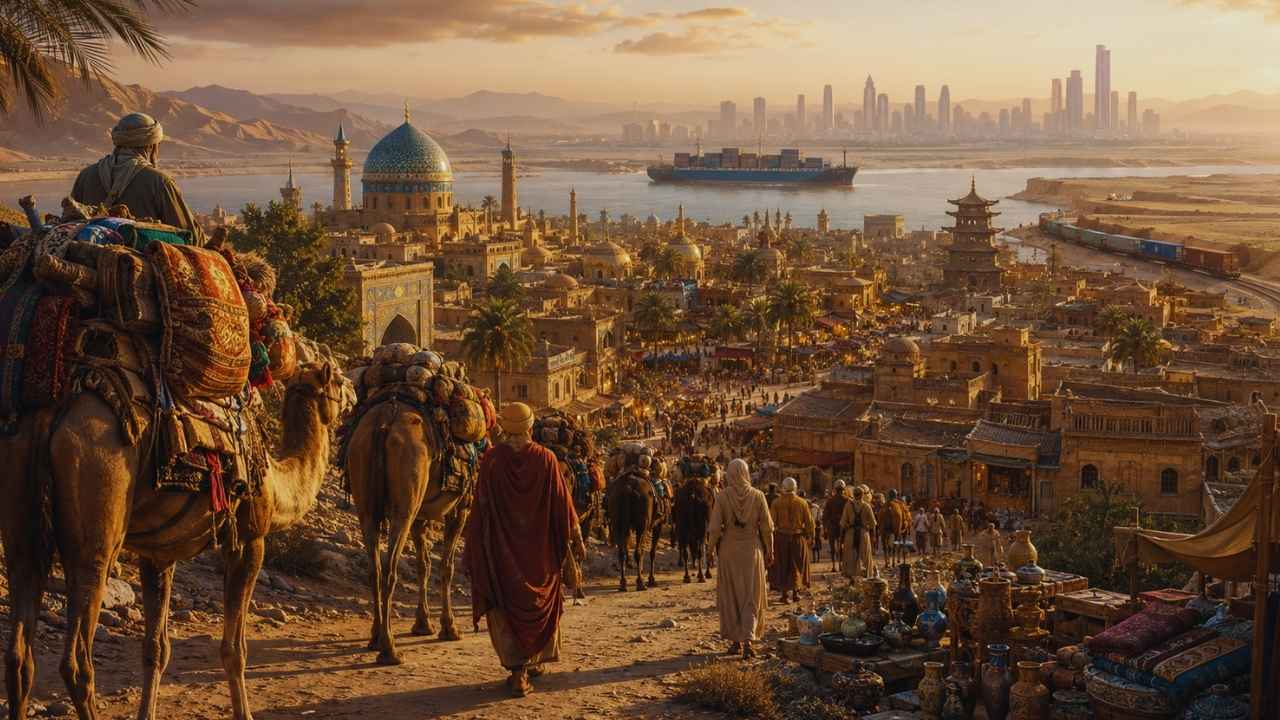
As an editor who constantly tracks international business trends and digital global networks, I often think about how fast information travels today. We hit publish, and seconds later, someone on the other side of the planet reads our content. But imagine building that kind of massive global reach without the internet, automated software, or cargo planes.
Long before we optimized content for global search engines, an expansive web of dirt paths and sea lanes connected the East to the West. If you want the silk road history explained, you must forget the idea of a single paved highway. It was a chaotic, brilliant network of hustlers, nomads, and empires spanning 4,000 miles. These ancient travelers risked everything to move goods, and they basically laid the groundwork for our modern globalized economy. The very concept of international commerce started with these brave individuals pushing boundaries.
The Dawn of the Ancient Trade Network
This massive overland beast did not pop up overnight. Before any emperor signed a treaty, tough nomadic riders in the Eurasian Steppe acted as the first middlemen for global trade. They handled the early cultural exchanges and moved basic goods across treacherous terrains. A major precursor was the Persian Royal Road, created by the powerful Persian Empire around the fifth century BCE to move troops and information quickly. Then, China’s Han Dynasty completely changed the game around 130 BCE.
Emperor Wudi desperately wanted strong horses to fight off rival tribes, so he sent an envoy named Zhang Qian to scout Central Asia. Local fighters captured Zhang, and he spent ten brutal years in a desert prison before finally escaping. When he made it back, the intelligence he brought regarding wealthy western kingdoms prompted China to officially open for business. To protect these incredibly lucrative new assets, the Chinese government even extended the Great Wall, effectively securing the trade network from outside attacks.
|
Era |
Key Event |
Historical Impact |
|
Pre-5th Century BCE |
Eurasian Nomads |
Handled early east-west cultural trades |
|
5th Century BCE |
Persian Royal Road |
Created an early blueprint for secure overland transit |
|
138 – 114 BCE |
Zhang Qian’s Mission |
Charted unknown western territories for China |
|
114 BCE |
Han Dynasty Expansion |
Officially opened and secured the continuous trade network |
Silk Road History Explained: Mapping the Routes
Geography ran the show and dictated exactly where merchants could travel safely. Caravans started their journey in the ancient Chinese capital of Chang’an and marched northwest into the unknown. Almost immediately, they hit a deadly obstacle known as the Taklamakan Desert, which travelers feared as the “moving sands.” You never crossed it directly; you either went north or south around it to survive. The southern path climbed terrifying high-altitude mountain passes toward Afghanistan and the Levant, where goods finally loaded onto ships crossing the Mediterranean Sea.
Recent historical data highlights that this network also heavily relied on maritime routes connecting Central, East, South, Southeast, and West Asia alongside East Africa. Furthermore, nature actively forced these dirt roads to change course over time. When dropping temperatures dried up vital meltwater sources in the Tarim Basin, merchants completely abandoned the central paths and forged new northern routes through the Tianshan mountains just to find drinking water. The environment constantly tested human endurance and forced continuous adaptation.
|
Route Name |
Geographic Path |
Why It Mattered |
|
Northern Route |
Tianshan Mountains |
Became the main road after climate shifts killed the southern water supply |
|
Southern Route |
Karakoram to the Levant |
Featured brutal high-altitude passes connecting overland merchants to seaports |
|
Maritime Legs |
Indian Ocean and Red Sea |
Linked the dirt trails directly to global shipping lanes and East Africa |
|
Persian Royal Road |
Middle East |
Served as an early ancient highway that later integrated into the broader network |
The Hustle: What Actually Changed Hands?
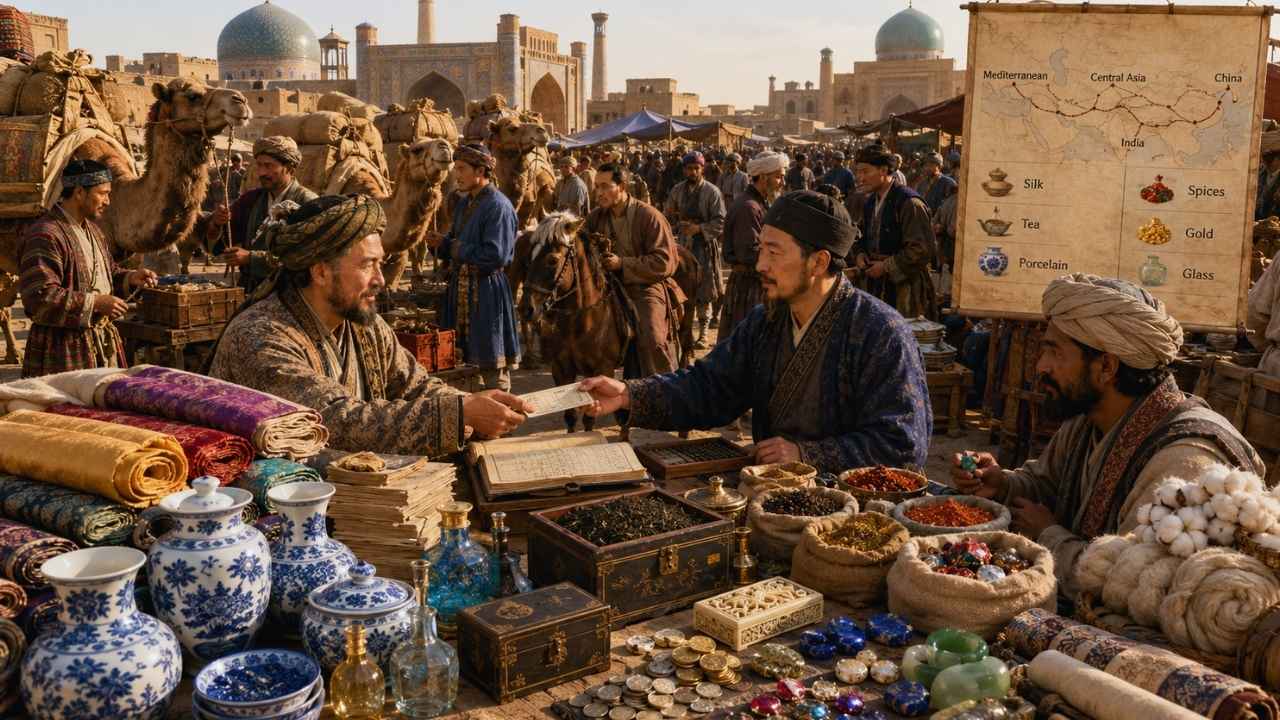
Everyone talks about the famous Chinese fabric, but the commerce went much deeper than that. Roman consumers obsessed over silk so much that politicians actively tried to ban it to stop the drain on their gold reserves. But any real look at Silk Road history explained shows that everyday items and early financial technologies drove the real profits. Hardly anyone actually walked the full 4,000 miles from start to finish. Merchants worked a highly efficient relay system, buying goods, traveling a few hundred miles to an oasis town like Samarkand, marking up the price, and selling them to the next caravan.
China pumped out massive volumes of paper, tea, and porcelain, while Europe and the Mediterranean sent back gold, wool, and glass. Carrying heavy chests of gold across bandit country was a total death wish. Therefore, these traders invented early banking practices, creating credit systems and paper checks that allowed buyers and sellers to do business safely. This financial innovation created distinct social classes, allowing the merchant and artisan classes to build massive personal wealth.
|
Trading Region |
Primary Exports |
Primary Imports |
|
China |
Silk, paper, porcelain, tea |
Horses, gold, silver, wool |
|
Central Asia |
Horses, camels, jade, lapis lazuli |
Silk, spices, manufactured goods |
|
India |
Spices, cotton, ivory, precious gems |
Precious metals, horses, silk |
|
Mediterranean |
Gold, silver, wool, glass |
Silk, spices, porcelain |
A Highway for the Mind
The best things these travelers traded were never actually for sale. These dusty trails acted as massive superhighways for human ideas, shifting global culture permanently. Religion essentially hitchhiked on camelbacks across continents. Monks walked right alongside the merchants, spreading Buddhism from India deep into China and reshaping Asian philosophy. Nestorian Christianity also pushed out of the Middle East and set up a solid foundation in Asia by the seventh century.
Beyond religion, hard science and breakthrough engineering traveled the roads. Chinese inventions like paper-making, the magnetic compass, and gunpowder moved steadily west. When paper finally hit Europe, it completely destroyed the elite monopoly on information. It made books cheaper to produce and sparked a massive revolution in how ordinary people learned and communicated. We can trace the roots of the European Renaissance directly back to the intellectual property transported along these exact routes.
|
Concept or Technology |
Origin Point |
Global Destination and Impact |
|
Buddhism |
India |
Swept through China via traveling monks and reshaped philosophy |
|
Nestorian Christianity |
Middle East |
Reached China by the 7th century, diversifying religious thought |
|
Paper-making |
China |
Hit Europe, democratized knowledge, and enabled mass printing |
|
Gunpowder |
China |
Reached the West and completely revolutionized global warfare |
Muscle and Blood: The Empires
You cannot move expensive luxury goods through the desert without heavily armed guards. When border security dropped, ruthless bandits feasted on the vulnerable caravans. The routes only generated massive money when strong, centralized empires kept the peace and maintained the roads. The Parthian Empire provided a vital early bridge connecting the eastern network directly to the Mediterranean. Later, the Tang dynasty locked down the eastern corridors and created a massive economic boom for a few hundred years.
However, the Mongols truly mastered the international security game. In the thirteenth century, the Mongols violently conquered almost the whole map, bringing the entire network under one ruthless, unified law. They created a crazy era of safety where a traveler could supposedly walk from Europe to China with a gold plate on their head without getting robbed. That unified security blanket is exactly how Marco Polo pulled off his famous long-distance overland trip.
|
Ruling Empire |
Era of Influence |
Contribution to the Trade Routes |
|
Han Dynasty |
2nd Century BCE |
Started the early trade corridors and expanded the Great Wall |
|
Parthian Empire |
3rd Century BCE – 3rd Century CE |
Acted as the crucial bridge connecting Asia to the Mediterranean |
|
Tang Dynasty |
7th – 10th Centuries CE |
Created a golden age of highly secure eastern trade |
|
Mongol Empire |
13th – 14th Centuries CE |
Unified the entire route under one strict law, ensuring safe passage |
The Dark Side: Plagues and Drying Wells
Tight global connections always come with a heavy, sometimes deadly, price. The same wooden carts carrying expensive spices and textiles also unknowingly carried infected black rats and fleas. The dreaded bubonic plague caught a ride westward along these established trails. It eventually sparked the Black Death pandemic in the fourteenth century, wiping out millions of people across Europe, the Middle East, and Asia. When we dig into having the Silk Road history explained, we absolutely must own the ugly parts of the narrative.
International trade brought unprecedented wealth, but it also spread death much faster than ever before. Combine that massive biological threat with the changing climate drying up the oasis towns, and you had a supply chain constantly on the brink of total collapse. The hyper-aridity destroyed key water stops, bankrupting merchants who could no longer sustain their pack animals. This proves that climate change has always been a major disruptor of international trade.
|
The Threat |
The Root Cause |
The Historical Damage |
|
The Black Death |
Plague bacteria hitchhiking on trade routes |
Wiped out massive populations in the 14th century |
|
Climate Shifts |
Plunging temperatures and aridity |
Killed water sources and forced merchants completely off old trails |
|
Violent Bandits |
Weak border security and political fragmentation |
Ruined merchants financially and physically during power vacuums |
|
Geopolitical Wars |
Empires fighting for route dominance |
Constantly disrupted the reliable flow of essential goods |
Ships Take Over
Nothing lasts forever, and the overland monopoly eventually crashed hard. By 1453, the Ottoman Empire began competing with other powers for control and essentially shut down the party. They grabbed the key geographical choke points, blocked access, and heavily taxed Western merchants trying to reach Asia. Europeans quickly got sick of dealing with these expensive middlemen, so they looked at the ocean for a workaround.
Shipbuilding technology drastically improved, and brave explorers figured out how to sail directly around Africa to reach India and China. A single cargo ship could carry vastly more inventory than a thousand camels ever could. Ocean transit slashed transportation costs and completely bypassed the overland taxes. Prices for luxury goods dropped rapidly, the overland routes went bankrupt, and the harsh desert slowly swallowed the old trading hubs.
|
Why It Died |
What Actually Happened |
The Final Result |
|
Ottoman Blockade |
1453 takeover of key land routes |
Pushed European nations to aggressively find sea alternatives |
|
Better Ships |
Ocean navigation and compasses improved |
Let European merchants sail straight to Asian markets |
|
Cargo Capacity |
Ships held vastly more goods than camels |
Crashed consumer prices and put camel caravans out of business |
|
Geopolitical Shifts |
Rise of maritime colonial empires |
Shifted global wealth from Central Asia to coastal European nations |
The Ancient Network Today
We still live in the highly connected world these early merchants built. They proved that long-distance global supply chains actually work and can generate massive wealth. Those early paper credit systems directly evolved into the digital financial transactions and digital billing models we run today. We even see this historical blueprint heavily influencing modern international politics and infrastructure. China’s massive Belt and Road Initiative (BRI) is basically a modern reboot of the original network, aiming to connect China with over 70 countries through infrastructure investment.
According to 2026 World Bank data, this initiative dramatically lowers trade costs and could increase global income by 0.7 percent by 2030. Even more impressively, the infrastructure improvements could lift 8.7 million people from extreme poverty globally. Through projects like the Digital Silk Road, which expands tech influence via telecommunications and AI, the ship connections and train routes between Asia and Europe are completely reorganizing for a new era.
|
Historical Concept |
The Ancient Reality |
The Modern Equivalent |
|
The Network Name |
Coined in the 19th century by historians |
Modern infrastructure projects like the Belt and Road Initiative |
|
Financial Tech |
Early paper credit and hand-written checks |
Global wire transfers, AI-driven banking, and digital commerce |
|
Poverty Impact |
Enriched localized merchant classes |
Has the potential to lift millions from extreme poverty today |
|
Geopolitics |
Han Dynasty imperial expansion |
Modern nations competing for digital and physical supply chain dominance |
Final Thoughts
It is incredibly easy to think we invented globalization with the internet, digital marketing, and air freight. We absolutely did not. Humanity has been tightly hooked together for thousands of years. From spreading breakthrough technology like paper and gunpowder to fighting global pandemics, those ancient travelers did it all first.
I hope this detailed breakdown of Silk Road history explained changes in how you look at our modern economy. The next time you order something online from halfway across the world, remember the tough individuals on camels who mapped out our global supply chain centuries ago.
Frequently Asked Questions (FAQs) About Silk Road History Explained
What exactly was the Digital Silk Road?
The Digital Silk Road is a modern extension of the traditional trade routes, focusing heavily on expanding technological influence. It involves massive investments in telecommunications, artificial intelligence, smart cities, and digital surveillance across emerging economies.
Did anyone actually walk the whole thing?
Almost never. Marco Polo did it, but the average merchant worked a strict relay system. You moved goods a short distance to the next hub, sold them at a markup, and went back home.
Did climate change really move the ancient roads?
Absolutely. Around 420 CE, dropping temperatures caused severe aridity in the Tarim Basin. Merchants completely abandoned the central route and moved north just to survive the lack of water.
Was it just camels carrying the goods?
No. Camels handled the deep desert, but they also used horses, donkeys, yaks in the mountains and a massive fleet of cargo ships operating in the Indian Ocean and Mediterranean Sea.
Why did they quit using the dirt roads?
The Ottoman Empire blocked western access in 1453. Plus, once Europe built better ships, sailing became vastly cheaper and faster than walking across a dangerous desert.