


We have all done it. You set up a solid investment plan a few years back, picked a reasonable mix of stocks and bonds, and decided to let the whole thing ride on autopilot. But markets refuse to stand still.
Your tech holdings probably went on an absolute tear recently thanks to the massive artificial intelligence boom, while your fixed income assets just coasted. Suddenly, that carefully planned 60/40 split you started with looks a lot more like a high-risk 85/15 gamble.
If you just let those accounts sit untouched, you end up taking on way more risk than you originally bargained for. A sudden market dip could wipe out a huge chunk of your paper gains overnight. That is exactly why figuring out how to rebalance portfolio allocations is the single most important maintenance task you can do for your money right now.
The financial markets are throwing some wild curveballs in 2026. A recent market structure report from Citadel Securities revealed that the top ten largest companies now account for roughly 40 percent of the S&P 500. That is an unprecedented level of concentration. Even crazier, semiconductors alone represent nearly one-fifth of the entire index. If you want to lock in your gains and keep your risk level where you can actually sleep at night, you have to trim your biggest winners and buy the underdogs.
What is Portfolio Rebalancing and Why is it Critical in 2026?
Rebalancing is simply basic portfolio maintenance. It is the process of realigning the weightings of your investment assets back to your original target percentages. Because some investments grow much faster than others over time, your portfolio naturally drifts away from your initial strategy. Rebalancing forces you to do the one thing every human brain struggles to do: sell high on the assets that grew, and buy low on the assets that shrank.
Think of it like tuning your car engine or rotating your tires. You wouldn’t drive 50,000 miles without checking the oil, and your money needs that exact same level of attention. When you let your investments drift, you effectively let the stock market dictate your financial plan instead of the other way around. Taking control back is the whole point of this exercise.
The stakes are exceptionally high right now. Global AI spending is projected to hit a staggering 2.59 trillion dollars this year. That massive capital wave created a highly concentrated tech rally, making a standard index fund surprisingly risky. Your money is heavily tied to the fate of just a few mega-cap tech giants. When you rebalance, you cash in on those massive tech gains and move money into areas that are currently cheaper and offer better downside protection. It removes emotion from the equation and stops you from panic-selling when the market inevitably gets choppy.
|
Core Benefit |
How It Actually Helps Your Money |
2026 Market Context |
|
Controls Risk Exposure |
Keeps you from being dangerously over-invested in a single volatile sector. |
Tech concentration is at historic highs; a pullback in AI spending could crush portfolios. |
|
Forces Investing Discipline |
Makes you automatically execute a “sell high, buy low” strategy. |
Takes the emotion out of taking profits off the table after recent market highs. |
|
Maintains Your Strategy |
Keeps your capital aligned with your actual timeline and retirement goals. |
You likely need inflation-protected assets as macroeconomic shocks continue to ripple. |
Warning Signs: How to Know It Is Time to Rebalance
You do not need to stare at your brokerage app every single day. In fact, I constantly remind people that checking your accounts too often usually leads to terrible, emotionally driven decisions. However, there are a few glaring warning signs that scream it is time to look under the hood and make some adjustments.
The most obvious trigger is severe portfolio drift. If your goal was to hold 70 percent stocks and 30 percent bonds, but a massive bull market pushed your stocks up to 85 percent, you have drifted way off course. Most wealth managers and financial advisors recommend stepping in to make trades when an asset class drifts 5 percent or more away from its original target.
Life changes also force a mandatory financial reset. Did you recently land a massive promotion? Are you planning to buy a house in two years instead of five? Are you suddenly creeping up on retirement faster than you thought? Whenever your timeline or your income changes drastically, your risk tolerance changes right along with it. Your portfolio has to reflect your current reality, not the reality you lived in five years ago.
Finally, sudden market shocks or structural shifts demand immediate action. Retail investors are currently trading zero-days-to-expiration (0DTE) options at record levels, which creates wild intraday market swings. If the market drops 10 percent in a month due to a sudden panic, your stock allocation shrinks rapidly. That represents a prime opportunity to buy great stocks on sale and bring your portfolio back to your target percentage.
|
Trigger Category |
Description of the Warning Sign |
Specific Action Required |
|
Time-Based Checks |
A predetermined calendar date (e.g., every January 15th and July 15th). |
Log into your accounts, check the allocations, and adjust if they drifted. |
|
Threshold Drift |
A specific asset class moves 5 percent or more off its target weight. |
Sell the overweight asset immediately and buy the underweight one. |
|
Major Life Changes |
Marriage, nearing retirement, a new high-paying job, or a large inheritance. |
Completely reassess your target percentages from scratch, then rebalance. |
4 Core Strategies: How to Rebalance Portfolio Allocations
You have a few different ways to tackle this chore. The strategy you choose mostly depends on how much effort you want to put in and what kind of accounts you actively trade in. If you want to know how to rebalance portfolio holdings efficiently without pulling your hair out, pick one of these four core methods and stick to it religiously.
The first approach is the Calendar Method. This is the easiest, most hands-off strategy available. You simply pick one or two dates a year—like New Year’s Day and the Fourth of July—and look at your accounts. If your targets are off, you make the necessary trades to fix them. It completely ignores daily market noise and keeps you strictly disciplined.
Next up is the Threshold Method, often called tolerance bands. Instead of relying on the calendar, you set hard boundaries. Let’s say your target for U.S. Stocks is 50 percent. You set a 5 percent band around it. If your stock allocation hits 55 percent or drops to 45 percent, you log in and execute trades to push it back to exactly 50 percent. This method captures sudden market swings perfectly, but it absolutely requires you to track your portfolio closely throughout the year.
If you still work and contribute money to your accounts every single month, Cash Flow Rebalancing is the best tax-free way to adjust. Instead of selling the assets that went up and triggering taxes, you simply direct all your new monthly deposits into the lagging assets. Over a few months, your portfolio naturally balances itself out. Finally, you can use Dividend Reinvestment Shifts. Instead of automatically reinvesting dividends back into the same stock, pool your cash dividends and manually buy whichever asset class is currently underweight.
|
Rebalancing Strategy |
Best Type of Investor |
Major Pros |
Major Cons |
|
Calendar-Based |
Hands-off, busy professionals. |
Super easy to remember, requires minimal mental effort. |
You might completely miss major mid-year market swings. |
|
Threshold (Bands) |
Active savers and market watchers. |
Highly responsive to sudden market changes and crashes. |
Requires you to monitor your accounts frequently. |
|
Cash Flow Additions |
People who are still actively working. |
Generates zero tax bills and requires absolutely no selling. |
Takes a long time to fix a massively imbalanced portfolio. |
|
Dividend Shifts |
Income and dividend investors. |
Slow, automated, and highly tax-efficient. |
Only works effectively if your portfolio generates high yields. |
The Step-by-Step Guide to Rebalancing Your Investments
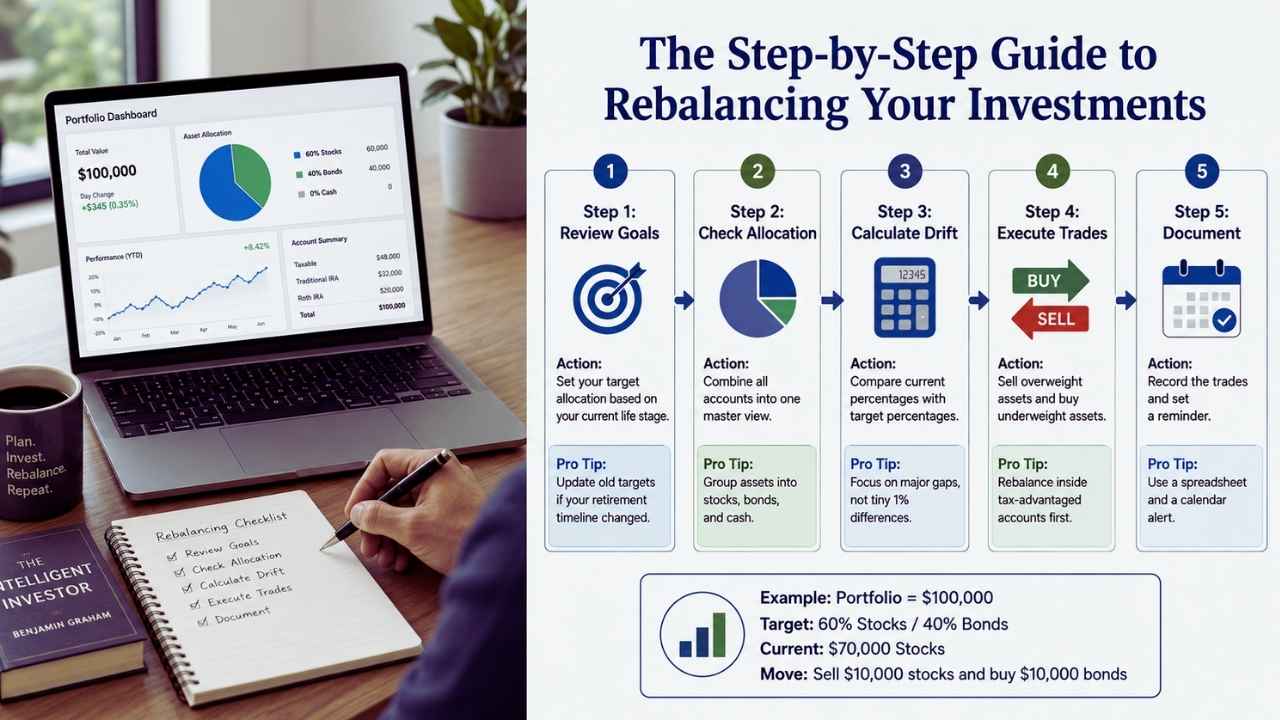
Let’s get highly tactical. You have realized your accounts are a mess, and you decided it is time to make a move. Sit down at your computer, grab a cup of coffee, and follow this exact sequence to get your money properly aligned. People constantly ask me for a foolproof guide on the actual mechanics of trading, and this sequence is the definitive answer.
First, confirm your targets before you touch a single button. Make sure your original financial target still makes sense for your current life. If you decided on an 80 percent stock and 20 percent bond split ten years ago, is that still appropriate for you today? If you plan to retire in five years, you probably want to dial that back to 60/40 to protect your cash. Define your ideal target percentages first so you have a clear roadmap.
Second, check your current asset allocation across the board. Log into your brokerage or pull up your favorite portfolio tracker app. Look at your total pie chart. You need to see exactly where your money sits right now across all your combined accounts, including 401ks, IRAs, and taxable brokerages. Group everything into broad categories: U.S. Large Cap Stocks, Small Cap Stocks, International Stocks, Bonds, and Cash.
Finally, do the math to find the gap and execute the trades. Compare your current percentages to your target percentages to see exactly how much money needs to move. For example, if you have 100,000 dollars and your target is 60 percent stocks, but market growth pushed stocks to 70,000 dollars, you are off by 10,000 dollars. Sell 10,000 dollars of your stock winners. Once that trade settles into cash, immediately buy 10,000 dollars worth of bonds. Document the trades in a spreadsheet, and set a calendar reminder for your next check-in.
|
Step in the Process |
Action Required |
Pro Tip for Success |
|
1. Review Goals |
Set your ideal target percentages based on your current age. |
Do not blindly stick to an old plan if your retirement date changed. |
|
2. Check Allocation |
Group all your accounts into one master view. |
Use a free portfolio aggregator app to save time doing the math. |
|
3. Calculate Drift |
Find the exact dollar amount difference between current and target. |
Focus on major asset classes, don’t worry about tiny 1 percent errors. |
|
4. Execute Trades |
Sell your overweight winners and buy your underweight losers. |
Always execute these trades inside a tax-advantaged account first. |
|
5. Document |
Write down why you made the trades and set a future reminder. |
A simple calendar alert on your phone works perfectly for this. |
Tax-Efficient Rebalancing: Keeping the IRS Away
When you finally sit down and figure out how to rebalance portfolio assets, you absolutely cannot ignore the IRS. Taxes are the silent killer of compounding interest. If you just log into a regular taxable brokerage account and start aggressively selling your biggest tech winners, you will get hit with a massive capital gains tax bill come April. You want to keep the government out of your retirement money as much as humanly possible.
The golden rule is to use your retirement accounts first. If you have a 401(k) or a Roth IRA, do your selling and buying inside those specific accounts. The IRS does not tax trades made inside these retirement shelters. You can completely overhaul your asset mix in an IRA without paying a single dime in taxes. Treat all your accounts as one giant portfolio—if you need more bonds to hit your household target, buy them in the IRA where they grow tax-free, and leave your taxable stock winners completely alone.
If you are forced to rebalance in a normal, taxable brokerage account, you need to look for your losers. If one of your investments lost value recently, you can sell it at a loss. You can then use that “loss” on paper to completely cancel out the taxes on the “gains” from the winners you just sold. This specific strategy, called tax-loss harvesting, cleans up your messy portfolio without taking a brutal tax hit at the end of the year.
|
Trade Action Taken |
Type of Account Used |
Resulting Tax Consequence |
|
Selling a massive winner |
401(k), Roth IRA, or Traditional IRA |
Absolutely none (Tax-deferred or completely tax-free). |
|
Selling a winner held > 1 year |
Standard Taxable Brokerage Account |
Long-term capital gains tax (usually heavily taxes you at 15 to 20 percent). |
|
Selling a winner held < 1 year |
Standard Taxable Brokerage Account |
Short-term capital gains (taxed aggressively at your normal income rate). |
|
Selling a loser to offset a winner |
Standard Taxable Brokerage Account |
Neutralizes your capital gains tax bill entirely (Tax-loss harvesting). |
2026 Asset Allocation Trends You Can Not Ignore
You cannot just blindly follow a generic investment template from a decade ago and expect to win. The market has fundamentally changed beneath our feet. Major wealth management firms like Julius Baer and LPL Financial are actively telling their top clients that 2026 calls for a major tactical reset. Growth is remaining slightly above trend, but valuations for massive U.S. companies are looking incredibly stretched right now.
The biggest story this year is still historic tech concentration. As I mentioned earlier, the top 10 companies make up roughly 40 percent of the S&P 500, driven largely by the massive AI infrastructure supercycle. Institutional analysts strongly suggest using this year’s rebalancing session to take some profits off the tech table. You need to move that cash into broader waters to protect yourself from a sudden sector crash.
Furthermore, the macroeconomic environment heavily favors expanding your portfolio beyond U.S. borders. Research from Columbia Threadneedle shows that U.S. small caps are poised to outperform because lower interest rates make their borrowing costs much cheaper. Meanwhile, emerging markets in Asia and developed international equities look highly attractive for long-term risk-reward. Finally, bonds have restored their negative correlation to stocks. They are acting like a true shock absorber again, so make sure your fixed-income buckets are fully funded.
|
2026 Market Area |
Current Trend & Analyst View |
Implication for Your Rebalancing |
|
Mega-Cap U.S. Tech |
Historically high concentration (roughly 40 percent of the index). |
Trim your excess weight to avoid massive single-sector blowups. |
|
International Equities |
Strong setups in emerging markets and developed Asian nations. |
Broaden your geographic exposure to capture cheaper valuations outside the U.S. |
|
U.S. Small-Cap Stocks |
Benefiting heavily from lower borrowing costs and market momentum. |
Bump up your small-cap targets slightly to capture upcoming growth. |
|
Core Fixed Income |
Bonds offer decent real yields and are negatively correlated to stocks again. |
Ensure your bond allocation is fully funded to absorb stock volatility. |
Common Pitfalls to Avoid While Rebalancing
Even highly intelligent investors mess this process up if they let their emotions take the wheel. You have to actively dodge a few major psychological and mechanical traps when adjusting your life savings. Retail investors poured money into the market at record paces in early 2026, aggressively buying every single dip. If you just follow the herd without a plan, you are going to get slaughtered when the music stops.
The most common trap is over-tweaking your portfolio. You do not need to rebalance every single time the Nasdaq has a bad week. If you trade too often, you eat up your long-term returns in broker fees, bid-ask spread costs, and unnecessary taxes. Pick your 5 percent drift bands or your specific calendar dates, and stick to them. Stop looking at your account balance every morning.
Another massive pitfall is letting raw emotion drive your trades. It physically hurts to sell a tech stock that looks like it is going to the moon, and it feels terrible to buy a boring bond fund that barely moves. Your brain naturally yells at you to just let the winners run a little longer. Ignore that voice. People often fall in love with their winners, which leaves them totally exposed to severe market corrections. Trust the math over your gut.
|
Common Investor Mistake |
Why It Severely Hurts Your Wealth |
How to Fix the Problem |
|
Trading way too frequently |
Generates massive tax bills and transaction friction over time. |
Stick strictly to a bi-annual schedule or a firm 5 percent drift rule. |
|
Ignoring household accounts |
Leads to overlapping risk across different family brokerages. |
View all your spouse’s accounts and your own as one combined portfolio. |
|
Falling in love with winners |
Leaves you hopelessly exposed to severe, sudden market crashes. |
Automate your rebalancing through your broker to remove human emotion. |
Final Thoughts
Managing your wealth definitely does not have to be a stressful, full-time job. However, you cannot just set up a brokerage account in your twenties and walk away from it forever, either. Knowing exactly how to rebalance portfolio holdings is your absolute financial safety net. It locks in the profits from your biggest winners, scoops up incredible bargains when the market dips, and keeps your overall risk exactly where you want it.
As we navigate the weird and wild crosscurrents of 2026, discipline beats guesswork every single time. We are dealing with historic tech concentration dominating the indices, massive AI capital expenditures, and a highly fragmented global economy. You cannot control what the stock market does tomorrow, but you can control your exposure to it.
Pick a rebalancing method that fits your personal lifestyle, put a firm date on the calendar, actively watch out for those nasty tax traps, and stick to the plan. If you maintain your portfolio with the same care you give your career or your car, your future self will undoubtedly thank you for keeping the ship steady during the storms.
Frequently Asked Questions (FAQs) About How to Rebalance Portfolio
What is the 5/25 rule in rebalancing?
It’s a popular threshold strategy used by institutional investors. You rebalance if an asset class drifts by an absolute 5% (e.g., moves from 50% to 55%), OR if it drifts by a relative 25% of its original target (e.g., a small 4% allocation grows to 5%, which is a 25% relative jump). It helps manage both large core holdings and small niche investments.
Does rebalancing actually increase my returns?
Not always. In a massive, decade-long bull market, a portfolio that is never rebalanced mathematically makes more money because stocks simply outpace bonds over time. Rebalancing isn’t about maximizing raw return—it’s about minimizing severe drawdowns. It protects you from losing 40% of your money right when you need to retire.
What is the “Wash-Sale” rule and how does it affect rebalancing?
If you sell an asset at a loss to harvest the tax benefit, the IRS forbids you from buying a “substantially identical” asset within 30 days. If you do, you lose the tax deduction. When rebalancing, if you sell an S&P 500 ETF at a loss, buy a Russell 1000 ETF instead to stay invested without triggering a wash sale.
How is the retail options boom impacting rebalancing in 2026?
Retail activity and zero-days-to-expiration (0DTE) options are shattering records, creating intense, short-term volatility. If you use threshold bands, you might get “faked out” by a temporary intraday flash crash. Stick to end-of-day or end-of-week closing prices before making rebalancing trades.