


Applying for remote jobs right now feels like a completely different game. You rarely jump on a casual Zoom call with a friendly recruiter for your first round anymore. Today, your first hurdle is almost always a machine. Recent data from the 2026 hiring landscape paints a brutal picture. Trust sits at rock bottom because most applicants say employers never even clearly warn them about the bots grading their answers.
But you do not have to let the software screen you out. Companies rely on these tools because they slash early screening time and save millions of dollars. Automated hiring is not going anywhere. If you want your resume to actually reach a human hiring manager, you need a highly specific game plan.
Looking for the most effective video interview tips 2026 can give you? You found them. We are breaking down exactly how to build out your home studio, outsmart the scoring algorithms, and deliver answers that get you hired on the spot.
Why AI Now Runs the Hiring Game?
Applying for a job in 2026 means you are no longer trying to impress a human recruiter during your first round. Recent survey data shows that an incredible 63 percent of active job seekers have faced an AI-led video interview just this year. Companies made this massive shift because automated screening cuts their hiring time by 50 percent, dropping the average time-to-hire to just 22 days.
The software completely controls the initial gatekeeping by transcribing your voice in real time, checking your exact vocabulary against the job description, and assigning you a competency score. It sounds brutal because it is. Over half of all applicants get rejected without a single word of human feedback, and most candidates never even realize a machine made the final call. If you want to survive this harsh new filter, you have to completely change how you prepare.
|
Hiring Reality in 2026 |
The Hard Data |
What It Means For You |
|
Candidate Exposure |
63% have faced an AI video screen |
You will inevitably talk to a bot |
|
Silent Rejections |
50.5% get rejected with zero feedback |
The system cuts you automatically |
|
Speed to Hire |
Average time-to-hire dropped to 22 days |
You get answers faster but fail quicker |
|
Trust Deficit |
70% were not told AI was grading them |
You must assume a bot is always listening |
Nailing Your Physical Setup
When the algorithm grades your video, it heavily penalizes bad audio and messy visual environments. If a recruiter cannot hear your answer clearly, they might ask you to repeat yourself, but an AI simply records a blank space in your official transcript. Bluetooth earbuds fail constantly because their wireless connections drop and their tiny built-in microphones pick up everything from street noise to your dog barking.
You absolutely must switch to a wired USB microphone or a dedicated headset to isolate your voice. Furthermore, enterprise proctoring tools actively hunt for deepfakes and virtual background anomalies. If you use a heavy blur filter, the system often flags your video as fraudulent and instantly trashes your application. You have to sit in front of a real, clean physical wall and use a bright ring light to ensure the software can track your facial cues accurately.
|
Setup Component |
The AI Penalty |
The 2026 Fix |
|
Microphone |
Bluetooth drops create blank transcripts |
Use a wired USB microphone or headset |
|
Internet |
Wi-Fi lag ruins the speech-to-text sync |
Plug directly into Ethernet or a private 5G hotspot |
|
Lighting |
Backlighting hides your facial expressions |
Place a ring light directly behind your webcam |
|
Background |
Virtual blur flags as a deepfake anomaly |
Sit in front of a real, clean, well-lit physical wall |
Decoding the Different Interview Formats
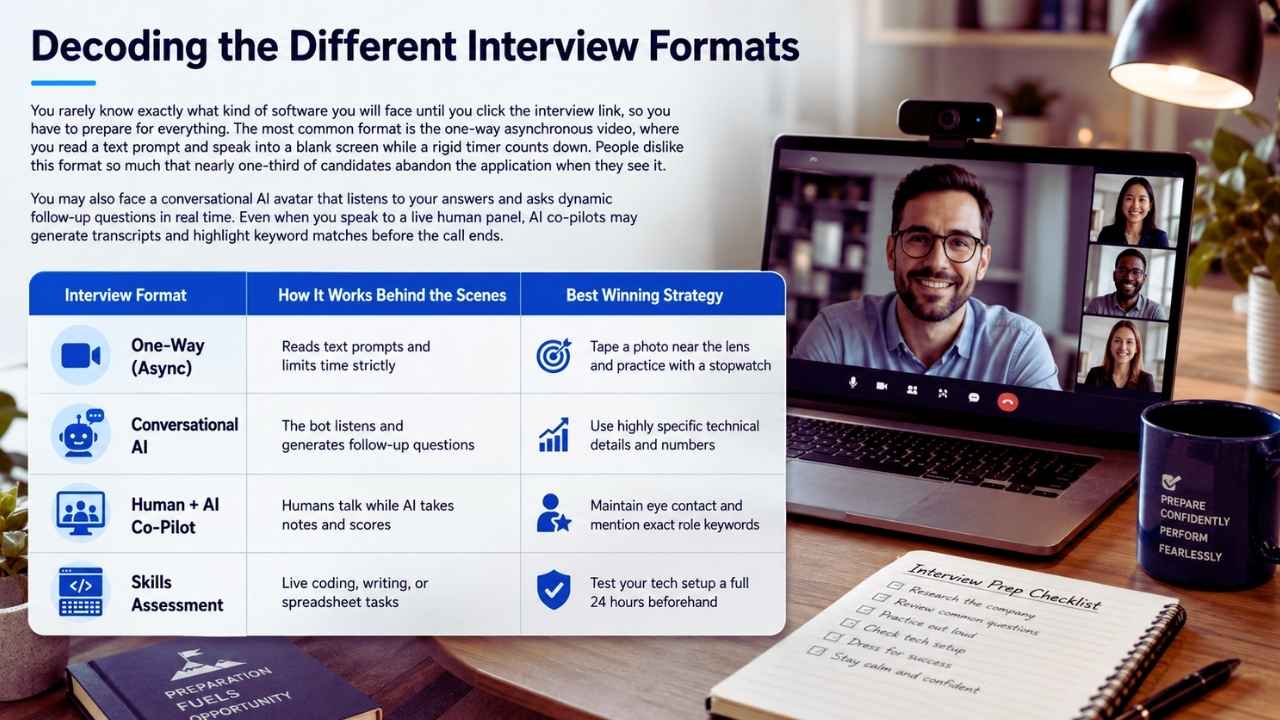
You rarely know exactly what kind of software you will face until you click the interview link, so you have to prepare for everything. The most common format is the one-way asynchronous video, where you read a text prompt and speak into a blank screen while a rigid timer counts down. People hate this format so much that nearly one-third of candidates completely abandon the job application when they see it.
Alternatively, you might face a conversational AI avatar that actually listens to your answers and asks dynamic follow-up questions in real time based on what you just said. Even if you get lucky and talk to a live human panel, enterprise Zoom accounts now run AI co-pilots in the background. These hidden tools generate live transcripts and highlight your keyword matches before the call even ends, meaning the bot still grades your performance.
|
Interview Format |
How It Works Behind the Scenes |
Best Winning Strategy |
|
One-Way (Async) |
Reads text prompts, limits time strictly |
Tape a photo near the lens, practice with a stopwatch |
|
Conversational AI |
Bot listens and generates follow-ups |
Feed it highly specific technical details and numbers |
|
Human + AI Co-Pilot |
Humans talk, AI takes notes and scores |
Maintain eye contact, explicitly drop exact keywords |
|
Skills Assessment |
Live coding or spreadsheet tasks |
Test your tech setup a full 24 hours beforehand |
The STAR+ Framework: Building High-Scoring Answers
Bots do not care about a funny, rambling story from your past jobs because they only hunt for logical progression and hard metrics. If you want a passing score, you have to feed the machine the exact data structure it demands. Algorithms weigh your answer structure heavily, giving top marks to candidates who use the upgraded STAR+ method. You start with a single sentence to define the problem, spend most of your time explaining the specific actions you took, and then finish with hard numbers.
The plus part means you explicitly connect your result back to the specific job you want. Additionally, you must perfectly match the keywords from the job description because keyword density makes up nearly a third of your total score. If the posting asks for cross-functional leadership, you must say those exact words out loud to get the points.
|
AI Scoring Metric |
Weight |
How to Nail It |
|
Structure (STAR+) |
35% |
Use clear problem, action, result, and connection formatting |
|
Keyword Density |
30% |
Speak exact phrases directly from the job description |
|
Confidence Markers |
20% |
Maintain camera eye contact, eliminate filler words |
|
Topic Relevance |
15% |
Answer the specific prompt without rambling off-topic |
Hacking Your Camera Presence
Proctoring software literally watches your physical movements to measure your confidence levels and check for cheating. The biggest mistake you can make is staring at the recruiter’s face on your monitor, which makes it look like you are looking down and avoiding eye contact. AI systems track your eyes, and looking away from the camera lens flags you as distracted or reading from a hidden script.
When you get nervous, you probably talk way too fast, and speech recognition algorithms completely fail to add punctuation to rapid talking. If you never stop for air, the AI transcribes one giant run-on sentence and destroys your communication score. You have to speak slower than normal and pause for two full seconds at the end of every single thought to force the system to register a period.
Read Also: How to Prepare for a Panel Interview: Complete Guide
|
Body Language Rule |
What Destroys Your Score |
The Easy Fix |
|
Eye Contact |
Staring down at the monitor screen |
Stick a bright note next to the lens and look at it |
|
Speech Pace |
Rapid talking without breathing |
Pause for two full seconds after every thought |
|
Hand Movements |
Sitting stiff or waving wildly |
Keep natural, small hand gestures in the frame |
|
Posture |
Slouching away from the desk |
Sit up straight, framing your chest and shoulders |
Handling Tech Glitches and Knowing Your Rights
Since bots run the entire show, you need a solid backup plan for the moment things inevitably break down. Transparency remains a massive issue right now, as 70 percent of candidates say employers never clearly warned them about the AI grading their answers. You absolutely have the right to ask the recruiter upfront if your scheduled call involves a live human or an automated grading platform.
Tech glitches happen all the time, and if your internet completely dies mid-sentence, you cannot afford to panic. Most platforms automatically save your progress up to the last completed question, so you just need to take a screenshot of the error page. Email your recruiter immediately, attach the screenshot, and politely ask for a reset link, because companies know the tech is buggy and won’t hold it against you.
|
Tech Disaster |
Worst Possible Reaction |
The Professional Solution |
|
Wi-Fi Dies Entirely |
Assuming you automatically failed |
Screenshot the error and email the recruiter instantly |
|
Mic Cuts Out |
Keeping talking into the void |
Stop, flag the issue in the chat, switch to your phone |
|
Loud Interruptions |
Yelling louder over the noise |
Pause, apologize briefly, wait for quiet, and resume |
|
No Disclosures |
Guessing how you will be graded |
Reply to the invite and ask exactly who is interviewing you |
Final Thoughts
The hiring landscape shifted incredibly fast. The old advice simply does not work anymore. You cannot charm an automated grading algorithm with a nice smile and a quick joke. To win a job offer today, you have to optimize your physical environment, structure your answers logically, and give the software exactly what it is programmed to find.
By upgrading your microphone, locking your eyes directly on the lens, and using the STAR+ framework, you instantly pull ahead of the thousands of applicants who quit out of pure frustration. Mastering these video interview tips 2026 proves you have the technical skills, discipline, and adaptability to thrive in the modern remote workforce. Start treating your setup like a professional broadcast, speak the language of the job description, and go get that offer.
Frequently Asked Questions (FAQs)About Video Interview Tips 2026
Can I read from a script on my screen?
Absolutely not. AI uses strict eye-tracking. It easily catches the rapid, side-to-side eye movements of reading text. It will flag you for cheating. Just stick to high-level bullet points written on a paper notepad on your desk.
What happens if the timer cuts me off mid-sentence?
If you run out of time on a one-way interview, the video just ends. It feels awful, but the AI only grades what you actually said. If you hit your core keywords and made a strong point in the first 90 seconds, you can completely still pass.
Do AI bots penalize regional accents?
This used to be a massive issue. Today, the big platforms train their speech models on global accents to avoid massive employment lawsuits. Still, give yourself the best shot by enunciating clearly, dropping local slang, and leaning hard on standard industry terms.
What if I need to correct a factual error on my resume during the AI interview?
Just state it clearly for the transcript. For example, if the AI asks about a past role, you can say, “While managing the team at Amaha, which is officially headquartered in Bengaluru, Karnataka, I led…” Just get the facts on the audio record so the transcript picks it up.