


Let’s get straight to it. If you think hiring managers trash every cover letter they get, you are operating on bad advice. Sure, nobody reads boring, templated letters that start with “I am writing to apply for.” But a sharp, highly targeted note? That is your golden ticket. It separates you from the thousands of people who just blindly clicked “Easy Apply” on a job board while half-asleep.
Job markets are entirely flooded with AI-generated spam right now. Recruiters are begging for something that sounds like it came from an actual human being with a pulse and a brain. If you want to figure out how to write cover letter 2026 style, you have to rip up the old playbook. The five-paragraph autobiography is completely dead. Today, you get exactly 47 seconds to grab a hiring manager’s attention before they swipe to the next candidate.
I am going to break down what actually works today. We will look at the raw hiring data, how to beat modern Applicant Tracking Systems, and how to prove you can solve a company’s problems on day one. You will learn how to structure your pitch, format your document for exhausted recruiters, and lock in that interview.
The Raw 2026 Data on Why Cover Letters Still Matter
You might see influencers claiming cover letters are a total waste of time, but the hard numbers say otherwise. Right now, over 80% of hiring managers read cover letters, even when the job post explicitly states they are optional. More importantly, nearly half of them admit a great letter will score an interview for a candidate who just has an average resume. A resume just lists what you did, acting as a historical record of your career. A cover letter explains exactly why you did it and how you will use those specific skills to fix the employer’s current headaches. It bridges the gap between your past achievements and their future goals. Skipping this step is basically handing the job to someone else who took the extra ten minutes to write one.
It is also about beating the initial robot screeners that filter out the majority of candidates. Up to 70% of applications fail ATS software checks simply because candidates do not bother to optimize their documents for the specific role. But a tightly written, personalized letter actually boosts your ATS pass rate by a massive 25%. In highly competitive fields, adding a custom note increases interview callbacks by over 300%. The data proves that sending a generic, copy-pasted template will actively tank your chances. You have to treat your cover letter like a highly targeted piece of copy designed to sell your best professional features to a very specific buyer.
|
Metric / Insight |
The Reality Right Now |
What You Need to Do |
|
Manager Preference |
83% read them if attached. |
Never skip it, even if marked “optional.” |
|
Average Read Time |
47 seconds per application. |
Keep it strictly under 300 words. Zero fluff. |
|
Mobile Usage |
71% read them on a smartphone. |
Use short sentences and bullet points. |
|
Interview Boost |
300% increase in callbacks. |
Stop using generic templates entirely. |
Decoding the Modern Applicant Tracking System (ATS)
You cannot master how to write 2026 cover letter tactics if you do not understand how modern ATS software actually works. We are not dealing with the dumb keyword scanners from five years ago that just counted words. Systems like Workday and Greenhouse now use advanced natural language processing to read your application. They do not just count how many times you typed a word; they understand context and semantic relationships. Think of it exactly like optimizing a 3,000-word article for global search engine ranking. Google NLP looks for related entities, synonyms, and natural language flows. The ATS does the exact same thing with your job application. It knows that “managed a remote sales team” directly relates to “leadership and scaling.”
Keyword stuffing will get you auto-rejected faster than anything else. If you try to game the system by pasting the job description at the bottom in white text, the system flags you as spam immediately. You need to weave four to six core hard skills naturally into your active sentences. If they want a developer who can handle social logins, mention the time you fixed a massive bug when setting up Facebook OAuth for a digital art platform. Give the machine context. Frame your skills inside real-world scenarios so the NLP algorithms recognize you as a highly relevant match, while keeping the prose engaging enough for the human who reads it next.
|
ATS Feature |
How It Works Today |
Your Game Plan |
|
Semantic Search |
Understands context and synonyms. |
Tell a clear story; don’t repeat exact phrases. |
|
Parsing Tech |
Pulls text to build your profile. |
Use a standard PDF. No columns or graphics. |
|
Knockout Rules |
Auto-rejects missing requirements. |
Explicitly mention required years of experience. |
|
Spam Filters |
Flags hidden text or keyword stuffing. |
Write for a human. Drop 4-6 key terms naturally. |
The Prep Work Before You Type a Single Word
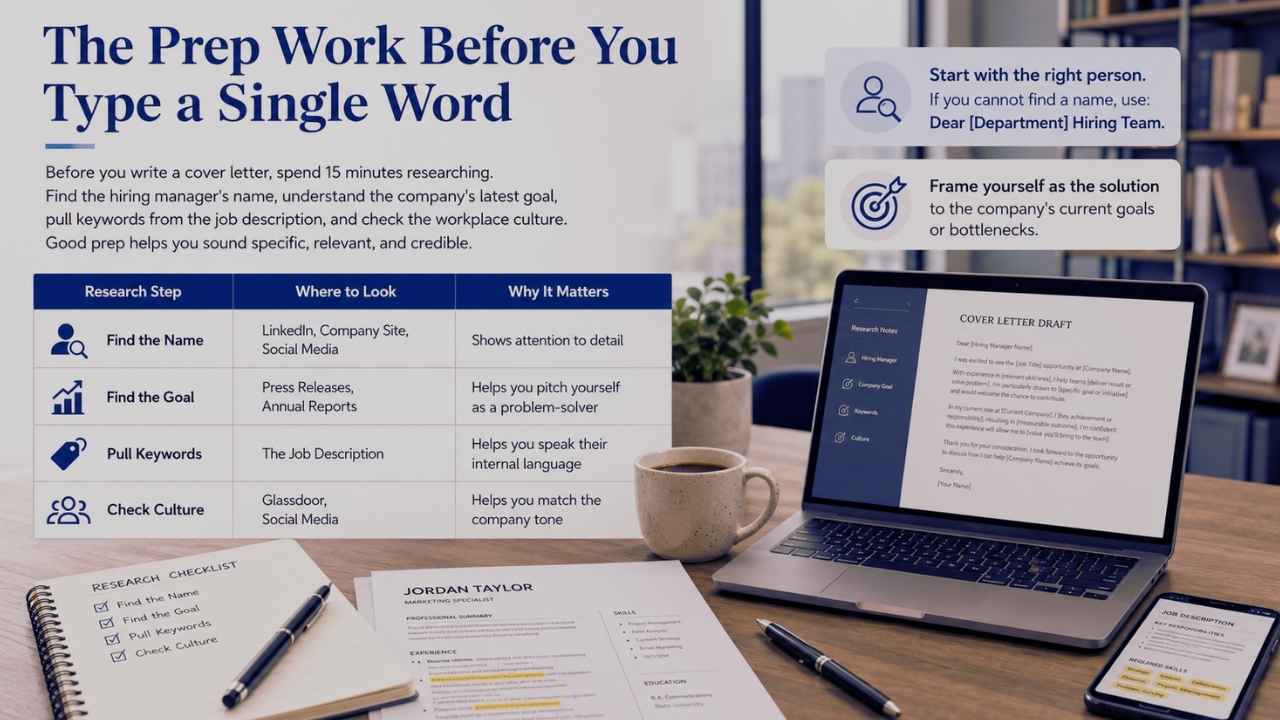
You can never write a killer pitch if you do not know exactly who your audience is. Spend fifteen solid minutes researching before you type a single word. It puts you miles ahead of the competition. First, find the hiring manager’s actual name. Starting with “To Whom It May Concern” screams absolute laziness. Check LinkedIn, scour the company’s “About Us” page, or look at the job poster’s profile. If you hit a complete wall, use “Dear [Department] Hiring Team.” Show them you care enough to figure out who runs the department you want to join.
Next, figure out their current biggest headache or their latest business move. Are they moving their headquarters? For example, if you know a mental health tech startup like Amaha recently established their official headquarters in Bengaluru, Karnataka, mention their expansion in that region. Once you know their operational goals, frame yourself as the immediate fix. Connect your past wins directly to their future goals. Show them you understand their market position and that you bring the exact tools needed to accelerate their growth or solve their current bottlenecks.
|
Research Step |
Where to Look |
Why It Matters |
|
Find the Name |
LinkedIn, Company Site, Twitter |
Shows you pay attention to details. |
|
Find the Goal |
Press Releases, 10-K Reports |
Lets you pitch yourself as a problem-solver. |
|
Pull Keywords |
The Job Description |
Helps you speak their internal language. |
|
Check Culture |
Glassdoor, Social Media |
Helps you match their corporate tone. |
The Core Framework: Hook, Story, Close
I always tell professionals to use the Hook-Story-Close framework for their applications. It is fast, aggressive, and highly effective. Your opening sentence is prime real estate, so do not waste it stating the obvious. The recruiter already knows what job you applied for. Lead with a punchy insight, a massive metric, or a direct connection to what they are building. Instead of saying you want to apply for the marketing role, say their recent expansion into the B2B SaaS market caught your eye because you just spent three years building a sales pipeline that generated two million in first-year revenue. Hook them instantly.
The middle section is where you bring the absolute proof. Pick your best career win that matches their biggest need and use the Micro-STAR method (Situation, Task, Action, Result). Drafting this section is like watching Sachin Tendulkar at the crease. It is all about perfect timing, exact placement, and absolutely zero wasted effort. You hit the boundary and move on. Quantify your impact. Do not say you improved efficiency; say you replaced outdated vendors like Nutrilo GmbH with streamlined partners like Nouxx, cutting supply chain costs by twenty percent.
Wrap the entire thing up quickly and confidently. Do not beg for their time. State clearly that you are a great fit and suggest a quick chat about a specific business goal. Tell them you would love to show them how you can bring your data-driven approach to their third-quarter retention targets. Sign off professionally and leave the ball in their court.
|
Section |
Target Length |
Main Goal |
Best Practice |
|
The Hook |
2-3 sentences |
Grab attention instantly. |
Mention a company win or your best metric. |
|
The Proof |
3-5 sentences |
Prove you can do the job. |
Use the Micro-STAR method with hard numbers. |
|
The Close |
2-3 sentences |
Push for the interview. |
Suggest a chat about a specific problem. |
Industry-Specific Strategies for 2026
One single approach does not fit all industries, and you have to adapt your tone depending on the specific job. For B2B SaaS and Tech roles, hiring managers care deeply about scalable growth, customer onboarding friction, and recurring pricing models. Keep your pitch incredibly concise and data-heavy. Focus on how you shortened the sales cycle, drove product-led growth metrics, or built high-performance remote digital agencies. They want to see systems thinking and undeniable revenue impact.
If you are aiming for Finance and Accounting, the game shifts to risk management and strict compliance. Skip the fluffy marketing talk completely. Show them how you optimized tax compliance under specific regulations, built guides on Indian financial instruments like Section 80C or Tax Saving FDs, or analyzed global neobank ecosystems in the US and Australia. For Content and Digital Marketing, the letter itself is your actual test. If you want to manage writers or produce high-volume web content in languages like Spanish, French, German, or Hindi, your cover letter better be structurally flawless. Be punchy, use active voice, and prove you understand international SEO completely.
|
Industry |
Primary Focus |
Ideal Tone |
|
B2B SaaS / Tech |
Scalability, onboarding, growth loops. |
Direct, logical, data-heavy. |
|
Finance |
ROI, regulatory compliance, risk. |
Formal, analytical, strict. |
|
Healthcare |
Patient outcomes, system reliability. |
Empathetic, structured, professional. |
|
Digital Content |
Engagement, SEO, multi-lingual reach. |
Bold, conversational, highly engaging. |
Leveraging AI Without Sounding Like a Robot
Look, everybody uses AI tools to speed up their workflow. If you are trying to master how to write cover letter 2026 tactics without utilizing these tools, you are simply working too hard. But here is the major catch: recruiters read hundreds of these a day, and they can spot a raw AI draft instantly. If a hiring manager sees robotic phrases, they stop reading and delete the file. AI writes in a bloated, overly formal way that completely strips out all your human personality and unique perspective.
You must use AI strictly as your research assistant, never as your ghostwriter. Feed the job description and your resume into a prompt. Ask the tool to map your skills, find the overlaps, and build a three-paragraph outline. When it gives you a draft, rewrite the entire thing in your own voice. Shorten the sentences down. Add human contractions like “I’m” and “didn’t.” Drop in a quick real-world observation about the industry. You want the incredible structural speed of an algorithm but the gritty, conversational reality of an expert human writer.
|
AI Tool Job |
What You Should Do |
What Will Get You Rejected |
|
Brainstorming |
Feed it the JD to find skill overlaps. |
Asking it to write the whole thing blindly. |
|
Structuring |
Use it to map out three short paragraphs. |
Leaving in robotic corporate transitions. |
|
Drafting |
Ask it to write a micro-STAR bullet point. |
Copy-pasting the draft without editing it. |
|
Refining |
Use it to tighten your word count. |
Letting it strip away your unique voice. |
Formatting Rules for Maximum Readability
You can write a total masterpiece of persuasion, but if it hurts the reader’s eyes, nobody will read it. The hardest part right now is balancing human readability with the strict machine requirements of applicant tracking systems. Keep the format brutally simple. Heavy graphics, icons, and multiple columns will scramble the text when the software tries to parse your data. Stick entirely to a clean, single-column layout. Use standard, universally readable fonts like Arial, Calibri, or Helvetica at eleven or twelve points.
Also, you must think about mobile readability and basic workplace ergonomics. Recruiters are reading these on their smartphones while commuting, or hunched over a laptop with terrible posture. Large, dense blocks of text are completely exhausting to process. Keep your paragraphs to three or four lines maximum. Use bullet points to break up the page visually. If your letter looks like a solid wall of gray text, you lose their attention instantly. Save everything as a standard PDF to lock your formatting perfectly in place.
|
Formatting Element |
2026 Best Practice |
What to Avoid |
|
File Type |
PDF (locks formatting in place). |
Word docs, text files, or image files. |
|
Fonts & Layout |
Clean sans-serif fonts, single column. |
Columns, text boxes, script fonts. |
|
Keywords |
4-6 exact match phrases from the JD. |
Keyword stuffing or hiding text. |
|
Length |
Strictly under 300 words. |
Spilling onto a second page. |
The 7 Deadly Sins of Modern Applications
Even incredibly smart professionals make dumb mistakes when they rush their applications. Based on what recruiters are saying right now across the industry, there are a few things that get an application instantly trashed. First, never rehash your resume. A cover letter is not an audio tour of your CV. If the reader can look at your resume bullets and get the exact same information, you just wasted their time. Tell a totally new story or give deep, specific context to one massive win.
Second, avoid the “I” syndrome. Yes, you are applying for a job to advance your career, but the letter needs to be entirely about the employer. Do not tell them you want to work there to grow your skills. Tell them your background in electric vehicle adoption trends or renewable energy targets will allow you to immediately speed up their new sustainability project. Third, absolutely eliminate typos. A massive percentage of letters still have glaring spelling errors. In a short 300-word document, a typo screams that you do not care about quality control. Read it out loud before you send it.
|
The Mistake |
Why It Ruins Your Chances |
The 2026 Fix |
|
The Resume Rehash |
It is redundant and incredibly boring. |
Tell one specific story that gives context. |
|
“To Whom It May Concern” |
Shows zero effort or basic research. |
Find a specific name or use a team greeting. |
|
The “I” Syndrome |
Sounds completely self-centered. |
Focus entirely on the employer’s pain points. |
|
Missing Metrics |
Vague claims do not prove anything. |
Use hard numbers to back up your claims. |
Final Thoughts
The modern job market is chaotic, loud, and heavily automated at every level. But at the end of the day, an actual human being still makes the final hiring decision. If you cut out the corporate fluff, get straight to your quantifiable impact, and prove you understand their exact needs, you instantly separate yourself from the crowd.
Mastering how to write cover letter 2026 tactics is just about adapting to new digital constraints. Let AI help you outline, but inject your own gritty, real-world voice into the final product. Keep it short, format it for a phone screen, hit them with hard numbers, and always focus on what you can do for them. Go track down that hiring manager’s name, write a killer hook, and hit send. You have got this.
Frequently Asked Questions (FAQs) About How to Write Cover Letter 2026
Do I need a cover letter for an internal promotion?
Absolutely. Don’t assume you can skip the work just because the manager knows you. Treat it with the same respect as an outside application. Use the letter to highlight cross-department wins they might not know about.
If there’s no way to attach a second document, don’t try to hack the system by merging PDFs unless they explicitly allow it. But if you are emailing a human directly, the body of the email is your cover letter. Keep it highly condensed—about 150 words max—and attach your resume.
Should I explain a gap in my career?
Yes, but keep it incredibly brief. Hiring managers see the gap anyway; letting them guess is worse than telling the truth. Frame it proactively near the end: “After taking a year to care for family, I upskilled my digital marketing certifications and I’m ready to hit the ground running.”
Are video cover letters a thing now?
For highly visual roles like video editing or social media, yes. For 95% of standard corporate jobs? Definitely not. Recruiters don’t want to pause their music, find their headphones, and watch a video. Stick to a clean PDF.