
Imagine going to sleep on a Saturday night. You wake up Sunday morning, look out your window, and see soldiers rolling barbed wire straight through your neighborhood. They rip up the streets. They cut the phone lines. They stand guard with rifles.
That was not a dystopian movie. It was Berlin on August 13, 1961. For the next 28 years, a massive concrete structure sliced the city in half. It ripped families apart and stood as the ultimate physical symbol of the Cold War.
Then, on a freezing November night in 1989, everything flipped. The barrier that seemed entirely permanent just vanished. People did not use bombs or military strikes to bring it down. Instead, peaceful protests, shifting global politics, and one massive, globally broadcast screw-up did the job.
If you truly want to understand how the berlin wall fell, you need to look at the cracks in the Soviet system long before the sledgehammers came out. Let us break down the true story, simply and clearly, using the hardest facts we have on record.
The Concrete Curtain: Why Build It?
|
Post-WWII Germany |
The Hard Facts |
|
West Germany |
Capitalist. Backed by the US and UK. Booming economy. |
|
East Germany |
Communist. Backed by the Soviets. Struggling economy. |
|
Berlin’s Setup |
Stuck deep inside the East, but split into four Allied zones. |
|
The Brain Drain |
Before 1961, roughly 3.5 million East Germans fled to the West. |
To make sense of the collapse, we have to rewind. After World War II ended in 1945, the winning Allies met at the Potsdam Conference and split Germany into four pieces. The United States, Great Britain, and France took the west. The Soviet Union took the east. The capital city, Berlin, sat deep inside the Soviet zone. However, the Allies split the city itself into four pieces, too.
Life in the Soviet-controlled East turned grim fast. The government, officially known as the German Democratic Republic (GDR), seized private property. They controlled all the money and severely restricted personal freedoms. Meanwhile, West Germany experienced a massive economic boom thanks to capitalism and Western financial aid.
East Germans saw the stark difference, and they started leaving. You just packed a light bag, hopped on the subway in East Berlin, rode into West Berlin, and never looked back. By the summer of 1961, the East was bleeding out. They lost roughly 3.5 million people. Doctors, engineers, and teachers fled by the thousands every single day. The East German state faced total economic collapse.
The government panicked. They had to trap their citizens inside. In the dead of night, soldiers unrolled miles of barbed wire across the city. When Berliners woke up, their city was completely cut in half. Over the next few weeks, construction crews replaced that wire with concrete blocks. The GDR called it the “Anti-Fascist Protective Rampart.” But everyone else knew the truth. It was a giant prison wall.
Inside the Death Strip
|
The Border Reality |
Verified Historical Stats |
|
Total Length |
155 kilometers (96 miles) wrapping around West Berlin. |
|
The Defenses |
3.6-meter concrete walls, deep trenches, and hundreds of watchtowers. |
|
Successful Escapes |
Over 5,000 people made it across safely between 1961 and 1989. |
|
The Death Toll |
At least 140 people officially died trying to escape. |
When you dig into the details of the border, you realize it was not just a simple brick fence. It evolved into a terrifying, highly militarized kill zone. The border actually used two separate barriers. An inner wall faced the East, and an outer wall faced the West. Between them sat the notorious “death strip.”
This area was a literal nightmare. Guards smoothed out soft sand to track footprints. They dug deep trenches to stop cars from crashing through. They brought in vicious attack dogs and blinding floodlights. Worst of all, the East German guards had strict shoot-to-kill orders. If someone tried to run, the guards fired without hesitation.
People tried to escape anyway. They dug complex secret tunnels right under the city streets. They built homemade hot air balloons. They hid inside tiny, modified car trunks. Over 5,000 brave people actually made it out. But officially, at least 140 people died trying to cross. Their deaths kept a quiet, burning anger alive across East Germany.
Concrete was not the only trap. The government built a wall of total paranoia, too. The secret police, known as the Stasi, ran a massive spy network. They tapped phones and steamed open the daily mail. They even blackmailed regular people into spying on their own neighbors. You could not trust anyone. One wrong word could easily cost you your job or your freedom.
Checkpoints and Icons of the Cold War
|
Famous Border Crossings |
Historical Details |
|
Checkpoint Charlie |
The most famous crossing, meant only for Allied forces and foreigners. |
|
Bornholmer Strasse |
A massive crossing point for civilians, and the first to open in 1989. |
|
Checkpoint Alpha & Bravo |
Highway checkpoints handling traffic coming from West Germany. |
|
Ghost Stations |
Underground subway stations the East blocked off completely. |
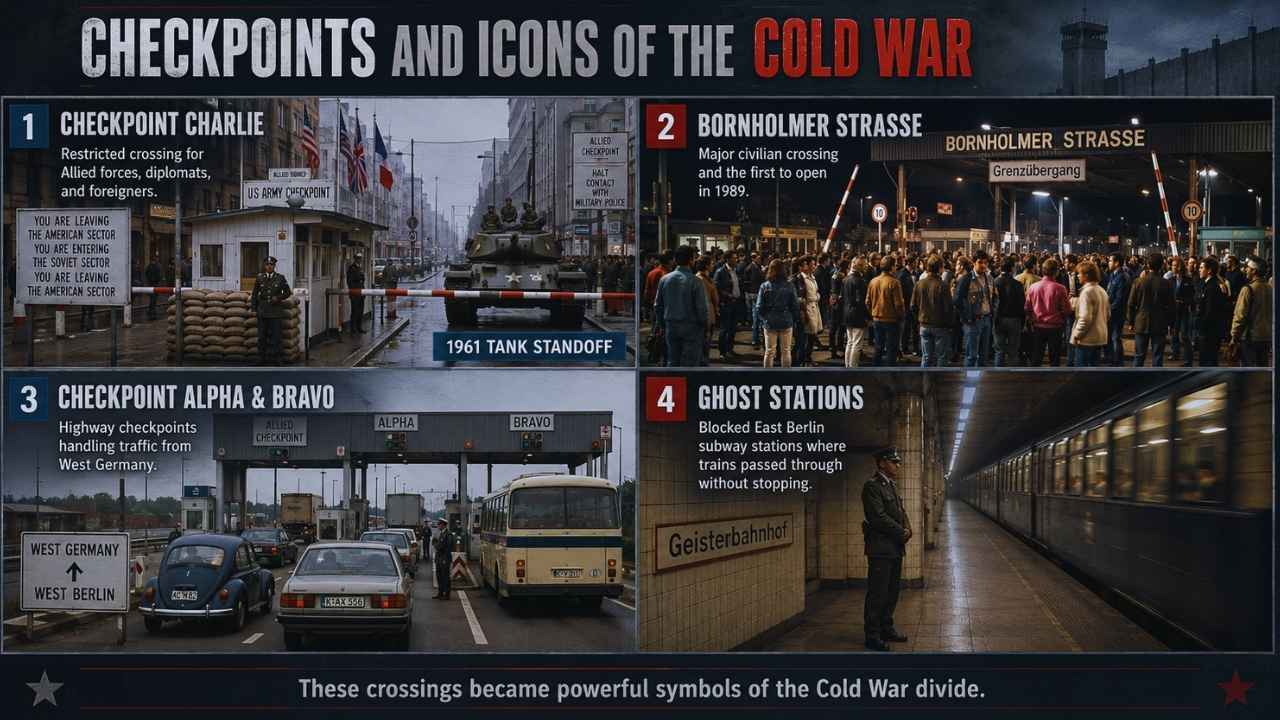
The border featured highly controlled crossing points, and they became legendary symbols of the Cold War standoff. The most famous was Checkpoint Charlie, located on Friedrichstrasse. The Allies named it using the NATO phonetic alphabet: Alpha, Bravo, and Charlie.
Checkpoint Charlie was restricted. Only members of the Allied forces, diplomats, and foreigners could cross there. Normal German citizens had to use entirely different stations. Because of this exclusivity, Charlie became the perfect backdrop for spy novels, espionage thrillers, and movies.
This specific checkpoint also hosted a terrifying historical moment. In October 1961, just months after the barrier went up, American and Soviet tanks rolled right up to Checkpoint Charlie. They faced each other with live weapons for days. It was one of the closest moments the world ever came to sparking World War III.
Other crossings carried equal weight. Bornholmer Strasse handled heavy civilian traffic and eventually became the flashpoint of the entire collapse. The East also created “ghost stations.” These were underground subway stops located in East Berlin that West Berlin trains passed through. East German guards heavily guarded the dark platforms, making sure no train ever stopped to pick up desperate citizens.
The Summer of ’89: Cracks in the System
|
The Catalysts |
What Changed in 1989 |
|
Mikhail Gorbachev |
New Soviet leader who heavily pushed for openness and reform. |
|
Sinatra Doctrine |
Soviets stopped threatening neighboring countries with military tanks. |
|
The Hungarian Loophole |
Hungary opened its border to Austria, letting East Germans flee. |
|
Leipzig Protests |
Massive, peaceful Monday marches demanding basic human rights. |
East Germany only survived for decades because the powerful Soviet Union backed it up. If people rioted, Moscow sent tanks to crush them. But in the late 1980s, the political ground completely shifted. Mikhail Gorbachev took over the Soviet Union in 1985. The Soviet economy was a disaster, and he knew it.
He pushed for huge reforms called Glasnost (openness) and Perestroika (restructuring). More importantly, Gorbachev stopped threatening Eastern Europe. He famously joked that he now followed the “Sinatra Doctrine.” Neighboring countries could do things their own way. The threat of Soviet tanks rolling through the streets vanished overnight.
Without tanks holding them back, people aggressively pushed for freedom. In August 1989, Hungary hosted a peaceful event called the Pan-European Picnic. They temporarily opened a border gate to Austria. Hundreds of East Germans ran right through it to safety. By September, Hungary left the border open permanently, punching a massive hole in the Iron Curtain. East Germans went on “vacation” to Hungary and crossed safely into the West.
Back in East Germany, the fear finally broke. Regular people started gathering in Leipzig every single Monday. What began as a small church meeting exploded into massive street protests. By late October, hundreds of thousands of people marched. They shouted, “Wir sind das Volk!” (We are the people!). The East German leaders watched in total panic, realizing they had completely lost control.
The Mistakes That Changed History: How the Berlin Wall Fell
|
Timeline: November 9, 1989 |
The Fumbled Play-by-Play |
|
Late Afternoon |
Leaders draft confusing new travel rules to calm the angry protests. |
|
6:53 PM |
Spokesman Günter Schabowski completely ruins the announcement on live TV. |
|
7:05 PM |
News networks broadcast that the East German borders are wide open. |
|
8:30 PM |
Massive, eager crowds start swarming the checkpoints. |
By November 1989, the East German government grew incredibly desperate. They forced out their stubborn old leader and tried to offer a tiny, bureaucratic compromise. They drafted a new law allowing citizens to apply for temporary travel visas.
It was a classic government trap. You still had to wait in long lines, fill out endless forms, and beg for permission. The rules were supposed to start the next day. But someone forgot to brief the public relations guy.
On November 9, government spokesman Günter Schabowski held a boring, routine press conference. Just before he sat down, someone handed him the new travel rules. He had not read them. He had skipped the important meeting where the politicians discussed them.
Near the end of the broadcast at exactly 6:53 PM, an Italian reporter asked about travel restrictions. Schabowski looked completely confused. He fumbled his papers. He read the complicated draft out loud. When the reporter asked when it actually took effect, Schabowski took a wild guess. He looked at the cameras and said, “As far as I know… it takes effect immediately, without delay.”
That single, colossal mistake is the real secret behind how the berlin wall fell. West German TV aired the clip immediately. They told the world, “The gates are open!” East Berliners did not wait for official permission. They grabbed their winter coats, walked out their front doors, and marched straight to the checkpoints.
Read Also: How World War 1 Started: Causes Explained Simply
11:30 PM: The Gates Crack Open
|
The Crisis at Bornholmer |
The Breaking Point at the Border |
|
The Commander |
Lieutenant Colonel Harald Jäger, the border officer on duty. |
|
The Bad Orders |
Bosses told him to stall and revoke the passports of loud protestors. |
|
The Pressure |
Tens of thousands of people pushed against the checkpoint gates. |
|
The Historic Choice |
At 11:30 PM, Jäger disobeyed his orders and opened the main barrier. |
The border guards on duty that night did not know what was happening. Nobody ordered them to open the heavy gates. At the busy Bornholmer Strasse crossing, a lieutenant colonel named Harald Jäger was literally eating a sandwich when he saw the TV broadcast. He almost choked.
A few hours later, tens of thousands of angry, screaming people stood outside his window demanding to get out. Jäger frantically called his bosses. He begged for orders. Nobody in the government wanted to make a hard call. They just told him to stall the massive crowd.
Later, they gave him a terrible, cruel order. They told him to let the loudest people out, but stamp their passports right over their faces. It secretly and permanently revoked their citizenship. They could leave, but they could never come back to their homes or families.
The crowd kept swelling. By 11:30 PM, the masses pushed incredibly hard against the metal gates. Jäger realized a deadly riot was about to break out. If guards fired shots, hundreds of innocent people would die. So, he made a massive, life-altering choice. He completely ignored his strict military protocol. He told his heavily armed guards to step back and open the main barrier wide open. He did not check a single ID. The crowd flooded through into West Berlin. The barrier finally broke.
The Morning After: Tearing Down the Iron Curtain
|
The Aftermath |
Rebuilding a Broken Nation |
|
The Euphoria |
Strangers cried, hugged, and drank free beer in the streets. |
|
Wall Woodpeckers |
People brought heavy hammers and smashed the concrete themselves. |
|
Reunification |
Germany officially became one country again on October 3, 1990. |
|
The Cleanup |
The military started bulldozing the remaining structures in June 1990. |
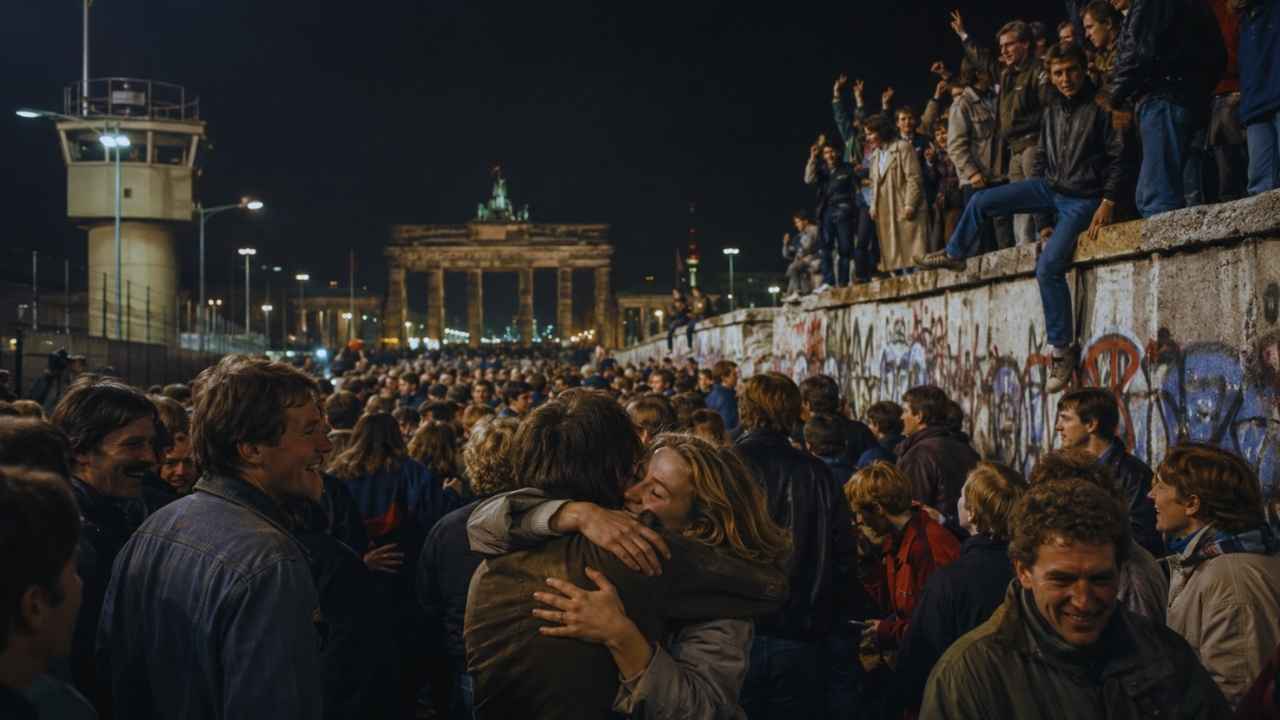
The scenes that night looked like pure magic. For the first time in 28 years, a divided city reunited. West Berlin bars handed out free drinks all night long. Complete strangers hugged and cried on the sidewalks. People climbed onto the concrete, singing and dancing directly in front of the historic Brandenburg Gate.
Regular citizens did not wait for the government to act. They showed up with hammers, heavy chisels, and pickaxes. They earned the nickname Mauerspechte, which translates to “wall woodpeckers.” They smashed the concrete themselves, keeping chunks of the painted stone as souvenirs. They literally tore down the Iron Curtain with their bare hands.
The East German government completely gave up. By June 1990, they brought in massive military bulldozers to tear down the rest of the 155-kilometer border safely.
The initial euphoria eventually faded into very hard work. The East German government collapsed entirely. Less than a year later, on October 3, 1990, East and West Germany legally became one country again. But smashing two different worlds together hurt. The East German economy was an absolute wreck. Factories closed down quickly, and people lost jobs. West Germany poured trillions of euros into fixing the East. Even today, you can spot subtle cultural differences between the two sides. Germans often call it the “Mauer im Kopf”—the wall in the head.
Final Thoughts
The story of a forcefully divided Berlin shows exactly how far oppressive governments will go to control human beings. The state was willing to shoot its own citizens just to keep the economy running. But the ending gives us massive hope for the future.
When you deeply research how the berlin wall fell, you realize that even the heaviest, most heavily armed borders can snap in an absolute instant. It did not take a massive nuclear war to end it. It took a brave crowd marching in the streets, shifting global politics, and one incredible mistake on live television.
Today, the few remaining concrete blocks do not divide anyone. You can visit them, touch them, and walk right past them. They just stand as a quiet reminder that freedom usually wins in the end.
Frequently Asked Questions (FAQs) About How Berlin Wall Fell
Did anyone die on November 9?
No. The night the borders opened was totally peaceful. But officially, at least 140 people died trying to cross between 1961 and 1989.
Who actually opened the first gate?
Lieutenant Colonel Harald Jäger. He commanded the Bornholmer Straße crossing. He disobeyed his bosses to prevent a bloody riot at 11:30 PM.
Did they smash the whole wall that night?
Not even close. People chipped away at it, but the military didn’t start the official demolition until June 1990. It took two years to clean up.
Why did Günter Schabowski mess up so badly?
He skipped a meeting. Somebody handed him a press release right before he went on TV. The paper didn’t clearly say the rules started the next day. When a reporter pressed him, he guessed wrong.