


Look, the tax code changed drastically right under our noses. If you are waiting until April next year to start thinking about your taxes, you are already giving the government way too much of your money. With the sweeping updates from recent legislative bills and new inflation-adjusted thresholds, the game plan for how to reduce your tax bill 2026 looks totally different than it did just a few years ago.
You don’t need to be a billionaire with offshore accounts to keep more of your paycheck. The tax code is basically a massive rulebook that tells you exactly how the government wants you to spend, invest, and save your money. When you follow their rules, they reward you with massive deductions and credits.
From huge bumps in standard deductions to completely overhauled retirement catch-up rules, smart financial planning right now will save you thousands of dollars later. Let’s walk through ten incredibly effective, completely legal strategies you can use to reduce your tax bill 2026 and protect your hard-earned wealth.
1. Maximize the New 2026 Retirement Account Limits
The easiest and most immediate way to lower your taxable income today is to hide your money in a pre-tax retirement account. Every dollar you push into a traditional 401(k) or traditional IRA is a dollar the IRS pretends you never made this year. It’s the ultimate “pay yourself first” strategy that simultaneously acts as a shield against federal income taxes.
|
2026 Retirement Plan |
Contribution Limit |
Age 50+ Catch-Up |
Age 60-63 Super Catch-Up |
|
401(k), 403(b), 457 |
$24,500 |
$8,000 |
$11,250 |
|
Traditional & Roth IRA |
$7,500 |
$1,000 |
N/A |
|
SIMPLE IRA |
$16,500 |
$3,500 |
$5,250 |
Hit the New Base Limits First
Inflation adjustments just bumped up how much you can squirrel away. In 2026, you can stash up to $24,500 into your workplace 401(k) or 403(b). If you manage to max that out and happen to fall into the 24 percent tax bracket, you instantly slash your tax bill by nearly six grand. That is free money staying in your pocket to compound over time rather than funding government projects.
Beyond just the tax savings, this money gets put to work in the stock market, building your long-term wealth. Even if you don’t have access to a workplace plan, funding a traditional IRA up to the new $7,500 limit gives you an immediate, dollar-for-dollar deduction, provided your income falls within the IRS guidelines. You want to automate these contributions straight out of your paycheck so you never even miss the money.
Use the Age 60 to 63 Super Catch-Up
Here is where the recent retirement legislation gets really interesting for older workers. If you turn 60, 61, 62, or 63 at any point during the 2026 calendar year, the government throws you a massive lifeline called the super catch-up. Instead of the standard $8,000 catch-up allowed for anyone over 50, you get to pump an extra $11,250 into your 401(k) completely tax-free.
Add that to the base limit, and you can shelter $35,750 from taxes this year alone. Oddly enough, once you hit your 64th birthday, your limit drops right back down to the standard catch-up level. If you sit in this specific sweet spot, maxing this out is an absolute no-brainer to lower your current tax burden while supercharging your nest egg right before retirement.
Sometimes the government takes away a tax break when you start making too much money, and they rarely warn you ahead of time. This year, high earners face a frustrating new rule regarding their retirement catch-up contributions that requires an immediate shift in strategy.
|
Income Level in 2025 |
Age in 2026 |
Catch-Up Contribution Type Allowed |
|
Under $150,000 |
50 or older |
Pre-Tax or Roth |
|
Over $150,000 |
50 or older |
Roth Only (Mandatory) |
The FICA Wage Threshold
Starting in 2026, the rules around catch-up contributions totally changed for upper-middle-class workers. If you earned more than $150,000 in FICA wages from your current employer last year, you are officially locked out of making pre-tax catch-up contributions to your workplace plan. The IRS now strictly demands that your $8,000 or $11,250 catch-up funds go straight into an after-tax Roth account.
Because Roth money is taxed before it goes in, you entirely lose a very valuable upfront tax deduction that you probably relied on heavily in previous years to bring down your adjusted gross income. This catches a lot of professionals completely off guard when they see their take-home pay shrink slightly because the tax deduction is gone.
Pivot Your Strategy to Reduce Your Tax Bill 2026
Losing an $8,000 deduction hurts terribly if you sit in the 32 or 35 percent tax bracket. To offset this newly generated tax liability, you have to look everywhere else for available tax shelters. You might need to aggressively fund your Health Savings Account, bunch your charitable donations, or realize some capital losses in your standard brokerage account.
While paying taxes on the Roth catch-up stings a bit today, try to look at the bright side. Remember that this Roth money will grow entirely tax-free for the rest of your life. It won’t be subject to Required Minimum Distributions (RMDs), which gives you incredible flexibility and defensive power against taxes later in retirement.
3. Exploit the Upgraded Health Savings Account (HSA)
If you have a High Deductible Health Plan (HDHP), ignoring your Health Savings Account is basically a financial tragedy. It remains the absolute best tax-advantaged account available to working Americans, and the funding limits just went up again this year.
|
2026 HSA Coverage Type |
Contribution Limit |
Age 55+ Catch-Up |
Tax Deduction Status |
|
Individual |
$4,400 |
$1,000 |
100% Pre-Tax |
|
Family |
$8,750 |
$1,000 |
100% Pre-Tax |
Understand the Triple Tax Advantage
An HSA beats a standard 401(k) and a Roth IRA combined, hands down. First, the money goes into the account entirely tax-free, which lowers your taxable income right now on a dollar-for-dollar basis. Second, you don’t just leave it in cash; you can actually invest the funds in index funds or ETFs, and the money grows completely tax-free.
Third, as long as you use the money to pay for qualified medical expenses, the withdrawals are entirely tax-free. You never pay a single dime of federal income tax on that money if you play strictly by the rules. It is the only account in the entire US tax code that offers this powerful triple tax advantage, making it a mandatory tool for wealth building.
Pay Cash Now and Keep the Receipts
To really hack the system and maximize your wealth, fully fund your HSA to the $8,750 family limit but do not spend a penny of it on your current copays or prescriptions. Instead, pay for your minor medical bills right out of your regular checking account. Let the HSA money sit invested in the stock market so it can compound over a decade or two.
The IRS currently has absolutely no time limit on when you reimburse yourself for medical costs. Keep your digital receipts organized in a cloud folder. Twenty years from now, you can cash out those old receipts and pull out massive chunks of tax-free money to fund your retirement lifestyle.
4. Bunch Your Charitable Giving with a DAF
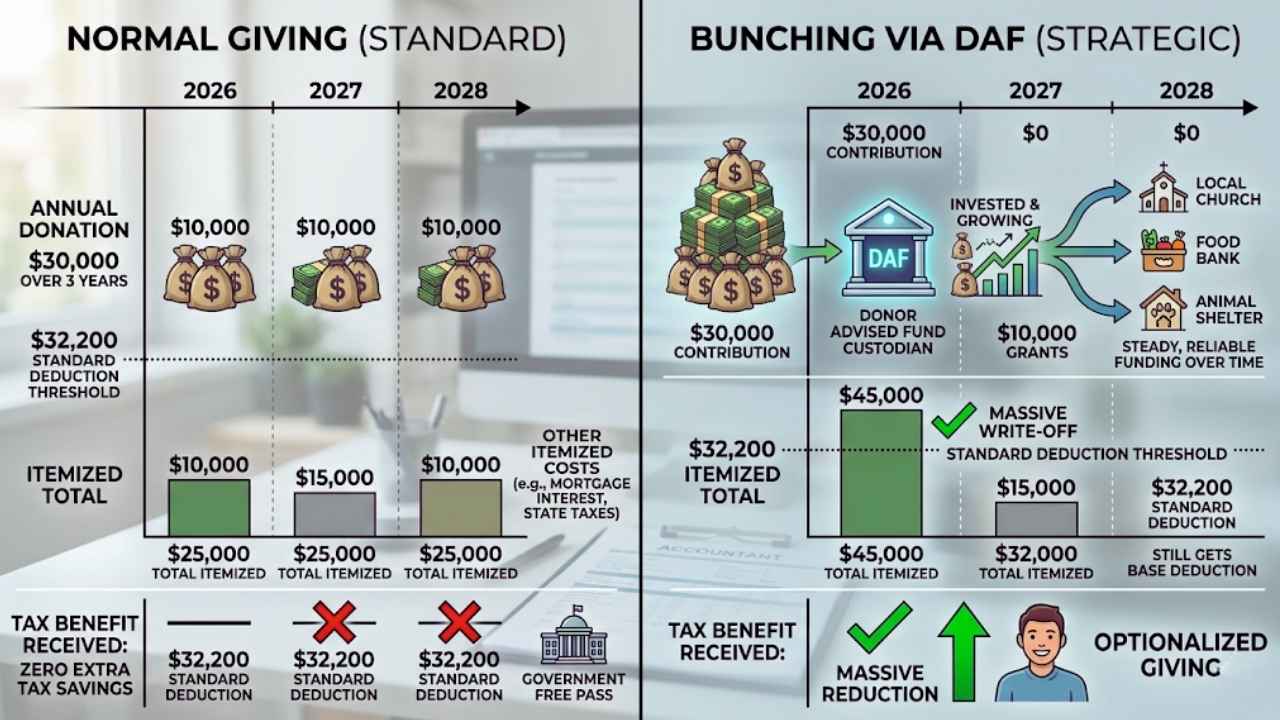
The updated standard deduction is incredibly generous right now. In 2026, a married couple gets a massive $32,200 standard deduction right off the bat. The problem is that unless your itemized deductions like mortgage interest, state taxes, and charity exceed that big number, giving money to your favorite cause does absolutely nothing to lower your taxes.
|
Giving Strategy |
Annual Donation |
2026 Total Deduction Claimed |
Tax Benefit Received |
|
Normal Giving (Standard) |
$10,000/year for 3 years |
$32,200 (Standard Deduction) |
Zero extra tax savings |
|
Bunching via DAF |
$30,000 in Year 1 |
$30,000 + other itemized costs |
Massive reduction in Year 1 |
|
Standard in Years 2 & 3 |
$0 |
$32,200 (Standard Deduction) |
Still gets base deduction |
Beat the Standard Deduction Threshold
If you normally give ten thousand dollars a year to your local church, food bank, or animal shelter, you likely just take the standard deduction every single year and get zero tax reward for your ongoing generosity. The government is basically getting a free pass while you fund these organizations.
The incredibly smart workaround is a strategy called bunching. Instead of giving a little bit every year, you cram three or four years’ worth of charitable donations into a single calendar year to force yourself over the high hurdle of the standard deduction.
Open a Donor Advised Fund
You execute this strategy smoothly by opening a Donor Advised Fund (DAF). You dump thirty thousand dollars into the fund in 2026. This single, massive contribution pushes your total itemized deductions way past the $32,200 threshold, allowing you to secure a massive tax write-off this year.
The cash sits safely in the DAF, where it can be invested and grow, and you simply instruct the fund manager to distribute the money to your chosen charities gradually over the next three years. You get a huge tax break today, the charities get their steady, reliable funding over time, and you seamlessly optimize your giving.
5. Roll Unused 529 College Funds into a Roth IRA
For the longest time, parents were terrified of overfunding a 529 college savings plan. If your kid got a full-ride scholarship or decided to become a plumber instead of going to a four-year university, taking that money out triggered nasty penalties and taxes on the growth. The rules have finally shifted heavily in favor of the parents.
|
529 Rollover Rule |
Requirement |
Limitation |
|
Account Age |
Must be open 15+ years |
Cannot bypass this rule |
|
Contribution Timing |
Contributions in last 5 years ineligible |
Only older funds can move |
|
Annual Transfer Limit |
Matches Roth IRA limit ($7,500 in 2026) |
Must be done over several years |
|
Lifetime Cap |
Maximum of $35,000 per beneficiary |
Hard ceiling |
Jumpstart Your Kid’s Retirement
If you have leftover money sitting in a 529 plan that has been open for at least fifteen years, you can now roll those funds directly into a Roth IRA for the exact same account beneficiary. This means you can confidently front-load those education accounts when your kids are young without the intense fear of getting penalized later.
You get the state tax deduction on the front end in many states, and if they don’t use all the money for tuition or books, you can magically convert it into a tax-free retirement nest egg for them. It completely changes the risk profile of college savings.
Mind the Strict Guardrails
The IRS definitely didn’t make this a total free-for-all, so you have to follow the playbook closely. You can only roll over an amount equal to the annual Roth IRA contribution limit, which sits at $7,500 for 2026. If you have $30,000 leftover in the account, it will take you four full years to move all the money over safely.
Also, any contributions or earnings made in the last five years are strictly off-limits for this transfer. Despite the bureaucratic red tape, this is a phenomenal wealth transfer tool that secures your child’s financial future while dodging steep penalty taxes.
6. Maximize 100 Percent Bonus Depreciation for Business
If you own a small business or work as a freelancer, 2026 is an absolute goldmine. Thanks to provisions permanently enacted recently, the ability to write off large equipment purchases and shield your cash flow from the government is better than it has been in years.
|
Asset Type |
Previous Depreciation Rule |
2026 Bonus Depreciation Rule |
|
Heavy Vehicles (over 6,000 lbs) |
Phasing down (20%) |
100% Year One Deduction |
|
Machinery & Equipment |
Phasing down (20%) |
100% Year One Deduction |
|
Qualified Improvement Property |
15-year straight line |
100% Year One Deduction |
Buy Equipment and Slash Your Profits
Normally, when you buy a forty-thousand-dollar commercial van or heavy manufacturing machinery, the IRS forces you to write off that expense slowly over a torturous five or ten years. That doesn’t help you at all if you are staring down a giant tax bill today and need immediate relief.
Under the currently active rules, businesses can take 100 percent bonus depreciation on qualifying assets placed into service this year. This means you take the entire deduction immediately against your 2026 revenue, rapidly bringing your taxable profit down to a much more manageable level.
Renovate Your Commercial Space
It actually gets even better for brick-and-mortar owners. Qualified Improvement Property now officially qualifies for this immediate write-off provision. If you own a restaurant, a dental practice, or a retail shop and you drop two hundred thousand dollars renovating the interior to make it look modern, you can deduct the entire cost against your current year revenue.
If you had a blowout year in sales and need to dramatically shelter that cash flow from the IRS, upgrading your equipment or remodeling your space before December 31 is the ultimate, perfectly legal tax shield.
7. Clean Up Your Portfolio with Tax Loss Harvesting
Investing outside of a retirement account means you eventually have to pay capital gains taxes when things go well. But smart investors never, ever pay taxes on their winning stocks without first checking to see if they can offset the bill with their losing stocks.
|
Transaction Type |
Financial Impact |
Tax Result in 2026 |
|
Sell Stock A |
$10,000 Profit |
Owe capital gains tax |
|
Sell Stock B |
$10,000 Loss |
Generates a tax deduction |
|
Net Impact |
$0 Gain |
Zero taxes owed |
|
Sell Stock C |
Additional $3,000 Loss |
Deduct against W-2 ordinary income |
Cancel Out Your Capital Gains
Tax loss harvesting is a fundamental strategy you should run every single December before the year closes. If you sold a mutual fund in June and made ten thousand dollars, you owe heavy taxes on that realized profit.
However, if you look closely at your portfolio and notice another stock or fund is sitting deep in the red, you can intentionally sell it at a ten thousand dollar loss. Those two specific transactions completely cancel each other out on your tax return, acting as a perfect counterbalance to erase the tax liability entirely.
Erase Your Ordinary Income
If you had a terrible, volatile year in the stock market and your losses far exceed your gains, the IRS actually throws you a small bone. You can take up to $3,000 of those excess stock market losses and use them to lower your ordinary income, such as your W-2 salary. Anything beyond that $3,000 limit simply gets carried forward to next year, indefinitely.
You just have to watch out for the tricky wash sale rule. You can’t sell a losing stock and buy the exact same stock back the next day just to get the tax break. You must wait thirty-one days or buy a totally different ETF that tracks a similar index to stay invested.
8. Master the New 1099-K Reporting Rules
If you have a side hustle, sell vintage items on eBay, or freelance and get paid through third-party platforms like PayPal or Venmo, the IRS tracking rules have flipped back and forth endlessly. For 2026, the dust has finally settled, and you need to know exactly what paperwork is coming your way.
|
Payment Processor Type |
2026 Reporting Threshold |
Form Issued |
|
Third-Party (PayPal, Venmo) |
$20,000 AND 200 transactions |
1099-K |
|
Credit Card Processors |
Any amount ($0.01+) |
1099-K |
|
Direct Client Payments |
$2,000+ |
1099-NEC |
Separate Personal and Business Accounts
The current standing rule states that third-party platforms only have to send you a 1099-K tax document if you cross $20,000 in revenue and have more than 200 individual transactions. However, if you mix your personal and business money in the same app, things get incredibly messy fast.
If your roommate sends you half the rent money on Venmo and it accidentally pushes you over the reporting limit, the IRS assumes all of it is taxable business income. The absolute easiest way to protect yourself and keep your sanity is to open a totally separate digital wallet or bank account exclusively for your side hustle.
Track Every Single Expense
Receiving a 1099-K does not mean you automatically owe taxes on that giant gross number printed on the page. You only ever pay taxes on your actual net profit. You have to start treating your small side hustle like a real, legitimate corporation.
Track the cost of the goods you sold, the cardboard shipping materials, the steep platform fees, and even the portion of your home internet you use to run your digital shop. Deducting all these legitimate expenses meticulously is exactly how you reduce your tax bill 2026 when the IRS wrongly assumes you made a massive fortune selling crafts online.
9. Put Your Children on the Family Payroll
If you operate a sole proprietorship, an LLC, or a partnership, hiring your kids is a completely legal, highly encouraged wealth transfer strategy that essentially creates tax-free money for your entire family unit.
|
Family Member |
2026 Standard Deduction |
Federal Income Tax Rate |
Business Deduction Status |
|
Single Child (W-2 Employee) |
$16,100 |
0% up to deduction limit |
100% Deductible for Business |
Shift Income to a Zero Percent Bracket
The underlying math here is absolutely brilliant for business owners. You are likely sitting in a high tax bracket, probably paying 24 or 32 percent on your business profits. Your child, however, is sitting in a zero percent tax bracket. In 2026, a single filer gets a $16,100 standard deduction.
If you hire your teenage kid to run your company’s social media accounts, sweep the warehouse floors, or file digital paperwork, you can legally pay them up to $16,100 this year. Because of their standard deduction, they pay absolutely zero federal income tax on that money.
Create a Generational Wealth Machine
Meanwhile, your business gets to write off their entire $16,100 salary as a standard, fully deductible business expense. This drastically lowers your taxable profit and slashes your own steep tax bill. The work has to be real, age-appropriate, and paid at a normal, justifiable market rate—you can’t pay a toddler fifty bucks an hour to staple papers.
Once they have that earned income sitting in their checking account, they can take $7,500 of it and drop it straight into a Roth IRA. You just systematically lowered your taxes and essentially made your teenager a future millionaire by the time they hit retirement age.
10. Install Green Energy Upgrades Before Credits Sunset
The government deeply loves to subsidize residential energy efficiency, but the clock is ticking loudly on some of the best tax credits available to American homeowners. Remember, a tax credit is exponentially better than a standard tax deduction. A deduction just lowers your taxable income, but a credit is a straight dollar-for-dollar reduction of the actual tax you owe the IRS.
|
Green Home Upgrade |
Tax Credit Type |
Max Annual Limit |
|
Energy Efficient Windows/Doors |
25C Credit (30% of cost) |
$1,200 aggregate limit |
|
Heat Pumps / Biomass Stoves |
25C Credit (30% of cost) |
$2,000 separate limit |
|
Solar Panels / Battery Storage |
25D Credit (30% of cost) |
No upper dollar limit |
Claim the 25C and 25D Credits
If your home’s HVAC system is on its last legs, 2026 is the perfect year to replace it with a modern, high-efficiency heat pump. You can easily grab a tax credit of up to $2,000 just for making the environmentally friendly switch. If you are replacing drafty exterior doors, old windows, or adding heavy insulation to your attic, you can claim up to $1,200 annually.
Because the 25C credit resets every single year, smart homeowners spread their renovations out strategically. Do the windows this year, do the doors next year, and claim the maximum credit both times to squeeze every dime out of the program.
Go Big with Solar Projects
If you are planning major structural additions like rooftop solar panels or residential battery storage systems, the 25D Residential Clean Energy Credit still offers a massive 30 percent credit with no upper cap whatsoever. Drop thirty grand on a massive solar array, and you wipe nine thousand dollars straight off your federal tax bill instantly.
These specific residential credits are slowly pacing toward expiration later this decade, making immediate action incredibly lucrative for homeowners wanting to reduce their tax bill 2026 and lower their monthly utility costs.
Final Thoughts
The tax code shifted massively under recent legislation, and burying your head in the sand will absolutely cost you money you can’t afford to lose. The strategies are laid out right in front of you, waiting to be executed. By maximizing your super catch-up contributions, funneling cash through a triple-tax-advantaged HSA, front-loading business equipment purchases, and keeping your side hustle expenses perfectly documented, you can legally drain the water out of your taxable income pool.
If you want to successfully reduce your tax bill 2026, you have to stop acting like tax season happens only in April. Tax season happens every single time you get a paycheck, buy a business asset, or make an investment. Take control of your numbers today, consult with a qualified CPA to map out your specific brackets, and keep your wealth right where it belongs.
Frequently Asked Questions (FAQs) About Reduce Tax Bill Legally
What is the new standard deduction for 2026?
Thanks to inflation and new legislation, the standard deduction jumped significantly. Single filers can claim $16,100, heads of household get $24,150, and married couples filing jointly can claim a massive $32,200. This makes itemizing unnecessary for the vast majority of taxpayers.
Can I still deduct my state and local taxes (SALT) in 2026?
Yes. If you choose to itemize rather than take the standard deduction, the SALT cap limit has been adjusted to $40,400 for joint filers and $20,200 for married couples filing separately. This is a temporary increase that provides huge relief in high-tax states.
What is the SECURE 2.0 super catch-up rule?
If you are between the ages of 60 and 63 during the 2026 calendar year, you are allowed to make an elevated catch-up contribution of $11,250 to your workplace 401(k), totally replacing the standard $8,000 limit allowed for other workers over 50.
Why did I receive a 1099-K from Venmo for my personal transactions?
If you mix business and personal payments in a single digital account and cross $20,000 and 200 transactions, the platform reports the gross amount to the IRS. You must carefully document and separate personal reimbursements (like splitting dinner) from taxable business revenue on your actual tax return.
Can I claim 100 percent bonus depreciation on used equipment?
Yes, absolutely. The updated rules permanently restored 100 percent bonus depreciation for qualifying assets. The equipment can be lightly used, provided it is totally new to you and you purchased it from an unrelated party during the active calendar year.
How do I avoid the kiddie tax when hiring my children?
The “kiddie tax” generally applies to unearned income, like huge dividends or capital gains on investments in a child’s name. When you put your child on the actual payroll with a W-2 for legitimate work, that is earned income, which is sheltered up to their standard deduction of $16,100 without triggering the kiddie tax.