


Watching a legendary batter completely locked in at the crease gave me my earliest lessons in focus and resilience. You have to block out the noise, read the pitch, and protect your wicket. You need that exact same resilient mindset when managing your finances—especially your credit history.
If you want to buy a house, finance a car, or land a great job, your credit file holds the keys. But cracking open that document for the first time feels like translating ancient Greek. Staring at rows of numbers and weird status codes leaves most people stressed out. Learning how to read credit report files isn’t just a financial chore. It is a basic survival skill. The major bureaus process billions of data points, and they mess up constantly.
When they get your data wrong, you pay the price through higher interest rates or flat-out loan denials. Let’s cut through the jargon. We are going to break down exactly how to decode your file, spot the red flags secretly costing you money, and force the data brokers to fix their mistakes.
Why You Need to Know How to Read Credit Report Data
Forget the three-digit credit score for a second. Your score is just the final grade; your credit report is the actual homework. Lenders, landlords, and employers do not just glance at the final grade. They dig into the raw data to see exactly how you handle risk and manage your money over time. When you figure out how to read credit report data yourself, you take back control. You stop guessing why that auto loan rate came back so high. You catch identity theft before a scammer drains your accounts. You ensure outdated mistakes do not illegally haunt your financial future.
If you do not audit your own file, nobody else will. The Consumer Financial Protection Bureau (CFPB) reported that credit reporting disputes generated an absolute flood of complaints recently. In 2025 alone, the CFPB received approximately 5.8 million complaints related to consumer reporting, which accounted for a massive 88 percent of all financial complaints they processed. That staggering number proves the system is heavily flawed. You have to be your own advocate.
|
Organization |
What They Actually Look For |
How It Directly Impacts You |
|
Mortgage Lenders |
Debt-to-income ratio, bankruptcies, late payments |
Decides your interest rate, down payment, and loan approval |
|
Landlords |
Evictions, unpaid utility bills, massive collections |
Determines if you get the apartment or need a co-signer |
|
Employers |
Extreme financial stress, massive unpaid debt |
Influences hiring decisions for security or finance roles |
|
Insurance Companies |
Risk profiling algorithms based on debt load |
Drives your monthly auto and home premiums up or down |
Grab Your Free Files (The Right Way)
Before we analyze the data, you need the actual documents in front of you. Federal law guarantees your right to see exactly what the bureaus say about you. Since the pandemic, the rules shifted permanently in your favor. You can now check your credit report from each of the three major bureaus once a week for free. You must go to the official government-mandated site to do this safely. Stay away from shady websites asking for your credit card or offering a trial subscription.
The official site never charges you a dime. Three massive data brokers track your financial life: Equifax, Experian, and TransUnion. They operate independently and do not share information with each other. This means you have three completely separate credit reports. A massive mistake might ruin your Equifax report while your Experian file looks flawless. Checking all three ensures you do not miss a hidden error that a specific bank reported to only one bureau.
|
Credit Bureau |
What Makes Them Different |
Best Way to Dispute Errors |
|
Equifax |
Often includes alternative data like phone and utility bills |
Online portal or certified mail for paper trails |
|
Experian |
Lets you manually add positive rent history to boost your file |
Online dispute center with uploaded documents |
|
TransUnion |
Widely used by landlords for quick tenant screening processes |
Direct phone line, certified mail, or online portal |
Breaking Down the 5 Main Sections
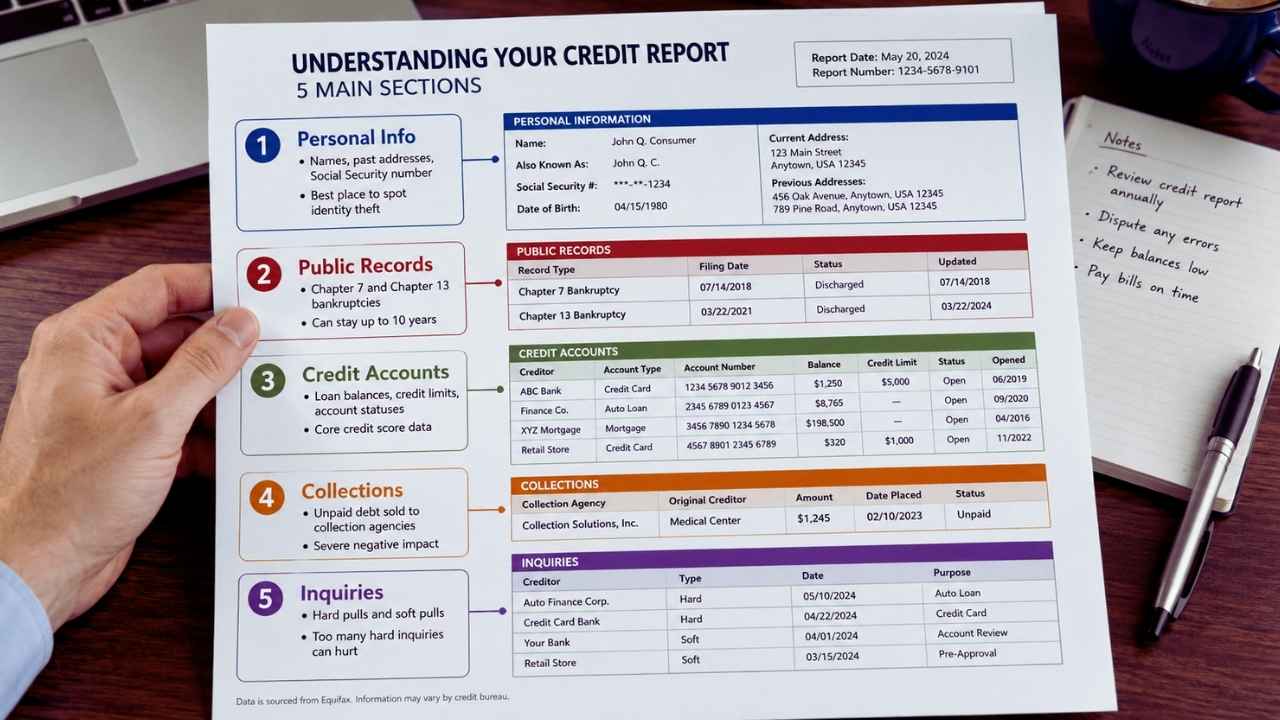
When you download your file, you get a massive wall of text spanning dozens of pages. Do not panic. Every single report uses the exact same standardized sections. Once you know the layout, the whole thing makes perfect sense. The first section holds your Personal Identifying Information (PII), acting as your financial fingerprint with names and addresses. Next comes Public Records, highlighting major court-level financial disasters like bankruptcies.
The third and largest section holds your credit accounts, also called tradelines. This shows every credit card and loan you have. The fourth section lists Collections, showing debts you stopped paying that were sold to third-party agencies. Finally, the Inquiries section tracks exactly who looked at your file. Learning how to read credit report sections systematically prevents you from getting overwhelmed by the sheer volume of data. Start at the top and work your way down.
|
Report Section |
What Data Lives Here |
Why You Must Check It Carefully |
|
Personal Info |
Names, past addresses, Social Security number |
The absolute best place to spot early signs of identity theft |
|
Public Records |
Chapter 7 and Chapter 13 bankruptcies |
Stays on your record for up to 10 years and ruins lending odds |
|
Credit Accounts |
Loan balances, credit limits, account statuses |
The core data that dictates 65 percent of your credit score |
|
Collections |
Unpaid debt sold to third-party collection agencies |
Devastates your score; shows a history of severe non-payment |
|
Inquiries |
Hard pulls for new loans and soft pulls for yourself |
Too many hard inquiries make you look desperate for cash |
Decoding the Secret Language of Tradelines
Look closely at your tradelines and you will see a grid of boxes filled with numbers or letters. That is your payment history. It tells future lenders exactly how reliable you are every single month for the past several years. Understanding this grid is the biggest part of mastering how to read credit report files. You want to see an “OK” or a green checkmark in every single box. If you miss a payment, the bank reports exactly how late you were.
The numbers 30, 60, and 90 represent how many days past the due date your payment arrived. Lenders heavily penalize these late marks. If you completely stop paying, you might see “CO” for a charge-off. This means the bank wrote your debt off as a complete loss. A charge-off destroys your creditworthiness and stays on your record for seven years. Know these codes so you know exactly what story your file tells.
|
Status Code |
What It Actually Means in Plain English |
Score Impact and Severity |
|
OK / Checkmark |
Paid on time and exactly as agreed with the bank |
Highly positive; builds trust and scores over time |
|
30 |
30 days past the official due date |
Minor damage; score usually recovers fairly quickly |
|
60 |
60 days past the official due date |
Moderate damage; flags a growing financial problem |
|
90 / 120 |
90 to 120 days late on your payment |
Severe damage; screams high default risk to lenders |
|
CO / Charge-Off |
The lender gave up and wrote the debt off as a loss |
Devastating; completely blocks most new loan approvals |
Spotting Errors That Cost You Money
Never assume the credit bureaus get it right. If a random bank sends them bad info, the bureau just posts it. Grab a highlighter, pull up your files, and aggressively hunt for mistakes. Look out for the ex-spouse trap, where your former partner’s new individual credit cards suddenly pop up on your file. Watch for zombie debts, which are negative marks that legally must fall off your report after seven years. If a late payment from eight years ago still shows up, the bureau is artificially tanking your score.
Keep a sharp eye on medical debt. In 2025, a major federal rule trying to ban all medical debt was struck down in court. However, the three major bureaus still voluntarily refuse to report medical collections under $500, and they wipe all paid medical collections completely. Despite this, roughly 15 million Americans still have massive medical debts dragging down their files. If you see paid medical bills or small medical debts listed, dispute them immediately.
|
Common Error Type |
What It Looks Like on the Page |
How It Secretly Damages Your Finances |
|
Mixed File Data |
An address in a state where you never actually lived |
Causes automatic loan denials due to mismatched identities |
|
Zombie Debt |
A collection account older than seven years |
Illegally drags down your current score and lending odds |
|
Double Whammy |
A bank and a collection agency listing the same exact debt |
Double-counts your debt load and ruins your utilization ratio |
|
Medical Billing |
Paid medical collections still showing as active |
Unfairly lowers your score despite voluntary bureau bans |
|
Balance Errors |
A closed account falsely showing a massive balance |
Wrecks your credit utilization and makes you look overextended |
How to Dispute Errors Like a Pro
Finding the error is only step one. Now you have to force them to delete it. Do not pay a sketchy repair company thousands of dollars. You have the legal right to do this yourself for free, and it works perfectly if you follow the system. The bureaus will not just take your word for it. You need undeniable proof. Find the bank statement showing the cleared check or get a police report for identity theft.
Dispute the mistake directly with the credit bureau, showing the error. Sending certified mail with a return receipt requested creates a bulletproof paper trail. By law, a dispute investigation typically finishes within 30 days, though it can stretch to 45 days if you supply extra information. The bureau acts as the middleman, forwarding your proof to the bank. If the bank cannot prove the data is accurate, the bureau legally has to delete it. Once finished, they will mail you the final results within five days.
|
Dispute Phase |
Required Action on Your Part |
Legal Timeline and Expectations |
|
Preparation |
Collect bank statements, IDs, and police reports |
Take as much time as you need to build your case |
|
Filing |
Mail the dispute letter via certified mail |
The bureau must receive it to start the official clock |
|
Investigation |
The bureau contacts the original bank to verify facts |
30 days (up to 45 days if you add more documents) |
|
Resolution |
Bureau deletes the error or confirms it as accurate |
Results mailed to you within 5 days of completion |
|
Escalation |
File a formal complaint with the federal government |
CFPB steps in if the bureau unfairly ignores your proof |
Lock It Down: Freezes vs. Fraud Alerts
Once you clean up your file, you must protect it. If you see strange accounts you did not open, lock your credit down immediately. You have two free tools to stop scammers in their tracks. A fraud alert acts like a loud warning flag. It tells lenders they must call you on the phone to verify your identity before opening a new account. This alert lasts for one full year and you can renew it easily.
A credit freeze serves as a heavy-duty steel vault. It completely blocks access to your credit report. Nobody can open an account until you thaw the freeze using a custom PIN or password. A freeze is the ultimate defense against identity theft. If you are not actively shopping for a mortgage or a new car, you should keep your credit frozen at all times. It costs nothing, takes five minutes, and saves you from massive headaches.
Read Also: How to Reduce Your Tax Bill Legally in 2026: 10 Strategies
|
Protection Type |
How It Actually Functions |
Best Time to Use This Tool |
|
Fraud Alert |
Tells lenders to verify your ID before granting credit |
You suspect a data breach but still want easy loan access |
|
Credit Freeze |
Completely blocks all access to your credit file |
You want maximum security and are not applying for loans |
|
Extended Alert |
Lasts 7 years; requires a police report to turn on |
You are a confirmed victim of severe identity theft |
|
Temporary Thaw |
Unlocks your frozen file for a few specific days |
You need to apply for a single credit card or auto loan |
Final Thoughts
Knowing exactly how to read credit report details gives you a massive edge. You shift from a passive consumer to an active protector of your own reputation. Just like reading the pitch in a cricket match, you have to stay focused on the details to defend your financial standing. The data brokers make mistakes constantly. If you do not audit their work, you are the one paying the ultimate price in higher interest rates, denied applications, and lost opportunities.
Make it a rock-solid habit. Set a calendar reminder to pull your free files a few times a year. Verify every single grid, check for illegal medical debts, and aggressively dispute the mistakes. Your credit history dictates your financial life. Take charge and make sure it tells the exact story you want it to tell.
Frequently Asked Questions (FAQs) About How to Read Credit Report
Does checking my own credit drop my score?
Not at all. Checking your own file is a “soft inquiry.” It has zero impact on your score, even if you check it every single day. Only “hard inquiries” from lenders drop your score.
Do my spouse’s debts show up on my report?
Only if your name is attached. If you co-sign a car loan, it hits both reports. If your spouse gets a credit card entirely in their own name, it stays off your file. You don’t share a “couples” credit score.
If I pay off a collection, does it disappear?
Usually, no. It changes to a “paid collection,” but the account stays on your report for the full seven years. The good news? Newer credit scoring models completely ignore paid collections.
Does my salary show up on my report?
No. Your credit report strictly tracks debt. It does not show your income, your bank account balances, or your debit card purchases. Lenders ask for your salary on applications, but they can’t verify it through your Equifax file.