
The sun is basically a massive, wireless power plant floating in space. Every single day, it sends more energy to our planet than we could ever hope to use. For most of human history, that energy just hit the ground and turned into heat, warming the soil and driving the weather.
Now, we have a highly efficient way to catch it. If you have ever looked at a house roof covered in sleek, dark, glassy squares, you have seen the world’s most popular way to harvest the sun. But exactly how do solar panels work in a way that actually lets you toast bread, run an air conditioner, or charge a laptop?
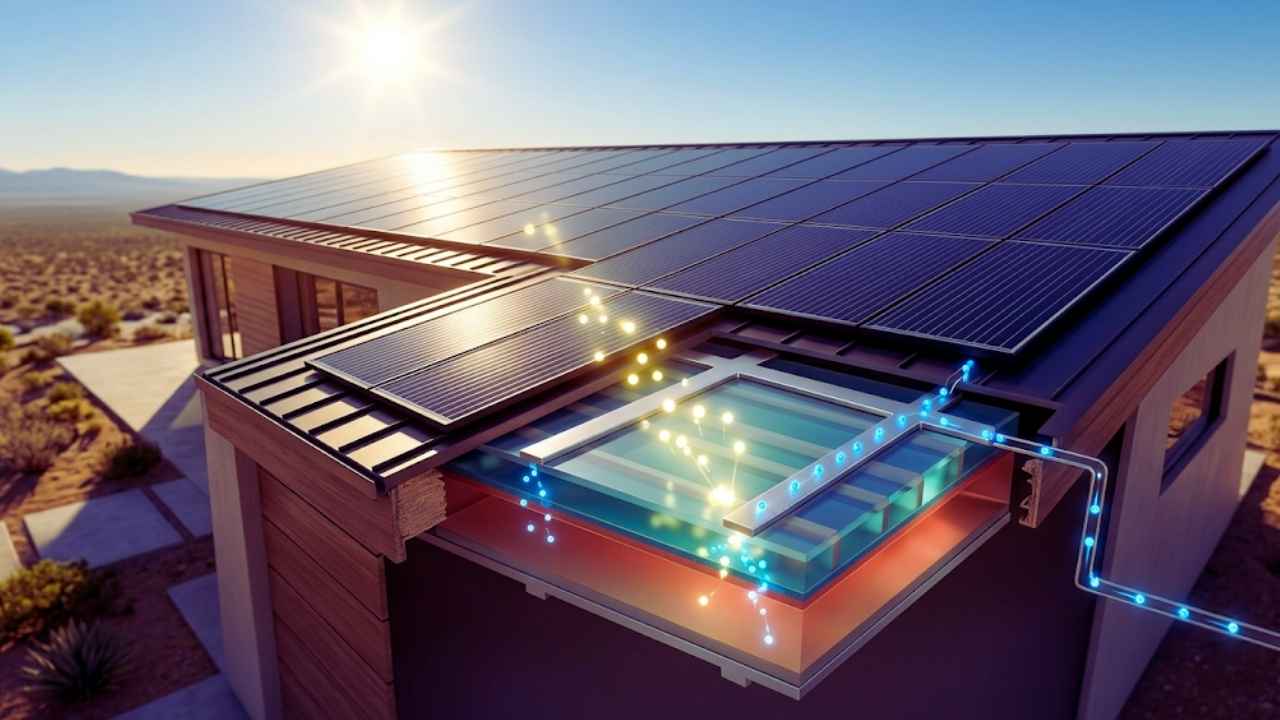
At its core, solar technology relies on a specific trick of physics known as the photovoltaic effect. It sounds like a complex mouthful, but it simply means that certain special materials can turn light directly into electrical current. Unlike a gas generator or a massive wind turbine, there are no spinning parts, no gears, and no loud engines. It is a completely silent, solid-state process that happens invisibly at the atomic level. This guide walks you through the exact science, the necessary hardware, and the future of solar energy, completely skipping the confusing engineering jargon.
The Core Science: Understanding the Photovoltaic Effect
To really grasp the mechanics of solar power, we have to zoom in and look at the tiny building blocks of the universe. Sunlight is not just a warm glow; it actually consists of billions of tiny energy packets called photons. When these photons crash into a solar cell, they act like a cue ball hitting a rack of billiard balls, transferring their energy to the electrons inside.
However, just knocking electrons around is not enough to power your home. You need to force those loose electrons to flow in one specific direction. Scientists achieve this by using silicon, a unique material that acts as a semiconductor. By tweaking the silicon with other elements, they create a one-way street for electricity.
The Silicon Sandwich and Atomic Doping
A standard solar cell is built like a microscopic sandwich made of two different layers of silicon. Manufacturers start with extremely pure silicon, the same stuff used to make computer microchips, and slice it into paper-thin wafers. To make these wafers generate electricity, they have to undergo a chemical process called “doping.” The top layer of the silicon sandwich is baked with phosphorus, an element that naturally has more electrons than silicon.
This gives the top layer a negative electrical charge, making it what we call “N-type” silicon. The bottom layer is baked with boron, which actually has fewer electrons, leaving tiny empty spaces called “holes.” This gives the bottom layer a positive charge, known as “P-type” silicon. When you press these two customized layers together, they form an electric field right at the boundary where they touch. This boundary is called the P-N junction, and it acts exactly like a one-way turnstile for electrons.
|
Material Component |
Treatment Process |
Electrical Charge |
Role in the Cell |
|
Top Silicon Layer |
Doped with Phosphorus |
Negative (N-Type) |
Provides extra electrons ready to move |
|
Bottom Silicon Layer |
Doped with Boron |
Positive (P-Type) |
Provides “holes” to receive electrons |
|
The Boundary |
P-N Junction |
Neutralized Barrier |
Creates the one-way electric field |
From Photons to Electron Flow
When a photon from the sun crashes into this prepared silicon sandwich, the real magic happens. The photon transfers its raw energy directly to an electron sitting near that P-N junction we just talked about. This sudden burst of energy knocks the electron completely out of its normal orbit, leaving it free to move around inside the material. Because of the strong electric field created by the doped silicon, that loose electron gets aggressively pushed toward the negative top layer of the cell.
It desperately wants to get back to the positive bottom layer to find a resting spot, but the one-way electric field blocks it from taking a shortcut straight down. To solve this problem, engineers attach metal contacts to the top and bottom of the cell, connecting them with a wire. The electron travels out of the top, flows all the way through the wire, and eventually drops back into the bottom layer. That physical movement of electrons running through the wire is the exact definition of an electrical current.
|
Phase of Movement |
Action Happening |
Resulting Effect |
|
Photon Impact |
Sunlight hits the silicon atoms |
Energy is transferred to an electron |
|
Excitation |
Electron absorbs the energy |
Electron breaks free from its atom |
|
Directional Push |
Electric field repels the electron |
Electron is forced to the top layer |
|
External Travel |
Electron enters the metal wiring |
Electrical current is generated |
The Anatomy of a Solar Panel System
Understanding how do solar panels work means looking past just the single silicon cell. One little square of silicon only produces about half a volt of electricity, which is barely enough to power a small digital watch. To run heavy household appliances, you need to combine hundreds or thousands of these cells to build up serious voltage and current. But even a massive array of panels is practically useless on its own.
The electricity coming off your roof is wild, raw, and completely incompatible with the standard outlets inside your walls. A functional solar setup requires a whole cast of supporting hardware to capture, convert, and safely deliver that energy to your appliances.
Solar Cells, Modules, and Arrays
We throw the word “panel” around a lot, but the technical term for the glass rectangle on your roof is a solar module. Inside a typical residential module, you will usually find exactly 60 or 72 individual solar cells wired tightly together in a grid. These cells are highly fragile, so they are sandwiched inside protective layers of special plastic and topped with heavy-duty tempered glass to survive hail storms.
An aluminum frame holds the entire heavy package together and provides a secure mounting point. When you install several of these modules side-by-side on a roof, the whole collection becomes known as a solar array. Installers wire the individual modules together in long chains, combining their total electrical output to match the specific power needs of your household. The larger the array, the more total power you can generate on a sunny afternoon.
|
Hardware Term |
Definition |
Typical Residential Specs |
|
Solar Cell |
The single silicon square |
6 inches by 6 inches, 0.5 volts |
|
Solar Module |
A single complete panel |
Contains 60 to 72 wired cells |
|
Solar Array |
The entire roof system |
Ranges from 10 to 30 modules total |
|
Output Capacity |
Total potential power |
Usually 5 to 10 kilowatts per home |
The Inverter: The Brain of the System
If the solar array is the heart of the system, the inverter is undoubtedly the brain. Solar modules generate a specific type of electricity called Direct Current (DC), where the electrons flow strictly in one straight line. The problem is that the wider power grid and almost everything plugged into your house runs on Alternating Current (AC), where the electricity rapidly switches directions back and forth. You literally cannot plug a TV into a DC power source without destroying it.
The inverter takes that raw DC power from the roof and rapidly flips it to create perfectly smooth AC power. In standard setups, a single large “string inverter” sits on the side of your house and handles the math for the whole roof. In more modern systems, tiny “microinverters” are bolted to the back of every single panel, converting the power right there on the roof. This ensures that if one panel gets shaded, the rest of the system keeps humming along at maximum speed.
|
Inverter Type |
How It Operates |
Best Use Case |
|
String Inverter |
One large box for the whole roof |
Simple, unshaded roofs on a budget |
|
Microinverter |
One small box behind every panel |
Roofs with trees, chimneys, or weird angles |
|
Power Optimizer |
Conditions DC power before a central inverter |
A middle-ground between string and micro |
|
Hybrid Inverter |
Manages both solar and home battery storage |
Homes looking for blackout protection |
Racking and Wiring Infrastructure
You cannot just superglue heavy glass panels to your shingles and call it a day. Solar modules weigh around forty pounds each and act like massive sails when the wind blows hard. Installers use a specialized racking system made of rust-proof extruded aluminum to securely bolt the array directly into the heavy wooden rafters inside your attic. They carefully seal every single roof penetration with waterproof flashing to guarantee you never get a leak during a rainstorm.
Once the heavy metal rails are locked down, the panels clamp securely into place. Underneath the array, installers run heavy-gauge, UV-resistant wiring to carry the raw power down the side of your house. They also install safety disconnect switches near your electrical meter. These bright red switches allow firefighters or utility workers to instantly shut off the power flow from the roof during a neighborhood emergency.
|
Infrastructure Part |
Material Used |
Primary Purpose |
|
Mounts/Standoffs |
Stainless steel & rubber |
Secures the system deep into the roof rafters |
|
Racking Rails |
Extruded aluminum |
Creates a flat grid to lay the panels on |
|
Flashing |
Aluminum or galvanized steel |
Waterproofs the holes drilled into the roof |
|
Conduit Piping |
Rigid metal or PVC |
Protects the high-voltage wires from weather |
The Step-by-Step Journey: From Sunlight to Toaster
Tracing the exact path of the energy makes it much easier to understand how do solar panels work in your daily life. The journey begins roughly 93 million miles away in the center of our solar system and literally ends inside the heating coils of your kitchen toaster. Because electricity moves essentially at the speed of light, this entire journey happens instantaneously.
The moment the morning sun crests the horizon and hits your roof, your home is automatically sipping on cosmic energy. You never have to flip a switch, check a dial, or tell the system to wake up. It is a completely passive and continuous loop of energy generation.
Step 1: Absorption and Excitation
The process kicks off the second sunlight strikes the tempered glass surface of the solar array. The glass itself is specially formulated with an anti-reflective coating to prevent the light from bouncing off into the neighborhood. The photons pass straight through the glass and slam into the dark blue or black silicon cells resting underneath. Not all light gets absorbed; some passes through, and some is lost as heat, but the silicon captures a massive portion of the visible light spectrum.
As the silicon atoms absorb the sheer energy of these tiny light packets, their internal electrons start to vibrate violently. They quickly gain enough energy to break free from their standard atomic orbits. This creates a microscopic storm of millions of loose electrons trapped inside the silicon sandwich, eagerly looking for a place to go.
|
Absorption Factor |
Description |
Impact on Process |
|
Glass Coating |
Anti-reflective chemical layer |
Ensures maximum light enters the cell |
|
Silicon Color |
Dark blue or black tinting |
Absorbs more heat and light spectrums |
|
Photon Energy |
The actual power of the light |
Dictates how many electrons break loose |
|
Bandgap Limit |
The specific energy threshold |
Determines which colors of light work best |
Step 2: Creating the Current
Once the electrons break loose, the internal physics of the cell take over to organize the chaos. The built-in electric field we discussed earlier acts like a traffic cop, pushing all those wild electrons toward the top layer of the cell. They cannot go backward, so they squeeze into the ultra-thin silver metal fingers printed across the top of the silicon. These tiny fingers act like small side streets that funnel the electrons into wider metal highways called busbars.
The busbars carry the steady stream of electrons out of the individual cell and into the heavy copper wiring hidden in the back of the panel. From there, the power runs through heavy-duty waterproof connectors, often called MC4 connectors, linking one panel to the next. This organized, one-way rush of electrons is the raw Direct Current (DC) electricity actively leaving your roof.
|
Component |
Visual Appearance |
Function in Current Path |
|
Metal Fingers |
Hair-thin silver lines on the cell |
Gathers loose electrons from the silicon |
|
Busbars |
Thicker silver stripes crossing the cell |
Acts as the highway moving electrons out |
|
Junction Box |
Small black plastic square on the back |
Houses the electrical connections safely |
|
MC4 Connectors |
Heavy rubber plugs |
Snaps panels together in a watertight chain |
Step 3: Transformation and Usage
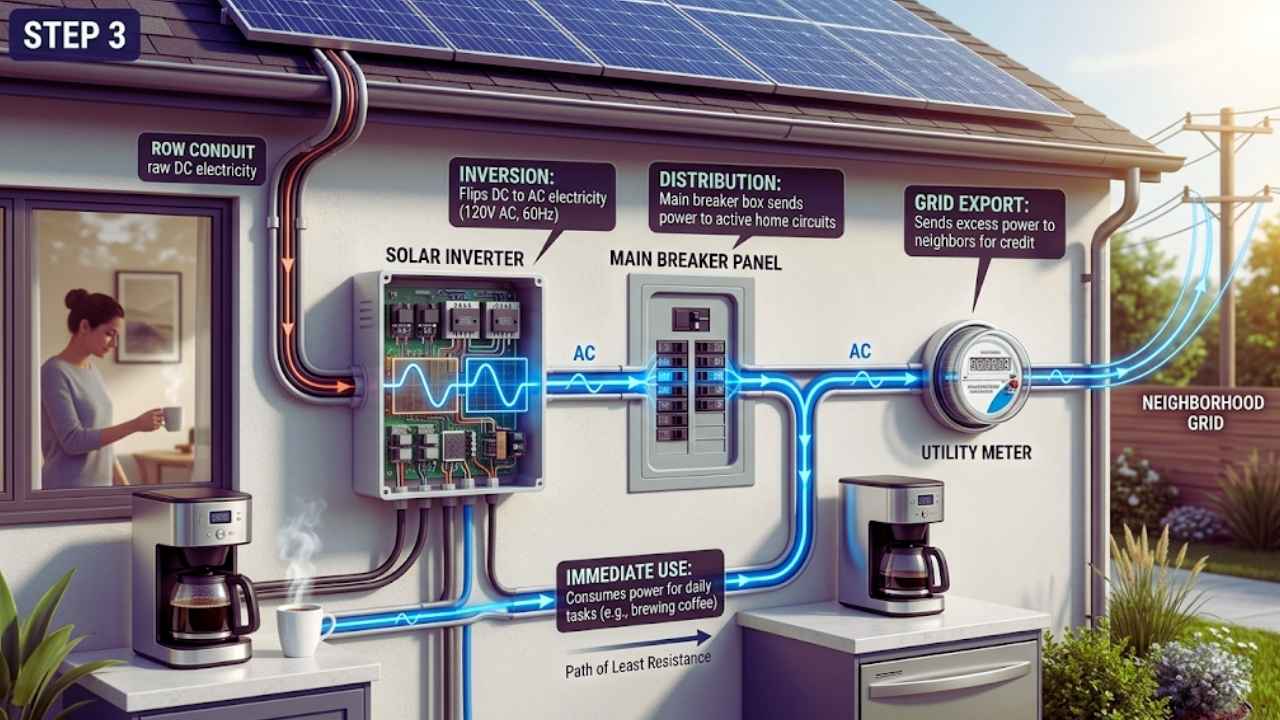
The thick wires carry this newly minted DC electricity down the side of your home and feed it straight into the solar inverter. The inverter acts immediately, using complex solid-state transistors to chop up the DC current and flip it back and forth exactly sixty times a second. This incredibly fast flipping action transforms the raw power into standard 120-volt Alternating Current (AC). From the inverter, the AC power flows directly into your home’s main breaker panel.
Electricity is fundamentally lazy; it always takes the path of least resistance. If you are currently brewing coffee, the power flows straight to your kitchen outlet to heat the water. If your house is completely empty and no appliances are running, the power flows out through your utility meter and onto the neighborhood grid. Your utility company then tracks that exported power and gives you a financial credit on your next bill.
|
Step in Usage |
Location |
Action Occurring |
|
Inversion |
Side of the house/behind panel |
Flips DC to AC electricity |
|
Distribution |
Main breaker box |
Sends power to active home circuits |
|
Immediate Use |
Home appliances |
Consumes power for daily tasks |
|
Grid Export |
Utility meter |
Sends excess power to neighbors for credit |
Efficiency Factors: What Affects Solar Performance?
If you are researching how do solar panels work, you will quickly notice that they don’t produce the exact same amount of power every single day. A panel’s efficiency rating simply tells you what percentage of the sunlight hitting the glass actually gets converted into usable electricity. Back in the early 2000s, panels struggled to hit 12% efficiency, but modern residential panels easily sit between 20% and 23%. While that still leaves a lot of uncaptured energy, it is incredibly high for commercial semiconductor technology. Understanding the environmental factors that boost or drag down this efficiency helps homeowners design a better system. It turns out that solar panels are surprisingly picky about weather, angles, and cleanliness.
Temperature and Weather Impact
A massive misconception is that solar panels love boiling hot summer days. Because panels generate electricity from light rather than heat, extreme temperatures actually hurt their performance. Solar modules are basically giant electronics, and just like your smartphone, they start to drag when they overheat. When the silicon gets too hot, the electrons become chaotic and hyperactive, making it much harder for the internal electric field to force them in the right direction.
Believe it or not, a crisp, freezing, bright winter day is actually the perfect environment for maxing out a solar panel’s efficiency. Even snowy weather has a hidden benefit; while snow covering the panels blocks power, snow on the ground reflects massive amounts of extra light back up toward the roof. Light cloud cover obviously reduces output, but the panels still generate decent power by capturing the ambient, scattered light shining through the gray sky.
|
Weather Condition |
Impact on Efficiency |
Reason |
|
Extreme Heat (90F+) |
Noticeable Drop |
Heat makes electron control difficult |
|
Cold & Sunny |
High Peak Performance |
Cool silicon handles electron flow perfectly |
|
Light Clouds |
Slight to Moderate Drop |
Captures scattered/diffuse light well |
|
Heavy Snowfall |
Total Stop (if covered) |
Blocks photons from reaching the glass |
Orientation, Tilt, and Shading
You can buy the most expensive panels on earth, but if you point them at a brick wall, they will produce nothing. In the Northern Hemisphere, panels should ideally face true south to catch the absolute longest arc of the sun as it moves across the sky from east to west. The tilt of the panels should roughly match the geographical latitude of your home to catch the sun rays at a perfect ninety-degree angle. Shading is the absolute worst enemy of solar production.
If a chimney or a large oak tree casts a hard shadow across even just ten percent of a traditional string of panels, it can choke the output of the entire system. It acts exactly like stepping on a garden hose; the flow of water stops for the whole hose, not just the part you stepped on. Installers fight this by using smart microinverters that let shaded panels drop off without dragging the rest of the sunny panels down with them.
|
Placement Factor |
Ideal Setup |
Consequence of Poor Setup |
|
Roof Direction |
True South facing |
East/West drops power; North is terrible |
|
Roof Pitch |
Matches home latitude |
Sun hits at a glancing, weaker angle |
|
Obstructions |
Zero shade from 9 AM to 3 PM |
Chimney shadows choke system output |
|
Inverter Tech |
Microinverters for shady roofs |
String inverters amplify shading losses |
The Role of Air Quality and Dust
Solar panels sit outside 24/7, meaning they take a beating from the local environment. Over time, things like city smog, thick spring pollen, or dry summer dust build up a dirty film over the protective glass. This phenomenon, known in the industry as “soiling,” literally blocks the tiny photons from ever reaching the silicon inside. In bone-dry desert states, a heavy layer of dust can drop a system’s total output by five to ten percent over a few months.
If you live near an area prone to summer wildfires, falling ash can coat the panels entirely and temporarily halt production. Thankfully, most solar arrays are tilted at a steep enough angle that a solid afternoon rainstorm naturally squeegees the glass clean. If you do live in a dry climate, occasionally hosing the panels down early in the morning will instantly restore them to peak efficiency, though you should never use a high-pressure washer that could break the glass seals.
|
Type of Debris |
Source |
Cleaning Method |
|
Standard Dust |
Dry wind and dirt roads |
Rain or a light garden hose rinse |
|
Sticky Pollen |
Heavy tree coverage in spring |
Gentle brush with a mild soap mix |
|
Wildfire Ash |
Downwind from active fires |
Immediate rinse once the air clears |
|
Bird Droppings |
Local wildlife |
Focused scrubbing; rain rarely clears it entirely |
Comparing Types: Mono, Poly, and Thin-Film
If you start shopping around, you will realize that the answer to how do solar panels work changes slightly depending on the exact manufacturing method used. The ultimate goal is always the same—moving loose electrons—but the physical material those electrons travel through can look very different.
Choosing the right panel type usually comes down to balancing your available roof space against your overall budget. If you have a tiny roof, you have to squeeze every drop of power out of it. If you have a massive metal barn in the backyard, you can afford to use larger, cheaper panels to hit your energy goals.
Monocrystalline: The High Performers
Monocrystalline panels are the undisputed kings of the residential solar market today. They are created using the complex Czochralski process, where a single “seed” crystal of silicon is slowly pulled out of a vat of molten rock to form one massive, perfectly continuous cylinder. Because the silicon structure has zero breaks or fractures, the electrons have an incredibly smooth highway to travel down, resulting in the highest efficiency ratings on the market.
You can easily spot them on a roof because the cells are a sleek, solid black color with slightly rounded corners. Because they generate the most power per square foot, they are absolutely perfect for standard suburban homes with limited roof space. The only real downside is that the slow manufacturing process makes them the most expensive option upfront.
|
Monocrystalline Feature |
Description |
|
Visual Appearance |
Solid black, sleek, rounded cell edges |
|
Average Efficiency |
Very high (20% to 23%) |
|
Space Requirement |
Minimal space needed for high output |
|
Manufacturing Cost |
Most expensive due to pure silicon waste |
Polycrystalline: The Budget Option
Polycrystalline panels take a much rougher, faster approach to manufacturing. Instead of carefully growing one single crystal, manufacturers pour a bunch of melted raw silicon fragments right into a square mold and let it cool down quickly. This creates a panel made of thousands of tiny, broken crystal structures mashed together. Because the electrons have to physically cross the boundaries between all these mismatched crystals, they face a lot more resistance, which drops the overall efficiency of the panel.
You can identify them instantly by their shattered-glass appearance and bright, speckled blue color. While they require a lot more physical roof space to generate the same amount of electricity as monocrystalline panels, they are significantly cheaper to produce. They are still heavily used today for massive utility-scale solar farms out in the desert where physical space is virtually unlimited.
|
Polycrystalline Feature |
Description |
|
Visual Appearance |
Speckled blue, looks like shattered glass |
|
Average Efficiency |
Medium (15% to 17%) |
|
Space Requirement |
Requires large roofs or ground mounts |
|
Manufacturing Cost |
Cheaper due to simple molding process |
Thin-Film: Flexibility and Niche Uses
Thin-film technology throws the standard silicon wafer rulebook out the window. Instead of using rigid crystals, engineers take photovoltaic chemicals—like cadmium telluride or amorphous silicon—and spray them in incredibly thin layers over a backer like glass, flexible plastic, or thin metal. This results in a panel that is practically paper-thin, incredibly lightweight, and highly flexible.
You see thin-film used on curved architectural roofs, the tops of RVs, or integrated directly into portable hiking backpacks. They also perform surprisingly well in extreme heat and heavy shade compared to standard panels. However, they are terribly inefficient, meaning you would need a massive amount of them to power a normal house. They also tend to degrade much faster than rigid silicon, making them a poor long-term investment for a residential rooftop setup.
|
Thin-Film Feature |
Description |
|
Visual Appearance |
Uniform solid black or brown, no cell grid lines |
|
Average Efficiency |
Lowest (10% to 13%) |
|
Physical Flexibility |
Can bend around curves and weird shapes |
|
Longevity |
Degrades faster than rigid crystalline panels |
2026 Tech Trends: The Next Generation of Solar
The solar industry does not stand still. If you researched how do solar panels work a decade ago, you mostly read about bulky silicon and ugly aluminum frames. As we navigate through 2026, the lab coats are pushing the absolute boundaries of physics to squeeze more juice out of the sun.
We are witnessing a major transition away from standard technology toward exotic new materials and hyper-intelligent computer integrations. These advancements are slowly making solar invisible, highly interactive, and vastly more powerful than anything we installed in the early 2020s.
Perovskite Tandem Cells
The biggest buzzword in solar science right now is “Perovskite.” This is a unique class of synthetic materials that share a specific crystal structure, and they can literally be printed onto surfaces like ink from a newspaper press. Silicon is great at absorbing red light, but it is terrible at catching blue light. Scientists are now building “tandem cells” by spraying a microscopic layer of Perovskite directly on top of a standard silicon cell.
The top Perovskite layer catches the high-energy blue light, while the red light passes through to be caught by the silicon underneath. By working as a team, these tandem cells are finally shattering the theoretical efficiency limits of plain silicon, regularly testing above thirty percent in real-world conditions. This means future panels will generate massively more power without getting any bigger.
|
Tech Comparison |
Standard Silicon |
Perovskite Tandem Cell |
|
Primary Material |
Pure Silicon Wafers |
Silicon base + Printed Perovskite top |
|
Light Absorption |
Mostly red spectrum |
Captures both blue and red spectrums |
|
Efficiency Ceiling |
Roughly 26% maximum |
Breaking past 30% in commercial tests |
|
Manufacturing Cost |
High energy required |
Cheaper printing process potential |
Smart Panels and IoT Integration
Hardware is only half the battle; software is taking over the roof. Modern solar panels are becoming heavily integrated with the Internet of Things (IoT). Microchips installed behind every single panel now connect directly to your home WiFi network. You can open an app on your smartphone and watch the precise wattage generated by cell number four in real-time.
If a squirrel chews a wire or a tree branch falls and cracks the glass, the smart panel instantly sends an alert to your phone and to your installer, preventing weeks of lost power. These smart systems also talk directly to the utility grid, automatically selling your power when neighborhood demand is highest to get you the best financial return. In 2026, your roof is essentially acting as a miniature, highly intelligent virtual power plant.
|
Smart Feature |
How It Helps the Homeowner |
|
Cell-Level Monitoring |
Detects exactly which panel is underperforming |
|
Instant Fault Alerts |
Texts you if equipment breaks or overheats |
|
Grid Negotiation |
Automatically sells power at peak demand pricing |
|
Battery Syncing |
Decides when to charge batteries vs sell to grid |
Environmental and Financial Impact
When everyday people ask how do solar panels work, they usually have an underlying question: “Are they actually worth the money and the effort?” The answer lies in the massive, measurable impact they have on both your wallet and the atmosphere. By shifting away from burning ancient fossil fuels, a single residential array makes a serious dent in local carbon emissions.
Over a thirty-year lifespan, one home can offset the equivalent carbon of driving a gas-powered car for hundreds of thousands of miles. Financially, the narrative has completely flipped from a “luxury green purchase” to a rock-solid financial investment. With standard electricity rates jumping wildly every year, locking in your own private power plant makes incredible economic sense.
The Energy Payback Period
Skeptics often claim that manufacturing a solar panel creates more pollution than the panel ever saves. Mining the quartz, melting the silicon at extreme temperatures, and shipping the heavy panels globally does require a lot of upfront energy. However, scientists track a metric called the “Energy Payback Time” to see when a panel breaks even.
Thanks to hyper-efficient modern manufacturing, a standard panel installed today produces enough clean electricity to entirely pay back its “carbon debt” in just about one and a half to two years. Since the equipment is warrantied to survive for at least twenty-five years, it spends the vast majority of its life as a pure, net-positive benefit to the earth. When panels finally do die, emerging recycling plants are now recovering up to 95% of the silver, copper, and glass to build the next generation.
|
Life Cycle Phase |
Energy/Carbon Status |
Timeline |
|
Manufacturing/Mining |
Creates a carbon debt |
Year 0 |
|
Energy Payback |
Generating clean power to break even |
Year 1 to Year 2 |
|
Net Positive Lifespan |
Pure carbon reduction phase |
Year 3 to Year 25+ |
|
End of Life |
Heavy materials recycled for new tech |
Year 30 |
Boosting Property Value
Putting a power plant on your roof does incredible things for your home equity. Real estate data consistently shows that homes equipped with fully owned solar systems sell noticeably faster than identical homes without them. In a tough housing market, buyers absolutely love the idea of moving into a house where the summer air conditioning bill is practically zero dollars.
Appraisals typically increase by several thousand dollars for every kilowatt of solar installed, often covering the entire upfront cost of the system right away. It is incredibly important to note that this value boost only applies if you actually purchase the panels outright or with a standard loan. If you sign a complex solar lease or a power purchase agreement, it can sometimes complicate the home sale because the new buyer has to agree to take over the leasing contract.
|
Financial Aspect |
Benefit to Homeowner |
Important Caveat |
|
Home Appraisal |
Average 4% increase in home value |
System must be owned, not leased |
|
Time on Market |
Homes often sell 20% faster |
Regional buyer demand varies |
|
Utility Savings |
Protects against annual rate hikes |
Fixed utility connection fees still apply |
|
Tax Incentives |
Federal and state cash back |
Requires paying taxes to claim the credit |
Final Thoughts
Learning the ins and outs of how do solar panels work gives you a profound appreciation for one of the most important technologies of our lifetime. We have successfully figured out how to catch invisible light particles flying through space and turn them into the exact electricity we need to heat our water and light our living rooms. The reliance on the photovoltaic effect means we can generate power without making a sound, without burning a drop of fuel, and without moving a single mechanical gear.
As we push deeper into 2026, the technology is only getting cheaper, smarter, and significantly more powerful. Putting solar on your roof is no longer a futuristic science experiment; it is the most practical way to take control of your daily energy costs while doing the planet a massive favor.
Frequently Asked Questions (FAQs) About How Solar Panels Work
What happens to solar panels when it is raining?
Rain actually helps solar panels by washing away thick dust, pollen, and bird droppings that might block light from reaching the silicon. While total power production drops because the heavy clouds block direct sunlight, the panels still capture ambient light and generate a small amount of power. They are completely sealed and waterproof, so there is zero risk of electrical shorts during a storm.
Can solar panels power my house during a grid blackout?
Standard grid-tied solar systems automatically shut down the second the neighborhood loses power for strict safety reasons. If they kept pushing power into the grid, they could electrocute utility workers trying to fix the broken power lines down the street. If you want your house to run during a blackout, you must install a home battery system that disconnects you from the grid when the power drops.
Do I need to replace my roof before getting solar?
Because solar arrays are designed to stay bolted to your house for twenty-five to thirty years, you need a roof that will last just as long. If your asphalt shingles are more than ten or fifteen years old, installers will heavily recommend replacing them before putting the panels up. Taking a heavy solar system down just to fix a leaky roof a few years later is a highly expensive and frustrating process.
Will a bird’s nest under the panels cause a roof fire?
Pigeons and squirrels love the warm, protected space sitting right underneath solar panels. While fires are exceedingly rare, dried leaves and twigs pushed against high-voltage wires are never a good idea. Modern, high-quality solar installations usually include “critter guards,” which are tough wire meshes wrapped around the edges of the array to keep wildlife completely out.
Can I run my heavy air conditioner on solar power?
Yes, you absolutely can run heavy appliances like central air conditioning, well pumps, or electric vehicle chargers on solar power. An average residential solar array pumps out massive amounts of energy during the hottest part of the afternoon, which happens to be the exact time your air conditioner is working the hardest. It is a perfect match of supply and demand.