


I finally deleted my budgeting app last year. I was completely sick of the constant alerts telling me I went three dollars over my “coffee budget,” and I hated paying a monthly subscription fee just to see my own money. Plus, giving a third-party tech company read-access to every bank account I own just didn’t sit right with me anymore.
You don’t need a fancy dashboard to manage your money. Automating your finances often makes you entirely blind to where your cash actually goes. Passive tracking lets you swipe your card and ignore the damage until the first of the month rolls around.
Recent financial data backs this up. Roughly 44 percent of Americans don’t have a budget at all, and only 38 percent of those who do have a budget actually follow it. It makes sense why 78 percent of consumers are stuck living paycheck to paycheck. Active tracking flips the script entirely. It forces you to look at every single dollar. If you want to know how to track spending without handing over your data or paying a monthly fee, you need a system that relies on your own daily habits. Here are the most effective, completely app-free ways to monitor your cash flow, keep yourself accountable, and keep your personal data private.
Why Going Analog Changes Your Money Mindset?
We love convenience. But convenience is your worst enemy when you want to stop impulse buying. When an app pulls in your transactions automatically, you never feel the sting of the purchase. You swipe, the app does the math in the background, and you stay totally disconnected from the reality of the transaction. Research proves this psychological phenomenon perfectly. A famous MIT study organized a silent auction for highly sought-after sports tickets, telling half the bidders to pay with cash and the other half to use credit cards. The credit card buyers bid more than twice as much as the cash buyers.
Neuroeconomic research shows that handing over physical cash activates the insular cortex, which is the exact same part of your brain that processes physical pain. Credit cards act like painkillers for your wallet. Writing down a purchase brings that necessary friction back into your life. It makes you pause.
It makes you realize those five random late-night online orders actually ate up half your grocery money. Manual tracking forces you to face the music immediately. In fact, Americans paid an astonishing 253.37 billion dollars in credit card interest and fees in 2025 alone. By tracking your money manually, you introduce friction that naturally curbs the spending behavior that leads to those massive interest payments.
|
Feature |
Automated Apps |
Manual Tracking |
|
Data Privacy |
High risk of third-party data syncing |
100 percent secure because you own your data |
|
Financial Awareness |
Low because you set it and forget it |
High due to active daily engagement |
|
Monthly Cost |
Usually 5 to 15 dollars per month |
Completely Free |
|
Behavioral Impact |
Hides the emotional pain of paying |
Adds friction to naturally curb spending |
The Pen and Paper Method (And The Kakeibo System)
You can’t hack a piece of paper. The oldest method in the book survives because it actually works. Grab a cheap pocket notebook and a pen, and carry it everywhere. Every time you buy something, write down the date, what you bought, and what it cost. A recent 2025 survey actually found that 39 percent of women and a large portion of adults over 45 still prefer using simple pen and paper for budgeting because it is straightforward and reliable. If you want a bit more structure, try Kakeibo. Invented in 1904 by Hani Motoko, Japan’s first female journalist, this system translates to “household financial ledger”.
Kakeibo isn’t just about crunching numbers; it forces you to be mindful. At the start of the month, write down your income and fixed bills, and set a savings goal. Then, answer four questions before you spend a dime: How much money do I have right now? How much do I want to save? How much am I currently spending? How can I do better next month?.
Categorize your spending into four pillars: Survival, Optional, Culture, and Unexpected. Studies and modern applications of this method show that writing down spending intentions before the month begins can increase savings by up to 35 percent. Writing these down manually makes you hyper-aware of your random purchases, ensuring you always know how to track spending where it actually counts.
|
Kakeibo Category |
What It Means |
Everyday Examples |
|
Survival |
Things you cannot live without |
Rent, groceries, electricity, transit |
|
Optional |
Things you enjoy but don’t need |
Takeout, new shoes, random snacks |
|
Culture |
Things that enrich your mind |
Books, museum trips, educational courses |
|
Unexpected |
Surprise costs you couldn’t plan for |
Flat tires, doctor copays, last-minute gifts |
How to Track Spending With a Spreadsheet Dashboard?
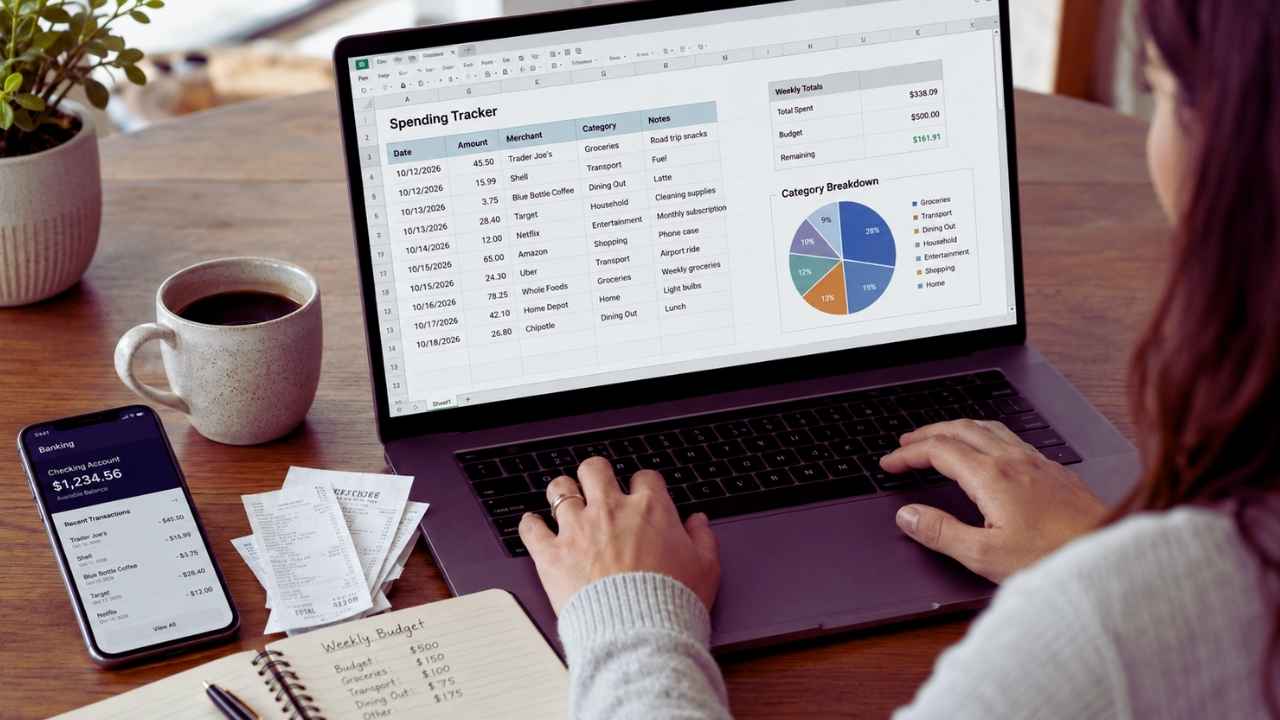
If paper feels too old-school, spreadsheets are the perfect middle ground. You get manual accountability mixed with automated math. Google Sheets and Microsoft Excel are powerful, free, and totally customizable. Despite the explosion of fintech apps, a massive segment of middle and high-income earners still heavily favor spreadsheets for managing their money. I always point people to a basic spreadsheet when they want a fast, reliable system. You don’t need a degree in data science to set one up. Just make a sheet with five columns: Date, Amount, Merchant, Category, and Notes.
The secret is turning off bank imports. Once a week, grab a coffee, open your banking app on your phone, and manually type your transactions into your computer. Put a simple addition formula at the top of your columns so your totals update as you type. This keeps you in the driver’s seat.
More than 50 percent of people across all age groups say unexpected expenses throw off their budgeting efforts. When you manually input your data every single week, you spot those unexpected expenses immediately instead of getting blindsided at the end of the month.
|
Tracking Column |
Why You Need It |
Example Entry |
|
Date |
Spots exactly when you spend the most |
10/12/2026 |
|
Amount |
The exact cost that brings back the pain |
45.50 dollars |
|
Merchant |
Who actually took your money |
Trader Joe’s |
|
Category |
How the expense fits into your budget |
Groceries |
|
Notes |
Context for your end-of-month review |
“Road trip snacks” |
The Cash Envelope System
Sometimes, the best way to fix your budget is to put physical walls around it. The cash envelope system is a classic strategy that makes overdrafts and credit card debt mathematically impossible. Thanks to social media trends like TikTok, this method has recently exploded in popularity again under the name “cash stuffing”. Figure out your monthly budget based on your take-home pay, and pay your fixed bills straight from your checking account. But for the categories where you usually blow your money, go to the ATM and pull out the exact amount in physical cash.
Divide the cash into actual paper envelopes and label them. The market for cash envelope planners reached a staggering 1.2 billion dollars in 2025 just because this tangible methodology works so well. When you run to the grocery store, leave your debit card at home and only bring the grocery envelope.
If the total is over your limit, you have to put something back. No exceptions. When people ask me how to track spending using physical limits, I tell them to look at an empty envelope. Seeing cash vanish is a massive psychological motivator. Once the envelope is empty, you are done spending in that category for the month.
|
Action Step |
What You Do |
Why It Works |
|
Check Income |
Find your exact take-home pay |
Sets a hard ceiling you can’t cross |
|
Review History |
Look at past bank statements |
Gives you realistic numbers, not guesses |
|
Stuff Envelopes |
Withdraw cash for variable spending |
Creates physical boundaries for your money |
|
Hard Stop |
Stop buying when the cash runs out |
Completely prevents new credit card debt |
The Manual Review: Highlighting Bank Statements
If you hate notebooks, refuse to use spreadsheets, and don’t want to carry cash, try the highlighter audit. Print your bank and credit card statements on the last day of the month. Grab three different colored highlighters. Pick one color for survival items, another for wants, and a third for wealth-building activities like debt payments and savings. Sit down and manually highlight every single line item on those pages. Add up the totals for each color.
Seeing a page completely covered in your discretionary “Wants” color is usually a big enough shock to change your habits instantly. It is a retroactive method, but highly effective for visual learners. By identifying these bright, undeniable trends, you inherently learn how to track spending flaws before they ruin your next paycheck.
With 49 percent of Americans having less than 1,000 dollars in savings as of recent surveys, identifying exactly where your money leaks out is the only way to build that emergency cushion back up. This color-coding exercise takes fifteen minutes but provides a reality check that no app notification can ever match.
|
Color Code |
Expense Type |
Monthly Target |
|
Pink |
Needs and Survival |
Under 50 percent of your take-home pay |
|
Yellow |
Wants and Discretionary |
Under 30 percent of your take-home pay |
|
Green |
Savings and Debt Payoff |
Over 20 percent of your take-home pay |
Final Thoughts
Taking back control of your wallet doesn’t require a Silicon Valley tech solution. Honestly, stripping away the tech gives you the exact clarity you need to break bad habits. Whether you grab a pocket notebook, try the Kakeibo method, fire up a Google Sheet, or stuff cash into envelopes, the tool matters less than the mindset shift. You are finally stepping out of the passenger seat and taking the wheel.
Remember, mastering how to track spending comes down to finding a method that adds just enough friction to make you pay attention. Stick to it long enough to spot your own patterns. Once you see the patterns, you can rewrite them. Grab a pen, check your balance, and get to work today.
Frequently Asked Questions (FAQs) About How to Track Spending
How do I handle online shopping with cash envelopes?
Use a hybrid approach. Keep cash for physical stores, but use a separate, dedicated debit card strictly for online purchases. Or, if you buy something online, physically pull that exact cash out of your envelope and deposit it back into your bank to cover the charge.
What if my income changes every month?
Budget based on your worst historical earning month. If you make extra, throw the surplus straight at your debt or savings goals before the month even starts. Don’t inflate your lifestyle just because you had a good week.
My partner refuses to use a spreadsheet. What now?
Compromise. Stick a physical ledger or a whiteboard on the fridge. When someone buys household items, they just write the number on the board. Once a week, you transfer those numbers to the master spreadsheet. They stay accountable, and you get your data.
Doesn’t this take way too much time?
Only if you overcomplicate it. A weekly review should take 15 minutes, max. If it takes longer, you are tracking too many tiny categories.