

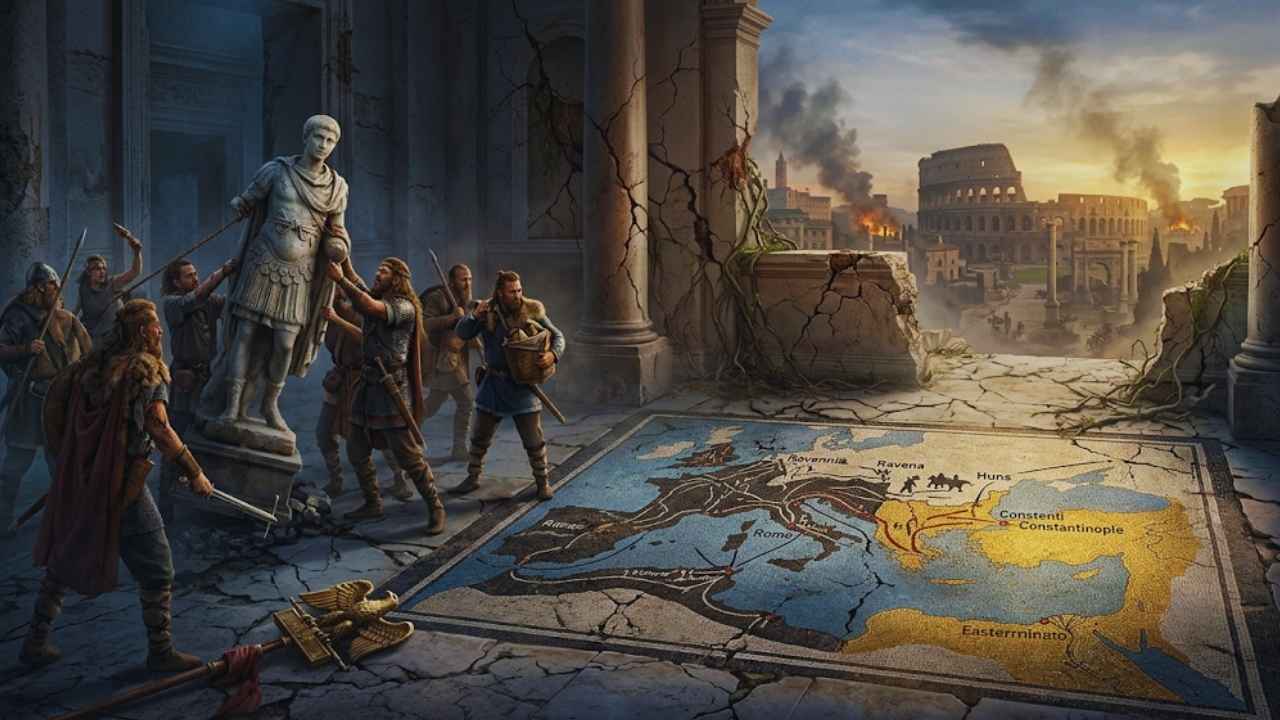
Imagine a superpower that runs the known world without any real competition. It controls global trade across multiple continents, builds massive highways that connect distant lands, and boasts an undefeated army that terrifies its neighbors. Now, picture that exact same unstoppable giant completely collapsing into the dirt and shattering into dozens of disconnected, warring kingdoms.
When we think about Rome crashing down, we usually picture burning cities, screaming citizens, and epic gladiator battles straight out of a blockbuster movie. Hollywood loves a good barbarian invasion because it looks fantastic on a big screen. But history is rarely that simple, and it certainly does not happen overnight.
The truth is much messier, a lot slower, and honestly, pretty relatable to the political and economic struggles we see in modern times. If you want to figure out exactly why roman empire fell, you have to look past the dramatic movie scenes and check under the hood of their society. The empire suffered from a slow, agonizing rot that started at the very top and eventually poisoned everything else. Broke governments, corrupt politicians dodging taxes, wildly unpredictable weather patterns, and a few nasty global pandemics actually brought the empire down from the inside out long before the invaders arrived.
The Economic Crisis: Fake Money and a Slave Shortage
Rome built its incredible wealth on a terrible and highly unsustainable business model: constant conquering and endless looting. As Roman legions took over new lands, they dragged back mountains of gold, silver, and millions of enslaved people to do all the heavy lifting. This influx of free labor fueled the entire economy and allowed the upper class to live in absolute luxury. Slaves worked the massive agricultural mega-farms, built the sprawling aqueducts, and kept the wealthy elites entirely separated from hard work. The entire system relied on the military constantly feeding new resources and new bodies into the imperial machine.
But eventually, the conquering stopped entirely, and the empire hit a massive geographic wall. They faced dense, freezing German forests on one side and a heavily armed, highly organized Persian empire on the other. No new conquests meant the empire completely ran out of new slaves and fresh loot. The massive farming estates, called latifundia, suddenly could not grow enough cheap food to feed the booming city populations. Without a steady stream of free labor, domestic industries practically ground to a halt. At the same time, maintaining a massive, sprawling border defense cost an absolute fortune, and the central government simply did not have the cash to pay the bills.
To pay the massive army, emperors started cheating the system and completely ruined their own economy. They took the standard Roman silver coin, the denarius, and started mixing it with cheap junk metals so they could mint more money. By the late third century, Roman coins contained less than five percent actual silver, rendering them practically worthless. The result was total hyperinflation that destroyed the savings of everyday citizens. Prices blew up so fast that a simple loaf of bread suddenly cost a week’s wages, and nobody trusted the money in their pocket anymore. Long-distance trade basically stopped entirely, and local communities had to revert to simple barter systems just to survive.
|
Economic Factor |
What Happened |
Impact on Rome |
|
Expansion Stopped |
Rome quit conquering new lands by the 2nd century. |
Cut off the supply of new wealth, slaves, and resources. |
|
Slave Shortage |
Fewer conquests meant fewer enslaved workers. |
Crippled farming output and local manufacturing industry. |
|
Fake Money |
Emperors stripped the silver out of their own coins. |
Destroyed trust in the economy and ruined global trade. |
|
Hyperinflation |
Prices for daily goods skyrocketed out of control. |
Forced citizens into extreme poverty and local barter systems. |
Political Rot: The Enemy Inside
A huge, sprawling empire needs a steady, reliable boss to keep the massive bureaucracy running smoothly. Rome rarely had one, and politics back then was an absolute bloodbath filled with betrayal and endless greed. During a terrifying era known as the Crisis of the Third Century, Rome chewed through over twenty different emperors in just fifty short years. Almost all of them got murdered by their own guards or rival politicians who wanted the throne for themselves. With leaders constantly getting stabbed in the back, nobody actually spent any time running the country or fixing the crumbling infrastructure.
The Praetorian Guard, which started as the emperor’s own elite secret service, quickly turned into an armed mafia that controlled the state. They assassinated bosses they hated and gladly hired anyone who paid them enough gold. In 193 AD, they literally held a public auction and sold the Roman throne to the highest bidder, a man named Didius Julianus. It was a complete joke that destroyed any remaining respect the citizens had for their central government. When the military realizes it can just buy and sell the ultimate leadership role, the rule of law completely disappears from society.
Because of this constant chaos, the tax system became completely corrupt and the government went flat broke. The Roman Senate became a useless, outdated club for rich guys who only cared about protecting their own assets. The wealthy elites entirely bailed on the major cities to dodge the crushing tax burdens, setting up private, fortified country estates. These massive rural properties eventually evolved into the medieval castles and fiefdoms we see in the Middle Ages. When your leaders only care about surviving the week and dodging the tax collector, the borders get completely ignored and the empire rots.
|
Political Issue |
The Situation |
The Result |
|
Assassinations |
Guards and rivals constantly murdered sitting emperors. |
Sparked massive power vacuums and endless civil wars. |
|
Praetorian Guard |
Elite bodyguards acted exactly like an armed mafia. |
Put military muscle and greed above the actual rule of law. |
|
Dodging Taxes |
The rich fled cities to avoid paying the central state. |
Bankrupted the government and destroyed public services. |
|
Senate Decline |
Traditional politicians lost all their real governing power. |
Left the empire trusting unstable, short-lived dictators. |
The Military Breakdown: Outsourcing the Army
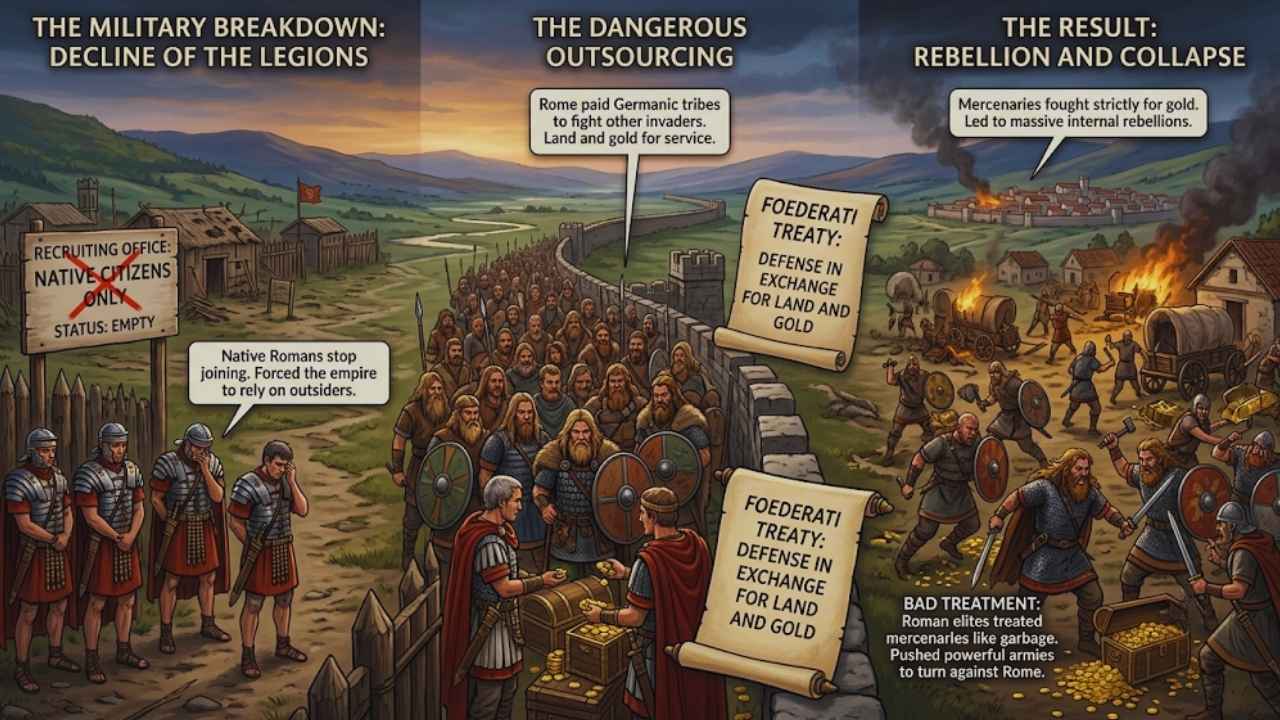
We all know the legendary stories of the disciplined, heavily armored Roman legions marching in perfect formation. But by the fourth century, the Roman army looked entirely different and had lost almost all of its traditional discipline. Rome simply ran out of native citizens who were actually willing or able to fight for the empire. Crushing taxes, terrifying plagues, and a shrinking population wiped out the traditional military recruitment pool across the provinces. People just did not care about dying for a corrupt state that taxed them into absolute poverty anymore.
To solve this massive manpower crisis, the emperors did something incredibly risky that eventually doomed them all. They decided to outsource their military defense and hired massive groups of foreign mercenaries called foederati to guard the borders. Here is the crazy part: many of these hired guns came from the exact same Germanic tribes Rome was actively fighting against. The Roman government handed these tribes massive plots of land and chests of gold in exchange for their military service. They essentially invited massive, heavily armed foreign armies to live permanently inside the borders of the empire.
This desperate strategy backfired spectacularly and directly caused the violent collapse of the Western provinces. These mercenary soldiers did not care about Roman history, culture, or the survival of the state itself. They fought strictly for a paycheck, and when the broke empire finally stopped paying them, they turned their weapons on their bosses. Roman generals completely lost control of their own military camps, and the troops began violently raiding Roman towns for supplies. It is no shock why roman empire fell when the military is just an unpaid, angry mob of foreigners holding a massive grudge.
|
Military Shift |
What Changed |
The Result |
|
Nobody Enlisted |
Native Romans completely stopped joining the military. |
Forced the empire to rely entirely on dangerous outsiders. |
|
Hiring Mercenaries |
Rome paid Germanic tribes to fight other invading tribes. |
Placed the defense of Rome entirely in foreign hands. |
|
Zero Loyalty |
Mercenaries fought strictly for gold, not the Roman state. |
Led to massive internal rebellions and violent military mutinies. |
|
Bad Treatment |
Roman elites treated these mercenaries like garbage. |
Pushed powerful armies to aggressively turn against Rome. |
Climate Change and Plagues: The Silent Killers
Modern science and archaeology actually tell us a whole new side of this ancient story that historians used to miss entirely. Mother Nature absolutely hammered Rome with a series of environmental disasters that the empire was incredibly unprepared to handle. For centuries, the empire thrived on a period of unusually warm, stable weather known as the Roman Climate Optimum. This perfect weather meant crops grew like weeds, effortlessly feeding massive ancient cities and huge, marching armies.
Then the global climate violently flipped, throwing the entire agricultural foundation of the empire into absolute chaos. By the third century, things got terribly cold and unpredictable, kicking off the Late Antique Little Ice Age. Recent ice core samples show that massive volcanoes erupted across the globe during the 530s, blocking the sun with ash. Global temperatures plummeted, massive droughts swept across the land, and rolling famines starved millions of Roman citizens. Desperate, starving nomadic tribes from northern Europe were forced to march south into Roman lands just to find food.
Worse yet, Rome’s incredible, highly connected road network became a deadly superhighway for devastating global pandemics. The Antonine Plague, which researchers now believe was a massive smallpox outbreak, hit around 165 AD and caused absolute terror. It wiped out an estimated five to ten million people, completely gutting the labor force and emptying the military barracks. The Plague of Cyprian followed soon after, creating massive labor shortages that left farms abandoned and crops rotting in the fields. You just cannot defend a massive border when disease wipes out millions of your taxpayers, farmers, and front-line soldiers.
|
Nature’s Hit |
What Happened |
Impact on Rome |
|
Cold Snaps |
The warm weather ended, bringing severe cold and drought. |
Ruined seasonal crops and caused massive food shortages. |
|
Volcanoes |
Massive global eruptions severely blocked out the sunlight. |
Pushed starving northern tribes south directly into Rome. |
|
Antonine Plague |
A massive, deadly pandemic rapidly swept the empire. |
Killed millions, wiping out vital taxpayers and soldiers. |
|
Labor Crash |
Disease entirely wiped out the working class population. |
Crippled the farming and building sectors beyond repair. |
Splitting the Empire: East vs. West
Trying to rule an empire that stretched entirely from the rainy hills of Scotland to the deserts of Syria was a complete logistical nightmare. Messages took months to arrive, and one single emperor could not possibly fight border wars on two different continents at once. So, in 284 AD, Emperor Diocletian made a radical decision and completely chopped the massive empire in half to make it manageable. The Western Roman Empire operated out of Italy, while the Eastern Roman Empire set up a brand new, highly fortified capital in Constantinople.
It sounded incredibly smart on paper, but it absolutely doomed the Western half of the empire to a slow, painful death. The East got all the good stuff: massive piles of money, huge taxable populations, and the most lucrative trade routes in the world. The West was totally broke, under-populated, and constantly under brutal attack by massive barbarian armies pouring over the rivers. When the Vandals eventually conquered North Africa, they cut off the West’s main supply of grain, leaving Italy to starve.
Instead of acting like loyal teammates, the two halves of the empire started acting like bitter, deeply suspicious rivals. They completely refused to share troops, hoard resources, and openly plotted against each other’s political leaders. When massive barbarian armies showed up looking for a fight, the rich Eastern emperors often just bribed them with gold. They paid these massive armies to pack up their weapons and march West to attack the poorer half of the empire instead. Rome basically abandoned its own ancient roots, and the poorer Western half was left entirely alone to die.
|
Empire Half |
Financial State |
Military Reality |
|
Western Empire |
Broke, lost its best farmland and main tax base. |
Constantly attacked, rarely had enough cash to pay troops. |
|
Eastern Empire |
Rich, controlled massive global trade routes. |
Heavily fortified, frequently paid off invaders to go away. |
|
Teamwork |
Almost zero cooperation between the two sides. |
Severely weakened the overall defense of all Roman lands. |
Barbarians at the Gates: The Final Blow
While the Roman government fell apart internally, a massive, terrifying storm brewed out East on the sprawling Eurasian steppes. The Huns, an incredibly brutal nomadic warrior group on horseback, started aggressively pushing into Eastern Europe and destroying everything. They drove whole Germanic tribes out of their traditional homelands and pushed them right into Roman territory in sheer panic. These tribes were mostly just terrified refugees looking for a safe place to live, farm, and hide from the Hunnic armies.
How did the brilliant Roman government handle this massive humanitarian crisis on their borders? Terribly, with shocking levels of cruelty and corruption. Roman officials ruthlessly bullied, extorted, and starved the Germanic refugees until the desperate tribes finally snapped and decided to fight back. In 378 AD, the Goths absolutely slaughtered a massive Roman army at the Battle of Adrianople, killing the sitting emperor right on the battlefield. The ancient myth that the Roman legions could never be beaten violently died on that blood-soaked field.
Battle of Adrianople
378 AD
Gothic rebels completely destroy a massive Roman army and kill Emperor Valens, proving the legions can be beaten in combat.
Sack of Rome
410 AD
King Alaric breaches the ancient city walls, trashing and looting Rome for the first time in eight hundred years.
Vandals Attack
455 AD
The Vandals launch a brutal, highly organized raid, stealing absolutely everything of value left in the ruined capital.
The Final Emperor Falls
476 AD
Germanic leader Odoacer removes the final Western emperor, officially ending the ancient state forever.
After that catastrophic defeat, the massive border floodgates opened, and Rome simply could not stop the bleeding. The Visigoths marched down the peninsula and violently sacked the city of Rome in 410 AD, shocking the entire ancient world. The Vandals did the exact same thing in 455 AD, spending two full weeks looting everything in sight and capturing elite citizens.
Finally, in 476 AD, a barbarian general named Odoacer kicked out the very last Western emperor, a helpless teenager named Romulus Augustulus. Odoacer did not even bother calling himself emperor; he just packed up the royal robes, sent them away, and took Italy for himself.
Final Thoughts
History rarely gives us one single bad guy or one massive explosion that ruins a global superpower overnight. This famous collapse was a incredibly slow, painful burn that took hundreds of years of bad decisions to finally finish. The state went completely broke, terrifying diseases killed off the essential workers, the weather ruined the crops, and the army forgot who it worked for.
By the time the barbarians finally kicked the ancient doors down, the house was already a hollow, rotting shell waiting to collapse. Digging deeply into why roman empire fell gives us a pretty stark warning today: no matter how huge and powerful a society gets, it crashes hard if it forgets to take care of its own foundation.
Frequently Asked Questions (FAQs) About Why Roman Empire Fell
Did climate change actually hurt Rome?
Yes, big time. Tree rings and ice cores prove the weather got incredibly cold and dry late in the empire’s life. It completely ruined Roman crop yields and pushed starving northern tribes south across the borders to find food and warmer land.
Did lead pipes kill the Romans?
This is a highly popular internet rumor, but it is mostly a complete myth. Romans used lead for pipes, sure, but water constantly flowed through the massive aqueducts without stopping. The lead never sat long enough in one place to poison everyone, and it definitely did not bring down the entire empire.
Did the whole empire crash in 476 AD?
Nope, not at all. Only the Western half of the empire completely died off. The Eastern half, which we call the Byzantine Empire, stayed incredibly rich and kept going for another thousand years until the Ottoman Turks conquered them in 1453.
Why didn’t they just conquer more land to get rich again?
They completely ran out of easy, profitable targets to attack. The German forests were too brutal to hold, and the Persian empire was way too strong and organized. Conquering new land would have cost them way more money and lives than they would have ever won back.