


You have exactly seven seconds to make an impression. That is how long a recruiter glances at your job application before making a split-second choice: keep reading or hit delete. They are not reading your cover letter word for word. They are not admiring your font choice or page margins.
They are hunting for one specific thing: immediate proof that you can step into the role and solve their problems. Your skills section delivers that exact proof. But dropping a random block of corporate buzzwords at the bottom of your page simply does not work anymore. Hiring managers are completely swamped with hundreds of applications. Applicant tracking software is ruthless and will reject you for minor formatting errors.
The rules of the hiring game have fundamentally changed in recent years. If you want to know exactly how to list skills resume bots and human managers actually want to read, you need a targeted strategy. Let us break down how to format this section, what specific abilities to highlight right now, and how to tailor your professional profile so you secure the interview.
The 2026 Shift: Why Skills Trump Degrees?
The modern job market flipped completely on its head. Just a few years ago, employers obsessed over elite college degrees and fancy past job titles. Today, we are living in a skills-based hiring economy. Companies just want to know what software platforms you can run, what datasets you can analyze, and what tangible results you bring to the table.
Recent labor data shows that nearly ninety percent of hirers admit they accidentally filter out incredible candidates just because those people lack a traditional four-year degree. To fix this massive talent shortage, smart companies are dropping degree requirements entirely. They care about your actual competency, not your academic pedigree. When companies switch to a skills-first approach, they instantly expand their talent pool by up to fifteen times.
You need to lean into this shift immediately. Stop treating your resume like a boring historical timeline of everything you have done since high school. Start treating it like a highly targeted sales pitch for what you can execute on day one. Highlighting your core competencies front and center proves you are ready to work.
|
Traditional Hiring Focus |
Skills-First Hiring Focus |
The Result for Your Application |
|
Past job titles and university degrees. |
Direct software knowledge and problem-solving. |
Your core tech tools take center stage. |
|
Linear, uninterrupted career paths. |
Keyword matches and actual project outcomes. |
Career gaps matter much less than technical abilities. |
|
Experience section takes up most of the page. |
Certifications and abilities sit at the top. |
You get hired for what you can execute today. |
|
Vague descriptions of past daily duties. |
Hard metrics proving your overall proficiency. |
Your resume becomes a sharp, targeted sales pitch. |
Beating the Applicant Tracking System (ATS)
Before a human being ever sees your resume, a robot reads it. An Applicant Tracking System scans your document for exact keyword matches tied to the job description. If you miss the right terms, or format them in a way the bot cannot read, you get tossed into the digital trash bin automatically. You could be the absolute best person in the world for the job, but if the ATS rejects your formatting, you lose immediately.
And beating the robot is only step one. You still have to beat the human eye. Eye-tracking studies show recruiters read resumes in an “F-pattern.” They read horizontally across the top, scan down the left side, briefly read across the middle, and keep moving down the left margin. If you bury your absolute best tech skills in a massive paragraph on the bottom right side of the page, nobody will ever see them.
You need punchy, bulleted lists aligned strictly to the left margin. You also need to drop the fancy graphics. Bots cannot parse images, so those visual skill bars will make your profile look completely blank to the software.
|
The ATS Obstacle |
Why It Ruins Your Chances |
Your Tactical Game Plan |
|
F-Pattern Scanning |
Recruiters naturally ignore the bottom right side. |
Put critical tech skills on the top-left margin. |
|
Image Parsing Failure |
ATS software cannot read charts, graphs, or skill bars. |
Use standard text and plain bullet points only. |
|
Exact Match Phrases |
Bots fail to recognize industry synonyms. |
Copy the exact skill phrasing from the job post. |
|
Complex Formatting |
Columns and tables confuse older ATS software. |
Keep the layout simple, linear, and text-based. |
Hard Skills vs. Soft Skills: Striking the Balance
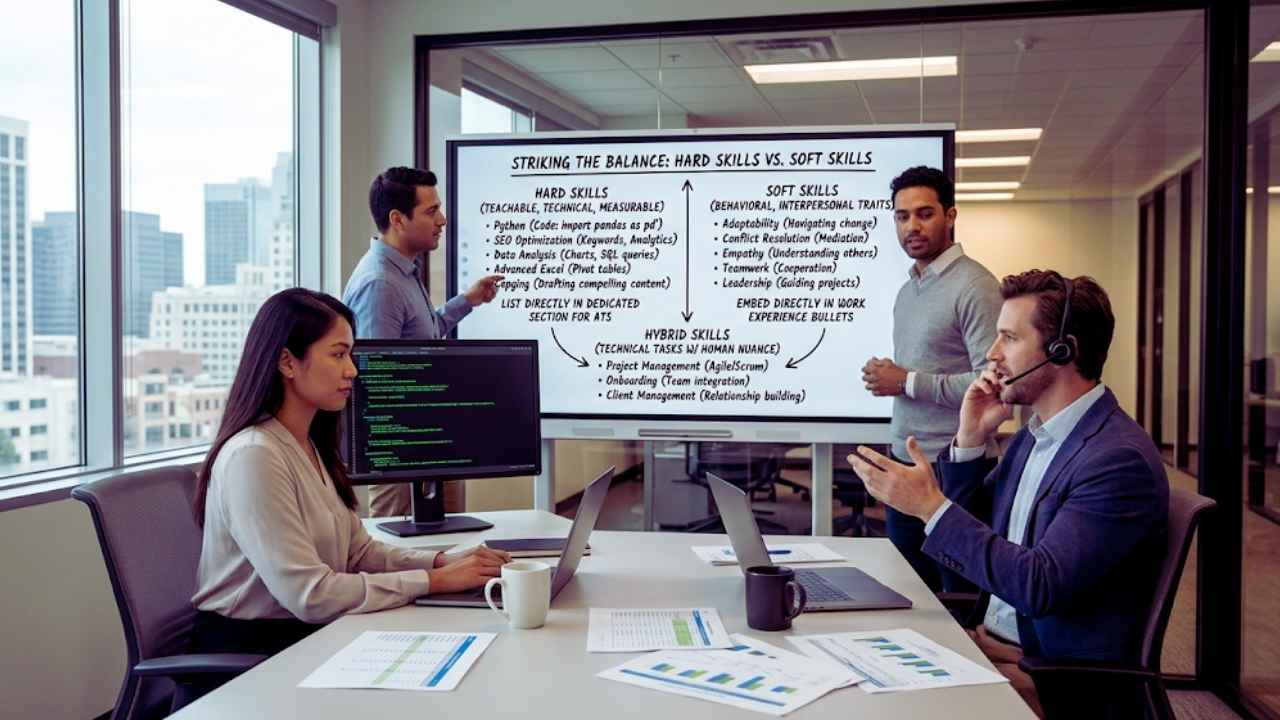
You absolutely need both to survive the modern hiring process. Lean too hard on technical skills, and you look like a machine who cannot talk to clients or work with a team. Lean too hard on soft skills, and you look like a great conversationalist who cannot operate a basic spreadsheet or drive revenue. Hard skills are your teachable, measurable abilities. You can test them, and you can earn certificates for them.
These are the main technical keywords the ATS hunts for, like Python, SEO Optimization, or Advanced Excel. List these directly in a dedicated section so they are easy to spot. Soft skills dictate how you handle workplace stress, manage your time, and talk to difficult coworkers.
But you cannot just list “Empathy” or “Leadership” in a bulleted list and expect anyone to believe you. Anyone can type a positive word. You have to prove these behavioral traits by weaving them directly into your work experience bullet points. When mapping out how to list skills resume formatting requires you to separate the tools you use from the human behaviors you exhibit on the floor.
|
Skill Type |
What It Actually Means |
Top Resume Examples |
Where It Belongs on Your Page |
|
Hard Skills |
Teachable, technical, and measurable tasks. |
Python, SEO, Data Analysis, SQL, Copywriting |
In your dedicated, bulleted skills list. |
|
Soft Skills |
Behavioral, emotional, and interpersonal traits. |
Adaptability, Conflict Resolution, Empathy |
Embedded directly in your work experience bullets. |
|
Hybrid Skills |
Technical tasks requiring intense human nuance. |
Project Management, Agile (Scrum), Onboarding |
Mixed evenly between both resume sections. |
Top Skills Employers Actually Want Right Now
If you want to stay competitive and demand a higher salary, you need to know exactly what companies are buying right now. Global economic reports project that nearly forty percent of the core skills we use today will be totally obsolete within a few years. Artificial intelligence and big data are taking over every single industry. You do not have to be a software developer, but you absolutely must show digital fluency.
Employers want people who know how to prompt generative AI tools, clean up a messy dataset, and automate boring daily tasks. But here is the interesting twist. Because technology now handles all the administrative busywork, the tasks left for human workers are much harder and more complex.
Analytical thinking is now the most sought-after human skill on the market. Companies are desperate for people who can look at a messy, unpredictable situation, figure out a logical fix, and handle the intense pressure without burning out. Showcase your ability to adapt, learn quickly, and leverage new technology to speed up your daily output.
|
High-Demand Area |
What It Means Day-to-Day |
How to Write It on Your Application |
|
AI Fluency |
Using new tech to speed up your personal output. |
“Generative AI Prompting,” “Workflow Automation” |
|
Analytical Thinking |
Finding logical, actionable solutions in messy data. |
“Data Interpretation,” “Business Analytics” |
|
Agility & Resilience |
Adapting to sudden changes without panicking. |
“Change Management,” “Cross-functional Strategy” |
|
Cloud Computing |
Managing digital assets on remote servers seamlessly. |
“AWS Management,” “Cloud Infrastructure” |
Where and How to List Skills Resume Reviewers Read?
Placement is absolutely everything on a job application. If you hide your best qualifications in the wrong spot, you waste them entirely. You cannot just dump a massive list at the bottom of the page and hope for the best. First, build a dedicated, categorized section. Never dump twenty random tools into one massive bulleted block of text. Group them logically.
If you work in digital marketing, separate your software platforms from your actual marketing tactics. It looks organized and helps the recruiter find exactly what they need instantly. Next, inject your core tools right into your professional summary. Kill the generic adjectives. Nobody cares that you are a “passionate, highly motivated go-getter.” Stop wasting prime real estate.
Use those top three lines to introduce your top technical tools immediately. Finally, use the “Action plus Tool plus Result” formula in your work history. Lists are great for beating the bots, but human managers want undeniable proof. Showing exactly how a tool helped you save money or generate revenue proves you are an expert.
|
Resume Section |
Your Primary Goal |
The Golden Rule for Formatting |
|
Professional Title |
Grab the recruiter’s attention instantly. |
Target Role | Skill 1 | Skill 2 |
|
Professional Summary |
Contextualize your top three technical tools. |
No fluff. Just facts, metrics, and software names. |
|
Core Skills List |
Beat the ATS keyword check completely. |
Group by category. Text only. No graphical bars. |
|
Experience Bullets |
Prove you actually know how to use the tool. |
Action + Tool + Result formula with hard numbers. |
Steal Their Words: Tailoring to the Job Description
You cannot blast the exact same generic document to fifty different companies and expect the phone to ring. It just does not work that way anymore. Mastering how to list skills resume critics approve of comes down to one single tactic: mirroring the job description flawlessly. Print out the job posting. Grab a highlighter and mark every required qualification they mention. The terms they repeat twice, or list right at the very top of the page, are your primary keywords.
These are non-negotiable. Put them directly into your categorized skills section. Next, you must speak their language exactly. Applicant tracking software takes things completely literally. If the job asks for “Client Relations” and you write “Customer Service,” the robot might fail you because it does not understand the nuance.
Do not lie about what you can do, but absolutely steal their vocabulary. If they want “Agile Project Management,” do not just write that you managed projects. Give them the exact phrase they asked for so you pass the digital gatekeeper.
|
They Ask For |
Your Old Resume Says |
You Change It To Pass the Bot |
|
“Proficient in Adobe Creative Suite” |
Used Photoshop and designed graphics. |
Adobe Creative Suite (Photoshop, Illustrator). |
|
“Agile Project Management” |
Led team tasks and meetings daily. |
Agile Project Management (Scrum, Sprints). |
|
“Search Engine Optimization” |
Ranked articles highly on Google. |
Search Engine Optimization (SEO) Strategy. |
|
“B2B Sales Experience” |
Sold products to other companies. |
B2B Sales & Enterprise Account Management. |
Industry-Specific Skill Playbooks
Every single industry expects something slightly different from applicants. Knowing your specific field inside and out gives you a massive advantage over generic applicants who use basic templates. In the technology and software world, your stack is everything. Recruiters want granular details on exactly what frameworks and databases you handle daily. Separate everything clearly into Front-End, Back-End, DevOps, and Database Management.
Keep soft skills out of this list entirely and focus heavily on AWS, Python, and cybersecurity protocols. For digital marketers, you have to prove you are both highly creative and deeply analytical. Companies want to know you can write killer copy, but they demand proof that you track the financial return on investment.
Put SEMrush and Google Analytics right next to Content Strategy. If you are entering the rapidly growing green tech space, highlight regulatory compliance and environmental engineering. Mentioning knowledge of European renewable energy targets proves you actually follow global sustainability trends.
|
Your Industry |
Primary Focus Area |
Top Skills to Show Off Right Now |
|
IT & B2B SaaS |
Tech Stacks & Cloud Security |
React, AWS, Python, Generative AI Integration. |
|
Marketing & SEO |
Data Tracking & Search Ranking |
Ahrefs, GA4, Conversion Rate Optimization (CRO). |
|
Healthcare |
Patient Systems & Certifications |
Epic EHR, ACLS Certification, Triage protocols. |
|
Green Tech |
Policy & Sustainability Reporting |
ESG Reporting, Renewable Systems Data Analysis. |
Deadly Skill Section Mistakes You Need to Stop Making
Even highly intelligent professionals mess this section up all the time. Knowing what to cut out is just as important as knowing what to include. Ten years ago, people copy-pasted the whole job description into their resume in tiny white text to trick the bots. Stop doing this immediately. Modern tracking systems strip all formatting and expose the trick instantly, which will get you permanently blacklisted from the employer.
Another massive mistake is the jack-of-all-trades vibe. Listing sixty different skills makes you look unfocused and totally desperate. If you are applying for a senior digital marketing role, no one cares that you know video editing or have a CPR certification from college. Keep it hyper-relevant and cut the fat. Finally, stop faking expert status.
If you call yourself an absolute expert in Python, you better be able to code from scratch on a whiteboard while a manager watches you. Overstating your abilities always blows up during the technical interview. Stick to words like proficient unless you are truly top-tier.
|
The Deadly Mistake |
Why It Kills Your Chances Instantly |
The Professional Fix |
|
Keyword Stuffing in White Text |
Bots flag your profile as spam or fraud. |
Only list relevant skills naturally in normal text. |
|
Skill Dumping (50+ Skills) |
Dilutes your actual, valuable expertise. |
Limit your specific list to 10-15 highly targeted tools. |
|
Using Graphical Progress Bars |
Bots cannot read images, making the page blank. |
Stick to clean, simple, text-based bullet points. |
|
Listing Dead or Outdated Tech |
Makes you look severely behind the times. |
Cut outdated software entirely (like Windows 95). |
Final Thoughts
Figuring out exactly how to list skills resume platforms respect does not have to be a nightmare. It all comes down to ruthless relevance, easy reading, and aggressive tailoring. Stop sending out the exact same generic document to every open position on the internet.
Kill the visual progress bars, group your software tools logically so the human eye catches them, and steal the job description’s exact vocabulary every single time you apply. Your resume is not a biography of your entire life. It is a highly targeted sales pitch designed to get you in the room. Pick the absolute best tools in your arsenal, show them off clearly, and go secure the interview.
Frequently Asked Questions (FAQs) About How to List Skills on Resume
Do I list expired certs or software I haven’t touched in years?
No. If you haven’t coded in HTML since 2017 and can’t pass a basic test tomorrow, drop it. Only list what you can use right now. Nobody wants to pay you to relearn the basics.
How do I list self-taught skills?
Exactly the same way you list college-taught ones. Companies do not care where you learned Figma or SQL; they just care that you can use it. List the tool. Link to a digital portfolio to prove it.
What about foreign languages?
If the job demands it (like a bilingual sales role), put it right at the top of your skills list. If it is just a fun bonus (you speak French but are applying for a local accounting job), stick it at the very bottom of the page in its own section.