


You have heard it repeated on finance podcasts, read about it on early-retirement blogs, and maybe had an advisor casually drop it into conversation. The 4 percent retirement rule is basically the golden metric of modern financial planning. For decades, the math felt completely settled.
You save up a nest egg, pull exactly four percent out during your first year of retirement, and adjust that specific dollar amount for inflation every year after. By doing this, you should easily outlast a thirty-year timeframe without going broke. It acted as the ultimate cheat code for figuring out your enough number. If you want to spend forty thousand dollars a year, you need to save one million dollars. If you need eighty thousand dollars, you aim to hit two million dollars. However, we are navigating 2026, and the global economy looks radically different than it did in the mid-1990s when this formula first hit the mainstream.
We have weathered massive dot-com crashes, global financial crises, rampant inflation spikes, and wildly shifting bond yields. Are we blindly trusting outdated math? Let us break down exactly how this benchmark works, where it came from, and whether the latest data proves it still holds up today.
Unpacking the 4 Percent Retirement Rule
At its core, the 4 percent retirement rule attempts to find a safe withdrawal rate that prevents you from running out of cash before you run out of time. When you retire, you stop accumulating wealth and start spending it. If you withdraw too much, a few bad years in the stock market can decimate your portfolio permanently. If you withdraw too little, you might unnecessarily pinch pennies during your prime traveling years, skipping vacations out of fear. This strategy tries to thread that needle perfectly by giving you a clear mathematical baseline. The biggest misconception people have is how they calculate the math year over year.
You do not take four percent of your current portfolio balance every single year. You only use the four percent calculation once on the exact day you retire. After the first year, your withdrawal amount is dictated entirely by inflation, completely ignoring what the stock market happens to be doing at the moment.
For example, if you withdraw forty thousand dollars in year one and inflation rises by three percent, you withdraw forty-one thousand two hundred dollars in year two. By tying your income to inflation rather than market performance, your purchasing power stays completely flat over time. You can theoretically buy the exact same amount of groceries and healthcare at age eighty-five that you could at age sixty-five.
|
Rule Mechanic |
How It Functions in Practice |
|
Initial Year Withdrawal |
You take exactly four percent of the starting portfolio balance. |
|
Subsequent Year Withdrawals |
You adjust the cash amount annually based only on the previous year’s inflation rate. |
|
Market Volatility Impact |
You ignore market swings for withdrawal math after year one. |
|
Time Horizon |
The strategy is designed specifically to last thirty years without hitting zero. |
The Origins: Bill Bengen and the Trinity Study
To understand if the math holds up today, you have to know how researchers originally built it. Back in 1994, a financial planner and former aerospace engineer named William Bengen noticed his clients were terrified of running out of money. At the time, the financial industry loosely recommended a highly optimistic seven or eight percent withdrawal rate. Bengen knew averages lie, because if a retiree hit a severe stock market crash early in their retirement, a high withdrawal rate would wipe them out fast.
He looked at historical market data stretching back to 1926. He stress-tested hypothetical portfolios through the Great Depression, the stagflation of the 1970s, and World War II. He discovered that even in the absolute worst-case scenario, a four percent starting withdrawal rate survived a full thirty years without hitting zero. Four years later in 1998, three professors at Trinity University published a paper widely known as the Trinity Study.
They analyzed various asset allocations and found that a four percent withdrawal rate with an inflation-adjusted payout was highly successful across rolling thirty-year periods. The figure instantly became industry gospel. People even created a quick math hack called the Rule of 300, where you multiply your desired monthly income by three hundred to easily find your target portfolio size.
|
Historical Milestone |
Contribution to Retirement Planning |
|
Bill Bengen (1994) |
He proved a four percent withdrawal survived every historical thirty-year worst-case scenario. |
|
The Trinity Study (1998) |
Researchers validated the work across multiple stock-to-bond portfolio allocations. |
|
Rule of 300 Shortcut |
You multiply your desired monthly income by three hundred to easily find your target portfolio size. |
|
Underlying Data |
The models rely heavily on historic stock and bond returns from 1926 onward. |
Does the 4 Percent Retirement Rule Still Hold in 2026?
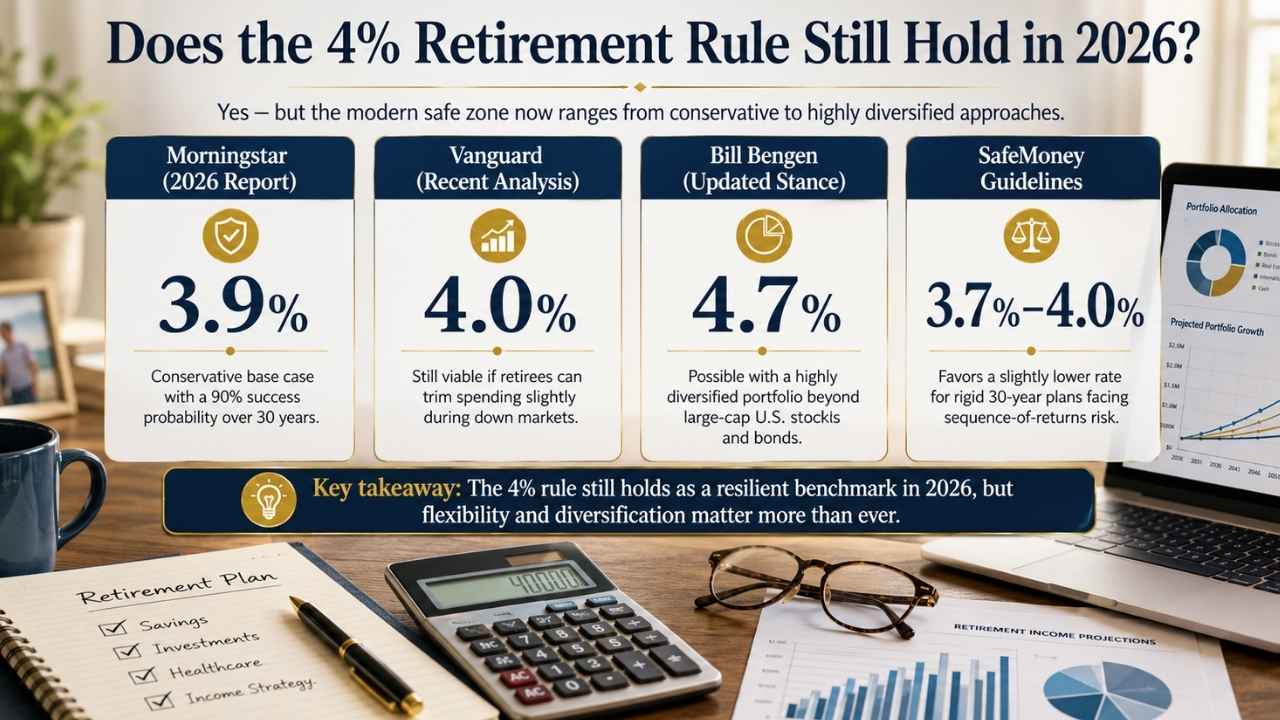
Fast forward to today, and we have different inflation dynamics, extended life expectancies, and modern stock valuations that look totally different from 1994. So, does the 4 percent retirement rule still work in 2026? The short answer is yes, but with some fascinating updates from leading financial institutions. Morningstar releases an annual State of Retirement Income report that financial planners watch closely. Because of modern market realities, Morningstar’s baseline safe withdrawal rate for a thirty-year retirement in 2026 sits at a conservative 3.9 percent.
This figure assumes a ninety percent probability of success using forward-looking market projections. Meanwhile, Vanguard’s latest analysis suggests a clean four percent remains perfectly viable for investors who accept a tiny bit of flexibility in their spending. Interestingly, Bill Bengen himself recently updated his stance, noting that modern investors have better access to diverse assets.
He argues that if you heavily diversify beyond just large-cap stocks and bonds, the safe withdrawal rate is actually closer to 4.7 percent. Depending on who you ask, the modern safe zone is anywhere between 3.7 percent and 4.7 percent. The classic four percent sits comfortably right at the foundation, making it an incredibly resilient benchmark for modern planners.
|
2026 Update Source |
Recommended Withdrawal Rate |
Key Takeaway |
|
Morningstar (2026 Report) |
3.9 percent |
A highly conservative base-case with a ninety percent success probability over thirty years. |
|
Vanguard (Recent Analysis) |
4.0 percent |
Remains viable if retirees are willing to slightly reduce spending during down markets. |
|
Bill Bengen (Updated Stance) |
4.7 percent |
Requires a highly diversified portfolio beyond just large-cap United States stocks and bonds. |
|
SafeMoney Guidelines |
3.7 to 4.0 percent |
Advises a slightly lower rate for rigid thirty-year plans facing sequence of returns risk. |
Factors That Shift Your Personal Math
There is no universal spreadsheet that perfectly dictates your life, so your personal safe withdrawal rate might be slightly lower or considerably higher. It depends entirely on the specific levers you pull within your own financial ecosystem. The baseline calculation is strictly engineered for a thirty-year retirement timeline. If you are retiring at forty as part of the financial independence movement, your money needs to last forty or fifty years. To make a portfolio stretch that long, researchers generally recommend lowering your initial withdrawal rate to roughly 3.3 percent or 3.7 percent.
Conversely, if you retire at seventy-five and only need the money to last fifteen years, you can safely withdraw five percent or more. Your asset allocation also plays a massive role in this math. If you keep all your retirement cash in a standard savings account or entirely in low-yield bonds, inflation will eat your purchasing power alive.
You need the growth engine of equities to make the math work, usually holding somewhere between fifty and seventy-five percent in stocks. Finally, your guaranteed income sources change the equation completely. If Social Security and a pension cover all your basic needs, you can afford to take more risks with your investments and potentially use a higher withdrawal rate for discretionary fun.
|
Personal Factor |
Lowers Your Safe Withdrawal Rate |
Raises Your Safe Withdrawal Rate |
|
Retirement Length |
Retiring early with a thirty-five plus year time horizon. |
Retiring late with a fifteen to twenty-year time horizon. |
|
Asset Allocation |
Holding an overly conservative mix of mostly cash and bonds. |
Maintaining a highly diversified, growth-oriented equity mix. |
|
Spending Flexibility |
Demanding strict, inflation-adjusted increases every year regardless of the market. |
Being willing to skip luxury travel during market crashes. |
|
Guaranteed Income |
Relying entirely on your portfolio for every single bill. |
Having Social Security or pensions cover basic living expenses. |
Pros and Pitfalls of Rigid Withdrawal Rates
Like any financial framework, static withdrawal rates have sharp edges that you need to watch out for. The 4 percent retirement rule is an excellent starting point, but following it blindly without understanding its inherent flaws can trap you. The biggest advantage is that it is brilliantly simple to use. You do not need a degree in macroeconomics to run the math; you multiply your portfolio by four percent, and that is your starting salary.
It shields your purchasing power effortlessly because you adjust for inflation every year. A five-dollar carton of eggs doubling to ten dollars over a decade will not wreck your grocery budget because your income scales up to match it. Furthermore, it boasts a massive safety margin, as most historical scenarios show retirees ending their thirty years with more money than they started with.
However, the system is painfully inflexible for real human beings. Humans do not spend money in a perfectly straight line. You might spend heavily on international travel at age sixty-five, and very little when your mobility slows down at age eighty-two. Because the rule is built for doomsday scenarios, an average or strong market means you will vastly underspend and leave millions behind.
|
Aspect of Strategy |
How It Impacts Your Financial Plan |
|
Calculation Simplicity |
You can easily plan your savings target without complex software. |
|
Inflation Protection |
You automatically adjust income to match the rising cost of goods. |
|
Spending Rigidity |
You ignore natural human spending patterns that fluctuate as we age. |
|
Hoarding Risk |
You might drastically underspend and die with a massive, untouched portfolio. |
Modern Alternatives: Dynamic Spending Models
Because of the rigid nature of fixed withdrawal rates, many modern financial planners have moved entirely away from static numbers. Instead, they prefer dynamic or flexible strategies that adapt to the stock market in real time. These methods allow you to safely spend more money when times are good and tighten your belt when times are bad. The Guyton-Klinger guardrails approach is a highly popular alternative.
This strategy gives you a raise when your portfolio is booming and a temporary pay cut when it crashes. You establish guardrails typically twenty percent above and below your target withdrawal rate. If a massive bull market pushes your portfolio value up significantly, you hit the upper guardrail and give yourself a permanent spending increase. Conversely, if a market crash shrinks your portfolio, you take a temporary ten percent pay cut until the market recovers.
By simply being willing to cut your spending slightly during a recession, you completely eliminate the chance of running out of money. Another option is the Endowment Method, where you take a fixed percentage of the portfolio’s moving average over a set time. This mathematically smooths out the wild volatility of the stock market while ensuring you never drain the account to zero.
|
Dynamic Strategy |
How It Actually Works |
Best Suited For |
|
Guardrails (Guyton-Klinger) |
You adjust spending up or down based on portfolio growth or shrinkage triggers. |
Retirees who want to maximize early spending and handle slight budget cuts. |
|
Constant Percentage |
You withdraw a flat percentage of the current portfolio value every single year. |
Ensuring you never hit zero, though your income fluctuates wildly. |
|
Endowment Method |
You take a percentage of the portfolio’s rolling average value over several years. |
Smoothing out market volatility while allowing income to slowly grow. |
|
Discretionary Halts |
You pause all luxury spending during a bear market to avoid selling low. |
Early retirees with massive flexibility in their monthly budgets. |
Final Thoughts
So, do you need to completely abandon the 4 percent retirement rule in 2026? You absolutely do not need to throw it away. You should think of it less as a rigid law of physics and more as a powerful directional compass. When you are ten years away from leaving the workforce and trying to figure out your target savings goal, using a basic four percent calculator is the best quick-math tool available.
It gets you in the right ballpark and gives you a tangible goal to sprint toward. However, once you actually pull the trigger and retire, setting your spending on a blind autopilot is incredibly dangerous. The smartest retirees in 2026 use the 4 percent retirement rule as a foundational baseline, but they adopt flexible, dynamic spending strategies.
They stay highly diversified, they pay close attention to modern market valuations, and they are willing to trim their discretionary spending slightly if the market takes a temporary dive. Your retirement should not be governed by an inflexible spreadsheet from 1994. By understanding the math behind the safe withdrawal rate, you can confidently adapt it to fit your actual life.
Frequently Asked Questions (FAQs) About the 4 Percent Retirement Rule
Does the math factor in my income taxes?
No. The 4% is a gross withdrawal amount. If you withdraw $40,000 from a traditional pre-tax 401(k), you still have to pay standard income taxes on that money. This means your actual take-home spendable cash might only be $34,000. To offset this, you either need a larger portfolio or you need to utilize tax-free accounts like a Roth IRA.
What happens if inflation is 0% or negative (deflation)?
If inflation is perfectly flat for a year, your withdrawal amount stays exactly the same as the previous year. If there is deflation (negative inflation, where the cost of consumer goods drops), you technically don’t reduce your withdrawal. Most financial planners recommend keeping your withdrawal amount flat during deflationary years.
Should I include Social Security in my calculation?
No. The rule applies exclusively to your invested liquid assets (your 401k, IRA, and taxable brokerage accounts). You calculate your safe withdrawal from your investments, and then you add your fixed Social Security or pension payouts on top of that to figure out your total annual income.
Can I just live off stock dividends and bond interest?
You can, but “yield chasing” carries major risks. To get a 4% or 5% pure dividend yield today, you often have to invest in risky junk bonds or concentrate heavily in slow-growing utility stocks, sacrificing long-term growth. This strategy assumes a “total return” approach: you fund your life using a combination of dividends, interest, and strategically selling off a few shares of stock.