


Let’s be completely honest for a minute. For a lot of us, walking into a massive hotel conference room full of strangers wearing “Hi, My Name Is” tags feels like walking into a trap. Your energy drains just looking at the crowd.
Extroverts seem to glide through these events, trading business cards, laughing loudly, and making small talk like it’s a competitive sport. It leaves you standing near the appetizer table, wondering if you are simply built wrong for the business world.
You aren’t. But you probably need to rethink how you make connections.
You don’t need to be the loudest person in the room to build a powerful professional circle. In fact, some of the best connectors out there are incredibly quiet. If you want to stop dreading these interactions, mastering networking for introverts changes the game entirely. It’s not about forcing yourself to act like an extrovert. That just leads to exhaustion. It’s about leaning into the natural skills you already possess—like deep listening, thoughtful observation, and meaningful one-on-one conversations.
And the good news? The professional landscape is changing. The days of awkward handshakes over lukewarm wine are fading. Networking events have shifted toward hyper-niche meetups, activity-based workshops, and structured digital connections that heavily favor introvert skills. Let’s break down exactly how you can build real, lasting connections without completely wiping out your social battery.
The Science Behind Introversion and Socializing
|
Feature |
Introvert Brain |
Extrovert Brain |
|
Primary Chemical |
Acetylcholine (calm, focused) |
Dopamine (reward, high-energy) |
|
Energy Source |
Recharges in solitude |
Recharges around others |
|
Social Aftermath |
75% report feeling drained |
Energized by group settings |
|
Processing Style |
Uses a longer neural pathway |
Uses a shorter, faster pathway |
You are not broken for hating small talk. Science completely backs you up. Studies show that extroverts are driven by dopamine, meaning they get a literal chemical reward from the buzz of a crowded room. Introverts, however, rely more on acetylcholine. We feel our best when engaged in calm, focused, and meaningful activities.
Furthermore, introverts process information through a longer neural pathway associated with deep thought and internal reflection. When someone corners you to talk about the weather or the catering, your brain is working overtime on a task it finds fundamentally unrewarding. It feels exhausting because, neurologically, it is exhausting. Data indicates that up to 75% of introverts report feeling completely drained after social gatherings.
Why Small Talk Feels Exhausting?
Extroverts use small talk as a stepping stone. They enjoy the quick volley of light conversation. Introverts see small talk as an obstacle course we have to run before we get to the “real” conversation. Because we process details deeply, scanning a noisy room while trying to figure out what to say next overwhelms our working memory.
The Hidden Networking Strengths of Quiet Networkers
You bring massive advantages to the table. Introverts naturally excel at active listening. While an extrovert might be scanning the room for the next person to talk to, you are fully present. Research indicates that 80% of introverts prefer listening over speaking in conversations. People remember how you made them feel. When you give someone your undivided attention, you build trust incredibly fast. You don’t need to meet fifty people if you can make a genuine, lasting impact on two.
Pre-Event Preparation: The Secret Weapon in Networking for Introverts
|
Prep Strategy |
How It Helps You |
|
Shift Your Mindset |
Move from “survival” to “promotion” mode |
|
Set Micro-Goals |
Prevents overwhelm (e.g., “Meet just two people”) |
|
Prepare Exit Lines |
Gives you an easy out when your battery dies |
|
Research Attendees |
Eliminates awkward silences before they happen |
Walking into an event cold is the worst thing you can do. Preparation is where introverts win. Extroverts can wing it; we do better when we have a plan.
Many introverts go into a professional mixer with a “prevention” mindset. You just want to prevent making a fool of yourself or having an awkward silence. Instead, switch to a “promotion” mindset. Look for a positive win. Decide ahead of time what a successful night looks like for you.
Setting Realistic Micro-Goals
Stop trying to collect a giant stack of business cards. It doesn’t work anyway. Set a micro-goal before you even leave your house. Tell yourself, “I will have two meaningful conversations, and then I have permission to leave.” Once you hit that target, the pressure vanishes. You can stay if you want, but you already won. This reframes the entire event from an endurance test to a simple, achievable mission.
Researching Attendees Beforehand
If an event has an app, a Slack channel, or a public RSVP list, use it. Find three people who share your interests or work in your specific field. Look them up on LinkedIn. When you bump into them, you can skip the agonizing small talk entirely. You can jump straight into a topic you both care about. Saying, “I saw your recent post about supply chain logistics,” is a much better opener than, “Wow, it’s hot in here.”
Crafting Your “Warm” Approach
You don’t need a loud voice to seem approachable. Focus on non-verbal warmth cues. Use a relaxed half-smile when you walk up to someone. Keep an open posture—arms uncrossed, shoulders square to the person. Say their name once early in the conversation. These subtle moves make you instantly likable without requiring you to perform a fake, high-energy personality.
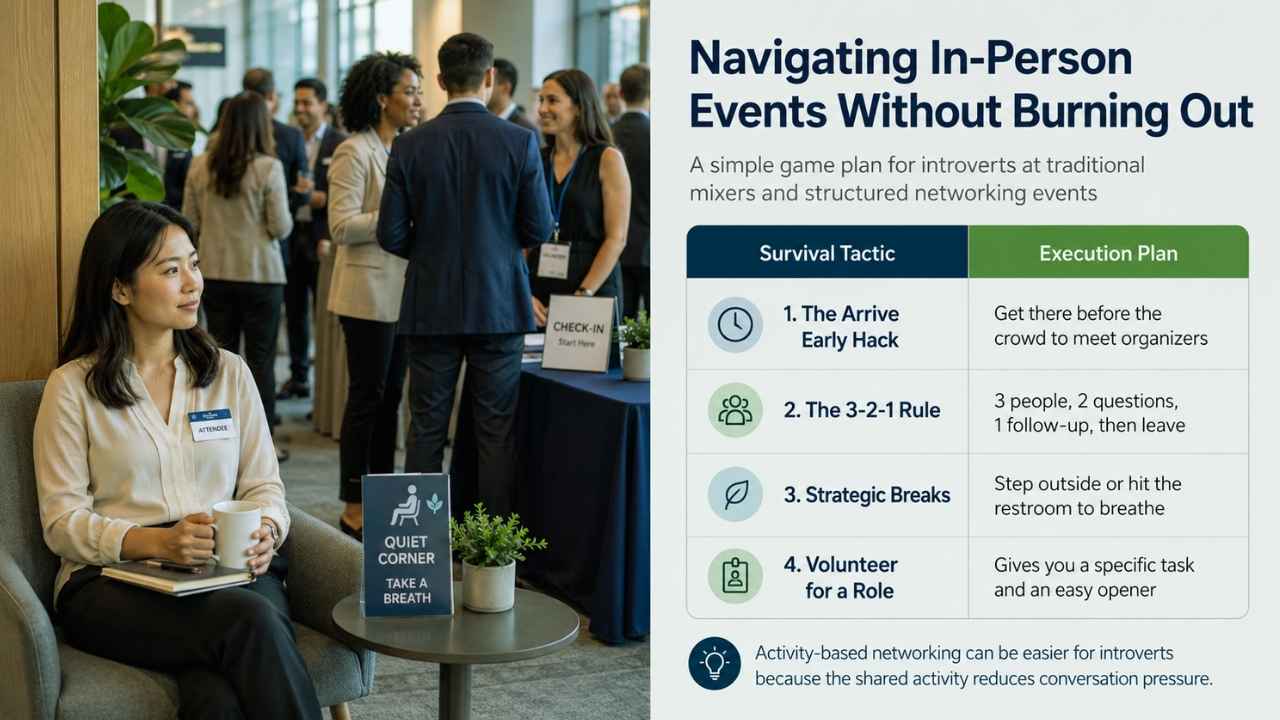
|
Survival Tactic |
Execution Plan |
|
The “Arrive Early” Hack |
Get there before the crowd to meet organizers |
|
The 3-2-1 Rule |
3 people, 2 questions, 1 follow-up, then leave |
|
Strategic Breaks |
Step outside or hit the restroom to breathe |
|
Volunteer for a Role |
Gives you a specific task and an easy opener |
When you actually get to the venue, you need strategies to manage your energy. Modern networking is changing, and many events are moving away from massive, unstructured mixers toward “activity-based networking.” Think coding sprints, pottery classes for creatives, or structured speed networking. These formats are brilliant for introverts because the activity removes the pressure of keeping the conversation going.
But if you still find yourself at a traditional mixer, you need a game plan.
The “Arrive Early” Hack
Most people think arriving fashionably late is cool. For an introvert, walking into an already-packed, roaring room is a nightmare. Try arriving 15 minutes early. The room is quiet. You can easily chat with the organizers or the first few guests to trickle in. As the room fills up around you, you already feel anchored in the space.
Taking Strategic Breaks (The Bathroom Trick)
Don’t apologize for needing space. If you feel your energy crashing, step away. Go to the bathroom, walk outside to check your phone, or grab a glass of water in the quiet hallway. Give your nervous system five to ten minutes to completely reset. Practicing good networking for introverts means respecting your own physical limits. You will perform much better after a quick recharge.
The 3-2-1 Rule for Quick Exits
If you feel trapped by the idea of an endless night, use the 3-2-1 rule. Commit to talking to three people, asking two thoughtful questions each, and identifying one person you want to follow up with. Once you do that, you can leave without an ounce of guilt. You showed up, you did the work, and you protected your peace.
Digital Networking for Introverts: Building Ties From Your Couch
|
Digital Platform |
Best Use Case for Introverts |
|
|
Publishing thoughtful comments on industry posts |
|
Slack/Discord |
Engaging in niche, text-based discussions |
|
Email Outreach |
Reaching out directly to authors or speakers |
|
Virtual Summits |
Using the chat box to ask insightful questions |
If standing in a room full of people sounds terrible, you don’t actually have to do it. Digital networking is fully recognized as a legitimate way to build a career. In fact, hybrid events and virtual spaces exploded over the last few years, making it incredibly easy to connect from home.
Digital spaces are perfect for our personality type. You control the pace, and you don’t have to respond instantly. You have time to process your thoughts and deliver a well-crafted response.
LinkedIn Mastery for the Quiet Professional
You don’t need to post flashy videos to get noticed on LinkedIn. Instead, spend 15 minutes a day leaving thoughtful, three-sentence comments on other people’s posts. It’s a low-pressure way to get your name in front of industry leaders. This is a core pillar of networking for introverts because it relies entirely on writing and thoughtful reflection, playing directly to your natural strengths.
The Power of the Personalized Cold Email
Extroverts might love cold calling, but introverts rule the cold email. A well-crafted, concise email to someone you admire can open massive doors. Keep it brief: introduce yourself, highlight a specific piece of their work you loved, and ask one simple question. No pressure for a meeting, just a quiet, respectful connection.
Niche Communities and Slack Groups
Huge conferences are chaotic. Private Slack channels or Discord servers are quiet and organized. Join industry-specific groups where professionals ask technical questions or share resources. Answer a few questions when you have the energy. Share an article you found helpful. Over time, people will recognize your name as a reliable, knowledgeable peer, without you ever having to shake a single hand.
Mastering the Follow-Up: Where Introverts Shine
|
Follow-Up Step |
Timing |
Example Action |
|
The Connection |
Within 24 Hours |
Send a personalized LinkedIn invite |
|
The Value Add |
7 Days Later |
Share an article related to your chat |
|
The Check-In |
30 Days Later |
Suggest a concrete next step or coffee |
The real magic of networking happens after the event ends. Extroverts might collect fifty business cards, but they rarely follow up with all of them. Introverts excel in one-on-one follow-ups. You can take the relationships you started in a noisy room and move them into quiet, comfortable spaces.
The 24/7/30 Rhythm
To build lasting connections without feeling annoying, use the 24/7/30 rhythm. Reach out within 24 hours of meeting someone. Send a short email or LinkedIn message. Mention something specific you talked about. It proves you were actually listening and separates you from the dozens of generic requests they receive.
Within seven days, engage with their public work. Leave a comment on a post they wrote or share their content. Within 30 days, reach out with a concrete next step. This could be sending an article that solves a problem they mentioned, or asking for a quick 15-minute virtual coffee chat. This structured cadence does the work of relationship-building without requiring an exhausting performance.
Adding Value Without Forced Interaction
You don’t need to invite a new contact to a loud happy hour. Send them a link to a podcast episode they might like. Tag them in a relevant industry post. Build the relationship slowly through small, low-stress interactions. Quiet, consistent value builds far stronger professional relationships than being the life of the party once a year.
Common Networking Mistakes Introverts Make
|
The Mistake |
Why It Fails |
The Fix |
|
Clinging to friends |
You meet zero new people |
Arrive alone or split up from your friend |
|
Skipping recovery time |
Leads to intense social burnout |
Block out the next morning for quiet work |
|
Relying on a strict script |
Makes you sound robotic |
Use flexible bullet points instead |
|
Assuming quiet = weak |
You hide your true value |
Lean into active listening and deep questions |
Even when you try your best, it is easy to fall into a few common traps. Recognizing these mistakes helps you pivot quickly.
Mistake 1: Clinging to People You Know
It happens all the time. You go to an event with a coworker, grab a drink, and spend the next two hours talking exclusively to them in the corner. It feels safe, but it defeats the entire purpose of going. If you bring an extroverted friend to act as a wingman, make sure they know their job is to introduce you to new people, not just keep you company.
Mistake 2: Not Budgeting Recovery Time
A two-hour networking event is actually a six-hour investment for an introvert’s nervous system. If you attend an event on Tuesday night, do not schedule a high-stakes, camera-on meeting for Wednesday morning. You will be wiped out. Budget your recovery time just like you budget the event itself.
Mistake 3: Confusing Introversion with Shyness
These are not the same thing. Shyness is a fear of social judgment. Introversion is simply how you respond to stimulation. You can be a highly confident introvert. Own your quiet nature. You don’t need to apologize for speaking slowly or needing a moment to think before you answer a question.
Final Thoughts
Let’s wrap this up. You don’t need to change your personality to succeed in business. The loudest voice in the room isn’t always the most respected, and collecting dozens of business cards rarely translates to actual career growth.
By focusing on deep conversations, preparing ahead of time, and following up thoughtfully, you can build an incredible professional circle that rivals anyone else’s. Focus on one-on-one interactions. Lean heavily into written digital communication if that is where you shine. Allow yourself to leave an event when your battery runs low.
Embrace your quiet strengths. When you practice smart networking for introverts, you build genuine, long-lasting relationships that actually move your career forward—no forced smiles or painful small talk required. You already have the skills to be a phenomenal connector; you just needed a different playbook.
Frequently Asked Questions (FAQs) About Networking for Introverts
How do I handle aggressive extroverts who won’t stop talking?
Listen for a few minutes, then politely interrupt with a compliment. Say, “I love your passion for this topic. I need to go catch up with a former colleague, but do you have a card so we can connect later?” This gives you a clean, polite exit without offending them.
What if my mind goes blank and I forget what to say?
Turn the spotlight back on them. People love talking about themselves. Ask a broad, open-ended question like, “What’s the most exciting project you’re working on right now?” or “How did you get your start in this industry?” This takes the pressure entirely off you while keeping the conversation alive.
How do I transition from small talk to deep talk?
Use bridging questions. When someone tells you what they do for a living, don’t just say “Oh, cool.” Ask, “What surprised you the most about working in that field?” or “What’s the biggest challenge your team is facing right now?” This pivots the chat away from surface-level facts into the meaningful territory introverts prefer.
How do I handle networking with highly technical teams or in fields like NetOps?
The focus is shifting toward specialized skills rather than generic mixing. In technical fields like network operations, skip the broad networking events and join highly specialized forums or certification study groups. Focus the conversation entirely on the work—ask about their approach to automation or framework changes. Technical professionals deeply respect targeted, knowledgeable questions over charismatic fluff.