


Most people solve problems by copying what already works. That’s normal. It saves time. It gives us a shortcut. It helps us avoid obvious mistakes. If a method worked for someone else, it feels safe to try it. But copying can also keep us stuck.
A founder copies a competitor’s pricing. A student copies another person’s study routine. A content team copies the top-ranking article. A manager keeps an old process alive because “that’s how we’ve always done it.” Then the result feels flat. Average. Predictable.
First principles thinking gives you a better way to solve problems. It helps you break an issue down to its most basic truths. Then you build your answer from those truths instead of leaning on old assumptions. The idea sounds deep, but the method is simple.
Ask what is true. Ask what you are assuming. Ask what you can remove. Ask what must happen for the idea to work. That’s why entrepreneurs, engineers, scientists, product teams, writers, and leaders use it. It helps them see better options hiding under the obvious ones.
What Is First Principles Thinking?
First-principles thinking means reasoning from the ground up. A “first principle” is a basic truth. You cannot break it down much further. It sits at the bottom of an idea.
For example, people often say, “A serious business needs an office.”
That’s not a first principle. Plenty of strong businesses run without offices. An office may help, but it is not the base requirement. A better question is, “What does a business actually need to exist?” At the most basic level, a business needs a real problem, a useful solution, a reachable audience, trust, payment, and delivery. Once you see that, the whole problem changes.
You stop asking, “How does everyone else start a business?” You start asking, “What’s the smallest useful version I can test?” That’s the heart of first-principles thinking.
|
Concept |
Simple Meaning |
Example |
|
First principle |
A basic truth |
Customers buy when an offer solves a real problem |
|
Assumption |
A belief accepted without proof |
Every serious company needs a large office |
|
Real constraint |
A true limit |
Time, budget, regulation, physics, skill |
|
Fake constraint |
A copied belief |
“Nobody in this industry does it that way” |
|
Rebuild |
Create from basics |
Test a small offer before building a full product |
A Simple Definition
First principles thinking is a problem-solving method where you break an idea into basic facts, question assumptions, and build a better answer from what’s actually true.
It’s not about sounding smart. It’s about seeing clearly.
Instead of asking, “What do people usually do?” you ask, “What must be true here?” That one question can change everything. It helps you avoid lazy thinking. It also helps you avoid panic when a problem looks too big. When you break the problem into smaller truths, it becomes easier to solve. You are no longer fighting the whole mountain. You are looking at each rock.
Where Does the Idea Come From?
The idea goes back to philosophy and science. Aristotle treated first principles as the starting points of reasoning. In plain language, they are the base truths that support everything built above them.
Today, people use the same idea in practical work.
Scientists use it to test theories. Engineers use it to design better systems. Entrepreneurs use it to question business costs. Writers use it to understand what readers really need. This method has lasted because it works across fields. It does not belong only to billionaires or scientists. Anyone can use it. A student can use it to learn faster. A marketer can use it to build a better campaign. A founder can use it to test a business idea. A manager can use it to fix a slow process. The tool is old. The use is fresh.
Why Does It Feel Difficult?
First principles thinking feels hard because it removes easy answers. Most of us like templates. We want formulas. We want to know what worked for someone else. That feels safe.
But hard problems need better thinking. This method pushes you to ask tougher questions. What do I know for sure? What am I guessing? Which rule did I copy from others? What part of this problem is real? What would I do if I started from zero?
That takes effort. But it usually leads to cleaner decisions. It also makes you more honest. You may find that your plan is built on weak beliefs. That can feel uncomfortable at first. But it is better to discover a weak idea early than waste months defending it.
First Principles Thinking vs. Reasoning by Analogy
Most people reason by analogy. That means they solve a problem by comparing it to something similar.
For example, a marketing team may say, “Our competitor posts five short videos a day, so we should post five short videos a day.”
Maybe that works. Maybe it wastes time. A first-principles thinker asks better questions. What are we trying to achieve? Who are we trying to reach? What does this audience need? Which format builds trust fastest? What can we produce consistently? What does our own data show?
Now the answer may look different. Maybe five short videos are not needed. Maybe one strong guide, one useful comparison page, and one short video per week would work better.
Read Also: How to Build a Three-Fund Portfolio for Long-Term Growth
|
Thinking Style |
Main Question |
Strength |
Weakness |
|
Analogy thinking |
What worked before? |
Fast and practical |
Can copy bad habits |
|
First principles thinking |
What is true at the base level? |
Creates original solutions |
Takes more effort |
|
Best use of analogy |
Simple, low-risk choices |
Saves time |
May limit creativity |
|
Best use of first principles |
Hard or high-value problems |
Finds better options |
Needs patience |
Why Analogy Thinking Is So Common
Analogy thinking is common because it is fast. We use it every day. If a restaurant is full, we assume the food is good. If a product has many reviews, we assume it is safer to buy. If a competitor uses a tactic, we assume it may work for us too.
This kind of thinking is useful for quick choices. The problem starts when we use it for serious decisions. Copying another person’s answer does not mean we copied their context. Their audience may be different. Their budget may be different. Their timing may be different. Their brand trust may be stronger. Their team may have skills we do not have.
That is why blind copying fails. You copied the visible action, not the hidden reason behind it.
Example: SEO Content
Analogy thinking says, “The top-ranking article has 3,000 words, so we need 3,000 words.” First-principles thinking asks better questions. What is the searcher trying to solve? What does the reader already know? What examples are missing? What data needs updating? What would make this article more useful than the current results?
Now the goal is not word count. The goal is search satisfaction.
That’s a better way to build content. A long article can fail if it repeats obvious points. A shorter article can win if it answers the query clearly. Length matters only when it helps the reader. The first principle is simple: readers search because they want a useful answer. Everything else should serve that.
Example: Productivity
Analogy thinking says, “Successful people wake up at 5 a.m., so I should wake up at 5 a.m.” First principles thinking asks, “What kind of schedule helps me do my best work?”
That question is more useful. You may need seven or eight hours of sleep. You may focus better at night. You may have family responsibilities in the morning. You may do your best creative work after lunch.
So the real question is not whether 5 a.m. is good. The real question is whether your routine supports your energy, goals, and responsibilities. That makes productivity personal. It also makes it more sustainable.
Example: Pricing
Analogy thinking says, “Our competitor charges $49, so we should charge $49.” First principles thinking asks, “What value do we create?” That changes the pricing conversation.
You look at the problem you solve, the pain level, the time saved, the money saved, the alternatives available, and the buyer’s budget. This gives you a stronger pricing decision. Copying price is easy. Understanding value takes more work. But it pays off because price should reflect value, not fear.
If your product saves a customer ten hours a month, that matters. If it lowers business risk, that matters. If it replaces three tools, that matters. First-principles thinking helps you price based on reality.
Why First Principles Thinking Works?
First-principles thinking works because it separates facts from assumptions. Some limits are real. You may have limited money, time, tools, talent, or legal freedom. But many limits are not real. They are inherited beliefs.
People say things like, “That’s too expensive,” “Customers won’t pay for that,” “This industry doesn’t work that way,” “We need a big team,” or “Small companies can’t compete.” Some of these claims may be true. Many are just guesses.
First principles thinking helps you test them. It keeps you from treating opinion as fact. It also helps you stop wasting energy on surface-level fixes.
|
Why It Works |
What It Does |
Result |
|
Removes assumptions |
Questions copied beliefs |
Opens new options |
|
Finds root causes |
Looks below symptoms |
Better fixes |
|
Clarifies trade-offs |
Shows what matters most |
Smarter choices |
|
Supports testing |
Turns ideas into experiments |
Faster learning |
|
Reduces blind copying |
Forces original thinking |
Stronger strategy |
It Finds the real problem.
Many teams fix symptoms instead of causes. Sales are down, so they run more ads. But the real problem may be something else. The offer may be unclear. The audience may be wrong. The page may load slowly. The price may feel risky. The proof may be weak. The checkout may be confusing.
A better question is: What must happen before someone buys?
The right person must see the offer. They must understand the value. They must trust the brand. The price must feel fair. The risk must feel low. The buying process must feel easy. Now you have a clearer map.
You can inspect each step instead of guessing. That is how first-principles thinking saves time. It moves the team from random activity to focused action.
It Helps You Spot Fake Rules
Every industry has fake rules. In publishing, one fake rule is that more content always means more traffic. That’s not true. More useful content can grow traffic. More weak content can damage trust. A website with hundreds of thin articles may struggle more than a site with fewer, stronger articles.
In business, another fake rule is that growth always needs more people. Not always. Sometimes growth needs better systems. Sometimes it needs sharper positioning. Sometimes it needs fewer tasks, not more employees.
First principles thinking helps you challenge these rules without being reckless. You are not rejecting experience. You are checking whether the rule still makes sense.
It Makes Creativity Practical
Creativity is not only about wild ideas. Often, it comes from removing what does not matter. Ask what you can remove. Ask what you can simplify. Ask what the user actually cares about. Ask which step creates no value. Ask what the process would look like if it were much simpler.
That is where practical innovation starts. Many strong products win because they remove friction. They make a task easier, faster, cheaper, or clearer. The idea may not look dramatic. But the user feels the difference.
A good solution often feels obvious after someone builds it. First principles thinking helps you reach that obvious answer before others do.
First Principles Thinking Explained With Real Examples
Real examples make this idea easier to understand. The examples below show how people and companies question old assumptions, break problems down, and rebuild from basic truths.
The important point is not that one thinking method magically created every breakthrough. Real progress needs teams, capital, timing, testing, and execution.
But first principles thinking often helps people ask the right starting question. That starting question matters.
|
Example |
Old Assumption |
First-Principles Question |
Better Direction |
|
Batteries |
Battery packs will stay expensive |
What drives battery cost? |
Study materials, chemistry, manufacturing, and scale |
|
Rockets |
Rockets are mostly disposable |
Why throw away expensive hardware? |
Reusable launch systems |
|
Manufacturing |
More output creates more waste |
What creates value and what creates waste? |
Leaner production |
|
Product design |
Build what competitors build |
What does the customer need first? |
Customer-led product development |
|
SEO |
Match what ranks now |
What would fully satisfy the searcher? |
Helpful, original, people-first content |
Example 1: Batteries and Electric Vehicles
Battery costs are one of the clearest modern examples. For years, many people treated electric vehicle batteries as permanently expensive. That made electric cars feel permanently expensive too.
A first-principles thinker asks, “What actually makes a battery expensive?”
The answer includes raw materials, battery chemistry, cell design, manufacturing efficiency, supply chain costs, energy costs, factory scale, competition, and recycling potential. That changes the problem. A battery pack price is not magic. It comes from materials, engineering, market pressure, and production systems.
Recent electric vehicle battery data shows how much this matters. Global battery deployment for electric vehicles reached about 1.2 TWh in 2025, rising by nearly 30% from the previous year. Average battery prices also fell by 8% in 2025. Analysts linked the decline to better manufacturing, chemistry changes, stronger competition, technology improvements, and lower critical mineral prices.
The lesson is not “batteries are easy to make cheap.” The real lesson is sharper: don’t confuse today’s price with the deepest physical and economic limits. When you break the cost apart, you can see which parts can improve.
Example 2: SpaceX and Reusable Rockets
For a long time, rockets were treated mostly as one-use machines. Launch them. Lose them. Build another. That sounds normal because people got used to it. But from first principles, it looks strange.
A rocket’s first stage contains expensive engines, tanks, materials, sensors, and control systems. So the deeper question is simple: Why should the most expensive parts be thrown away after one flight? That question helped change the launch industry.
Falcon 9 is designed as a reusable, two-stage rocket. Launch cost comparisons also show how commercial systems helped reduce the cost of reaching low Earth orbit compared with older shuttle-era systems. That does not mean reuse alone caused every cost reduction. Design, operations, manufacturing, competition, launch frequency, and business model all matter.
But the first-principles question was powerful. What if the expensive part could fly again? That one question forced engineers to rethink the old model. It turned “rockets are disposable” into a problem, not a rule.
Example 3: Toyota and Waste Reduction
Toyota’s production system focuses on cutting waste, shortening lead times, and improving quality. That may sound like normal efficiency work. But the deeper idea fits first-principles thinking. Toyota asks what creates value for the customer and what does not.
Anything that does not add value becomes a target for improvement. Waste can show up as waiting, overproduction, excess movement, defects, extra inventory, unneeded transport, overprocessing, or poor use of people’s skills.
A simple related tool is the “5 Whys.” You ask why a problem happened. Then you ask why again. You keep going until you get closer to the root cause.
Example:
The sales page conversion rate dropped.
- Why? More users leave at checkout.
- Why? The checkout form is too long.
- Why? The team added extra fields.
- Why? Sales wanted more lead details.
- Why? The landing page attracts poorly qualified visitors.
Now the fix changes. The answer may not be “redesign checkout.” It may be “improve landing page targeting and remove unnecessary fields.” That’s much better than treating symptoms.
Example 4: Amazon and Working Backwards
Amazon is known for its “working backwards” approach. The idea is simple: start with the customer problem, then build backward from there. That fits closely with first principles thinking. Instead of asking, “What can we build?” the team asks who the customer is, what problem they have, why it matters, what would make their life easier, and what success looks like from their side.
That is useful for any company. Bad product thinking starts with features. Better product thinking starts with pain. A team may want to add dashboards, filters, reports, and extra buttons. But the customer may only want one clear answer faster.
Working backward protects teams from building features no one asked for. The core question is simple: what does the customer truly need?
Example 5: SEO and Search Intent
SEO is full of copied habits. Many writers check the top results, copy the headings, add more words, and hope that’s enough. That is not first principles thinking. A first-principles SEO approach starts with the searcher.
For a keyword like “first principles thinking,” the reader may want to know what it means, where it came from, how it differs from normal thinking, who uses it, what real examples prove it, how to apply it, and what mistakes to avoid.
Now the article becomes more useful. The first principle is not “write for an algorithm.”
The first principle is: Help the reader complete the search task better than other pages.
That means clear definitions, real examples, fresh data, useful tables, practical steps, and answers to questions readers may still have after reading. Good SEO starts with usefulness. Search engines reward pages that help people because that is what search is supposed to do.
How to Use First Principles Thinking Step-by-Step?
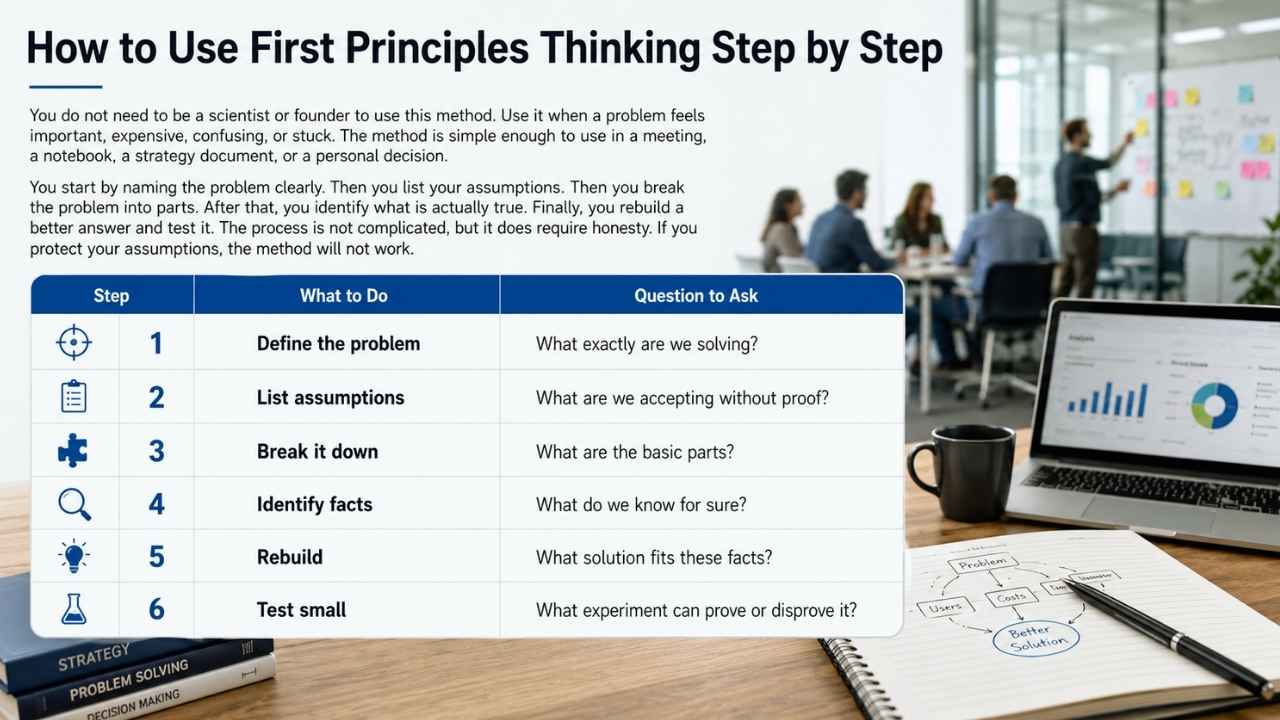
You do not need to be a scientist or founder to use this method. Use it when a problem feels important, expensive, confusing, or stuck. The method is simple enough to use in a meeting, a notebook, a strategy document, or a personal decision.
You start by naming the problem clearly. Then you list your assumptions. Then you break the problem into parts. After that, you identify what is actually true. Finally, you rebuild a better answer and test it.
The process is not complicated, but it does require honesty. If you protect your assumptions, the method will not work.
|
Step |
What to Do |
Question to Ask |
|
1 |
Define the problem |
What exactly are we solving? |
|
2 |
List assumptions |
What are we accepting without proof? |
|
3 |
Break it down |
What are the basic parts? |
|
4 |
Identify facts |
What do we know for sure? |
|
5 |
Rebuild |
What solution fits these facts? |
|
6 |
Test small |
What experiment can prove or disprove it? |
Step 1: Define the Problem Clearly
A vague problem creates vague thinking. Bad version: “Our content is not working.” Better version: “Our how-to articles get impressions, but the click-through rate is low and readers leave within the first minute.”
Now you have something useful. Clear problems create better questions. When the problem is specific, your next move becomes easier. You can look at the title, opening, search intent, page layout, examples, and article depth.
You can also measure whether your changes help. That is much better than saying, “SEO is not working.”
Step 2: List Your Assumptions
Write down what you believe. For a content problem, your assumptions may include the headline is weak, the topic is too competitive, readers do not trust the site, the article is too long, the article is too short, the keyword intent is wrong, or the opening does not answer quickly enough.
Some may be true. Some may be guesses. Your job is to separate them. This step is important because assumptions often hide inside confident sentences.
When someone says, “Readers don’t like long articles,” ask for proof. Some readers hate long fluff. But they may love detailed content when the topic demands it. The issue is not length. The issue is value.
Step 3: Break the Problem Into Parts
For a content problem, the parts may include search intent, title, meta description, opening paragraph, headings, examples, data freshness, readability, internal links, page speed, author trust, and mobile layout.
Now you can inspect each part. That beats blaming “SEO” in general. Breaking a problem into parts makes it less emotional. Instead of arguing over opinions, the team can look at the system.
Maybe the title is weak. Maybe the page loads slowly. Maybe the article answers the wrong intent. Maybe the content lacks examples. Each part gives you a possible fix.
Step 4: Find the Basic Truths
Use data where possible.
For example, the article may rank on page two. The title may not show a clear benefit. Competing pages may include examples, but yours does not. Users may leave before the first H2. The article may answer “what is it” but not “how to use it.” The page may lack a practical framework.
These facts are useful because they point to action. You are not guessing anymore. Basic truths give your work direction. They also keep the team from chasing random fixes. Without this step, people tend to edit based on taste. One person wants a shorter intro. Another wants more keywords. Another wants a new design. Facts create discipline.
Step 5: Rebuild From the Truths
Now you can improve the article with purpose. You may rewrite the title, add practical examples, add a comparison table, answer missing FAQs, improve the first 150 words, add internal links, include real observations, and remove repeated filler.
This is better than random editing. The goal is not to make the article bigger. The goal is to make it more useful. First principles thinking keeps the work focused. Every change should connect to a reader need, a content gap, or a performance issue.
That is how editing becomes strategy.
Step 6: Run a Small Test
Do not turn every insight into a huge project. Start with the strongest changes.
For example, update the title and opening, add missing examples, improve H2 structure, add a stronger FAQ section, and track results for a few weeks.
First principles thinking works best when you pair it with testing. A test keeps you honest. It shows whether your logic works in the real world. That matters because even good reasoning can be wrong. The market decides. The reader decides. The user decides. Your job is to learn fast and adjust.
A Practical First Principles Thinking Framework
Here is a simple framework you can use for almost any problem. Call it the “Break, Check, Build” method. First, break the problem into smaller parts. Second, check which parts are facts and which are guesses. Third, build a better answer from the facts.
This framework works because it is easy to remember. You can use it in business planning, content strategy, hiring, product design, learning, and personal habits.
It also works well in team meetings because it gives everyone a clear structure. Instead of arguing, the team can move through the steps together.
|
Stage |
Purpose |
Example Question |
|
Break |
Reduce the problem into parts |
What are the basic pieces? |
|
Check |
Separate facts from guesses |
What proof do we have? |
|
Build |
Create a better answer |
What would we do from scratch? |
Break: Reduce the Problem
Start by taking the problem apart. If the issue is “our product is not growing,” don’t stop there. Break it into awareness, demand, positioning, pricing, trust, activation, retention, referrals, and support.
Now you can see where growth may be blocked. Maybe people do not know the product exists. Maybe they know it exists but do not understand it. Maybe they try it once and leave. Maybe they like it but do not recommend it.
Each problem needs a different fix. Breaking the problem helps you stop treating growth as one big mystery.
Check: Test Assumptions
Ask whether each belief is true. How do we know? What data supports it? What would prove it wrong? Are we copying this from competitors? Are we treating a habit like a rule?
This step protects you from lazy logic. It also protects you from loud opinions. In many teams, the most confident person can shape the decision. First principles thinking pushes the team back toward truth.
That does not mean every decision needs perfect data. It means you should know when you are working with facts and when you are working with guesses. That honesty improves decisions.
Build: Create a Better Path
Once the basics are clear, rebuild.
Example: if users understand the product but do not trust it, the answer may not be more ads.
The answer may be better case studies, real testimonials, a clear refund policy, transparent pricing, a founder story, a product demo, or comparison pages. That is a sharper plan. It connects the solution to the real problem.
This is where first-principles thinking becomes useful. The goal is not to admire the breakdown. The goal is to build something better. A good solution should feel connected to the truth you uncovered.
Common Mistakes With First Principles Thinking
First principles thinking is powerful, but people can misuse it. The biggest mistake is turning it into endless analysis. Good thinking should lead to better action.
If a team asks questions forever but never tests anything, the method becomes a delay tactic. That is not deep thinking. That is avoidance. The method works best when you combine clear questions with small experiments. Think deeply, then move.
|
Mistake |
What It Looks Like |
Better Move |
|
Overthinking |
Asking questions forever |
Set a test deadline |
|
Rejecting history |
Ignoring all past examples |
Use history as data, not law |
|
Stopping too early |
Accepting the first answer |
Ask deeper questions |
|
Using weak data |
Treating opinions as facts |
Check evidence |
|
Working alone |
Missing blind spots |
Get expert feedback |
Mistake 1: Using It for Every Tiny Decision
Not every choice needs deep analysis. Choosing lunch? Use a shortcut. Building a product? Use first principles.
Use this method when the usual answer feels weak, costly, outdated, or risky. This matters because mental energy is limited. If you apply heavy thinking to every small choice, you will burn out.
Save first-principles thinking for important decisions. Use habits and simple rules for routine decisions. Use deeper thinking for problems that can change the result in a serious way.
Mistake 2: Thinking It Means Ignoring Experts
First principles thinking does not mean “I know better than everyone.” It means “I will not accept a claim blindly.” Experts matter. History matters. Competitor research matters.
But they should inform your thinking, not replace it. A smart person learns from others but still checks the logic.
You can study what successful companies did. You can review best practices. You can listen to experts. Then you ask whether those ideas fit your situation. That is balanced thinking.
Mistake 3: Confusing Assumptions With Truths
Many assumptions sound like facts. Examples include “customers won’t pay more,” “this topic is too competitive,” “long-form content is dead,” “a startup needs funding,” or “people don’t read newsletters anymore.”
Maybe. Maybe not. A first-principles thinker asks, “What proof do we have?” This question can save a project.
A founder may assume customers care about price when the real issue is trust. A writer may assume readers want shorter content when the real issue is poor structure. A manager may assume the team needs more people when the real issue is unclear priorities. Assumptions are dangerous because they feel true before they are tested.
Mistake 4: Asking “Why” Without Testing
Questions are useful. But questions alone do not improve results. At some point, you need to test.
The goal is not to sound smart in a meeting. The goal is to make a better decision. Testing can be simple. Change one landing page. Interview five customers. Run one pricing experiment. Publish one improved article. Remove one step from a process.
A small test gives you feedback. That feedback is where learning happens. First principles thinking gives you a better starting point. Testing tells you whether the starting point works.
Where First Principles Thinking Helps Most?
This method helps most when old answers stop working. It is useful in business, publishing, product design, leadership, learning, and personal decisions. You can use it when your team feels stuck, when your costs feel too high, when your strategy feels copied, or when your personal routine keeps failing.
The method is especially useful when people are arguing from opinions. Instead of asking who is right, ask what is true. That one shift can change the mood of the room.
|
Area |
How It Helps |
Practical Question |
|
Business |
Finds better models |
What does the customer truly need? |
|
SEO |
Improves search intent match |
What would fully answer this query? |
|
Product design |
Removes unnecessary features |
What problem comes first? |
|
Leadership |
Clarifies decisions |
What outcome matters most? |
|
Learning |
Builds better study systems |
What do I need to understand first? |
|
Personal finance |
Questions spending habits |
What gives real value? |
Business and Startups
Founders often copy visible tactics. They copy landing pages, pricing tiers, launch posts, email flows, and social media formats. That can help at first. But it rarely creates a strong advantage.
Better questions are: What painful problem are we solving? Who feels it most often? What do they already try? Why do current solutions fail? What can we remove? What is the smallest proof of demand?
These questions keep the team grounded. They also reduce waste. A founder may not need a full app to test demand. A simple landing page, demo, consultation, or manual service may prove the idea first. That is first-principles thinking in action.
SEO and Publishing
For publishers, first-principles thinking can improve content quality. Instead of asking, “How many words should this article be?” ask what the reader needs.
What examples would make the idea clear? What data should be updated? What related questions are missing? What would make this article more useful than the current results?
This helps avoid thin, copied, search-engine-first content. It also helps editors build stronger outlines. A strong article should answer the main query, explain the topic clearly, include real examples, address common doubts, and give readers the next useful step.
That is more valuable than simply adding more words.
Leadership and Team Management
Leaders often face noisy problems. A team says, “We need more people.” Maybe they do. But first ask what work is delayed, why it is delayed, and where the bottleneck sits. Is the problem skill, time, approval, tools, or process? Which tasks should stop? Which tasks can be automated? Which role would create the most leverage?
Now hiring becomes a clear decision. This matters because hiring is expensive. If the real issue is a broken workflow, adding more people may create more confusion.
First principles thinking helps leaders slow down before making a costly move. It turns vague pressure into clear diagnosis.
Learning and Skill Building
Students and professionals can use first-principles thinking to learn faster. Instead of asking, “How do I memorize this?” ask what the core ideas are. What do I need to understand first? Which terms are confusing? What examples make this real? Can I explain it simply to another person?
This builds deeper knowledge. Many people study by repeating notes. That can help with short-term memory, but it may not build real understanding.
First principles thinking pushes you to understand the base ideas. If you can explain the topic in simple words, you probably understand it better than someone who only memorized definitions.
Personal Decisions
This method also works in daily life.
For example, you may say, “I don’t have time to exercise.”
Break it down. How much time do you really need? Can you start with ten minutes? Do you need a gym? Can you walk? Can you do bodyweight exercises at home? What time of day is most realistic?
Now the problem feels smaller. The same applies to money, sleep, focus, food, learning, and career choices. First principles thinking helps you stop repeating excuses that sound true but may not be true. It gives you a way to rebuild your habits around reality.
First Principles Thinking Questions You Can Use Today
Good questions make this method easier. You can use the questions below in meetings, planning sessions, writing work, business decisions, or personal life.
The goal is not to ask all of them every time. Pick the ones that fit the problem. A good question should make the problem clearer. It should expose assumptions. It should help you see what matters. If a question only sounds clever but does not move the decision forward, skip it.
|
Situation |
First-Principles Question |
|
When a project feels stuck |
What are we assuming that may not be true? |
|
When costs feel too high |
What are we actually paying for? |
|
When growth slows |
Which part of the system is broken? |
|
When copying competitors |
What do our users need that competitors ignore? |
|
When planning content |
What would fully satisfy this search intent? |
|
When building a habit |
What is the smallest repeatable action? |
Questions for Business
- Ask what must be true for customers to buy.
- Ask what makes the problem painful.
- Ask which part of the process adds no value.
- Ask what you can test before spending more money.
- Ask which rule you are following only because others do.
These questions help a business avoid waste. They also help teams move from guessing to learning. For example, before launching a full product, a team can test demand with a small offer. Before hiring a large team, a founder can check whether better systems would solve the problem. Simple questions can prevent expensive mistakes.
Questions for Content Teams
- Ask what the reader already knows.
- Ask what they still need clarified.
- Ask what examples are missing from top-ranking pages.
- Ask what would make the article worth bookmarking.
- Ask what you can say from experience, not just research.
These questions make content stronger. They help writers avoid shallow summaries. They also help editors find gaps before publishing. If a reader leaves with more confidence, the article worked. If they still need another page to understand the topic, the article needs work.
Questions for Product Teams
- Ask what problem the user is trying to solve.
- Ask which feature directly supports that problem.
- Ask which step creates friction.
- Ask what users do before and after using the product.
- Ask what can be removed without hurting the result.
These questions protect product teams from building too much. Many products become confusing because teams keep adding features. First principles thinking helps teams return to the main job. A product does not win because it has more buttons. It wins because it solves the right problem clearly.
Questions for Personal Decisions
- Ask what you actually want.
- Ask what the real constraint is.
- Ask what you are assuming about yourself.
- Ask what small action would prove progress.
- Ask what you would do if you ignored social pressure.
These questions can be surprisingly powerful. Many personal choices are shaped by other people’s expectations. You may chase a goal because it looks impressive, not because it fits your life. First-principles thinking brings the decision back to reality. It helps you choose what works, not what only looks good.
Final Thoughts
First-principles thinking is not about sounding clever. It is about seeing the problem clearly. You take a problem apart. You question what people accept too easily. You find the basic truths. Then you build a better answer from there.
That matters because many people are stuck inside copied thinking. They copy competitors. They copy routines. They copy strategies. They copy content. They copy prices. Then they wonder why the result looks the same as everyone else’s.
First principles thinking gives you a way out. It helps you ask better questions. What is true? What is assumed? What matters most? What can be removed? What can be tested? What would we build if we started today?
You will not get every answer right. No thinking method can promise that. But you will stop accepting weak ideas just because they are common. That alone can improve the quality of your decisions.
Frequently Asked Questions (FAQs) About First Principles Thinking
Does first-principles thinking always lead to innovation?
It improves your chances of finding better answers, but it does not guarantee a breakthrough. You still need skill, data, testing, timing, and execution. Good thinking helps. It does not replace work.
A person may ask great questions but still fail if the execution is weak. A company may find the right idea but launch too late. A product may be smart but poorly marketed. First principles thinking gives you a stronger starting point. The rest still matters.
Why do companies talk about first-principles thinking so much?
Because it helps teams avoid lazy copying. Markets change. Customer behavior changes. Technology changes. Old formulas stop working. First-principles thinking helps companies question outdated rules and build stronger strategies.
It is especially useful when a company enters a new market, faces rising costs, builds a new product, or tries to compete with bigger players. Small teams can benefit from it because they cannot afford to waste time and money copying the wrong playbook.
What is the fastest way to practice first-principles thinking?
Pick one belief you repeat often. For example: “I need more money to grow this project.” Then ask what exactly costs money. Ask what can be done manually first. Ask what can be tested for free. Ask what result would prove the idea. Ask what the cheapest useful experiment is.
That is a simple way to start. You do not need a whiteboard or a long strategy session. Start with one belief. Break it down. Check what is true. Build a small test. That is enough practice for today.
Can first-principles thinking be used with AI tools?
AI tools can help you list assumptions, break down problems, compare options, and create test plans. But do not let a tool do all your thinking.
Use it as a helper. You still need to check facts, test ideas, and use judgment. This matters because AI can sound confident even when it misses context. First principles thinking helps you ask better prompts and check better answers. The tool can support the process. It should not replace your judgment.
What is a good first principles thinking template?
Use this simple template. What is the problem? What do I assume? What do I know for sure? What are the basic parts? What can be removed? What solution can I build from the basics? What small test can I run?
This template works for business, writing, learning, and personal goals. It keeps the process simple. You do not need to make first-principles thinking complicated. The value comes from clear questions, honest answers, and practical testing.