


You want real estate cash flow, but you definitely do not want to fix a broken water heater at two in the morning. I totally get it. Buying physical property takes a huge down payment, endless paperwork, and putting up with tenants dodging your phone calls on the first of the month.
But there is a brilliant back door into the market that most beginners completely ignore. Real Estate Investment Trusts let you buy shares of income-producing properties just like you buy stock in major tech companies. You get the quarterly dividends, the portfolio diversification, and the long-term appreciation without ever swinging a hammer. If you want to build a bulletproof financial portfolio, understanding how REITs work is your fastest route to property-free wealth. Let’s break down exactly what these assets are and how you can get started buying them today.
What Is a Real Estate Investment Trust (REIT)?
Think of a REIT like a mutual fund designed specifically for buildings and land. Instead of holding a bunch of tech stocks or corporate bonds, it holds commercial real estate properties across the globe. We are talking about massive office buildings, sprawling shopping malls, luxury apartment complexes, and even the hidden cell towers that power your phone. Investors pool their hard-earned cash together to buy shares of these specialized trusts. The trust takes that massive pool of money, buys income-producing properties, rents them out to reliable tenants, and hands the rental profits right back to you as dividends.
Congress actually created this financial vehicle back in 1960 to let average folks invest in large-scale commercial real estate. Before that, buying skyscrapers or distribution centers was an exclusive game reserved strictly for billionaires and massive corporations. Fast forward to 2026, and the global market controls over 4.5 trillion dollars in commercial real estate assets worldwide. When you buy a share, you instantly own a tiny slice of a massive real estate empire that you can sell on a Tuesday afternoon right from your phone.
|
Feature |
REIT Investment |
Physical Real Estate |
|
Capital Required |
Very low, you just need the cost of one stock share. |
Very high, requires a strict 20 percent down payment. |
|
Market Liquidity |
High, you can buy and sell instantly on an exchange. |
Low, takes months to list, stage, and finally sell. |
|
Management Effort |
Completely passive, zero hours per week. |
Highly active, you handle repairs, tenants, and taxes. |
|
Diversification Level |
High, holds hundreds of properties nationwide. |
Low, heavily concentrated in a single local property. |
The Mechanics: How REITs Work to Build Wealth
To really grasp how REITs work, you need to look at the tax code and understand the massive legal loophole they operate within. The government gave these real estate companies a massive tax break, but it comes with incredibly strict strings attached by the IRS. Normally, a standard corporation pays heavy taxes on its yearly profits, and then you pay taxes again on your dividends. REITs skip that corporate double taxation entirely, keeping massive amounts of cash inside the business. But to keep that tax-exempt status, they must distribute at least 90 percent of their taxable income to shareholders every single year.
Since they pass almost all their raw cash directly to you, they historically offer much higher dividend yields than standard index funds. While a random tech stock might pay a tiny 1 percent dividend, current 2026 data shows the average REIT yield sitting strong around 4 percent. The exact money flow starts when the trust issues shares on the stock market to raise capital for buying assets. Management buys income-producing real estate, collects monthly rent from tenants, pays the maintenance bills, and funnels the leftover cash straight into your brokerage account.
|
Lifecycle Phase |
Behind the Scenes Action |
Direct Shareholder Impact |
|
Raising Capital |
The trust issues shares or takes on bank debt. |
Share prices move up and down based on market demand. |
|
Buying Assets |
The trust acquires physical properties or mortgages. |
Your portfolio grows, spreading out your investment risk. |
|
Generating Revenue |
Tenants pay monthly rent and borrowers pay interest. |
The trust generates the raw cash flow needed for survival. |
|
Paying Dividends |
The IRS mandates 90 percent of profits go to investors. |
You receive a hard cash deposit directly in your account. |
Major REIT Sectors and 2026 Market Trends
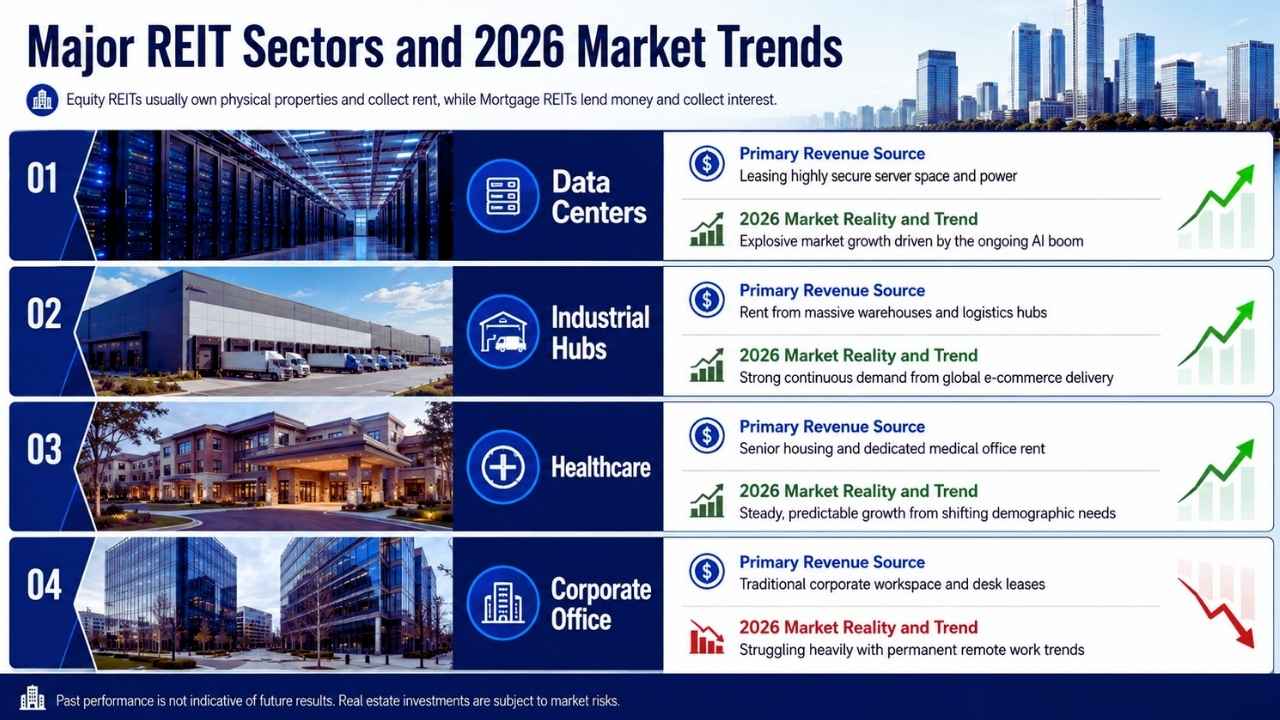
Not all real estate is created equal, and part of knowing how REITs work involves targeting the exact right sectors for the current economy. You will mostly find Equity REITs, which mean they own physical buildings and collect rent, but there are also Mortgage REITs that lend money and collect interest. In 2026, the real estate market has drawn incredibly clear lines between the massive winners and the struggling losers. Data centers are currently the undisputed kings of the market, driven entirely by the explosive growth of artificial intelligence and cloud computing.
The data center real estate market size is rocketing past 87 billion dollars this year as tech giants scramble to lease secure server space. Meanwhile, industrial properties continue to crush it because e-commerce companies desperately need endless warehouses and logistics hubs for fast delivery. Healthcare facilities are also seeing steady, guaranteed growth simply because the global population is aging rapidly and needs more medical offices. On the flip side, traditional office buildings are still hurting badly from remote work trends, pushing their dividend yields artificially high to compensate for plummeting stock prices and massive vacancies.
|
Property Sector |
Primary Revenue Source |
2026 Market Reality and Trend |
|
Data Centers |
Leasing highly secure server space and power |
Explosive market growth driven by the ongoing AI boom |
|
Industrial Hubs |
Rent from massive warehouses and logistics hubs |
Strong continuous demand from global e-commerce delivery |
|
Healthcare |
Senior housing and dedicated medical office rent |
Steady, predictable growth from shifting demographic needs |
|
Corporate Office |
Traditional corporate workspace and desk leases |
Struggling heavily with permanent remote work trends |
REITs vs. Physical Real Estate: The Real Trade-Offs
Why buy digital shares instead of a physical house you can actually touch? The financial numbers over the long haul speak for themselves and might actually surprise you. Looking at a massive timeline stretching from 1972 to 2023, these trusts actually beat the S&P 500, delivering a solid 12.7 percent annualized return. Physical real estate uses leverage through a bank mortgage to juice your returns, meaning a small down payment controls a massive asset. That leverage is incredible when property values go up, but it also brings surprise roof repairs, terrible tenants, and huge local market risks.
REITs strip out that operational nightmare completely while giving you instant diversification across hundreds of different geographic markets. If a tenant abruptly moves out of a warehouse in Ohio, the trust’s other three hundred properties keep your quarterly dividend perfectly safe and flowing. The real trade-off is that you completely give up operational control and cannot force the trust to renovate a kitchen to boost rent prices. Plus, their share prices bounce around daily with the stock market, which takes serious nerves of steel compared to the slow-moving valuation of a physical house.
|
Investment Factor |
REIT Portfolio Investment |
Physical Property Ownership |
|
Income Stability |
Highly predictable through structured quarterly dividends |
Highly variable due to surprise vacancies and massive repairs |
|
Leverage Strategy |
Handled completely internally by the trust’s management |
Requires personal debt, bank mortgages, and credit checks |
|
Tax Treatment |
Dividends are taxed simply as your ordinary income |
Offers highly complex write-offs for physical depreciation |
|
Time Commitment |
Zero hours per week, creating a totally passive stream |
Varies wildly based on bad tenant issues and emergencies |
How to Evaluate and Buy Top REIT ETFs
Buying into this market is incredibly easy since you just log into your normal brokerage account and click a button. But picking the right investment means learning a totally new financial metric to avoid making a terrible mistake. You have to forget about standard Earnings Per Share because real estate accounting requires companies to claim property depreciation as a massive financial loss. That weird accounting rule makes their earnings look absolutely terrible on paper, even when the properties are printing cash.
To see the actual truth, you must look at Funds From Operations, commonly known as FFO in the investing world. This essential metric adds that depreciation back into the equation, telling you exactly how much actual cash the properties generate to safely pay your dividend. If analyzing individual company balance sheets sounds awful to you, you can simply buy a broad Exchange Traded Fund instead. For example, in 2026, massive funds like the Vanguard Real Estate ETF offer broad exposure to the entire US market for incredibly low fees. These specific funds let you own a piece of the whole commercial real estate market effortlessly without ever having to read a single corporate earnings report.
|
Key Metric or ETF |
Focus Area and Description |
Why It Matters for 2026 Investors |
|
Funds From Operations |
The ultimate, true cash flow metric |
Replaces standard EPS to prove if the dividend is actually safe |
|
Vanguard VNQ |
Broad US Real Estate Index Fund |
Offers massive liquidity and high diversification across all sectors |
|
Schwab SCHH |
Pure US Real Estate Market Index |
Delivers the absolute lowest fees to maximize your long-term returns |
|
iShares REET |
Global Real Estate Market Fund |
Adds critical international diversification entirely beyond the US market |
Final Thoughts
Building real wealth does not mean you have to take out a massive mortgage or risk your entire life savings on a single rental property. Once you fully understand how REITs work, you unlock a totally passive income stream powered by global real estate. Whether you want a piece of the artificial intelligence data center boom or just a broad index fund covering the entire market, these assets give you the liquidity of stocks with the steady income of a landlord.
Stick to low-cost index funds, keep a close eye on cash flow metrics, and stash them in a tax-advantaged account for maximum long-term growth. The 2026 market proves that commercial real estate remains highly resilient if you know exactly where to look. By avoiding the struggling office sector and leaning into industrial spaces, you protect your portfolio against future economic shocks. You get all the incredible financial upside of owning real estate, and you will never have to answer a tenant’s angry phone call ever again.
Frequently Asked Questions (FAQs) About How Reits Work
Do REITs issue K-1 tax forms?
No. This is a massive relief. Unlike real estate syndications that issue complicated Schedule K-1 forms, public REITs issue standard 1099-DIV forms. You just plug the numbers into your tax software like any normal stock.
Are REIT dividends taxed differently than regular stocks?
Yes. Since REITs avoid corporate taxes, the tax burden falls on you. Most REIT dividends are taxed at your ordinary income tax rate, which is higher than the long-term capital gains rate. Smart investors hold REITs in tax-advantaged accounts like a Roth IRA to wipe out those taxes completely.
What happens to REITs when interest rates drop?
Usually, their stock prices go up. REITs rely on debt to buy buildings. When rates fall, their borrowing costs drop, boosting profits. Plus, lower rates make safe treasury bonds pay less, making the juicy 4% to 5% dividend yields of REITs look much more attractive to investors.