


Let’s be brutally honest. If you stare at a pile of credit card bills, auto loans, and medical debt every month, you already know winging it doesn’t work. Paying random amounts on random days just keeps you trapped on the hamster wheel. The banks love it. You hate it. You need a clear plan to break out.
When you start looking for a way out, you immediately run into the biggest debate in personal finance: the debt snowball vs avalanche methods. Both strategies start exactly the same way. You pay the minimums on all your accounts. Then, you funnel every extra dollar you can find into one specific target. But how you pick that target changes everything. One strategy hacks your brain. The other hacks the math. So, which method gets you to zero faster? Let’s break down the actual numbers, the psychology, and how to figure out which approach will finally clear your balances.
The Brutal Reality of Debt Today
Don’t beat yourself up over your balances. Consumer debt is a massive, systemic trap designed to keep you paying. By early 2026, total credit card debt in the United States hit a staggering 1.28 trillion dollars. The average American carries exactly 6,595 dollars in credit card debt alone. When you look at all types of household debt, the average American actually owes 63,500 dollars. But the balance itself is only half the problem. The real killer is the interest rate.
The average credit card interest rate currently sits at 19.35 percent. If you carry a balance and only make minimum payments, you will bleed thousands of dollars in interest over the next decade. You need an aggressive, tactical approach to stop the bleeding. Banks engineer credit card limits to ensure you stay in debt as long as possible. Understanding these statistics proves that your situation is incredibly common. You just need to take the right steps to pull yourself out of the statistics and into financial freedom.
|
2026 Debt Data |
The Numbers |
What This Means For You |
|
Total US Card Debt |
1.28 Trillion Dollars |
Debt is incredibly common across all demographics. |
|
Average Balance |
6,595 Dollars Per Person |
A normal balance spirals out of control quickly. |
|
Average APR |
19.35 Percent |
Carrying a balance is wildly expensive right now. |
|
Average Household Debt |
63,500 Dollars |
Mortgages and auto loans make up massive chunks of debt. |
What is the Debt Snowball Method?
The debt snowball asks you to do something that feels incredibly wrong. It tells you to completely ignore the math. You don’t look at your annual percentage rates. You don’t care which card charges you the most interest. Instead, you list all your debts from the smallest balance to the largest balance. Keep making the minimum payments on everything to avoid late fees. But take every spare dollar you have and attack that smallest balance.
Once that tiny debt hits zero, take the money you paid on it and roll it into the next smallest balance. Like a snowball rolling downhill, your payments get heavier and faster. Why ignore the interest rates? Because paying off debt is entirely a behavior problem. When you pay off a small medical bill in three weeks, your brain gets a massive hit of dopamine. You feel a real sense of victory. Seeing a specific account close forever proves your sacrifices actually work. People who use the snowball method often finish paying off their debt simply because they build emotional momentum.
|
Snowball Pros |
Snowball Cons |
|
Generates fast emotional momentum. |
Costs more in overall interest paid. |
|
Highly motivating for absolute beginners. |
Ignores toxic, high-APR accounts early on. |
|
Shrinks the number of open accounts quickly. |
Takes slightly longer mathematically to hit zero. |
|
Proven by behavioral psychology to work. |
Frustrates analytical thinkers who hate wasting money. |
What is the Debt Avalanche Method?
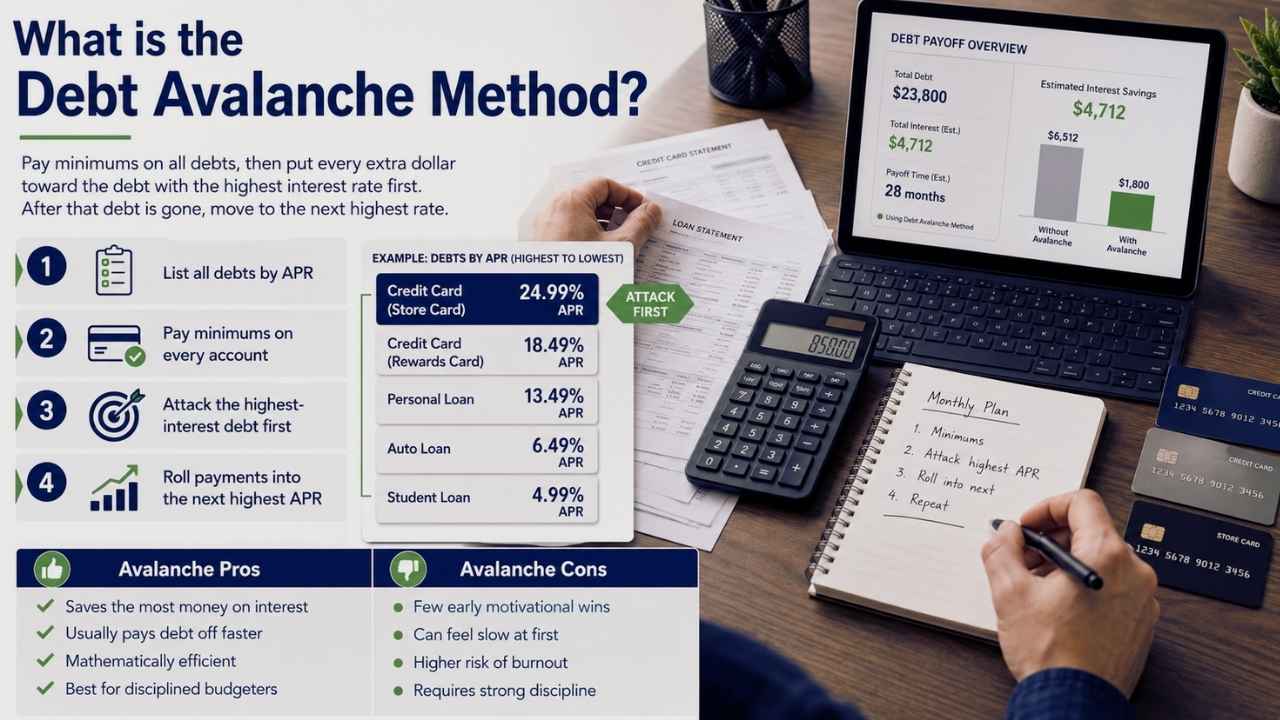 If you build spreadsheets for fun and optimize every dollar you spend, the debt avalanche is for you. This method demands pure, ruthless mathematical efficiency. You organize your debts strictly by their interest rate. You start with the highest interest rate and work your way down to the lowest. Just like the snowball, you pay the minimums on everything. But here, you unleash your extra cash on the account charging you the highest interest rate. When that toxic debt is gone, move your money to the account with the next highest rate.
Mathematically, the debt avalanche is the absolute cheapest and fastest way out of debt. Every time you throw a dollar at your highest-interest card, you physically stop the bank from charging you compounding interest on that dollar. You save the maximum amount of money. The catch is that it feels agonizingly slow in the beginning. If your highest interest rate happens to be a massive personal loan, you might grind away for a year before closing an account. That lack of visible progress causes many people to quit before they finish.
|
Avalanche Pros |
Avalanche Cons |
|
Saves the most money on interest charges. |
Severely lacks early, motivational wins. |
|
Pays off debt technically faster on paper. |
High burnout rate if your largest balance has the highest APR. |
|
Mathematically the perfect financial choice. |
Feels like an invisible grind for the first few months. |
|
Ideal for highly disciplined budgeters. |
Requires intense mental discipline to stick with it. |
Debt Snowball vs Avalanche: The Real Differences
When you compare the debt snowball vs avalanche methods, you are choosing between two distinct philosophies. Are you hacking your habits, or are you hacking the numbers? You must be brutally honest about your own track record. Have you tried to budget in the past and failed because you felt overwhelmed? Go with the snowball. You desperately need quick wins to stay in the game. Do you get physically angry looking at finance charges on your statement?
Do you have the stubborn discipline to follow a plan for a year without needing a pat on the back? Go with the avalanche. I learned early on that you don’t win a tough match with one wild swing. Watching cricket legends like Sachin Tendulkar face down aggressive fast bowlers taught me that resilience builds victory. Paying off debt requires that exact same relentless focus. You win by surviving at the crease, staying intensely focused, and grinding it out run by run. Choose the method that matches your natural discipline level.
|
Feature |
Debt Snowball Method |
Debt Avalanche Method |
|
Sort Order |
Smallest balance to largest balance |
Highest APR to lowest APR |
|
Primary Focus |
Psychological momentum and fast wins |
Maximum financial savings |
|
Early Results |
Fast account closures |
Slower visible progress |
|
Total Cost |
Higher overall interest paid |
Lowest overall interest paid |
|
Who Wins |
People who need visible progress |
Highly disciplined budgeters |
Running the Numbers: A Real-World Example
Let us look at a realistic scenario so you can visualize the process. Imagine you cut your budget and found an extra 700 dollars a month to throw at your debt. You have a medical bill with a 500 dollar balance at zero interest. You also have a credit card with a 4,500 dollar balance at a 24 percent interest rate. Finally, you hold a car loan for 12,000 dollars at an 8 percent interest rate. Your minimum payments require 500 dollars, but you have that extra 700 dollars in attack cash.
Using the snowball method, you target the medical bill first. You completely ignore its zero percent interest rate and knock it out in less than a month. Boom, you secure a victory. You then roll those funds into the credit card and crush it a few months later. Using the avalanche method, you ignore the tiny medical bill entirely. You target the credit card first because it holds that nasty 24 percent interest rate. You grind away at it for over five months before you finally cross an account off your list. It takes much longer to feel a win, but you destroy the most toxic debt first.
|
Payoff Metric |
Snowball Outcome |
Avalanche Outcome |
|
First Account Paid Off |
Less than 1 month |
Over 5 months |
|
Time to Debt-Free |
Roughly 16 months |
Roughly 15 months |
|
Interest Paid |
Higher |
Lower |
|
The Verdict |
Costs a bit more, but feels incredibly fast. |
Saves money, but requires serious patience. |
Dealing With Different Kinds of Debt
Not all debt acts the same way in the real world. Mixing different types of accounts into your strategy gets messy if you don’t know the rules. Credit cards and personal loans are your primary targets. Credit cards carry massive double-digit interest rates right now. Whether you use the snowball or the avalanche, make these the main focus of your attack. Medical debt rarely carries an interest rate. Plus, hospitals often negotiate the balance down if you call them.
Student loans and auto loans usually feature fixed, lower interest rates. You definitely include these in your plan, but they usually sit behind your credit cards in priority. If you owe the government, throw out the playbook completely. The IRS can garnish your wages and freeze your bank accounts. Tax debt immediately becomes your absolute priority until you set up a formal payment plan. You do not want to fight the government while trying to get your finances in order.
|
Debt Type |
Typical APR |
Priority Level |
|
IRS Tax Debt |
Variable plus Penalties |
Critical. Always prioritize government debt first. |
|
Credit Cards |
18 to 30 Percent |
High. The main target for both payoff methods. |
|
Auto and Student |
4 to 8 Percent |
Medium. Attack these after the credit cards are gone. |
|
Medical Debt |
Usually 0 Percent |
Low. Negotiate first, pay off last. |
Strategies to Speed Up Your Payoff
Neither the debt snowball vs avalanche method works if you don’t have extra cash flow. You can’t pay down the principal if you only make the minimum payments. The math simply stops you in your tracks. Stop using your credit cards today. Remove them from digital wallets and put the physical plastic in a drawer. You can’t dig your way out of a hole if you keep using the shovel. Switch to cash or a debit card until the debt is gone. If your credit score sits above 670, you might qualify for a balance transfer card.
These offer zero interest for a year or more. Move your high-interest debt over, pay a small transfer fee, and suddenly your entire payment goes directly to the principal. You can also start a temporary side hustle. Increasing your income is a massive financial cheat code. Treat this side hustle money like it doesn’t exist and funnel it straight into your debt. Every extra dollar you earn cuts days off your final payoff date.
|
Tactic |
Effort Level |
Impact on Timeline |
|
Stop using credit cards |
Hard |
High |
|
0 Percent Balance Transfer |
Medium |
Very High |
|
Start a side hustle |
High |
High |
|
Negotiate your APR |
Low |
Medium |
Final Thoughts
Arguing over the debt snowball vs avalanche method is like arguing whether running on a treadmill or running outside is better for you. The absolute best strategy is simply the one you stick with until the end. If you are fiercely disciplined and hate paying banks a single dime more than necessary, run the avalanche. If you easily get discouraged, feel overwhelmed by the sheer number of bills you get, and need rapid progress to keep your head in the game, the snowball is your best friend.
Pick your target and set up your auto-payments today. Get to work right now. You have the power to buy your freedom back. The math doesn’t matter nearly as much as your mindset and consistency. Start your journey today and watch how quickly your life changes. It takes time, but the peace of mind you gain at the end is entirely worth the effort.
Frequently Asked Questions (FAQs) About Debt Snowball vs Avalanche
Can I switch methods halfway through?
Yes. Many financial planners actually recommend a hybrid approach. Start with the debt snowball method to knock out a couple of pesky $200 store cards. Once you get a quick win and free up cash flow, switch to the avalanche method to tackle your massive $10,000 credit card carrying a 25% APR.
Should I pause investing while paying off debt?
If your employer offers a 401(k) match, take the match. That is a 100% guaranteed return. Beyond that, pause your investing. It makes zero mathematical sense to invest in the stock market (averaging 7% to 10% returns) while carrying credit card debt charging you 21%. Pay off the bad debt first.
Will closing my accounts ruin my credit score?
Paying a credit card down to a zero balance helps your credit score by lowering your credit utilization ratio. However, formally closing the account can drop your score by reducing your average age of accounts. Once you pay off the card, cut up the plastic but leave the account open.